 By
Quick answer: How do I stay motivated studying?
- Purpose — tie it to a job, raise or project.
- Deadline — book the exam date.
- Routine — same time, same place.
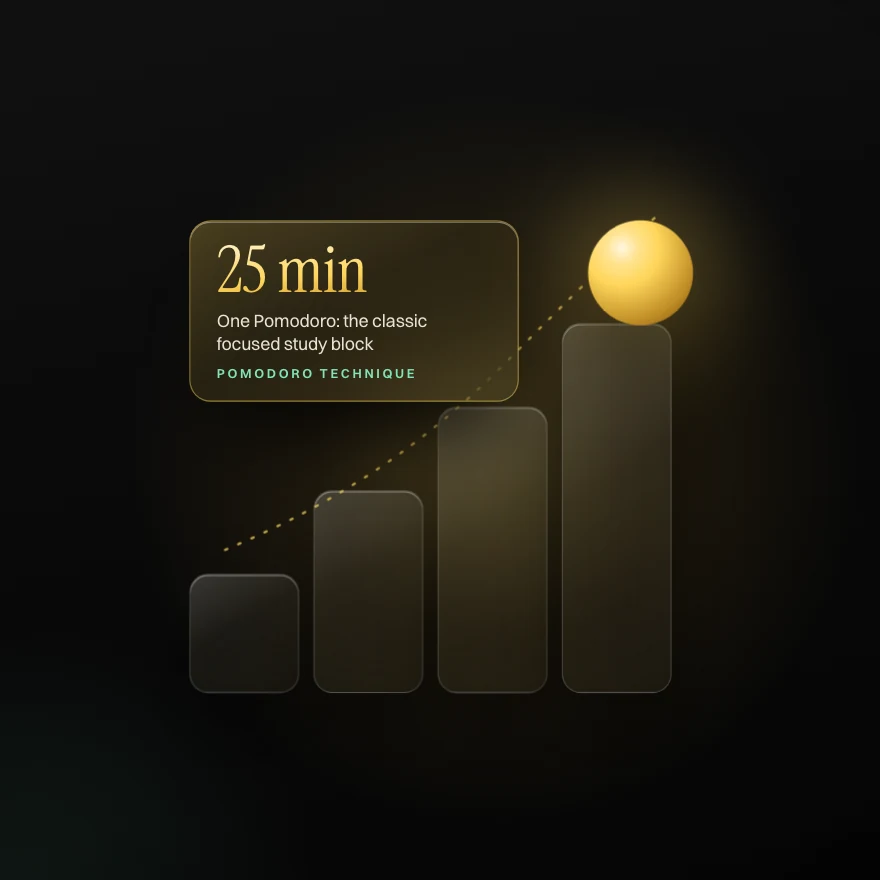
- Focus blocks — 25 min on, 5 min off.
- Progress — track streaks and scores.
Key takeaways
- Motivation follows action: start small and it grows.
- A booked exam date is the strongest motivator for certification learners.
- Pomodoro blocks (25/5) make long courses manageable.
- Remove the phone from the room to protect focus.
- Track visible progress: streaks, completed modules, practice-test scores.
A motivation system for long courses

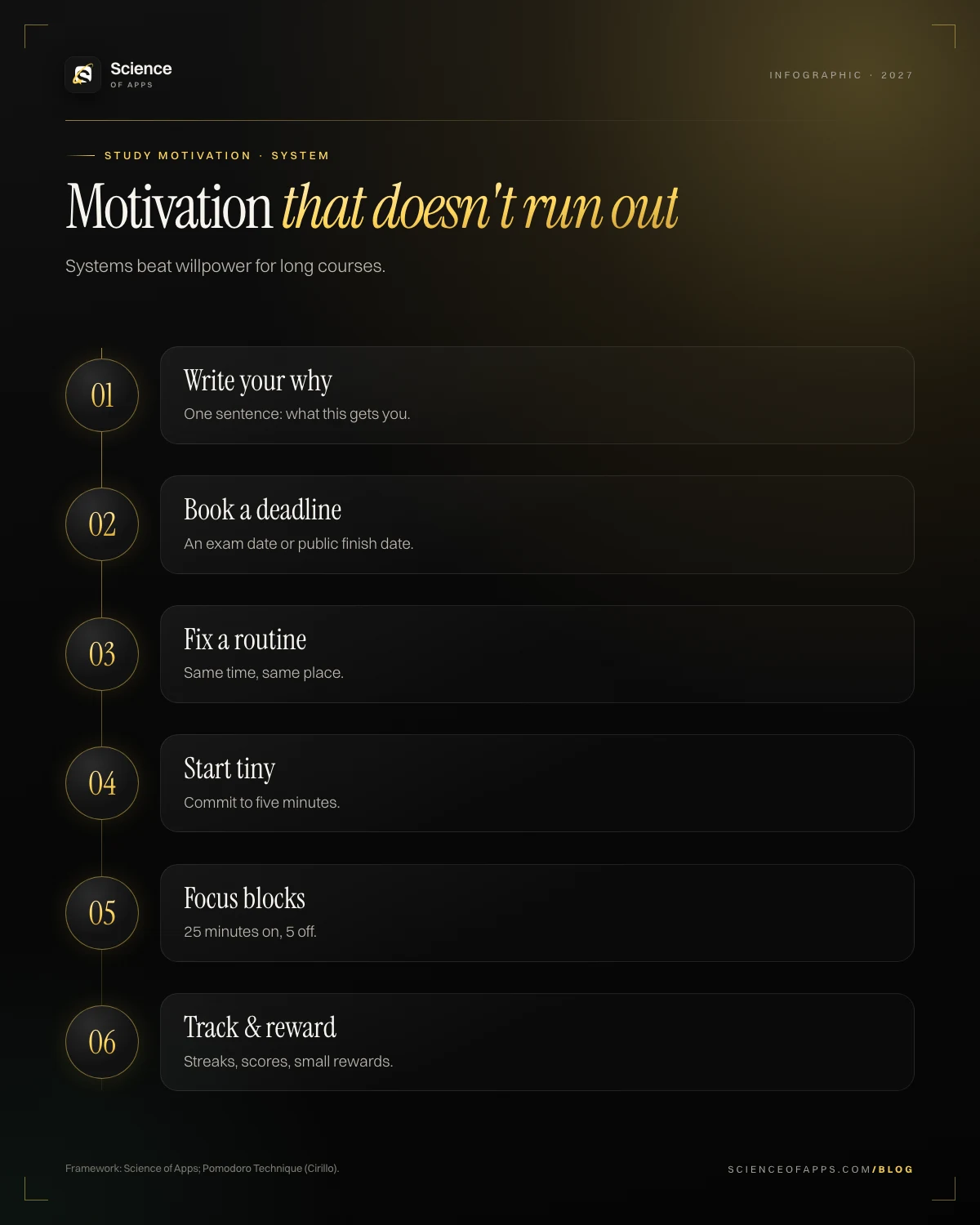
- Write your "why": one sentence on what this course gets you.
- Set a deadline: book the exam or set a public finish date.
- Fix a routine: same time and place, so studying needs no decision.
- Start tiny: commit to 5 minutes; you'll usually keep going.
- Work in focus blocks: 25 minutes on, 5 off1.
- Track progress: a visible streak or chart.
- Reward milestones: small, immediate rewards after each module.
How to stay focused studying at home
- Phone in another room, not just face down.
- One tab: close email and social media; use a site blocker if needed.
- Clear desk: only what you need for this session.
- Noise: quiet, or consistent background sound.
- Stop mid-task: leave a note of the next step so restarting is easy.
Online course motivation: special challenges
Self-paced online courses have no teacher or classmates to keep you on track, which is a major reason completion rates are low (see online course completion rates). Add structure yourself: a study buddy, a learning community, weekly check-ins or a cohort-based course.
When motivation dips
Motivation always dips around the middle of a long course. Plan for it: switch to easier tasks (flashcards, short quizzes) rather than stopping, revisit your "why", and take a short, winnable test to rebuild momentum. A free Science of Apps certification takes 10–30 minutes and gives a real sense of progress.
Prove it free: the tests that match this guide
Short wins keep motivation high. (Disclosure: Science of Apps publishes these tests.)
Staying motivated for big exams (MCAT, PMP, CPA)
For long preparation periods, break the journey into monthly milestones with practice-test targets, schedule rest days, and protect sleep and exercise. Burnout, not lack of ability, ends most long study plans.
Study motivation apps
Focus timers (Pomodoro apps, Forest), habit trackers, flashcard apps with streaks (Anki, Quizlet) and calendar blocking all help. Pick one or two; too many apps become their own distraction. See also AI study tools.
Frequently asked questions
How do I stay motivated studying?
Tie the course to a concrete goal, book a deadline, study at fixed times, use 25-minute focus blocks, track progress and reward milestones.
How do I stay focused studying?
Put your phone in another room, keep one tab open, clear your desk, and work in short focused blocks with breaks.
How do I stay focused studying at home?
Create a dedicated study spot, keep a routine, block distracting sites and tell others your study times.
How do I stay motivated for long online courses?
Add structure: deadlines, a study buddy or community, weekly milestones, and quick wins when motivation dips.
What should you do when study motivation dips?
Motivation always dips around the middle of a long course. Plan for it: switch to easier tasks (flashcards, short quizzes) rather than stopping, revisit your "why", and take a short, winnable test to rebuild momentum. A free Science of Apps certification takes 10–30 minutes and gives a real sense of progress.
Sources
- Francesco Cirillo: the Pomodoro Technique
- Dunlosky et al. (2013): Improving students' learning with effective learning techniques
- CDC: how much sleep do I need?
- Science of Apps: free online certifications
- Checked November 11, 2026. Figures that change — fees, salaries, prices — are reviewed every six months; if something is out of date, tell us.
Where to go from here
- Failed a certification exam? — failed your certification exam? retake policies, how to analyse your score repor
- Active recall & spaced repetition — how active recall and spaced repetition work, why they beat re-reading and how t
- Calm exam anxiety — 12 science-backed tips to calm exam anxiety before and during a certification te
- CertificationsStudy while working full-timeHow to study for a certification while working full-time: realistic schedules, time-blocking and motivation tips.
- CertificationsThe 7 best note-taking methodsThe 7 best note-taking methods for exams: Cornell, outline, mind map, charting, sentence, boxing and Zettelkasten, and which one fits how you study.
- CertificationsReturn to work courses & certificationsFlexible return-to-work courses and certifications for mothers and carers rejoining the workforce, from Google certificates to returnship programmes.
- Making moneyHow to earn money online for students in India — 15 real ways (and scams to avoid)15 real ways students in India can earn money online — internships, freelancing, tutoring, content and building apps — plus the 'task' scams to avoid.
- CertificationsPower BI PL-300 & Excel certificationHow to earn the Power BI PL-300 and Microsoft Excel certifications: exam format, cost, study plan and career value.
- Career guides by Science of Apps for 2027How to pass the CFA Program in 2027: a 24-week study plan and tips that workHow to pass the CFA Program in 2027: a 24-week study plan, exam format and cost, the best free resources and practice-test tips.



Get the ideas, not the noise.
Sign up with Google and we’ll send you short UX psychology tips by email — why people tap, stall and leave, and what to do about it. Unsubscribe anytime. Prefer something to keep? Get the free Laws of UX guide as a PDF.
Prove the skill before you pay for the exam.
1,200+ free, test-based certifications graded on our server. Pass and get a founder-signed certificate with a credential ID employers can verify.