 By
Quick answer: How do I calm down before an exam?
- Breathe — in for 4, out for 6, for 2–3 minutes.
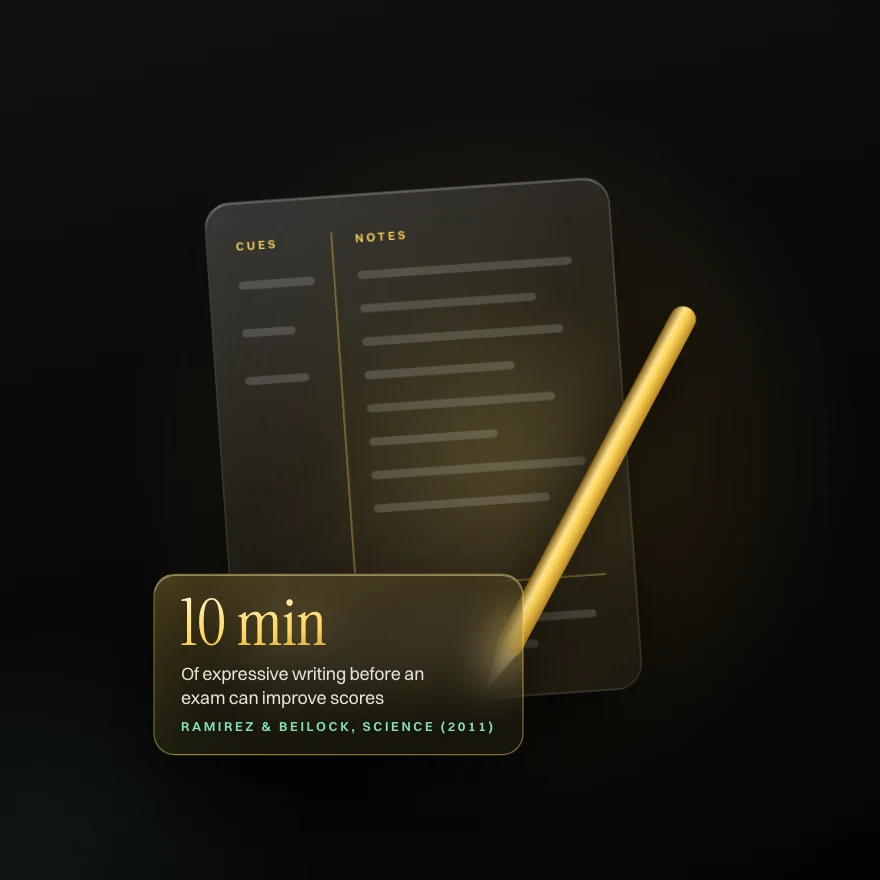
- Write it out — 10 minutes on your worries.
- Reframe — nerves = energy, not danger.
- Prepare — practice tests make it familiar.
- Basics — sleep, breakfast, arrive early.
Key takeaways
- Some nerves are normal and can even help performance.
- Slow breathing calms the body's stress response.
- Expressive writing about worries before an exam improved scores in a Science study (Ramirez & Beilock, 2011).
- Practice tests reduce fear by making the exam familiar.
- Seek professional help if anxiety is severe or long-lasting.
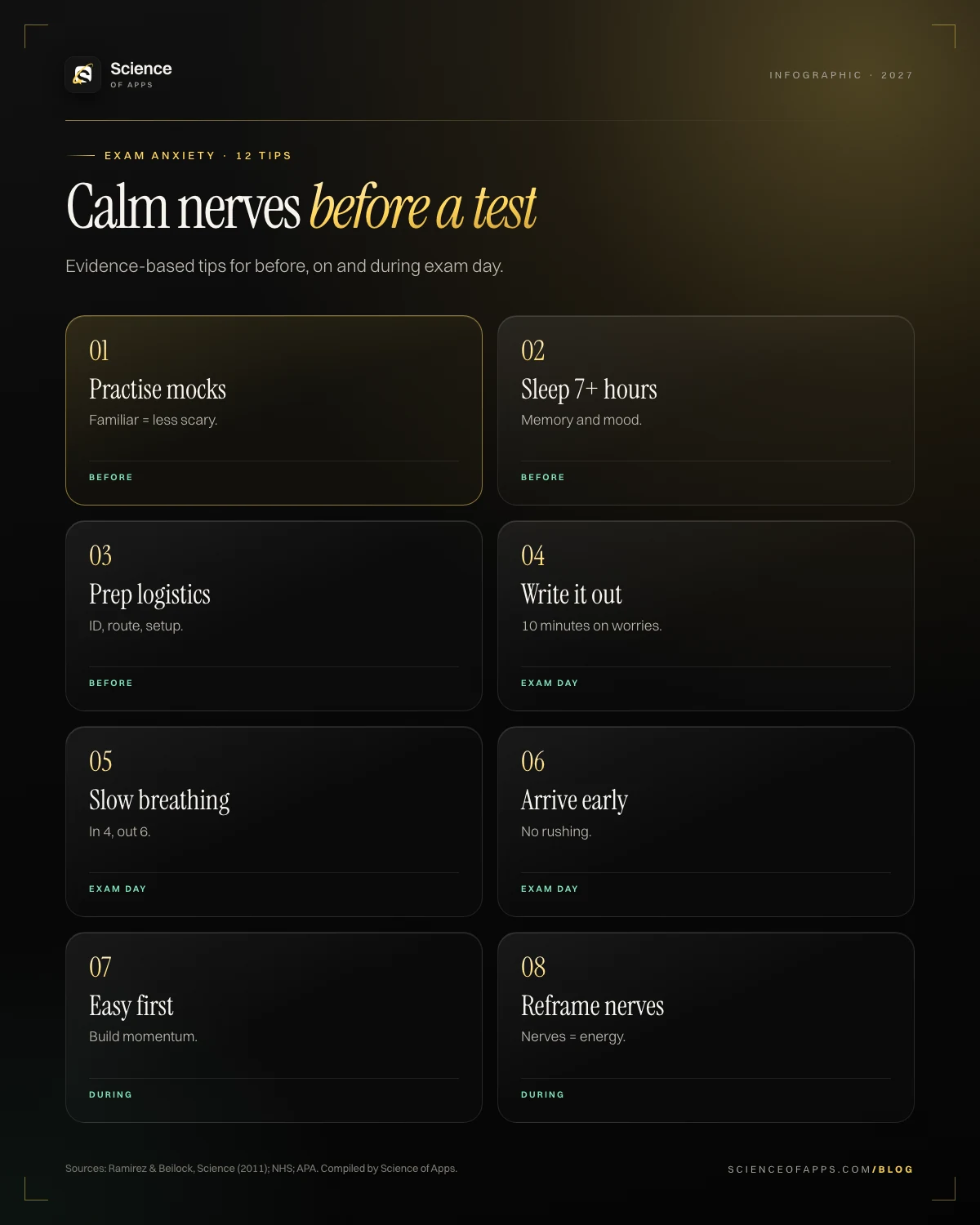
12 tips to calm exam anxiety

Before exam day
- Practise under exam conditions. Timed mocks make the real thing familiar.
- Plan your study. Uncertainty fuels anxiety; a plan reduces it.
- Sleep 7+ hours, especially the two nights before.
- Prepare logistics: ID, route, testing rules, online-proctoring setup.
On exam day
- Eat a normal breakfast and drink water.
- Arrive early or log in 30 minutes ahead for online exams.
- Write out your worries for 10 minutes before the test1.
- Slow breathing: in for 4, out for 6, for 2–3 minutes2.
During the exam
- Start with easy questions to build momentum.
- Flag and move on when stuck.
- Reframe nerves as energy: "I'm ready" rather than "I'm scared".
- Reset with three slow breaths if you feel panic rising.
What the research says
In a study published in Science, students who spent 10 minutes writing about their worries immediately before an exam performed better than those who didn't, especially students who usually experience high test anxiety1. The idea is that writing "offloads" worries that would otherwise use up working memory.
A 2-minute breathing exercise
Sit comfortably. Breathe in gently through your nose for a count of four, then out through your mouth for a count of six. Repeat for two to three minutes. Longer out-breaths help activate the body's relaxation response. The NHS publishes a simple guided version2.
Test anxiety tips for students and kids
- Help children practise in short, low-pressure quizzes.
- Praise effort and preparation, not just results.
- Keep routines normal the night before.
- For college students: use campus counselling and disability services if anxiety affects performance; accommodations may be available.
Prove it free: the tests that match this guide
Low-stakes practice is the best cure for exam nerves. (Disclosure: Science of Apps publishes these tests.)
- Emotional Intelligence at Work CertificationRecognize and manage your emotions under pressure.Start free test →
- Study Skills TestGood preparation is the most reliable cure for exam nerves.Start free test →
- AI Literacy CertificationA low-stakes 10-minute test to practise timed questions.Start free test →
When to get help
If anxiety causes panic attacks, prevents you from sitting exams or affects daily life, talk to a doctor, counsellor or mental health professional. The American Psychological Association has resources on managing stress3.
Practise with low-stakes tests
Low-stakes practice builds confidence. Free Science of Apps skill tests take 10–30 minutes and let you practise answering under time pressure with nothing to lose.
Frequently asked questions
How do I calm my nerves before an exam?
Use slow breathing (in for 4, out for 6), write about your worries for 10 minutes, eat a normal breakfast, arrive early and start with easy questions.
Why do I get exam anxiety?
Exams trigger the body's stress response, especially when stakes are high or you feel unprepared; practice and planning reduce it.
Does writing about worries help before a test?
Yes. A study in Science found 10 minutes of expressive writing before an exam improved scores, especially for anxious students.
What are test anxiety tips for students?
Practise with low-stakes quizzes, keep routines normal, sleep well, and use breathing and reframing techniques on the day.
Is there a quick breathing exercise for exam anxiety?
Sit comfortably. Breathe in gently through your nose for a count of four, then out through your mouth for a count of six. Repeat for two to three minutes. Longer out-breaths help activate the body's relaxation response. The NHS publishes a simple guided version.
Sources
- Ramirez & Beilock (2011): Writing about testing worries boosts exam performance, Science
- NHS: breathing exercises for stress
- American Psychological Association: test anxiety and stress
- CDC: how much sleep do I need?
- Science of Apps: free online certifications
- Checked November 11, 2026. Figures that change — fees, salaries, prices — are reviewed every six months; if something is out of date, tell us.
Where to go from here
- How many practice tests? — how many practice tests should you take before a certification exam? a data-back
- Failed a certification exam? — failed your certification exam? retake policies, how to analyse your score repor
- Best AI study tools — the best free ai study tools for certification exams, including chatgpt prompts,
- CertificationsHow many practice tests?How many practice tests before a certification exam? Usually 3–5 full mocks plus daily quizzes; sit the exam when you score 80–85%+ on fresh tests.
- CertificationsTalk about certifications in an interviewHow to talk about your certifications in a job interview, with example answers that link them to real results.
- CertificationsValuable vs useless certificationsNot all certifications are worth it. How to tell valuable certifications from useless ones before you spend money.
- Product managementProduct manager resume: examples, bullet formulas and a template that gets interviewsWrite a product manager resume that gets interviews: an outcome-first bullet formula, before-and-after examples, a one-page template and tips.
- CertificationsStudy while working full-timeHow to study for a certification while working full-time: realistic schedules, time-blocking and motivation tips.
- Career guides by Science of Apps for 2027How to pass CompTIA Network+ in 2027: a 10-week study plan and tips that workHow to pass CompTIA Network+ in 2027: a 10-week study plan, exam format and cost, the best free resources and practice-test tips.
Get the ideas, not the noise.
Sign up with Google and we’ll send you short UX psychology tips by email — why people tap, stall and leave, and what to do about it. Unsubscribe anytime. Prefer something to keep? Get the free Laws of UX guide as a PDF.
Prove the skill before you pay for the exam.
1,200+ free, test-based certifications graded on our server. Pass and get a founder-signed certificate with a credential ID employers can verify.