 By
Quick answer: How do I talk about certifications in an interview?
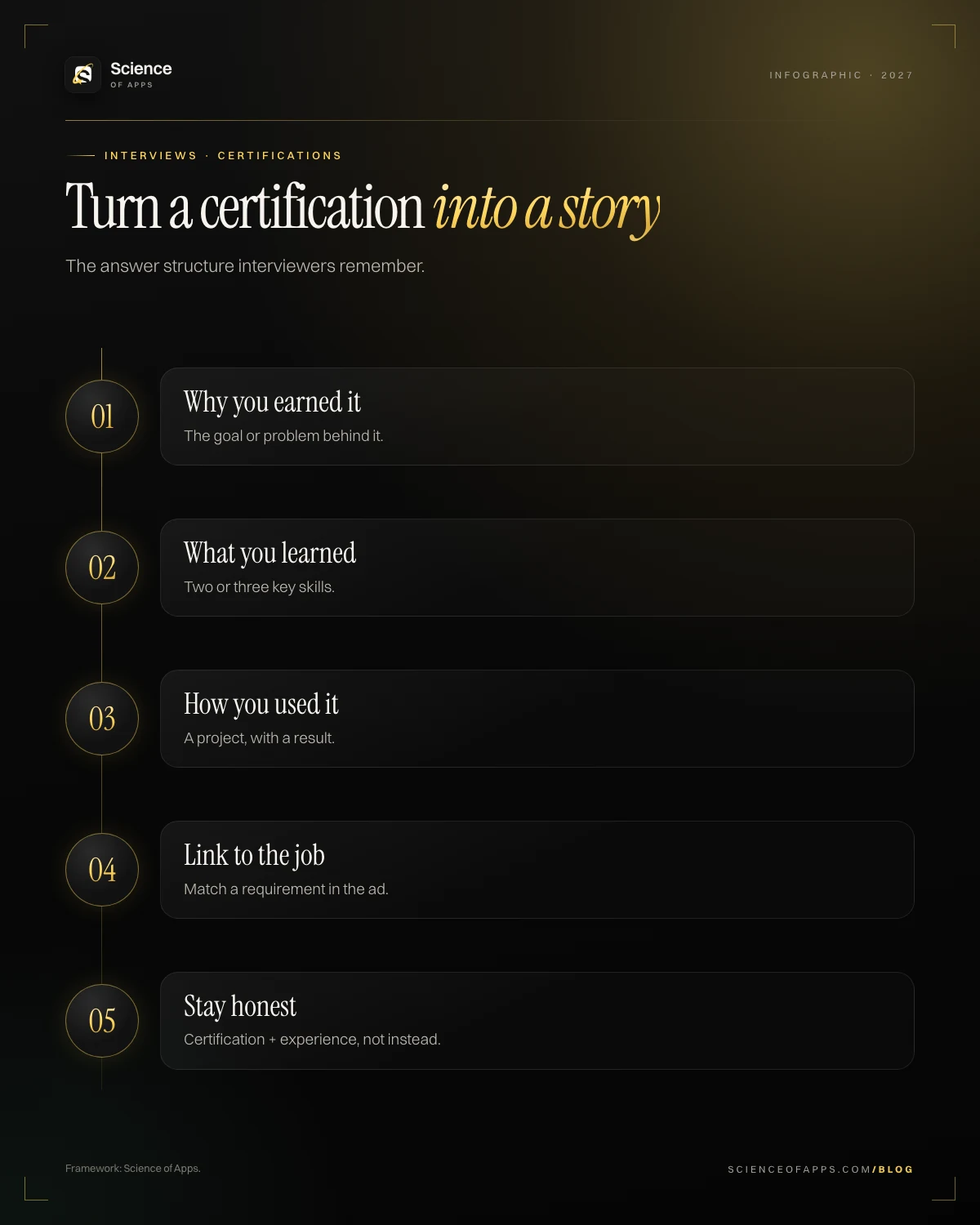
- Why — the goal behind earning it.
- What — two or three skills it gave you.
- How — a project or result using those skills.
- Link — connect it to the job's requirements.
- Be honest — certification + experience, not instead of.
Key takeaways
- Name it, then explain why, what and how.
- Use a STAR story to show the certification's skills in action.
- Link each certification to a requirement in the job description.
- Be ready for technical follow-up questions on the exam topics.
- Never overstate: interviewers test the skill.
The why–what–how framework

- Why: "I earned the AWS Solutions Architect – Associate because our team was moving to the cloud."
- What: "It gave me a solid grounding in high availability, security and cost optimization."
- How: "I used it to redesign our backup process, which cut storage costs by about a fifth."
Example answers
"Tell me about your certifications."
"The most relevant one for this role is my PMP. I took it after leading my first cross-functional project, because I wanted a structured approach to risk and stakeholder management. Since then I've used its risk register approach on three projects, including one where we spotted a supplier delay six weeks early."
"Why did you get this certification?"
"I'm moving from customer support into data analysis, so I earned PL-300 to prove I could model data and build dashboards in Power BI. I built a support-ticket dashboard for my current team as practice, and they still use it."
Career changer with a free certification
"I passed Science of Apps' UX certification to check my understanding of usability principles, then applied them in a redesign of a local charity's sign-up page. I can walk you through the before and after."
Prepare for follow-up questions
- Review the exam domains: interviewers may ask about them.
- Prepare one example per major domain.
- Know what's changed since you certified.
Prove it free: the tests that match this guide
Prepare to talk about your certifications. (Disclosure: Science of Apps publishes these tests.)
Being honest about certifications
If you have the certification but little experience, say so and emphasize projects and eagerness to apply the skills. If a certification is in progress, give a realistic date. Overstating is risky: technical interviews quickly reveal gaps.
How to say certifications on a resume and in person
Say the full name the first time ("Certified Information Systems Security Professional, CISSP"), then use the acronym. Mention the issuer if it isn't obvious.
Frequently asked questions
How do I talk about certifications in an interview?
Explain why you earned it, what you learned and how you've applied it, ideally with a short STAR story linked to the job's requirements.
Should I mention certifications in an interview?
Yes, when they're relevant to the role; connect them to real work or projects.
What if I have certifications but no experience?
Be honest, highlight projects where you applied the skills, and show how quickly you can contribute.
How honest should you be about certifications in an interview?
If you have the certification but little experience, say so and emphasize projects and eagerness to apply the skills. If a certification is in progress, give a realistic date. Overstating is risky: technical interviews quickly reveal gaps.
How do you mention certifications on a resume and in person?
Say the full name the first time ("Certified Information Systems Security Professional, CISSP"), then use the acronym. Mention the issuer if it isn't obvious.
Sources
- CompTIA certifications
- PMI certifications
- Science of Apps: free online certifications
- Checked November 11, 2026. Figures that change — fees, salaries, prices — are reviewed every six months; if something is out of date, tell us.
Where to go from here
- List certifications on a resume — how and where to list certifications on your resume, with examples for freshers,
- Build a portfolio with certification projects — turn your certifications into a job-winning portfolio
- Add certifications on LinkedIn — how to add certifications to your linkedin profile on desktop and mobile, step b
- Career guidesEnglish for job interviews in 2027: introducing yourself, answering common questions with STAR, professional vocabulary, etiquette and follow-up, listening to interviewers and how to practiseEnglish for job interviews in 2027: introducing yourself, answering common questions with STAR, professional vocabulary, etiquette, follow-up and practice.
- CertificationsMost in-demand skills 2027–2030The most in-demand skills for 2027 to 2030, based on millions of job postings, and the certifications that prove them.
- CertificationsCertifications for remote jobsThe best certifications for remote jobs: cloud, security, data, marketing, Salesforce and TEFL, including beginner options that need no experience.
- CertificationsCertifications to get a job fastThe best certifications to get a job fast in the USA: CompTIA A+, Google certificates, CDL, CNA, AWS and more, with time to complete, cost and demand.
- Career guidesExcel skills for jobs in 2027: what employers actually test, the questions they ask and how to prove itExcel skills for jobs in 2027: which roles need them, how employers test Excel in interviews, real test questions with answers, common traps and a plan.
- CertificationsAre online certificates legit?Are online certificates legit? How to tell real credentials from scams: verification, real assessments, accreditation claims and red flags to check.
Get the ideas, not the noise.
Sign up with Google and we’ll send you short UX psychology tips by email — why people tap, stall and leave, and what to do about it. Unsubscribe anytime. Prefer something to keep? Get the free Laws of UX guide as a PDF.
Prove the skill before you pay for the exam.
1,200+ free, test-based certifications graded on our server. Pass and get a founder-signed certificate with a credential ID employers can verify.