 By
Quick answer: How do I tell if a certification is valuable?
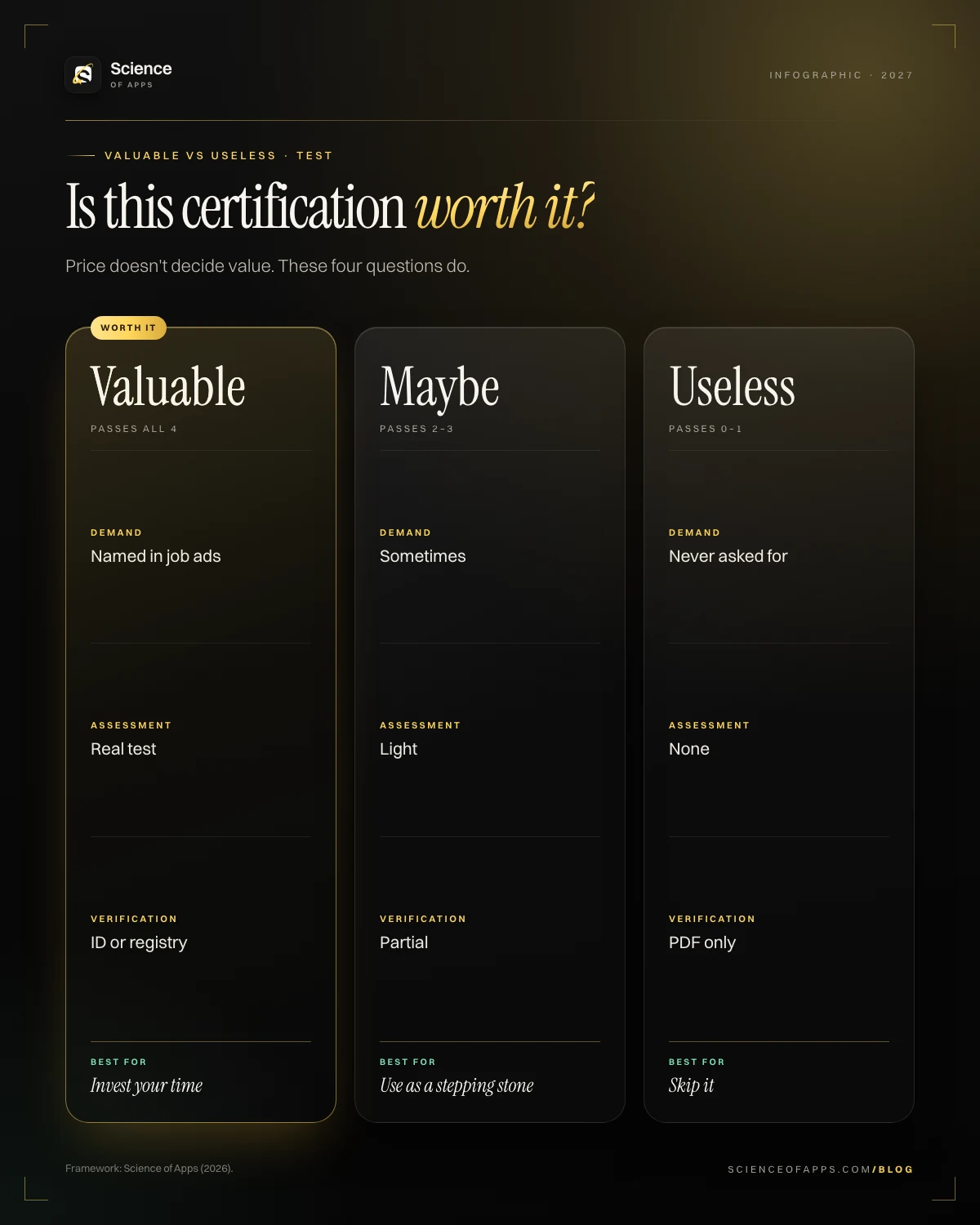
- Demand — named in job ads in your field.
- Assessment — you had to pass something real.
- Verification — ID, registry or QR.
- Relevance — skills you'll actually use.
- Free? — can still be valuable if it passes these tests.
Key takeaways
- Value comes from demand, assessment, verification and relevance, not price.
- Useless certifications are usually unrecognized, unassessed or unrelated to your goals.
- Free certificates can be valuable; expensive ones can be useless.
- Online degrees from accredited universities are worth the same as campus degrees.
- When unsure, test the certification against 20 job ads.
The 4-question value test

| Question | Valuable | Useless |
|---|---|---|
| Do employers ask for it? | Named in job ads | Never mentioned |
| Is there a real assessment? | Exam, project or scenario test | Pay and download |
| Can it be verified? | ID, registry, QR | PDF only |
| Will you use the skill? | Directly relevant | Unrelated to your goals |
Examples of valuable certifications
AWS and Azure (cloud), CompTIA Security+ (security), PMP (projects), PL-300 (data), Salesforce Administrator (CRM), CPC (medical coding), and free verifiable skill certifications when they match the role.
Signs of useless certifications
- Unknown issuer with no track record.
- No assessment or one you can't fail.
- Vague accreditation claims.
- Topics unrelated to any role you want.
- Expensive "certified expert" titles after a few hours of video.
Are online and free certificates worth anything?
Yes, when they pass the test. A free Google Ads certification is valuable for a PPC role; a free Science of Apps certification is valuable when it proves a skill named in the job ad and can be verified with a credential ID. Online degrees from accredited universities are equally valid.
The practitioner view
A frequent comment in career communities: "collecting certificates" impresses no one, but one relevant, verifiable certification plus a project does.
Expensive doesn't mean valuable
Some of the most valuable credentials are free or cheap: Google Ads and HubSpot certifications for marketers, Microsoft Fundamentals exams at $99, and free verifiable skill certifications. Meanwhile, some expensive programs promise "master" titles after short courses with no assessment. Judge by the four tests, not the price tag.
Prove it free: the tests that match this guide
These SOA certifications pass the four-question value test: in-demand, assessed, verifiable, relevant. (Disclosure: Science of Apps publishes these tests.)
- AI Literacy CertificationPasses all four tests: in demand, assessed, verifiable, relevant.Start free test →
- SQL Certification Test (Fundamentals)Passes the demand test: SQL appears in most analyst job ads.Start free test →
- Project Management Fundamentals CertificationPasses the relevance test: PM skills are recognized across industries.Start free test →
When certifications stack well
Credentials become more valuable in sensible combinations: Security+ plus a cloud certification for cloud security roles; PL-300 plus SQL for analysts; PMP plus Scrum for project managers. Random collections across unrelated fields look unfocused.
Do certifications lose value?
Yes, technology credentials lose value as tools change, which is why most expire every two to three years. Fundamentals and professional credentials with renewal (PMP, CISSP) keep their value as long as you maintain them.
Test any certification in 10 minutes
- Open 20 job ads for your target role.
- Count how many mention the certification.
- 5+ mentions: valuable. 1–4: helpful. 0: probably not worth paying for.
Frequently asked questions
What are the most valuable certifications?
Ones employers request in your field: AWS, Azure, Security+, PMP, PL-300, Salesforce Administrator, CPC and similar.
Are free online certificates worth anything?
Yes, when they're relevant, assessed and verifiable, like Google Ads for PPC roles or Science of Apps certifications for specific skills.
Are online degrees worth anything?
Online degrees from accredited universities are as valid as campus degrees.
Do certifications lose value?
Yes, technology credentials lose value as tools change, which is why most expire every two to three years. Fundamentals and professional credentials with renewal (PMP, CISSP) keep their value as long as you maintain them.
Are expensive certifications more valuable?
Some of the most valuable credentials are free or cheap: Google Ads and HubSpot certifications for marketers, Microsoft Fundamentals exams at $99, and free verifiable skill certifications. Meanwhile, some expensive programs promise "master" titles after short courses with no assessment. Judge by the four tests, not the price tag.
Sources
- AWS Certification
- CompTIA certifications
- PMI certifications
- CHEA: database of accredited institutions
- Science of Apps: free online certifications
- Checked November 11, 2026. Figures that change — fees, salaries, prices — are reviewed every six months; if something is out of date, tell us.
Where to go from here
- Digital credentials & blockchain certificates — what digital credentials and blockchain certificates are
- SOA verified certificates — every SOA certificate can be verified online in seconds
- Certification accreditation explained — accreditation bodies (ANSI, ISO 17024 and others) explained simply
- CertificationsAre online certificates legit?Are online certificates legit? How to tell real credentials from scams: verification, real assessments, accreditation claims and red flags to check.
- CertificationsUniversity certificates onlineThe best online certificate programmes from top universities: graduate, professional and platform certificates, with cost, duration and credit options.
- CertificationsCertifications to get a job fastThe best certifications to get a job fast in the USA: CompTIA A+, Google certificates, CDL, CNA, AWS and more, with time to complete, cost and demand.
- CertificationsAI in educationHow AI is transforming education and online certification, from AI tutors to adaptive exams and skills verification.
- Career guides by Science of Apps for 2027The best online certifications of 2027: ten worth your money, ranked, and how to choose yoursThe 10 best online certifications of 2027, ranked by demand, cost and time — AI, cloud, data, security and project management — with fees and direct links.
- CertificationsThe best online course platforms with certificates25 online course platforms compared on certificate value, price and employer recognition. See which ones are worth your time and money in 2027.
Get the ideas, not the noise.
Sign up with Google and we’ll send you short UX psychology tips by email — why people tap, stall and leave, and what to do about it. Unsubscribe anytime. Prefer something to keep? Get the free Laws of UX guide as a PDF.
Prove the skill before you pay for the exam.
1,200+ free, test-based certifications graded on our server. Pass and get a founder-signed certificate with a credential ID employers can verify.