 By
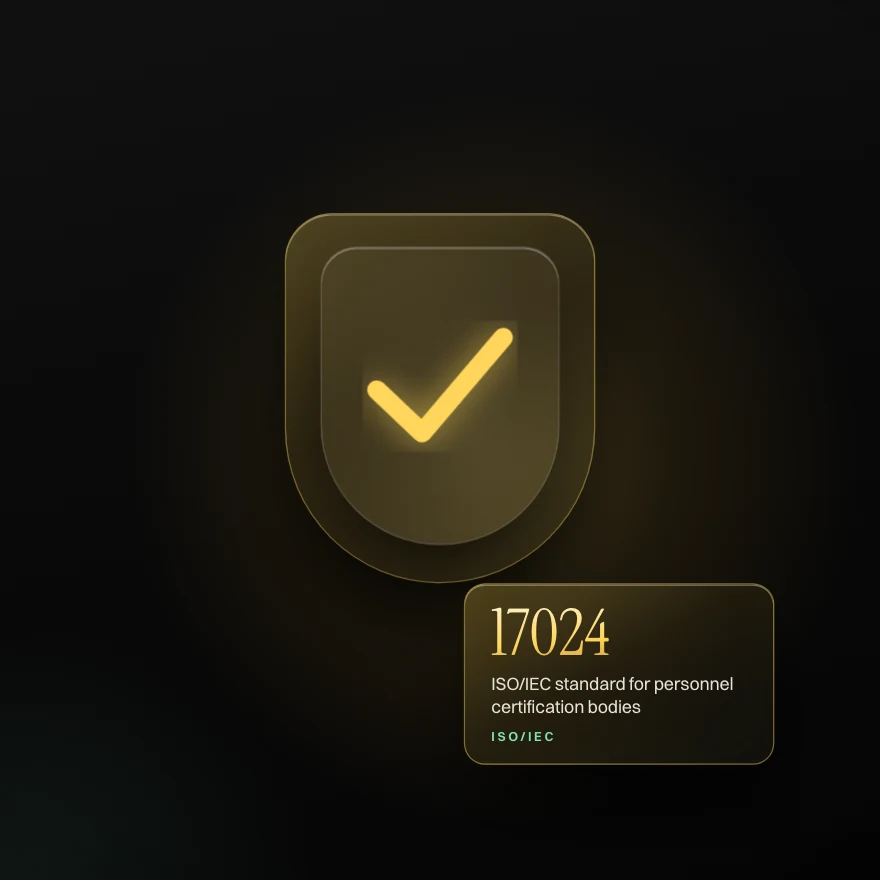
Quick answer: What does industry-recognized certification mean?
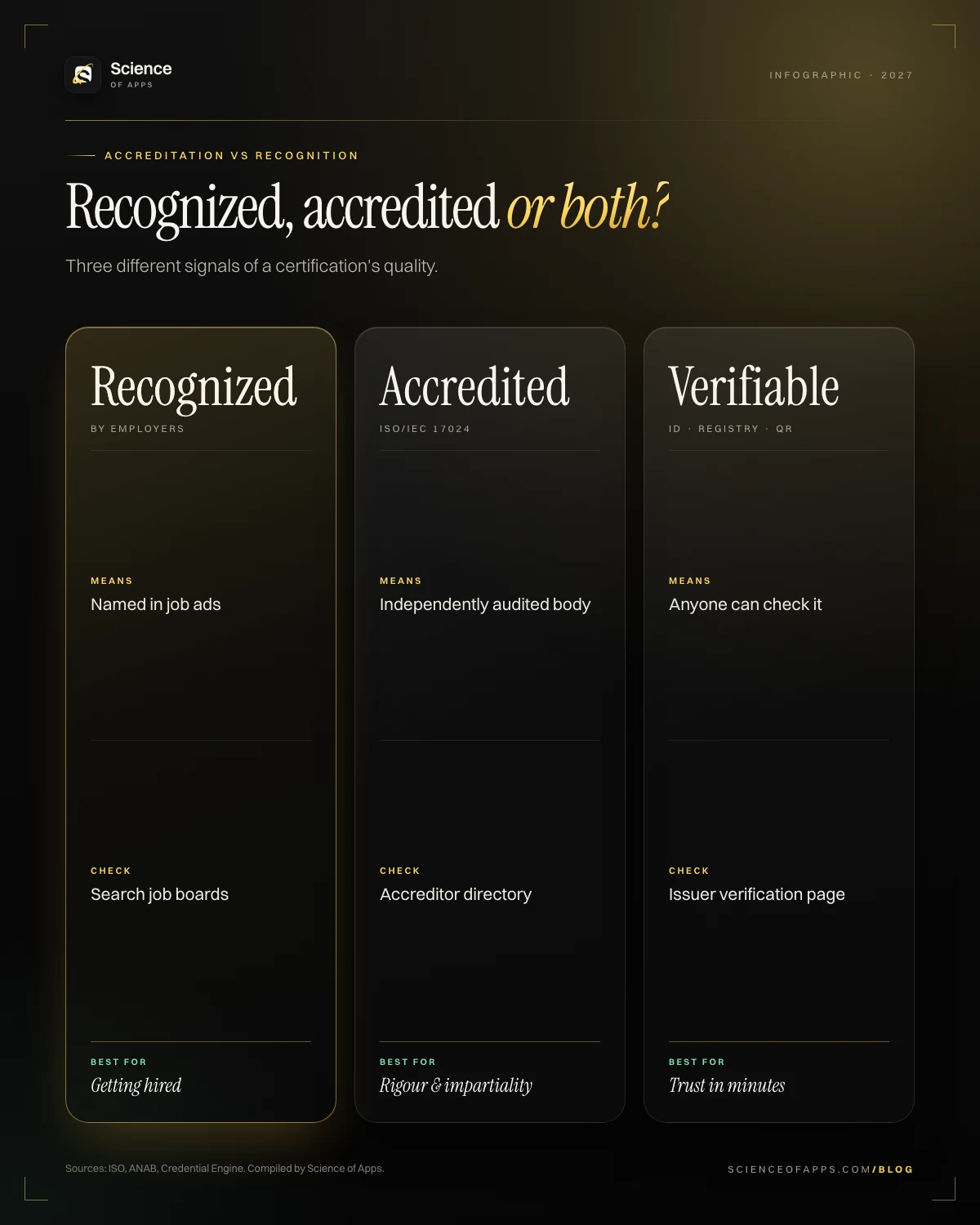
- Industry-recognized — employers know and request it.
- Accredited — independently audited, e.g. ISO/IEC 17024.
- Nationally recognized — on a government qualification framework.
- Accreditation bodies — ANAB and national accreditors.
- Best signal — recognition + accreditation + verification.
Key takeaways
- Accreditation checks the certifying body; recognition reflects employer demand.
- ISO/IEC 17024 is the main standard for personnel certification bodies.
- Accreditation bodies include ANAB in the U.S. and national accreditation bodies in other countries.
- "Nationally recognized" usually means listed on a government qualifications framework.
- Look for recognition, accreditation and verification together.
Key terms explained

| Term | Meaning | Example |
|---|---|---|
| Accredited | Certifying body audited against a standard | ISO/IEC 17024 via ANAB12 |
| Industry-recognized | Employers in the field know and request it | AWS, Salesforce, PMP |
| Nationally recognized | Listed on a government qualifications framework | UK Ofqual-regulated qualifications |
| Industry standard | Widely used benchmark credential in a field | Security+ for entry security roles |
Certification accreditation bodies
ANAB accredits personnel certification bodies in the U.S. against ISO/IEC 17024; many countries have national accreditation bodies that do the same, coordinated internationally through the International Accreditation Forum. Credential Engine maintains a public registry describing credentials in the U.S.3.
Recognized certifications in Canada and AI
In Canada, regulated trades use Red Seal and provincial certification, and professions use provincial regulators. In AI, recognition currently comes mostly from cloud vendors (AWS, Microsoft, Google), since formal AI accreditation is still emerging.
How to evaluate any certification
- Is it requested in job ads (recognition)?
- Is the body accredited (rigour)?
- Can it be verified (trust)?
- Is it maintained through renewal (currency)?
Related: industry-recognized certifications and accredited vs non-accredited certifications.
What ISO/IEC 17024 checks
The standard covers how a certification body manages impartiality, develops and validates exams, defines eligibility, handles appeals and complaints, protects exam security, and manages recertification. An accredited body is regularly audited, so accreditation is an ongoing commitment rather than a one-off badge.
Prove it free: the tests that match this guide
Understand how standards work, then earn certifications built on them. (Disclosure: Science of Apps publishes these tests.)
- ISO 9001 Certification TrainingHow ISO quality standards and audits work.Start free test →
- ISO 27001 Certification TrainingISO 27001, a widely recognized standard.Start free test →
- GRC Certification (Governance, Risk & Compliance)Governance, risk and compliance: the world accreditation lives in.Start free test →
Examples of accredited certifications
Many well-known professional certifications hold ISO/IEC 17024 accreditation for some or all of their programs, including several from CompTIA, ISC2 and PMI. Check the accreditor's directory for the exact credential, since accreditation can apply to specific programs rather than an organization's whole catalogue.
National qualification frameworks
Many countries map qualifications to a framework: the UK's RQF (regulated by Ofqual), the European Qualifications Framework, Australia's AQF and India's NSQF. A "nationally recognized" qualification usually sits on one of these and is offered by an approved provider.
How SOA thinks about recognition
Science of Apps certifications are free skills credentials: each test is built on a published standard or body of research, graded server-side, and verifiable by credential ID and QR code. They're designed to prove specific skills quickly, not to replace accredited professional exams or regulated licences.
Frequently asked questions
What does industry-recognized certification mean?
A credential employers in a field know and request, regardless of whether it's formally accredited.
What is an accredited certificate?
A credential from a body that an independent accreditor has audited against a standard such as ISO/IEC 17024.
What is a nationally recognized industry certification?
Usually a qualification listed on a government framework or approved by a national regulator.
Who accredits certification bodies?
Accreditation bodies such as ANAB in the U.S. and national accreditation bodies in other countries.
What does ISO/IEC 17024 check?
The standard covers how a certification body manages impartiality, develops and validates exams, defines eligibility, handles appeals and complaints, protects exam security, and manages recertification. An accredited body is regularly audited, so accreditation is an ongoing commitment rather than a one-off badge.
Sources
- ANAB: ISO/IEC 17024 personnel certification accreditation
- ISO/IEC 17024 standard
- Credential Engine
- Science of Apps: free online certifications
- Checked November 11, 2026. Figures that change — fees, salaries, prices — are reviewed every six months; if something is out of date, tell us.
Where to go from here
- Certificate verification — how employers verify certificates online, which databases they use and how to ma
- Digital credentials & blockchain certificates — what digital credentials and blockchain certificates are, how they prevent fraud
- Certificate mills & fake certifications — how certificate mills work, red flags of fake certification websites and how to
- CertificationsIndustry-recognized certificationsWhich certifications are actually industry-recognized? A list by field, with the governing bodies and employers behind each one.
- CertificationsAccredited vs non-accreditedWhat does 'accredited' really mean for a certification? How accreditation works and why it matters to employers.
- Tech explainedHow does ChatGPT work? Tokens, transformers, training and why it sometimes makes things upHow ChatGPT works, in plain English: it predicts the next token using a transformer trained on vast text, then tuned with human feedback. With diagrams.
- CertificationsCertifications to work abroadCertifications recognized worldwide that help you work abroad in Canada, the UK, the UAE, Australia and beyond.
- UI/UX designUI vs UX design: what's the difference, and which career fits you?UI vs UX design explained: what each covers, the skills and tools, how they work together, salaries in India and how to choose between the two careers.
- Product managementProduct manager vs project manager: what's the real difference?Product manager vs project manager: goals, responsibilities, skills, metrics, salaries in India and career paths compared — and how the two roles work together.
Get the ideas, not the noise.
Sign up with Google and we’ll send you short UX psychology tips by email — why people tap, stall and leave, and what to do about it. Unsubscribe anytime. Prefer something to keep? Get the free Laws of UX guide as a PDF.
Prove the skill before you pay for the exam.
1,200+ free, test-based certifications graded on our server. Pass and get a founder-signed certificate with a credential ID employers can verify.