 By
Quick answer: What makes a certification industry-recognized?
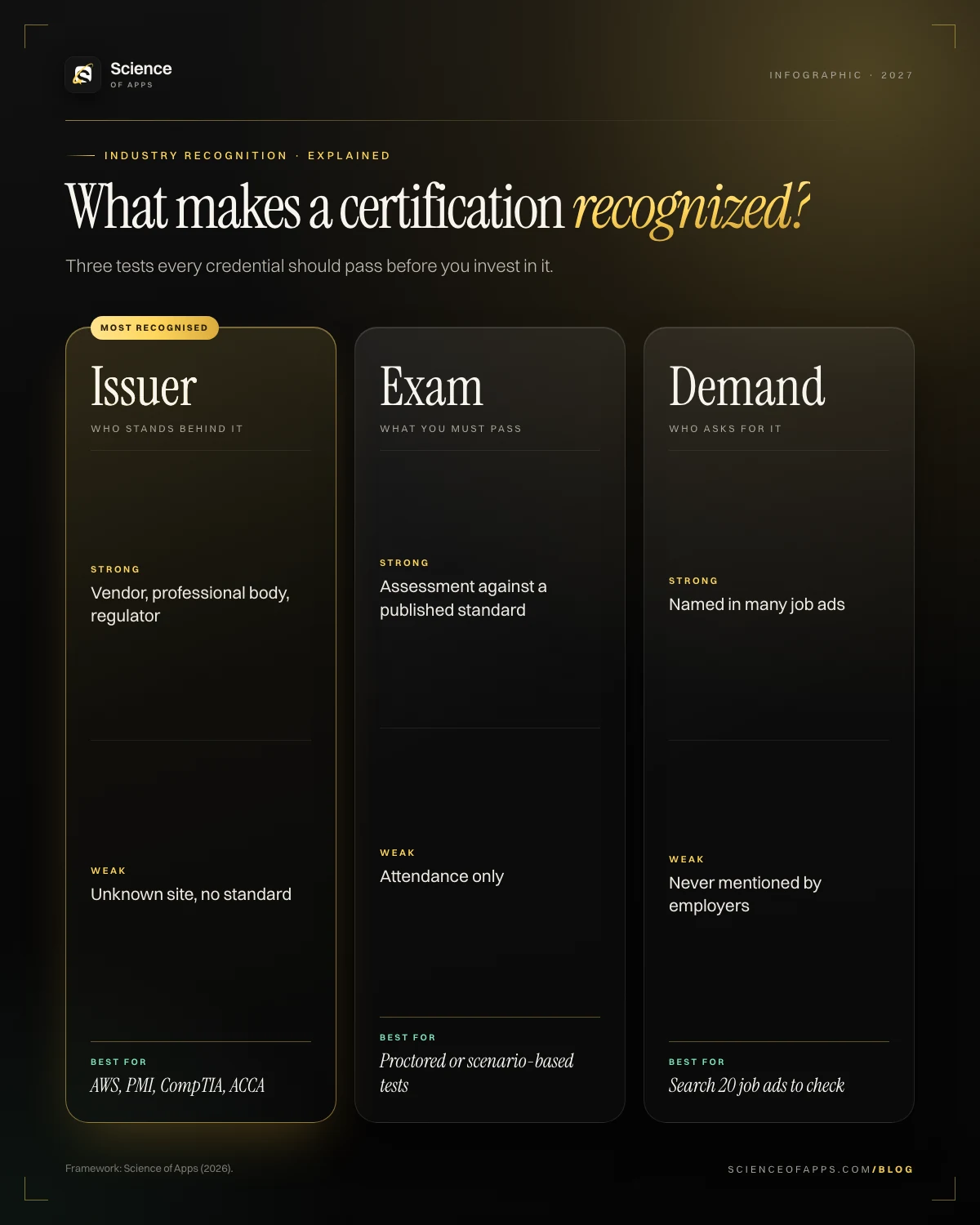
- Known issuer — a vendor, professional body or regulator.
- Real assessment — an exam against a published standard.
- Employer demand — it appears in job ads in that field.
- Maintenance — renewal or continuing education keeps it current.
- Verification — employers can check it.
Key takeaways
- Recognition comes from who issues it and whether employers ask for it.
- Professional-body and vendor certifications dominate job ads.
- "Globally recognized" usually means the exam is the same worldwide (PMP, AWS, CompTIA, ACCA).
- Check recognition by searching job ads, not marketing pages.
- Free, verifiable certifications (like Science of Apps) are best used to prove skills fast alongside recognized credentials.
What is an industry-recognized certification?

It's a credential that employers in a specific industry already understand. That recognition comes from three things: a reputable issuer, an assessment against a published standard, and demand from employers who name it in job requirements.
Industry-recognized certifications by field
| Industry | Widely recognized certifications | Issuer |
|---|---|---|
| Project management | PMP, CAPM, PRINCE2 | PMI1, PeopleCert |
| Cybersecurity | Security+, CISSP, CEH | CompTIA2, ISC2, EC-Council |
| Cloud | AWS, Azure, Google Cloud certifications | AWS3, Microsoft, Google |
| Data | PL-300 (Power BI), Google Data Analytics | Microsoft, Google |
| Finance & accounting | CFA, ACCA, CPA | CFA Institute, ACCA, state boards |
| HR | SHRM-CP, CIPD | SHRM, CIPD |
| Healthcare admin | CPC (medical coding) | AAPC |
Globally recognized certifications
Certifications with the same exam and standard everywhere (PMP, AWS, Microsoft, CompTIA, ACCA, CFA) travel well across countries, which is useful if you plan to work abroad.
How to check if a certification is recognized
- Search 20 job ads for your target role and count mentions.
- Check the issuer's accreditation (e.g. ANSI/ISO 17024 for some exams).
- Ask people in the role on LinkedIn what they hold.
Accreditation: the quiet signal of recognition
Some certification bodies are accredited against ISO/IEC 17024, the international standard for organisations that certify people, through bodies such as ANAB. Accreditation means the exam process, eligibility and renewal follow a standard. It isn't required for recognition (many vendor certifications aren't accredited this way), but it's a strong sign of rigour.
Prove it free: the tests that match this guide
Get ready for industry-recognized exams with SOA's free practice tests (independent, not affiliated with the vendors). (Disclosure: Science of Apps publishes these tests.)
- AWS Cloud Practitioner Practice ExamPractise for AWS Cloud Practitioner, a top recognized entry cert.Start free test →
- CompTIA Security+ Practice TestPractise for Security+, the most-requested security credential.Start free test →
- PMP Practice ExamPractise for PMP, the global project management standard.Start free test →
- AZ-900 Practice TestPractise for Microsoft AZ-900, the Azure entry exam.Start free test →
Industry-recognized certifications for data analysts
Microsoft PL-300 (Power BI), the Google Data Analytics Certificate, Tableau certifications and SQL credentials are the most commonly requested.
Internationally recognized certifications in finance
CFA (investment analysis), ACCA (accounting, recognized in many countries), FRM (risk) and CMA (management accounting) are the most portable finance credentials.
Why recognition matters for freelancers
Clients hiring freelancers can't check references easily. A recognized, verifiable certification on your profile lowers their risk and supports higher rates. Free verifiable credentials help fill gaps between bigger certifications.
Frequently asked questions
What is an industry-recognized certification?
A credential issued by a body that employers in a field know and trust, awarded after an assessment and commonly named in job ads.
Why are industry-recognized certifications valuable for freelancers?
Clients can't easily verify experience, so a recognized, verifiable certification builds trust quickly and helps justify higher rates.
What certifications should I get for business?
Common choices are PMP or CAPM (projects), Lean Six Sigma (operations), Google Analytics or HubSpot (marketing), and SHRM (HR).
Which certifications are recognized globally?
Certifications with the same exam and standard everywhere (PMP, AWS, Microsoft, CompTIA, ACCA, CFA) travel well across countries, which is useful if you plan to work abroad.
Does accreditation make a certification recognized?
Some certification bodies are accredited against ISO/IEC 17024, the international standard for organisations that certify people, through bodies such as ANAB. Accreditation means the exam process, eligibility and renewal follow a standard. It isn't required for recognition (many vendor certifications aren't accredited this way), but it's a strong sign of rigour.
Sources
- PMI certifications
- CompTIA certifications
- AWS Certification
- ANSI National Accreditation Board: personnel certification
- Science of Apps: free online certifications
- Checked November 11, 2026. Figures that change — fees, salaries, prices — are reviewed every six months; if something is out of date, tell us.
Where to go from here
- Free certifications for students — free certifications students and freshers can add to a resume today, from Google, Microsoft
- High-paying certificate careers — certificate programs that lead to high-paying jobs, with time to complete
- Professional certifications for working adults — the best professional certification courses you can finish while working full-time
- CertificationsCertifications for nurses, teachers & accountantsThe most valuable certifications for nurses (BLS, ACLS, CCRN), teachers (CTET, TEFL, CELTA) and accountants (CPA, CMA, ACCA), and what each one costs.
- Career guides by Science of Apps for 2027The best certifications by profession for 2027: one top pick for each of ten careersThe best certification for each profession in 2027: cloud, security, project management, data, marketing, HR, finance, healthcare, teaching and design.
- App marketing & ASO50 push notification examples that actually get clicked — and why they work50 push notification examples for onboarding, habits, commerce, money, social, learning and win-back — with the principle behind each one.
- Career guides by Science of Apps for 2027Top 5 certifications and courses of 2027: one for each career path, nothing you don't needThe top 5 certifications and courses for 2027, one per career path: AI, cloud, data, cybersecurity and project management, with costs and enrol links.
- CertificationsCertification accreditation explainedWhat makes a certification industry-recognized? Accreditation bodies (ANSI, ISO 17024 and others) explained simply.
- Career guides by Science of Apps for 2027The best professional certifications for 2027, industry by industry: the gold-standard credential in each fieldThe best professional certification in each industry for 2027: PMP, CISSP, CISA, CFA, FRM, CSCP, CBAP, SHRM-CP, AWS Solutions Architect and CKA, with costs.
Get the ideas, not the noise.
Sign up with Google and we’ll send you short UX psychology tips by email — why people tap, stall and leave, and what to do about it. Unsubscribe anytime. Prefer something to keep? Get the free Laws of UX guide as a PDF.
Prove the skill before you pay for the exam.
1,200+ free, test-based certifications graded on our server. Pass and get a founder-signed certificate with a credential ID employers can verify.