 By
Quick answer: What is a blockchain certificate?
- Digital credential — a certificate in a verifiable digital format.
- Open Badges — 1EdTech standard for shareable badges.
- Verifiable Credentials — W3C standard for cryptographic proof.
- Blockchain — anchors a fingerprint to make tampering evident.
- Worth it? — verification matters more than the technology.
Key takeaways
- Digital credentials make certificates shareable and instantly verifiable.
- Standards include Open Badges (1EdTech) and W3C Verifiable Credentials.
- Blockchain certificates make tampering evident, but aren't required for trustworthy verification.
- What matters is that the issuer is trusted and verification is easy.
- Science of Apps certificates use a credential ID and QR code for instant checks.
Types of digital credentials

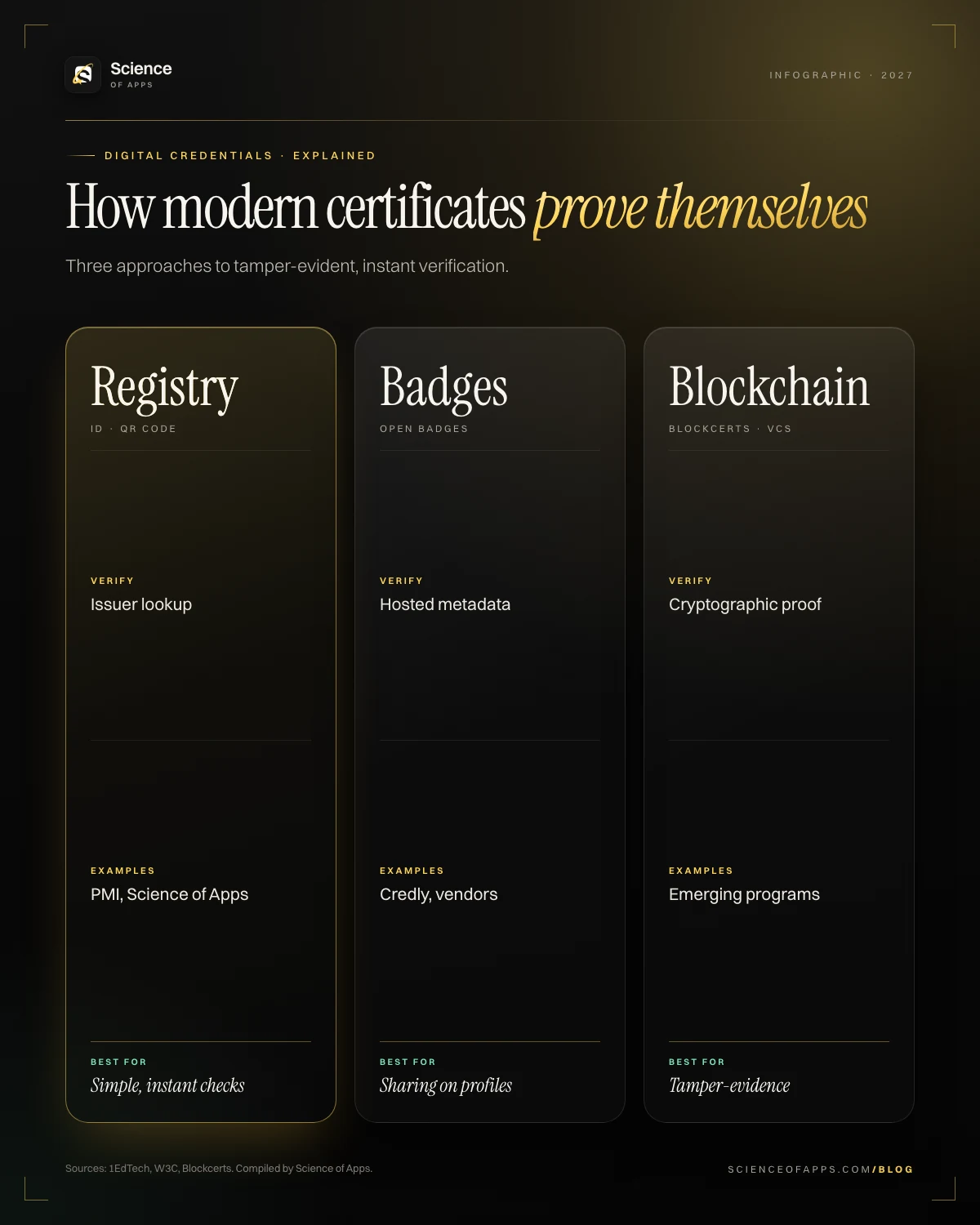
| Type | How it's verified | Examples |
|---|---|---|
| Registry-backed certificate | Issuer database lookup by ID or QR | PMI registry, Science of Apps |
| Open Badge | Badge metadata hosted by issuer/platform1 | Credly, many vendors |
| W3C Verifiable Credential | Cryptographic signature check2 | Digital wallets, emerging uses |
| Blockchain certificate | Fingerprint anchored on a blockchain3 | Blockcerts |
Is blockchain certification worth it?
Blockchain makes tampering evident and lets verification work even if the issuer's website changes. But for most learners and employers, a trusted issuer with a reliable verification page delivers the same practical benefit. Choose credentials for their substance and recognition, not their technology.
Digital credentials APIs
Organizations issuing credentials at scale use platform APIs (badge platforms, verifiable credential services) to issue, revoke and verify credentials automatically, and to connect them with HR systems.
What employers should look for
- Clear issuer identity.
- One-click or scan-to-verify.
- Status (active, expired, revoked).
- Metadata on what was assessed.
How SOA certificates are verified
Each Science of Apps certificate includes a credential ID and QR code that links to its verification, plus a founder signature, so employers can check it in seconds. See SOA certificate verification.
Benefits of digital credentials
- Instant verification saves recruiters time.
- Shareability on LinkedIn, CVs and portfolios.
- Rich metadata: what was assessed, when and by whom.
- Fraud resistance: harder to fake than a PDF.
- Portability: learners own and carry their records.
Prove it free: the tests that match this guide
Learn the technology behind digital credentials. (Disclosure: Science of Apps publishes these tests.)
- Blockchain Certification TestBlockchain fundamentals behind blockchain certificates.Start free test →
- Privacy Certification Test (Fundamentals)Privacy for credentials and learner records.Start free test →
- AI Literacy CertificationEarn an SOA digital certificate with credential ID and QR.Start free test →
Digital wallets and learner records
Verifiable credentials can be stored in digital wallets so learners hold their own records and share them selectively. Several governments and universities are piloting digital diplomas and comprehensive learner records based on these standards.
Digital badges vs certificates
A badge is usually a small, shareable image with embedded metadata linking to the issuer; a certificate is a document. Many issuers now provide both: a PDF certificate for records and a badge for profiles. What matters is that either can be verified.
The future of credentials
Expect more skills-level credentials, more automated verification inside HR systems, and more credentials that expire or update as skills change. Read more in micro-credentials vs degrees.
Frequently asked questions
What is a blockchain certificate?
A digital certificate whose fingerprint is anchored on a blockchain, making tampering evident and verification independent of the issuer's website.
Is blockchain certification worth it?
It adds tamper-evidence, but a trusted issuer with reliable online verification offers similar practical value.
What are digital credentials?
Certificates issued in a verifiable digital format, such as Open Badges, W3C Verifiable Credentials or registry-backed certificates with IDs and QR codes.
What is the difference between a digital badge and a certificate?
A badge is usually a small, shareable image with embedded metadata linking to the issuer; a certificate is a document. Many issuers now provide both: a PDF certificate for records and a badge for profiles. What matters is that either can be verified.
How are Science of Apps certificates verified?
Each Science of Apps certificate includes a credential ID and QR code that links to its verification, plus a founder signature, so employers can check it in seconds. See SOA certificate verification.
Sources
- 1EdTech: Open Badges
- W3C: Verifiable Credentials
- Blockcerts open standard
- Credential Engine
- Science of Apps: free online certifications
- Checked November 11, 2026. Figures that change — fees, salaries, prices — are reviewed every six months; if something is out of date, tell us.
Where to go from here
- Certification accreditation explained — what makes a certification industry-recognized? accreditation bodies (ansi, iso
- Valuable vs useless certifications — not all certifications are worth it
- Certificate verification — how employers verify certificates online, which databases they use and how to ma
- CertificationsCertificate verificationHow employers verify certificates online, which databases they use and how to make your credentials easy to verify.
- CertificationsSOA verified certificatesEvery SOA certificate can be verified online in seconds. Here's how verification works for learners and employers.
- Career guides by Science of Apps for 2027Are AI certifications worth it in 2027? An honest answer, by who you are and what you wantAre AI certifications worth it in 2027? When they help, when they don't, and the 7 that are worth the time for professionals, builders and leaders.
- Career guidesAI hallucination detection skills employers want in 2027: spotting invented facts, citations, quotes, numbers and code — and preventing themAI hallucination detection skills employers want in 2027: spotting fake citations, numbers, quotes and code APIs, and the workflows that prevent them.
- CertificationsMicro-credentials vs degreesWhat micro-credentials are, how they compare with degrees on cost, time and recognition, and whether they will replace traditional college.
- CertificationsGoogle Career Certificates: worth it?Are Google Career Certificates worth it? Honest review of cost, time, job outcomes and how employers view them in 2027.
Get the ideas, not the noise.
Sign up with Google and we’ll send you short UX psychology tips by email — why people tap, stall and leave, and what to do about it. Unsubscribe anytime. Prefer something to keep? Get the free Laws of UX guide as a PDF.
Prove the skill before you pay for the exam.
1,200+ free, test-based certifications graded on our server. Pass and get a founder-signed certificate with a credential ID employers can verify.