 By
Quick answer: How do I verify an SOA certificate?
- Scan — the QR code on the certificate.
- Or enter — the credential ID on SOA's site.
- Check — name, certification, issue date.
- How it's earned — scenario tests based on published standards.
- Limits — not proctored; not for visas or admissions.
Key takeaways
- SOA certifications are earned through scenario-based tests grounded in published standards and research.
- Certificates are founder-signed PDFs with a credential ID and QR code.
- Employers verify in seconds by scanning the QR code or entering the ID.
- Add the credential ID and link to LinkedIn so recruiters can check it.
- SOA credentials are skills proof; they don't replace regulated licences or proctored exams.
How SOA certifications are earned

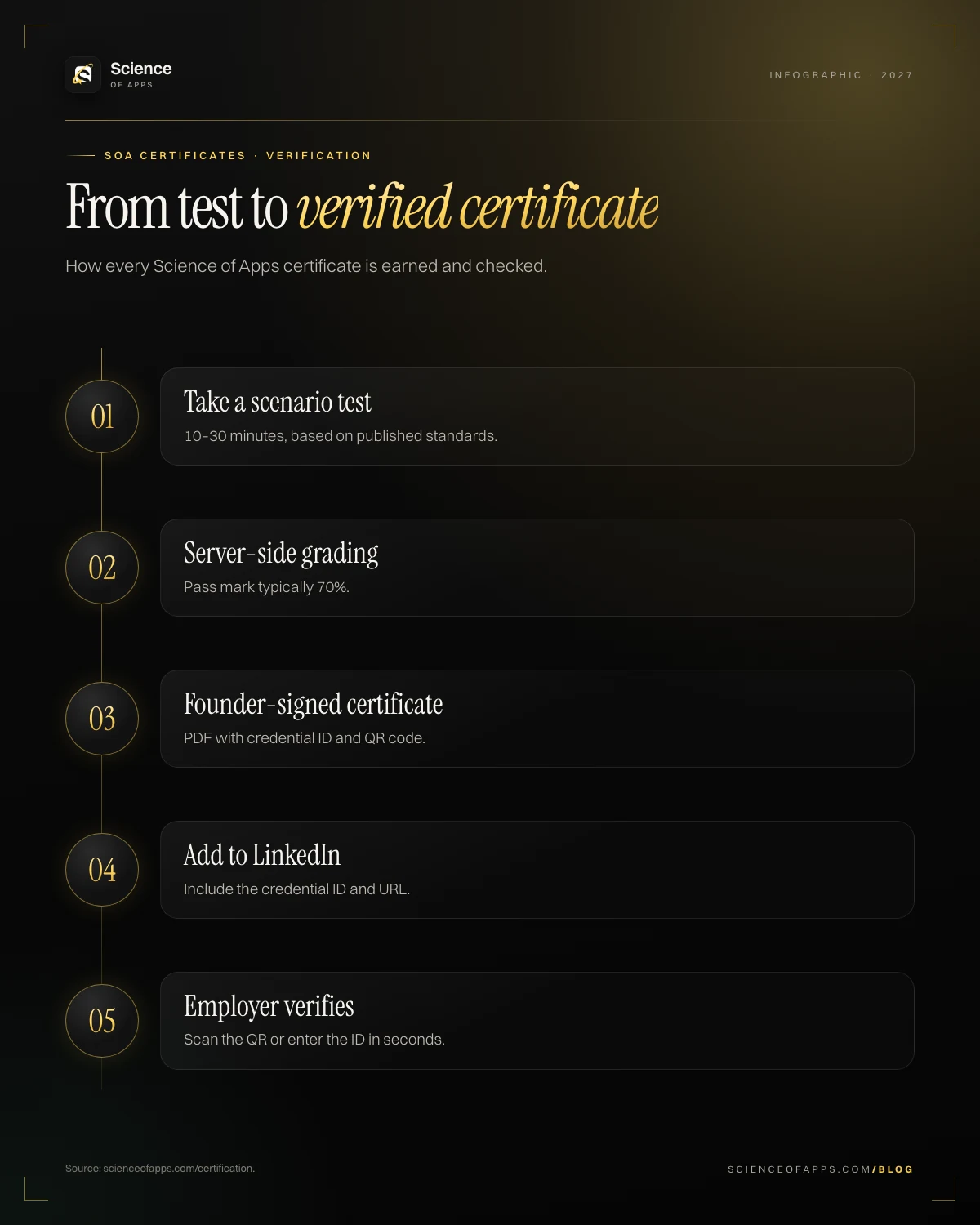
Science of Apps offers 2,403 free certifications and skill tests across 29 categories1. Each test is a set of original scenarios based on a published standard or piece of research, graded on SOA's server. Pass, and you receive a founder-signed certificate with a credential ID and QR code, emailed as a PDF and ready for LinkedIn.
| Step | What happens |
|---|---|
| 1. Choose a certification | Role certifications or 10–20 minute skill tests |
| 2. Answer scenarios | Real-world situations, not trivia |
| 3. Server-side grading | Pass mark typically 70% |
| 4. Certificate issued | Founder-signed PDF with credential ID + QR |
| 5. Share & verify | Add to LinkedIn; employers scan or enter the ID |
How employers verify an SOA certificate
- Scan the QR code on the certificate, or open Science of Apps and enter the credential ID.
- Confirm the holder's name, the certification title and the issue date.
- Compare with the CV or LinkedIn profile.
What SOA certificates are, and aren't
They are free, verifiable proof of specific skills, useful for CVs, LinkedIn, internal mobility and freelancing. They are not proctored and aren't accepted for visas, immigration or university admission. For regulated roles, you still need the official licence or exam.
Add your SOA certificate to LinkedIn
In Licenses & certifications, add the certification name, "Science of Apps" as the issuing organization, the issue date, credential ID and credential URL. See how to add certifications on LinkedIn.
Digital badges and verification
Verification is what turns a certificate into trusted proof. Read more about digital credentials and how employers verify certificates.
What you can get certified in
SOA's catalogue spans 29 categories, including AI (138 tests), security, cloud and DevOps (289), data and BI (120), finance (231), HR (45), ERP and CRM (95), Office (44), marketing, SEO and AEO (75), and UX (73). Role certifications include Product Manager, AI Product Manager, Prompt Engineer, UX/UI Designer, Mobile App Designer and Onboarding & Retention Designer.
Prove it free: the tests that match this guide
Try it yourself: take any of these free tests and get a founder-signed certificate with a credential ID and QR code. (Disclosure: Science of Apps publishes these tests.)
- AI Literacy CertificationSee verification in action: 10 minutes, beginner-friendly.Start free test →
- English Level TestCEFR-aligned English level, A1–C2.Start free test →
- Certified Typist: Typing Test with CertificateA verified WPM certificate, checkable by credential ID.Start free test →
- Product Manager CertificationSOA's professional Product Manager certification.Start free test →
Why SOA certifications are free
Science of Apps is a behavioral UX audit consultancy. Free certifications are part of its mission to make skills visible and verifiable for anyone, regardless of budget or location. There's no sign-up required to take a test.
How employers can use SOA certifications
- As a quick pre-screen for specific skills.
- For internal upskilling and mobility programs.
- To verify claims on a CV in seconds via credential ID or QR code.
An honest note on limits
SOA tests are not proctored, so they show that someone passed a scenario test, not that they did so under exam conditions. They are strongest alongside interviews, work samples and, where needed, formal licences. The English Level Test maps to CEFR levels but isn't accepted for visas or admissions.
Frequently asked questions
How do I verify a Science of Apps certificate?
Scan the QR code on the certificate or enter its credential ID on Science of Apps to confirm the holder, certification and issue date.
Are SOA certificates free?
Yes. Science of Apps certifications and skill tests are free, with no sign-up needed to take a test.
Are SOA certificates proctored?
No. They're free, verifiable skills credentials and aren't accepted for visas, immigration or university admission.
What is online certificate verification?
Checking a certificate's authenticity through the issuer's official website using a credential ID, QR code or registry.
What are Science of Apps certificates, and what are they not?
They are free, verifiable proof of specific skills, useful for CVs, LinkedIn, internal mobility and freelancing. They are not proctored and aren't accepted for visas, immigration or university admission. For regulated roles, you still need the official licence or exam.
Sources
- Science of Apps: free online certifications
- 1EdTech: Open Badges
- Checked November 11, 2026. Figures that change — fees, salaries, prices — are reviewed every six months; if something is out of date, tell us.
Where to go from here
- Valuable vs useless certifications — not all certifications are worth it
- Digital credentials & blockchain certificates — what digital credentials and blockchain certificates are
- Certification accreditation explained — accreditation bodies (ANSI, ISO 17024 and others) explained simply
- CertificationsCertificate verificationHow employers verify certificates online, which databases they use and how to make your credentials easy to verify.
- CertificationsDigital credentials & blockchain certificatesWhat digital credentials and blockchain certificates are, how they prevent fraud and why employers are adopting them.
- CertificationsYour 2027 certification roadmapPlan your career with SOA's certification roadmap: which certifications to take, in what order, for your goal.
- CertificationsOnline course completion ratesOnline course completion rates are low (about 3% in a study of MIT and Harvard MOOCs). What raises them, by format and price, and how to finish yours.
- CertificationsHow SOA designs certificationsHow Science of Apps designs each certification: a published standard, realistic scenarios, expert review, a 70% pass mark and verifiable certificates.
- CertificationsFree online courses with certificatesBrowse 200+ genuinely free online courses that include a certificate, sorted by field, provider and time to finish. Updated every month.
Get the ideas, not the noise.
Sign up with Google and we’ll send you short UX psychology tips by email — why people tap, stall and leave, and what to do about it. Unsubscribe anytime. Prefer something to keep? Get the free Laws of UX guide as a PDF.
Prove the skill before you pay for the exam.
1,200+ free, test-based certifications graded on our server. Pass and get a founder-signed certificate with a credential ID employers can verify.