 By
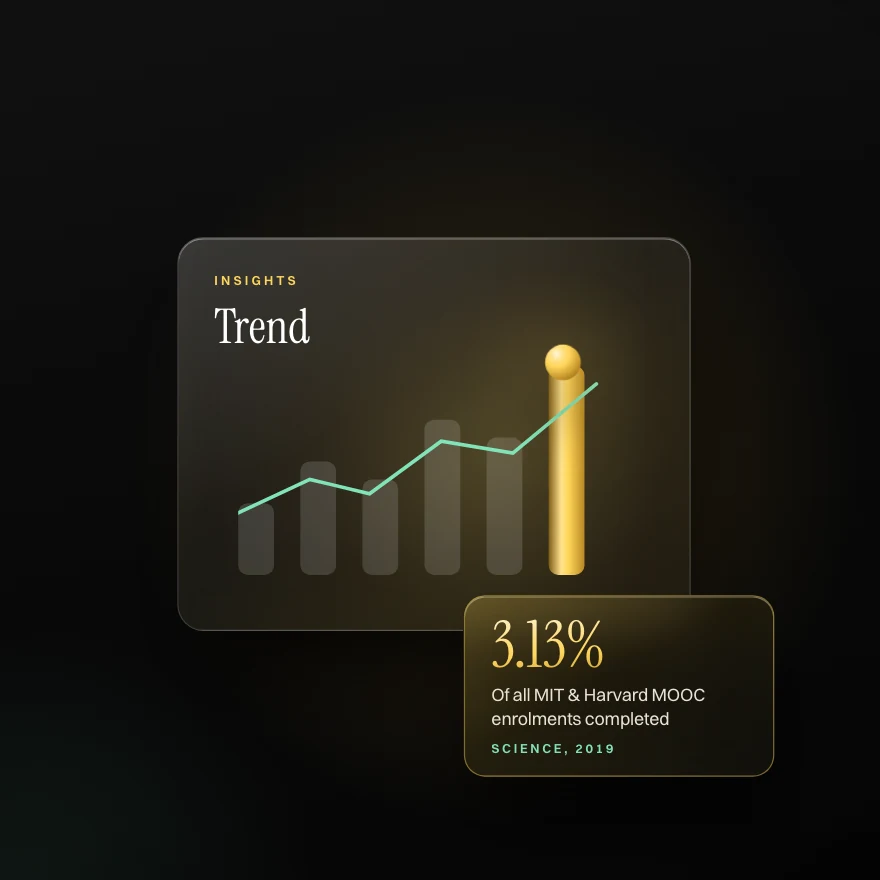
Quick answer: What is the average MOOC completion rate?
- All enrolments — ≈3% (MIT/Harvard, 2019 study).
- Paying learners — complete far more often.
- Why so low — free sign-ups, no deadlines, curiosity enrolments.
- Coursera — no official platform-wide rate.
- Finish more — short courses, deadlines, a goal and a credential.
Key takeaways
- About 3% of all MIT and Harvard MOOC enrolments were completed (Reich & Ruipérez-Valiente, 2019).
- Rates didn't improve over six years of data.
- Learners who pay for certificates complete at many times the overall rate.
- Low completion partly reflects "browsing": many sign up with no intention to finish.
- Short, assessed formats and clear goals raise completion.
What the research shows

Justin Reich and José Ruipérez-Valiente analysed several years of MIT and Harvard edX courses. Among all participants, about 3.13% completed their courses, and the rate did not rise over time; most learners who signed up never returned for a second course12. Learners on the paid, verified track completed far more often, which shows that commitment and goals drive completion more than platform design.
| Learner group | Completion (indicative) | Why |
|---|---|---|
| All MOOC enrolments | ≈3% | Free sign-up, browsing, no deadlines1 |
| Paid verified-certificate learners | Many times higher | Money and goals create commitment1 |
| Short courses and skill tests | Higher | Less time, clear end point |
| Cohort or instructor-led courses | Higher | Deadlines and peers |
Why completion rates are so low
- Curiosity enrolments: many people sign up to browse, with no intention of finishing.
- No deadlines: self-paced courses compete with work and family.
- Length: multi-week courses lose learners each week.
- No stakes: free courses with no exam carry no cost for quitting.
Coursera and Udemy completion rates
Neither Coursera nor Udemy publishes an official platform-wide completion rate. Figures quoted online are usually estimates or come from older MOOC research. Be cautious about any precise "Coursera completion rate" without a named source.
Prove it free: the tests that match this guide
Short tests get finished. SOA certifications take 10–30 minutes, so you'll actually complete them. (Disclosure: Science of Apps publishes these tests.)
Is a low completion rate a failure?
Not necessarily. Researchers point out that many learners get what they need from a few lessons. The problem is for learners who want a credential and don't finish. That's where goal-setting and format matter.
How to finish the online courses you start
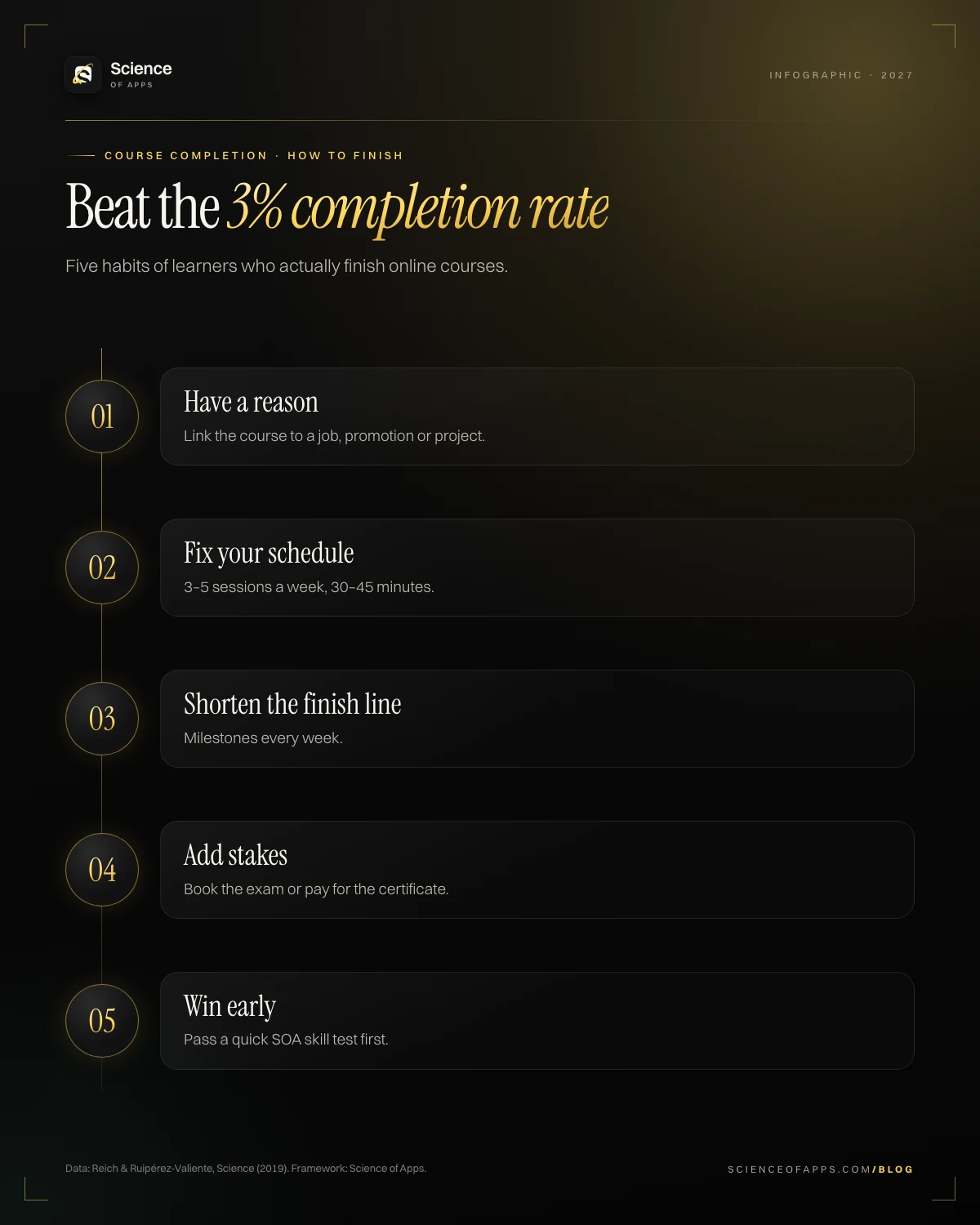
- Set a reason: tie the course to a job, promotion or project.
- Schedule it: 3–5 fixed sessions a week, 30–45 minutes each.
- Shorten the finish line: pick shorter courses or break long ones into milestones.
- Add stakes: book the exam date or pay for the certificate track.
- Start with a quick win: pass a 10–30 minute SOA skill test to build momentum.
See also our guide to study motivation and the 30-day exam study plan.
Frequently asked questions
What is the completion rate of MOOCs?
About 3% of all enrolments in MIT and Harvard MOOCs, according to a 2019 study in Science; completion is much higher among paying learners.
What is Coursera's completion rate?
Coursera doesn't publish an official platform-wide completion rate; treat precise figures quoted online with caution.
Why are online course completion rates so low?
Free sign-ups, curiosity enrolments, no deadlines and long course lengths all reduce completion.
How can I finish an online course?
Tie it to a goal, schedule fixed sessions, set milestones, add stakes such as an exam date, and start with quick wins.
Is a low completion rate a failure?
Not necessarily. Researchers point out that many learners get what they need from a few lessons. The problem is for learners who *want* a credential and don't finish. That's where goal-setting and format matter.
Sources
- Reich & Ruipérez-Valiente (2019), The MOOC Pivot, Science
- Inside Higher Ed: Why MOOCs didn't work, in 3 data points
- Coursera: Q4 and full-year 2025 results
- Science of Apps: free online certifications
- Checked November 11, 2026. Figures that change — fees, salaries, prices — are reviewed every six months; if something is out of date, tell us.
Where to go from here
- What certifications employers look for — we surveyed recruiters about which certifications matter most when hiring
- Most in-demand skills 2027–2030 — the most in-demand skills for 2027 to 2030, based on millions of job postings, a
- Online learning statistics 2027 — 100+ online learning and certification statistics for 2027
- CertificationsOnline learning statistics 2027100+ online learning and certification statistics for 2027: market size, completion rates, demographics and job outcomes.
- CertificationsPower BI PL-300 & Excel certificationHow to earn the Power BI PL-300 and Microsoft Excel certifications: exam format, cost, study plan and career value.
- CertificationsFree online courses with certificatesBrowse 200+ genuinely free online courses that include a certificate, sorted by field, provider and time to finish. Updated every month.
- CertificationsAffordable certifications that pay wellAffordable online certifications under $100 that employers respect, with real costs, time to finish and salary potential.
- CertificationsSOA verified certificatesEvery SOA certificate can be verified online in seconds. Here's how verification works for learners and employers.
- CertificationsCoursera vs Udemy vs edX vs LinkedIn LearningCoursera vs Udemy vs edX vs LinkedIn Learning: price, certificate value, course quality and which one fits your goal. Updated for 2027.

Get the ideas, not the noise.
Sign up with Google and we’ll send you short UX psychology tips by email — why people tap, stall and leave, and what to do about it. Unsubscribe anytime. Prefer something to keep? Get the free Laws of UX guide as a PDF.
Prove the skill before you pay for the exam.
1,200+ free, test-based certifications graded on our server. Pass and get a founder-signed certificate with a credential ID employers can verify.