 By
Quick answer: What are the most important online learning statistics?
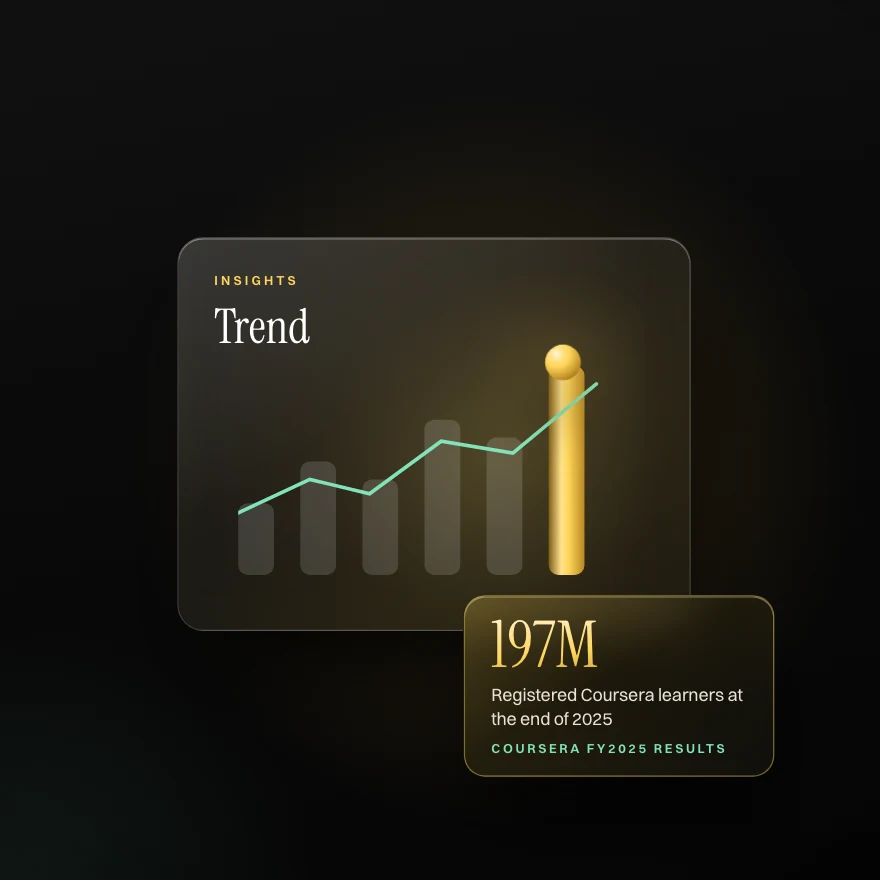
- Scale — 197M registered Coursera learners (Dec 2025).
- Growth — +17% Coursera learners year over year.
- Completion — ~3% of all MOOC enrolments complete.
- Skills shift — 39% of core skills change by 2030 (WEF).
- Outcomes — 91% of surveyed Coursera learners report a career gain.
Key takeaways
- Online learning keeps growing: Coursera added 29 million registered learners in 2025.
- Completion is the weak spot: around 3% of all MOOC enrolments finish, far higher among paying learners.
- Skills are changing fast: WEF expects 39% of core skills to change and 170 million new jobs by 2030.
- Self-reported outcomes are positive, but treat survey figures as indicators, not guarantees.
- Short, verifiable credentials (like 10–30 minute SOA tests) fit how people actually learn online.
Headline online learning statistics

| Statistic | Figure | Source |
|---|---|---|
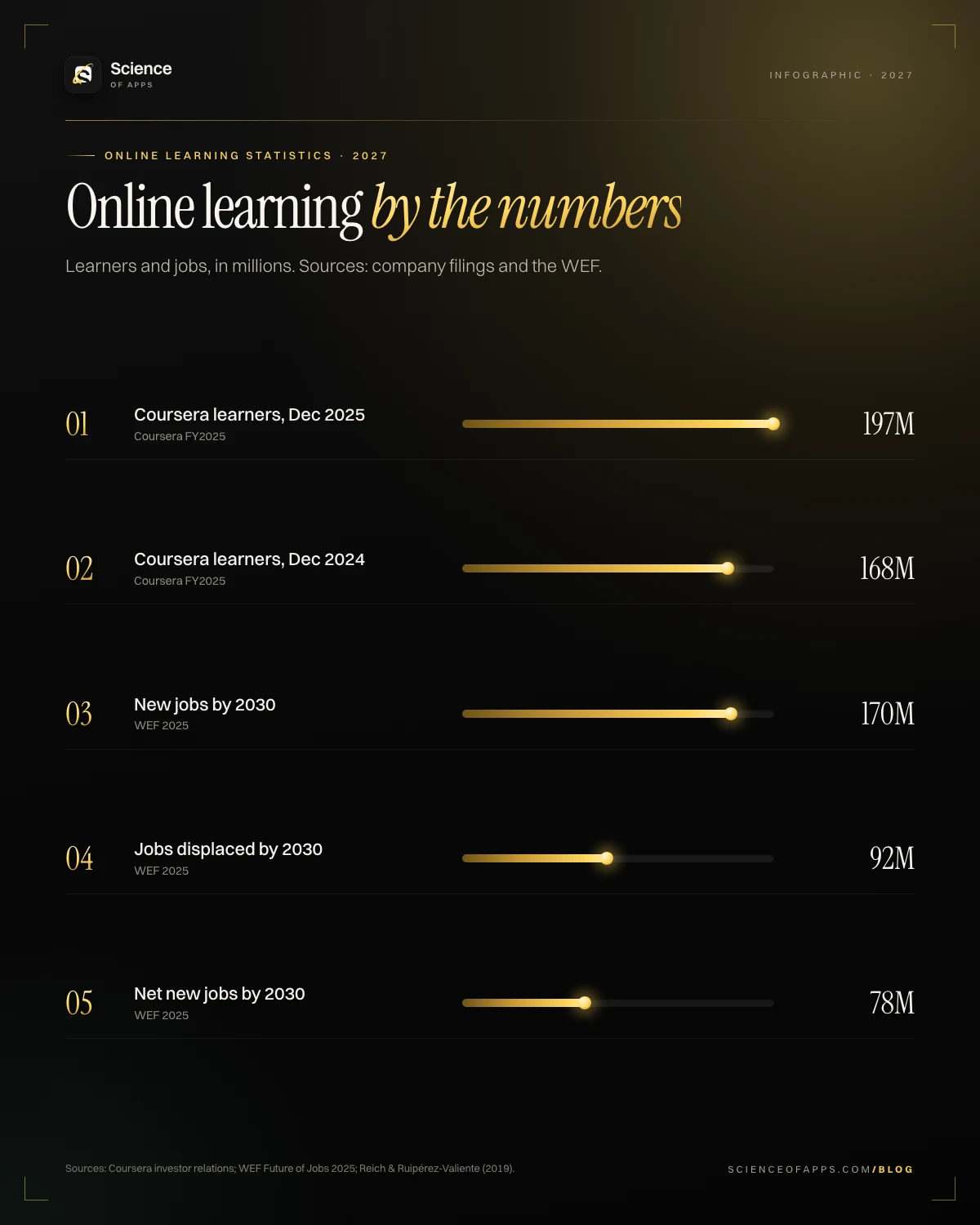
| Coursera registered learners (Dec 31, 2025) | 197 million | Coursera1 |
| Coursera learner growth in 2025 | +17% (from 168M) | Coursera1 |
| New Coursera learners, Q4 2025 | 6.8 million | Coursera1 |
| MOOC completion (all enrolments, MIT/Harvard) | ≈3.13% | Reich & Ruipérez-Valiente2 |
| Workers' core skills expected to change by 2030 | 39% | WEF3 |
| New jobs created / displaced by 2030 | 170M / 92M | WEF4 |
| Coursera learners reporting a positive career outcome | 91% (survey) | Coursera5 |
| Free SOA certifications and skill tests | 2,403 | Science of Apps6 |
How fast is online learning growing?
Coursera, one of the largest platforms, grew from 168 million to 197 million registered learners during 2025, adding roughly 6–7 million new learners every quarter1. Class Central, which tracks MOOCs, has long reported hundreds of millions of MOOC learners worldwide outside China7. Growth is driven by career learning: AI, data, cloud and business skills.
Online course completion statistics
Completion remains the biggest challenge. A widely cited 2019 study in Science found that only about 3% of everyone who enrolled in MIT and Harvard MOOCs completed, and that the rate did not improve over six years2. Learners who paid for a verified certificate completed far more often. See our full breakdown of online course completion rates.
Skills and jobs statistics
The WEF's Future of Jobs Report 2025 expects job disruption equal to 22% of today's jobs by 2030: 170 million new roles and 92 million displaced, a net gain of 78 million4. AI and big data, networks and cybersecurity, and technological literacy are the fastest-growing skills3.
Prove it free: the tests that match this guide
Join the online learners proving skills free. Start with the most popular SOA tests. (Disclosure: Science of Apps publishes these tests.)
- AI Literacy CertificationAI is the fastest-growing learning topic.Start free test →
- Generative AI Certification Test (Fundamentals)GenAI drove much of 2025's online learning growth.Start free test →
- Microsoft Excel Certification Test (Fundamentals)Excel remains one of the most-learned skills online.Start free test →
Career outcome statistics
In Coursera's 2025 Learner Outcomes Report, 91% of surveyed learners reported a positive career outcome and 46% reported a salary increase since enrolling5. These are self-reported survey results from a platform, so they're best read as directional. Official data supports the broader point that education pays: BLS reports higher earnings and lower unemployment at each higher level of education8.
What the numbers mean for learners
- Short beats long for completion: bite-sized courses and tests are more likely to be finished.
- Verification matters: as credentials multiply, employers favour ones they can check.
- Skills shift quickly: plan to refresh certifications every 2–3 years.
How to cite these statistics
Journalists, students and bloggers are welcome to use these figures. Please cite the original source listed in each row, and link to this page as "Science of Apps, Online Learning Statistics 2027". We review the figures every six months.
Frequently asked questions
How many people use online learning platforms?
Coursera alone had 197 million registered learners at the end of 2025; MOOC platforms together reach hundreds of millions of learners worldwide.
What percentage of online courses are completed?
Around 3% of all enrolments in MIT and Harvard MOOCs were completed (Science, 2019); learners who pay for certificates complete far more often.
Is online learning growing?
Yes. Coursera's registered learners grew 17% in 2025, from 168 million to 197 million.
Are e-learning statistics reliable?
Use figures from company filings, peer-reviewed research and official statistics agencies; treat platform surveys as directional.
What are online course completion rates?
Completion remains the biggest challenge. A widely cited 2019 study in *Science* found that only about 3% of everyone who enrolled in MIT and Harvard MOOCs completed, and that the rate did not improve over six years. Learners who paid for a verified certificate completed far more often. See our full breakdown of online course completion rates.
Sources
- Coursera: Q4 and full-year 2025 results
- Reich & Ruipérez-Valiente (2019), The MOOC Pivot, Science
- World Economic Forum: Future of Jobs Report 2025
- WEF press release: 170 million new jobs by 2030
- Coursera: 2025 Learner Outcomes Report
- Science of Apps: free online certifications
- Class Central: MOOCs by the numbers
- BLS: Education pays
- Checked November 11, 2026. Figures that change — fees, salaries, prices — are reviewed every six months; if something is out of date, tell us.
Where to go from here
- What certifications employers look for — we surveyed recruiters about which certifications matter most when hiring
- Online course completion rates — online course completion rates by platform, format and price, and what actually
- Most in-demand skills 2027–2030 — the most in-demand skills for 2027 to 2030, based on millions of job postings, a
- CertificationsWomen in tech statisticsWomen in tech and online learning statistics for 2027: women held about 26% of US computer and maths jobs in 2024, and how online learning widens access.
- CertificationsOnline course completion ratesOnline course completion rates are low (about 3% in a study of MIT and Harvard MOOCs). What raises them, by format and price, and how to finish yours.
- CertificationsOnline training platforms employers respectWhich online training platforms do employers actually trust? We ranked them by recruiter feedback, accreditation and job outcomes.
- CertificationsThe best data science certificationsThe best data science certifications for 2027, from free options to university programs, ranked by cost, depth and job outcomes.
- Career guides by Science of Apps for 2027The best AI certifications for data analysts in 2027: seven for analysts moving into AIThe 7 best AI certifications for data analysts in 2027: ML Specialization, DP-100, AWS ML Engineer, Databricks GenAI, AI-900, Kaggle ML and AI Essentials.
- Career guides by Science of Apps for 2027The best data science certifications of 2027: ten for learning the craft and proving itThe 10 best data science certifications of 2027: IBM Data Science, Google Advanced Data Analytics, Azure DP-100, Andrew Ng's ML, Kaggle, Databricks and more.




Get the ideas, not the noise.
Sign up with Google and we’ll send you short UX psychology tips by email — why people tap, stall and leave, and what to do about it. Unsubscribe anytime. Prefer something to keep? Get the free Laws of UX guide as a PDF.
Prove the skill before you pay for the exam.
1,200+ free, test-based certifications graded on our server. Pass and get a founder-signed certificate with a credential ID employers can verify.