 By
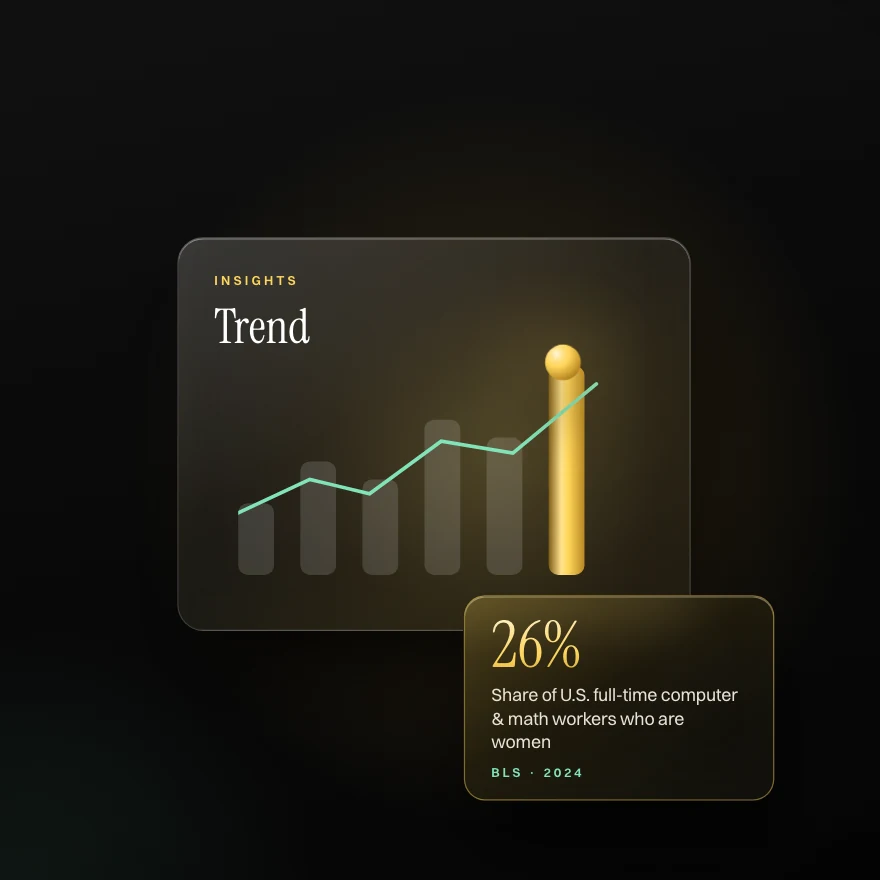
Quick answer: What percentage of tech workers are women?
- U.S. computing — ≈26% of full-time workers (BLS 2024).
- Share of women — 2.2% of employed women vs 5.5% of men.
- Leadership — women remain under-represented.
- Online learning — flexible routes in and back.
- Certifications — objective, verifiable proof of skill.
Key takeaways
- Women are about 26% of U.S. full-time computer and mathematical workers (BLS, 2024).
- 2.2% of employed women work in these occupations, vs 5.5% of men.
- The gap starts small among young workers and widens with age.
- Flexible online learning and certifications help women enter and return to tech.
- Verifiable credentials provide objective evidence that can reduce bias in screening.
Women in tech: key statistics

| Statistic | Figure | Source |
|---|---|---|
| Women's share of full-time computer & math workers (U.S., 2024) | 26.0% | BLS1 |
| Employed women working in computer & math occupations | 2.2% | BLS1 |
| Employed men working in computer & math occupations | 5.5% | BLS1 |
| Women in computer & math occupations (thousands, 2024) | 1,686 of 6,386 | BLS1 |

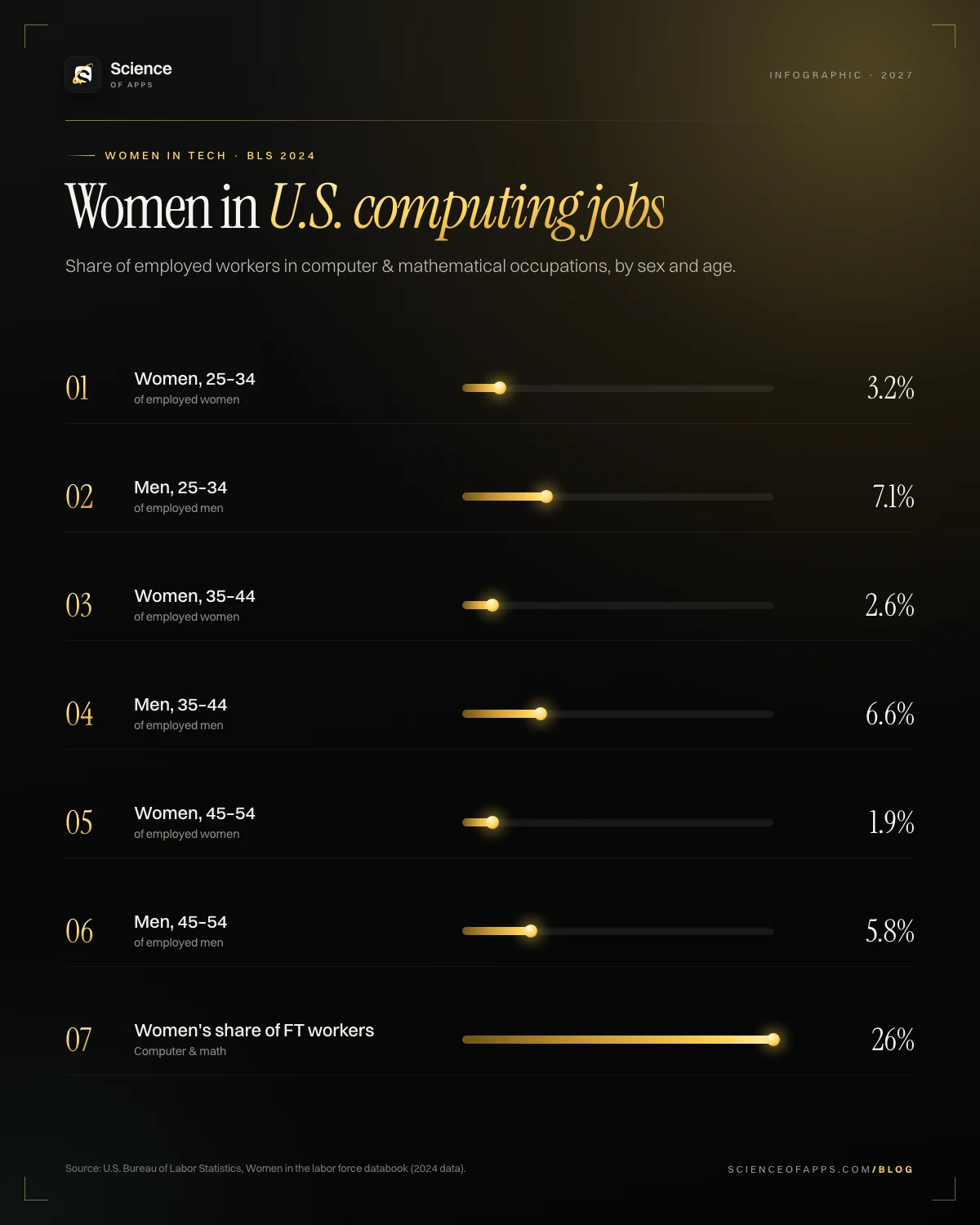
The gap widens with age
BLS data shows women's and men's careers begin in similar occupations but diverge with age. Among workers aged 25–34, 3.2% of employed women worked in computer and mathematical jobs versus 7.1% of men; by 45–54 it was 1.9% versus 5.8%1. Career breaks and a lack of flexible routes back are part of the explanation.
How online learning helps
- Flexibility: study around caring responsibilities.
- Lower cost: free and low-cost courses and certifications.
- No geography barrier: learn from anywhere.
- Objective proof: verifiable certifications provide evidence that's independent of networks.
Women returning to tech
Returnship programmes and refresher certifications help women come back after a career break. See return to work courses and certifications.
Prove it free: the tests that match this guide
Free, verifiable certifications to help women enter, or return to, tech. (Disclosure: Science of Apps publishes these tests.)
- AI Literacy CertificationA fast first step into tech skills.Start free test →
- Python Programming CertificationA first coding credential for women entering tech.Start free test →
- UX/UI Design Fundamentals CertificationUX is a popular route into tech from non-tech backgrounds.Start free test →
- Google Data Analytics Certificate Practice TestData analytics is a common route for returners and career changers.Start free test →
Women in tech in the UK and globally
The pattern is similar in many countries: women are under-represented in computing roles and leadership. Official sources such as national statistics offices and the U.S. Department of Labor's Women's Bureau publish updated data2.
What helps close the gap
- Skills-based hiring that values verified skills over pedigree.
- Flexible and part-time tech roles.
- Returner programmes and mentoring.
- Free, verifiable credentials that anyone can earn.
Frequently asked questions
What percentage of tech workers are women?
In the U.S., women were about 26% of full-time wage and salary workers in computer and mathematical occupations in 2024 (BLS).
How many women work in tech?
About 1.7 million of 6.4 million U.S. workers in computer and mathematical occupations in 2024 were women (BLS).
How can online learning help women in tech?
It offers flexible, low-cost routes into and back into tech, and verifiable certifications that provide objective proof of skills.
Does the gender gap in tech widen with age?
BLS data shows women's and men's careers begin in similar occupations but diverge with age. Among workers aged 25–34, 3.2% of employed women worked in computer and mathematical jobs versus 7.1% of men; by 45–54 it was 1.9% versus 5.8%. Career breaks and a lack of flexible routes back are part of the explanation.
How many women work in tech in the UK?
The pattern is similar in many countries: women are under-represented in computing roles and leadership. Official sources such as national statistics offices and the U.S. Department of Labor's Women's Bureau publish updated data.
Sources
- BLS: Women in the labor force, 2024 databook
- U.S. DOL Women's Bureau: women in STEM occupations
- Science of Apps: free online certifications
- Checked November 11, 2026. Figures that change — fees, salaries, prices — are reviewed every six months; if something is out of date, tell us.
Where to go from here
- Most popular certifications by country — the most popular certifications and online courses in every major country, from
- Trending certifications 2027 — the fastest-growing and declining certifications for 2027, based on search, job-
- Salary after certification — how much more do certified professionals earn? salary increases after pmp, aws,
- CertificationsOnline learning statistics 2027100+ online learning and certification statistics for 2027: market size, completion rates, demographics and job outcomes.
- Career guides by Science of Apps for 2027The top 10 online certifications for women in tech in 2027: to enter, grow and leadThe top 10 online certifications for women in tech in 2027: AWS, Security+, Google Data Analytics, Google UX, PMP, AI-102, Salesforce and leadership picks.
- CertificationsIndustry-recognized certificationsWhich certifications are actually industry-recognized? A list by field, with the governing bodies and employers behind each one.
- Career guidesGenerative engine optimization skills employers want in 2027: getting brands mentioned and cited in ChatGPT, Gemini, Perplexity and AI OverviewsGEO skills employers want in 2027: how AI assistants choose sources, quotable facts, authority and mentions, crawler access and tracking AI citations.
- Career guidesStatistics for data analyst interviews in 2027: the concepts employers test and how to explain them without jargonStatistics for data analyst interviews in 2027: the descriptive, inference and testing concepts employers check, real questions with plain answers.
- Career guides by Science of Apps for 2027The top online certifications for women returning to work in 2027: flexible routes back after a career breakThe 8 best online certifications for women returning to work in 2027: Google AI Essentials, Data Analytics, Project Management, Salesforce, HubSpot and more.
Get the ideas, not the noise.
Sign up with Google and we’ll send you short UX psychology tips by email — why people tap, stall and leave, and what to do about it. Unsubscribe anytime. Prefer something to keep? Get the free Laws of UX guide as a PDF.
Prove the skill before you pay for the exam.
1,200+ free, test-based certifications graded on our server. Pass and get a founder-signed certificate with a credential ID employers can verify.