Free English level test with certificate
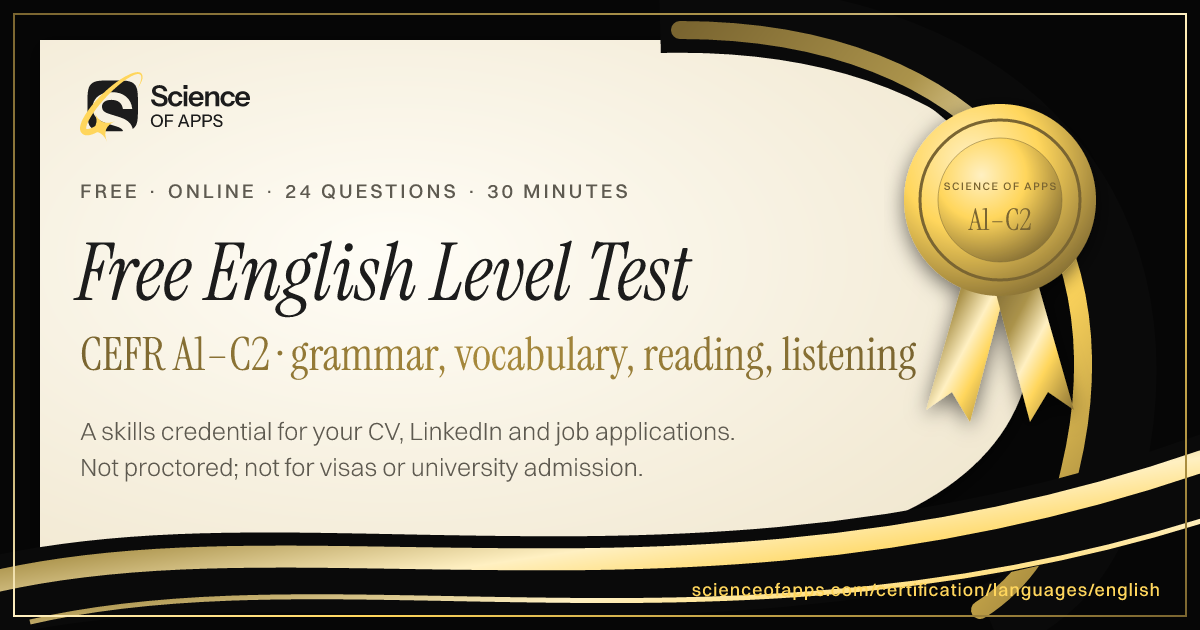
Find your English level from A1 to C2 in 30 minutes — grammar, vocabulary, reading and listening — and earn the English Level Certificate SOA-EN, stating your level, for your CV, LinkedIn and job applications.
- 24 questions · 4 skills
- 30 minutes, timed
- A1–C2 your level on the certificate
- Free no sign-up needed
- LinkedIn-ready · add it to your profile in one clickSee how ↓

 Founder, Science of Apps
What is the English Level Test?
The English Level Test is a free online test that places you on the CEFR scale from A1 (beginner) to C2 (proficient). In 30 minutes you answer 24 questions on grammar, vocabulary, reading and listening, graded instantly. Any result from A1 up earns a free certificate that states your level, with a credential ID employers can verify.
The levels, A1–C2
Your certificate states one of these 6 levels on the CEFR, easiest first.
| Level | What you can do | At work |
|---|---|---|
| A1 BeginnerBasic user | Understand and use familiar everyday phrases; introduce yourself and answer simple questions about where you live and what you have. | Read simple signs and notices, fill in basic details on a form. |
| A2 ElementaryBasic user | Understand sentences on familiar topics such as shopping, family and work, and handle simple, routine exchanges. | Follow short messages and instructions, handle simple customer requests. |
| B1 IntermediateIndependent user | Understand the main points of clear standard language on familiar matters, deal with most travel situations and describe experiences and plans. | Write routine emails, take part in team meetings on familiar topics. |
| B2 Upper intermediateIndependent user | Understand the main ideas of complex text, including technical discussion in your field, and talk with fluency and spontaneity. | Work in a team that uses the language, present and discuss work, read reports. |
| C1 AdvancedProficient user | Understand demanding, longer texts and implicit meaning, and use the language flexibly and effectively for social, academic and professional purposes. | Negotiate, write detailed reports, lead meetings and handle nuance. |
| C2 ProficientProficient user | Understand virtually everything heard or read, and express yourself precisely, distinguishing finer shades of meaning even in complex situations. | Work at a level close to an educated native speaker, including irony and idiom. |
What the test covers
4 skills, each with one question at every level from A1 to C2, so each skill starts easy and ends hard. They’re drawn from a bank of 72, 3 per skill and level, so a retake brings questions you haven't seen.
- 01
Grammar
25%- Verb tenses and forms
- Conditionals and the passive
- Formal and emphatic structures
- 02
Vocabulary
25%- Everyday and workplace words
- Collocations and phrasal verbs
- Idiom and precise meaning
- 03
Reading
25%- Notices, messages and emails
- Main ideas and detail
- Inference, attitude and tone
- 04
Listening
25%- Numbers, times and facts
- Messages, announcements and conversations
- Implied meaning across accents
Listening clips are short recordings in British, American, Indian and Australian English, made with synthetic voices; each has a transcript for anyone who can't listen. Speaking and writing aren't tested.
How your level is worked out
Your level is the highest one at which you answer at least 3 of its 4 questions correctly, as long as you got at least half right at every level below it. If no level qualifies, the result is below A1, with no certificate. So a slip on one easy question doesn’t cap your result, but a real gap does. Your results show your score at each level and in each skill, and every question with the right answer and why.
Try a sample question
Choose the correct word: "I've worked here ___ 2021."
- since
- for
- from
- during
Show the answer
A. since — With the present perfect, "since" marks the starting point (since 2021); "for" goes with a length of time (for three years). This is a B1-level question. The real test has 24 questions like this.
How the test works
30 minutes, 24 questions
One question per screen with a countdown. Each skill starts easy and gets harder. Your progress is saved on this device if you need to pause.
Graded on our server
Answers reach the page only after you submit, so a level can only be earned by answering correctly.
Your level, explained
See your level, your score at each level and in each skill, and every question with the right answer and why.
Your certificate
It states your level, with a QR code and credential ID. Download a PDF or PNG, add it to LinkedIn, and it's emailed to you.
What you earn
The certificate names you, your level on the CEFR and the skills tested, and says the test was online and not proctored — so anyone reading it knows exactly what it shows.
Pass, then add it to LinkedIn in one click
No typing. The Add to LinkedIn button opens your profile’s Licenses & certifications form already filled in: the certificate name, Science of Apps as the issuer, the issue date, your credential ID and a link recruiters can use to verify it.
- 1Take the 30-minute test
- 2Score 0% or more
- 3Click Add to LinkedIn

English Level Certificate
Science of Apps
Show credential ↗Land the job, not just the certificate
Career guide · 8 min readWhat English level do jobs need in 2027? CEFR levels A1 to C2 explained for job seekers, which roles need B1, B2 or C1, how employers test English, and how to prove your level
What English level do jobs need in 2027? CEFR A1–C2 explained, which roles need B1, B2 or C1, how employers test English and how to prove your level.
Read the hiring playbook →More language tests
- 20 questions · 25 minSOA-SPEN
Spoken English Test
A free Spoken English test: everyday conversation, listening & understanding, natural phrases & idioms and pronunciation & stress, with a verifiable certificate for your CV, LinkedIn and job applications.
Difficulty: IntermediateFor Job seeker, Graduate, Customer support executiveTake the 25-minute test → - 25 questions · 30 minSOA-BEN
Business English Test
A free Business English test: emails & writing, meetings & negotiation, business vocabulary, reading workplace texts and listening at work, with a verifiable certificate for your CV, LinkedIn and job applications.
Difficulty: IntermediateFor Job seeker, Graduate, Customer support executiveTake the 30-minute test → - 25 questions · 30 minSOA-EFI
English for Job Interviews Test
A free English for Job Interviews test: introducing yourself, answering common questions, professional vocabulary, etiquette & follow-up and listening in interviews, with a verifiable certificate for your CV, LinkedIn and job applications.
Difficulty: IntermediateFor Job seeker, Graduate, Customer support executiveTake the 30-minute test → - 20 questions · 25 minSOA-ECS
English for Customer Service Test
A free English for Customer Service test: call handling, listening to customers, empathy & tone and written support, with a verifiable certificate for your CV, LinkedIn and job applications.
Difficulty: IntermediateFor Job seeker, Graduate, Customer support executiveTake the 25-minute test →
Read more
English has more speakers than any other language, and most of them learned it as a second language. See where it sits among the 38 languages with 50 million or more speakers. Languages of the World →
The story of English and its alphabet, from Anglo-Saxon to today. English →
Frequently asked questions
What is the English Level Test?
The English Level Test is a free online test that places you on the CEFR scale from A1 (beginner) to C2 (proficient). In 30 minutes you answer 24 questions on grammar, vocabulary, reading and listening, graded instantly. Any result from A1 up earns a free certificate that states your level, with a credential ID employers can verify. A free skills credential for your CV, LinkedIn and job applications. Not proctored, and not accepted for visas, immigration or university admission.
Is this a free English test with a certificate?
Yes. Taking the test, receiving your certificate as a PDF and by email, adding it to LinkedIn and having it verified are all free, with no sign-up. The certificate states your level on the CEFR (for example CEFR B1). It has a credential ID and QR code anyone can check.
Can I use this English certificate for a visa, immigration or university admission?
No. A free skills credential for your CV, LinkedIn and job applications. Not proctored, and not accepted for visas, immigration or university admission. If an embassy, university or regulator asks for a language test, take the one they name.
How is my English level worked out?
Each test has 4 questions at every level, one per skill, so it can tell what you handle comfortably and where you start to struggle. Your level is the highest one at which you answer at least 3 of its 4 questions correctly, as long as you got at least half right at every level below it. If no level qualifies, the result is below A1, with no certificate.
What does the English Level Test cover?
Grammar, Vocabulary, Reading and Listening: Grammar (verb tenses and forms, conditionals and the passive, formal and emphatic structures); Vocabulary (everyday and workplace words, collocations and phrasal verbs, idiom and precise meaning); Reading (notices, messages and emails, main ideas and detail, inference, attitude and tone); Listening (numbers, times and facts, messages, announcements and conversations, implied meaning across accents).
Can I retake the English Level Test?
Yes. The bank holds 72 questions, so a retake draws questions you haven't seen. If your result is below A1 you can retake after 30 minutes.
What does CEFR mean, and what are the levels A1 to C2?
The CEFR (Common European Framework of Reference for Languages) is the Council of Europe's scale for describing language ability. It has six levels: A1 Beginner, A2 Elementary, B1 Intermediate, B2 Upper intermediate, C1 Advanced and C2 Proficient. A1 and A2 are "basic user", B1 and B2 "independent user", C1 and C2 "proficient user". Employers often ask for B2 or above for roles that use English every day.
Is it the same as IELTS, TOEFL or the Duolingo English Test?
No. Science of Apps isn't affiliated with or endorsed by any of them, and this test isn't equivalent to them or a way to predict their scores. They are proctored exams that institutions accept for admission and visas; this is a free, unproctored skills check that gives you a CEFR level to show on a CV and LinkedIn.
Who is the English Level Test for?
Job seekers, students, graduates and professionals who want to show their English level to employers. It suits roles where employers ask about English: customer support and BPO, sales, IT and software, hospitality and office jobs.
Does it test speaking and writing?
No. This free test covers grammar, vocabulary, reading and listening, which can be marked automatically and fairly. It doesn't assess your speaking or writing, so your certificate says which skills it covers.
How much do Science of Apps certifications cost?
Nothing. There is no fee to take a test, to receive the certificate, to have it emailed or to verify it, and no sign-up.
Do the certificates expire?
No. Every certificate is dated, so it always shows when you passed. Retake a test any time for a newer date or a higher score.
Can I add the certificate to LinkedIn?
Yes. After you pass, Add to LinkedIn opens the Licenses & certifications form with the certificate name, Science of Apps as the issuer, the issue date, your credential ID and the verification link filled in. You can also download it as a PDF or PNG, and it's emailed to you as a PDF.
How can an employer verify my certificate?
Every certificate has a credential ID and a QR code. Scanning it, or entering the ID at scienceofapps.com/certification/verify/, shows the holder's name, the certification, the score and the issue date from our records.
Are these accredited qualifications?
No. They are Science of Apps' own assessments of applied skill. They aren't issued by a university or standards body, and they work best alongside a portfolio that shows the skills in real work.
621 more certifications to collect
Languages
- English Level TestYou're here
- American Sign Language (ASL) Foundations Test25 min · Intermediate
- App & Software Localization Test25 min · Intermediate
- Arabic for Gulf Jobs Test25 min · Intermediate
- Arabic Level Test30 min · Beginner
- Bengali Level Test30 min · Beginner
- Business English Test30 min · Intermediate
- Danish Level Test30 min · Beginner
- Dutch Level Test30 min · Beginner
- English for Customer Service Test25 min · Intermediate
- English for Hospitality & Gulf Jobs Test25 min · Intermediate
- English for Job Interviews Test30 min · Intermediate
- English for Nurses & Healthcare Test25 min · Intermediate
- English Grammar Test20 min · Intermediate
- English Pronunciation Test20 min · Intermediate
- English Vocabulary Test20 min · Intermediate
- French for Canada Readiness Test25 min · Intermediate
- French Level Test30 min · Beginner
- German for IT Professionals Test30 min · Intermediate
- German for Nurses Test25 min · Intermediate
- German Level Test30 min · Beginner
- Greek Level Test30 min · Beginner
- Gujarati Level Test35 min · Beginner
- Hebrew Level Test30 min · Beginner
- Hindi Level Test30 min · Beginner
- Indian Sign Language (ISL) Foundations Test25 min · Intermediate
- Indonesian Level Test30 min · Beginner
- Italian Level Test30 min · Beginner
- Japanese for Caregivers & Skilled Workers Test25 min · Intermediate
- Japanese for IT Professionals Test30 min · Intermediate
- Japanese Level Test30 min · Beginner
- Kannada Level Test30 min · Beginner
- Korean Level Test30 min · Beginner
- Latin Reading Level Test25 min · Beginner
- Malayalam Level Test35 min · Beginner
- Mandarin Chinese Level Test30 min · Beginner
- Marathi Level Test35 min · Beginner
- UX Writing for Multilingual Products Test25 min · Intermediate
- Norwegian Level Test30 min · Beginner
- Persian (Farsi) Level Test35 min · Beginner
- Polish Level Test30 min · Beginner
- Portuguese Level Test30 min · Beginner
- Professional Email & Workplace Writing Test20 min · Intermediate
- Punjabi Level Test35 min · Beginner
- Russian Level Test30 min · Beginner
- Sanskrit Reading Level Test25 min · Beginner
- Spanish Level Test30 min · Beginner
- Spoken English Test25 min · Intermediate
- Swahili Level Test30 min · Beginner
- Swedish Level Test30 min · Beginner
- Tagalog (Filipino) Level Test30 min · Beginner
- Tamil Level Test30 min · Beginner
- Teaching English Online Test25 min · Intermediate
- Telugu Level Test30 min · Beginner
- Thai Level Test30 min · Beginner
- Translation Skills Test25 min · Intermediate
- Turkish Level Test30 min · Beginner
- Ukrainian Level Test30 min · Beginner
- Urdu Level Test35 min · Beginner
- Vietnamese Level Test30 min · Beginner
Foundation
AI & Generative AI
- AI UX Design Certification30 min · Advanced
- Prompt Engineering Certification30 min · Intermediate
- AI Product Manager Certification30 min · Advanced
Software Engineering & Web Development
- HTML and CSS Fundamentals Certification10 min · Beginner
- JavaScript Fundamentals Certification10 min · Beginner
- TypeScript Fundamentals Certification15 min · Intermediate
Data Analytics & Business Intelligence
- Product Analytics Certification30 min · Advanced
- Data Literacy Certification10 min · Beginner
- Microsoft Excel Fundamentals Certification10 min · Beginner
Digital Marketing, SEO, AEO & Growth
- Conversion Rate Optimization (CRO) Certification30 min · Advanced
- App Store Optimization (ASO) Certification30 min · Intermediate
- Growth Marketing Certification30 min · Intermediate
UX/UI, Design, Research & Creative
- UX Design Certification30 min · Intermediate
- UI Design Certification30 min · Intermediate
- Product Design Certification30 min · Intermediate
Product, Project Management & Business Analysis
- Product Manager Certification30 min · Intermediate
- Design Leadership Certification30 min · Advanced
- Agile Product Owner Certification30 min · Intermediate
Cybersecurity, IT, Cloud & DevOps
- Cybersecurity Fundamentals Certification10 min · Beginner
- Security Awareness and Phishing Detection Certification10 min · Beginner
- Network Security Fundamentals Certification15 min · Intermediate
Sales, Customer Success & Support
- Sales Fundamentals Certification10 min · Beginner
- Consultative Selling Certification15 min · Intermediate
- B2B Sales Development Representative Certification10 min · Beginner
Human Resources & People Management
- Human Resources Fundamentals Certification10 min · Beginner
- Talent Acquisition and Recruitment Certification10 min · Beginner
- Technical Recruitment Certification15 min · Intermediate
Finance, Accounting, Operations & Entrepreneurship
- Financial Literacy for Professionals Certification10 min · Beginner
- Accounting Fundamentals Certification10 min · Beginner
- Bookkeeping Fundamentals Certification10 min · Beginner
Communication, Leadership & Transferable Skills
- Critical Thinking Test10 min · Beginner
- Attention to Detail Test10 min · Beginner
- Cognitive Bias Test10 min · Beginner
Healthcare, Education, Legal Operations & Sustainability
- Healthcare Administration Fundamentals Certification10 min · Beginner
- Medical Office Administration Certification10 min · Beginner
- Healthcare Data Privacy Awareness Certification10 min · Beginner
Test Prep, Academics & Aptitude
- SAT Math Practice Test20 min · Advanced
- SAT Reading and Writing Practice Test20 min · Advanced
- ACT Practice Test (English, Math, Reading & Science)20 min · Advanced
Language Exam Prep
- IELTS Academic Practice Test with Band Score20 min · Advanced
- IELTS General Training Practice Test20 min · Advanced
- TOEFL iBT Practice Test20 min · Advanced
Office & Productivity Software
- Microsoft Word Skills Certification15 min · Intermediate
- Microsoft PowerPoint Skills Certification15 min · Intermediate
- Microsoft Outlook Skills Certification10 min · Beginner
Engineering, Architecture, Construction & Safety
- Mechanical Engineering Practice Test (FE-Style)20 min · Advanced
- Electrical Engineering Practice Test (FE-Style)20 min · Advanced
- Civil Engineering Practice Test (FE-Style)20 min · Advanced
Hospitality, Travel & Retail
- Hospitality Management Certification10 min · Beginner
- Food Safety Certification10 min · Beginner
- Hotel Revenue Management Certification15 min · Intermediate
Read before you test
- Career guidesEnglish for customer service jobs in 2027: call handling, listening to customers, empathy and tone, written support, what BPO and support employers test, and how to prove itEnglish for customer service jobs in 2027: call handling, listening, empathy and tone, written support, what BPO employers test and how to prove it.
- Career guidesWhat English level do jobs need in 2027? CEFR levels A1 to C2 explained for job seekers, which roles need B1, B2 or C1, how employers test English, and how to prove your levelWhat English level do jobs need in 2027? CEFR A1–C2 explained, which roles need B1, B2 or C1, how employers test English and how to prove your level.
- Career guidesPolish for careers in 2027: where Polish is used at work, shared-service centres, IT and logistics in Poland, translation and customer support, Polish grammar and CEFR levelsPolish for careers in 2027: shared-service centres, IT and logistics in Poland, translation and customer support, Polish grammar, pay and CEFR levels.
- Career guidesHindi for jobs in 2027: where Hindi is used at work, Devanagari script, workplace and customer Hindi, roles that need it, CEFR levels and how professionals relocating within India can learn itHindi for jobs in 2027: where Hindi is used at work, Devanagari script, workplace and customer Hindi, roles that need it, CEFR levels and how to learn it.
- Career guidesIndonesian for careers in 2027: where Indonesian is used at work, trade, mining, energy and tourism, customer support, translation, the easy Latin-script grammar and CEFR levelsIndonesian for careers in 2027: trade, mining, energy and tourism, customer support, translation, the Latin script, simple grammar, pay and CEFR levels.
- Career guidesWhy learn Latin in 2027: grammar and vocabulary, translation and reading, Latin roots in medicine, law and science, careers that use Latin and how to measure your reading levelWhy learn Latin in 2027: grammar, vocabulary, translation, Latin roots in medicine, law and science, careers that use Latin and your reading level.
Get the ideas, not the noise.
Sign up with Google and we’ll send you short UX psychology tips by email — why people tap, stall and leave, and what to do about it. Unsubscribe anytime. Prefer something to keep? Get the free Laws of UX guide as a PDF.