AI UX Design Certification
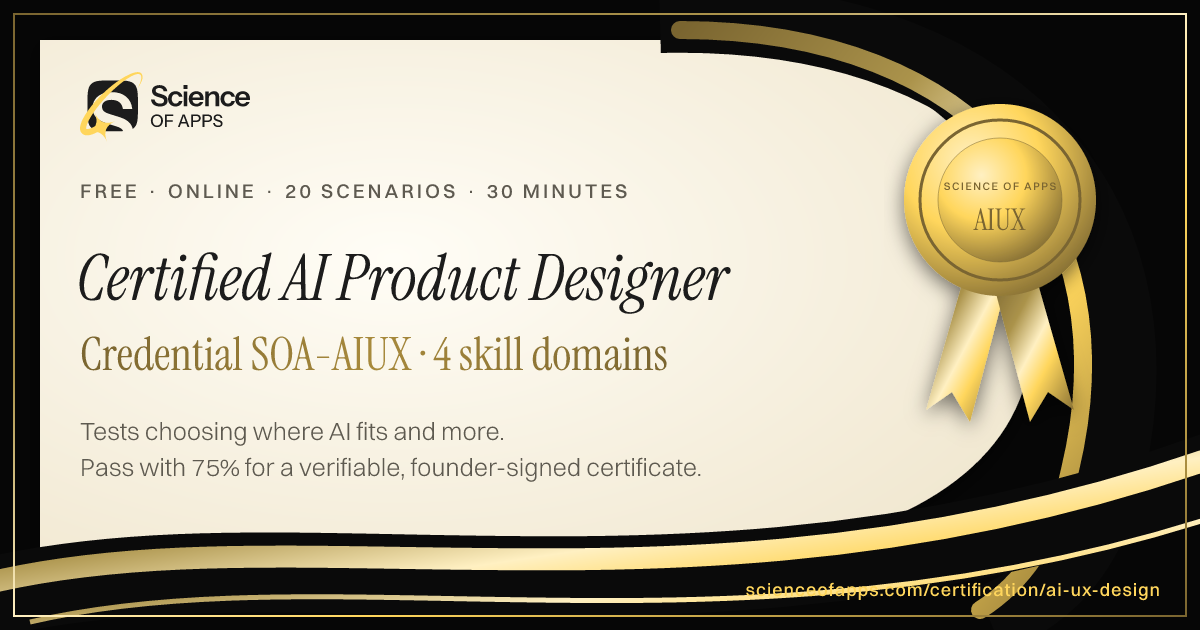
Earn the credential Certified AI Product Designer SOA-AIUX. It certifies that you can design AI-powered products people trust — setting expectations, conversational and agent UX, handling errors and uncertainty, and responsible AI.
- Advanced difficulty.Assumes years in the role or deep specialist knowledge.
- 20 scenario questions
- 30 minutes, timed
- 75% to pass · 90% for distinction
- Free no sign-up needed
- LinkedIn-ready · add it to your profile in one clickSee how ↓

 Founder, Science of Apps
What is the AI UX Design Certification?
The AI UX Design Certification is a free, test-based credential from Science of Apps. It certifies that you can design AI-powered products people trust — setting expectations, conversational and agent UX, handling errors and uncertainty, and responsible AI. Pass the 20-question, 30-minute test with 75% or more to become a Certified AI Product Designer (SOA-AIUX). Every question is based on published standards and research — including Guidelines for Human-AI Interaction (Microsoft Research), People + AI Guidebook (Google PAIR), People + AI Guidebook: Explainability + Trust (Google PAIR) — and each answer is explained with its source.
Built for your job title
Designers and PMs building generative AI, copilots, chatbots and AI agents.
- AI Product Designer
- AI UX Designer
- Conversation Designer
- AI Product Manager
- Product Designer (AI)
- Prompt / Interaction Designer
Land the job, not just the certificate
Career guide · 11 min readHow to get an AI product designer job in 2027: trust, uncertainty, agent UX and the portfolio that proves it
How to get an AI product designer job in 2027: what hiring managers test, trust and agent UX skills, portfolio proof, pay and a 6-week plan.
Read the hiring playbook →What the test covers
Four domains with 5 questions each, drawn from a bank of 10 per domain, so a retake brings questions you haven't seen. Every domain links to the free Laws of UX guides its questions draw on.
- 01
Choosing where AI fits
25%- Decide when AI helps and when it doesn't
- Pick automate vs augment
- Scope AI features around real tasks
Study: Tesler's Law, Occam's Razor, Mental Model
- 02
Expectations, trust & transparency
25%- Set capability expectations up front
- Show sources and confidence honestly
- Calibrate trust — not too much, not too little
Study: Mental Model, Authority Bias, Labor Illusion
- 03
Conversational & agent UX
25%- Design prompts, suggestions and follow-ups
- Keep users in control of agent actions
- Design for latency and streaming
Study: Doherty Threshold, Recognition over Recall, Progressive Disclosure
- 04
Errors, safety & responsible AI
25%- Design for wrong answers and hallucinations
- Collect feedback that improves the system
- Handle privacy, bias and consent
Study: Postel's Law, Peak-End Rule
Based on published standards
The questions are original scenarios, and each one names the public standard, official guide or research it draws on — shown under the question while you answer, and linked in your review. These are the sources behind this certification:
- Guidelines for Human-AI InteractionMicrosoft Research10 questions
- People + AI GuidebookGoogle PAIR8 questions
- People + AI Guidebook: Explainability + TrustGoogle PAIR4 questions
- People + AI Guidebook: Errors + Graceful FailureGoogle PAIR3 questions
- Laws of UXJon Yablonski1 question
- Building effective agentsAnthropic1 question
- Response Times: The 3 Important LimitsNielsen Norman Group1 question
- Progressive DisclosureNielsen Norman Group1 question
- What is GDPR?GDPR.eu1 question
- AI Risk Management FrameworkNIST1 question
- The Peak–End RuleNielsen Norman Group1 question
- Prompt engineering guideOpenAI1 question
- Progress Indicators Make a Slow System Less InsufferableNielsen Norman Group1 question
- Memory Recognition and Recall in User InterfacesNielsen Norman Group1 question
- C2PA content credentialsCoalition for Content Provenance and Authenticity1 question
- General Data Protection Regulation (full text)gdpr-info.eu1 question
- Customer service skillsZendesk1 question
Try a sample question
Your AI assistant sometimes invents product features that don't exist. Which design change helps users most?
- Make the assistant sound more confident
- Hide the AI label so users trust it more
- Add a longer disclaimer to the footer
- Ground answers in your docs and link the source for each claim
Show the answer
D. Ground answers in your docs and link the source for each claim — Grounding and citations let users check claims and calibrate trust. Confidence or hidden labels make wrong answers more harmful. The real test has 20 questions like this.
How the test works
30 minutes, 20 scenarios
One question per screen, with a progress bar and a countdown. Your progress is saved on this device if you need to pause.
Graded on our server
Answers reach the page only after you submit, so the certificate can only be earned by passing.
Every answer explained
Pass or not, you see every question with the right answer, why, and the source behind it. Pass mark 75%, distinction 90%.
Your certificate
Founder-signed, with a QR code and credential ID. Download PDF or PNG, add to LinkedIn, and it's emailed to you.
What you earn
Pass, then add it to LinkedIn in one click
No typing. The Add to LinkedIn button opens your profile’s Licenses & certifications form already filled in: the certificate name, Science of Apps as the issuer, the issue date, your credential ID and a link recruiters can use to verify it.
- 1Take the 30-minute test
- 2Score 75% or more
- 3Click Add to LinkedIn

Certified AI Product Designer
Science of Apps
Show credential ↗Add a specialism
- SpecialistSOA-PE
Prompt Engineering Certification
Certifies that you can get reliable results from large language models — prompt fundamentals, structure and reasoning, prompting for real product work, and evaluation, safety and reliability.
Difficulty: IntermediateEarn Certified Prompt Engineer → - ProfessionalSOA-AIPM
AI Product Manager Certification
Certifies that you can manage AI products — finding the right AI opportunities, data, models and evaluation, AI UX, trust and safety, and shipping, cost and operations.
Difficulty: AdvancedEarn Certified AI Product Manager → - 10 minSOA-AIL
AI Literacy Certification
Tests whether you understand what today's AI can and can't do, how large language models produce answers, and how to use AI tools safely and sensibly at work.
Difficulty: BeginnerTake the 10-minute test →
Frequently asked questions
What is the AI UX Design Certification?
The AI UX Design Certification is a free, test-based credential from Science of Apps. It certifies that you can design AI-powered products people trust — setting expectations, conversational and agent UX, handling errors and uncertainty, and responsible AI. Pass the 20-question, 30-minute test with 75% or more to become a Certified AI Product Designer (SOA-AIUX). Every question is based on published standards and research — including Guidelines for Human-AI Interaction (Microsoft Research), People + AI Guidebook (Google PAIR), People + AI Guidebook: Explainability + Trust (Google PAIR) — and each answer is explained with its source.
How do I get a AI UX Design certification for free?
Read the four skill domains on this page, study the free guides and sources linked to each, then take the 30-minute test online. There is no fee, course or sign-up. Score 75% or more and you get a Certified AI Product Designer certificate straight away — on screen, as a PDF and by email — with a credential ID anyone can verify.
Are the AI UX Design Certification questions based on real standards?
Yes. The questions are original scenarios written by Science of Apps, and each one is based on a public source you can read: Guidelines for Human-AI Interaction (Microsoft Research); People + AI Guidebook (Google PAIR); People + AI Guidebook: Explainability + Trust (Google PAIR); People + AI Guidebook: Errors + Graceful Failure (Google PAIR); Laws of UX (Jon Yablonski); Building effective agents (Anthropic). The source is shown under each question and linked in the answer review. Science of Apps doesn't copy questions from other tests.
What does an AI UX designer do?
An AI UX designer decides where AI should help users, sets honest expectations about what it can do, designs conversational and agent interactions that keep users in control, and plans for wrong or uncertain answers so people can trust and recover from the system.
Can I take the AI UX Design Certification from any country?
Yes. The certification is online, in English and free everywhere — people take it from India, the US, the UK, Europe, Africa, Latin America and Asia-Pacific. Your certificate is dated with your own local date and can be verified from anywhere at scienceofapps.com/certification/verify/.
Will the AI UX Design Certification help me get a job?
It helps you stand out: it shows employers, in a form they can check, that you can apply choosing where ai fits and expectations, trust & transparency to real product scenarios. Add it to LinkedIn and your CV, and back it with portfolio work that shows the same skills — certifications open conversations, portfolios close them.
How hard is the AI UX Design Certification?
We rate it Advanced: assumes years in the role or deep specialist knowledge. It has 20 scenario questions — 5 from each of 4 domains — and a 30-minute limit. You need 75% (15 of 20) to pass and 90% for distinction.
How do I prepare for a AI Product Designer job?
To get an AI product designer job in 2027, show you can decide where AI belongs, set honest expectations, design for wrong answers, keep people in control of agents and measure whether trust is calibrated. Hiring managers want one case study where an AI feature failed gracefully, not ten chat-screen mockups. Learn the PAIR and HAX guidelines, then prove the basics with a free test. Our full career guide covers the hiring process, interview loop, pay and a prep plan: scienceofapps.com/blog/ai-ux-design-career-guide/
How much do Science of Apps certifications cost?
Nothing. There is no fee to take a test, to receive the certificate, to have it emailed or to verify it, and no sign-up.
How are the tests graded?
On our server, not in your browser. The answers never reach the page until you submit, so a certificate can only be earned by passing. Each certificate gets a unique credential ID stored by Science of Apps.
What happens if I don't pass?
You see your score for each area and every question with the correct answer and why, with the published source behind it. You can retake after 30 minutes, and the retake draws questions you haven't seen yet.
Do the certificates expire?
No. Every certificate is dated, so it always shows when you passed. Retake a test any time for a newer date or a higher score.
Can I add the certificate to LinkedIn?
Yes. After you pass, Add to LinkedIn opens the Licenses & certifications form with the certificate name, Science of Apps as the issuer, the issue date, your credential ID and the verification link filled in. You can also download it as a PDF or PNG, and it's emailed to you as a PDF.
How can an employer verify my certificate?
Every certificate has a credential ID and a QR code. Scanning it, or entering the ID at scienceofapps.com/certification/verify/, shows the holder's name, the certification, the score and the issue date from our records.
Are these accredited qualifications?
No. They are Science of Apps' own assessments of applied skill. They aren't issued by a university or standards body, and they work best alongside a portfolio that shows the skills in real work.
741 more certifications to collect
AI & Generative AI
- AI UX Design CertificationYou're here
- Prompt Engineering Certification30 min · Intermediate
- AI Product Manager Certification30 min · Advanced
- AI Literacy Certification10 min · Beginner
- Generative AI Fundamentals Certification10 min · Beginner
- AI Tools for Workplace Productivity Certification10 min · Beginner
- Advanced Prompt Engineering Assessment20 min · Advanced
- AI Workflow Automation Certification15 min · Intermediate
- AI Agent Design and Orchestration Certification20 min · Advanced
- AI Agent Evaluation and Reliability Certification20 min · Advanced
- AI Research and Fact-Checking Certification15 min · Intermediate
- AI Output Quality Assurance Certification15 min · Intermediate
- AI Hallucination Detection Test15 min · Intermediate
- AI Safety and Responsible AI Certification15 min · Intermediate
- AI Ethics and Bias Assessment15 min · Intermediate
- AI Governance and Risk Fundamentals Certification20 min · Advanced
- AI for Business Professionals Certification10 min · Beginner
- AI for Entrepreneurs and Founders Certification10 min · Beginner
- AI for Managers and Team Leaders Certification15 min · Intermediate
- AI for HR Professionals Certification10 min · Beginner
- AI for Sales Professionals Certification10 min · Beginner
- AI for Digital Marketers Certification10 min · Beginner
- AI for UX/UI Designers Certification15 min · Intermediate
- AI for Product Managers Certification15 min · Intermediate
- AI for Software Developers Certification15 min · Intermediate
- AI for Data Analysts Certification15 min · Intermediate
- AI for Teachers and Educators Certification10 min · Beginner
- AI for Customer Support Certification10 min · Beginner
- AI Content Creation and Editing Certification10 min · Beginner
- AI Image Generation and Art Direction Certification15 min · Intermediate
- AI Video Generation and Editing Certification15 min · Intermediate
- AI Coding Assistant Proficiency Certification15 min · Intermediate
- Retrieval-Augmented Generation (RAG) Fundamentals Certification20 min · Advanced
- LLM Evaluation and Benchmarking Certification20 min · Advanced
- AI Data Privacy and Security Certification15 min · Intermediate
- AI Adoption and Change Management Certification15 min · Intermediate
- Deep Learning Certification25 min · Advanced
- MLOps Certification25 min · Advanced
- LLM Application Development Certification25 min · Advanced
- LLM Fine-Tuning Certification25 min · Advanced
- Multimodal AI Certification20 min · Intermediate
- AI Data Annotation Test15 min · Beginner
- LLM Inference Optimization Test25 min · Advanced
- Vector Database & Semantic Search Certification20 min · Intermediate
- LLM Observability Certification20 min · Intermediate
- LLM Cost Optimization Test20 min · Intermediate
- AI Red Teaming Certification25 min · Advanced
- EU AI Act Compliance Certification20 min · Intermediate
Foundation
Software Engineering & Web Development
- HTML and CSS Fundamentals Certification10 min · Beginner
- JavaScript Fundamentals Certification10 min · Beginner
- TypeScript Fundamentals Certification15 min · Intermediate
Data Analytics & Business Intelligence
- Product Analytics Certification30 min · Advanced
- Data Literacy Certification10 min · Beginner
- Microsoft Excel Fundamentals Certification10 min · Beginner
Digital Marketing, SEO, AEO & Growth
- Conversion Rate Optimization (CRO) Certification30 min · Advanced
- App Store Optimization (ASO) Certification30 min · Intermediate
- Growth Marketing Certification30 min · Intermediate
UX/UI, Design, Research & Creative
- UX Design Certification30 min · Intermediate
- UI Design Certification30 min · Intermediate
- Product Design Certification30 min · Intermediate
Product, Project Management & Business Analysis
- Product Manager Certification30 min · Intermediate
- Design Leadership Certification30 min · Advanced
- Agile Product Owner Certification30 min · Intermediate
Cybersecurity, IT, Cloud & DevOps
- Cybersecurity Fundamentals Certification10 min · Beginner
- Security Awareness and Phishing Detection Certification10 min · Beginner
- Network Security Fundamentals Certification15 min · Intermediate
Sales, Customer Success & Support
- Sales Fundamentals Certification10 min · Beginner
- Consultative Selling Certification15 min · Intermediate
- B2B Sales Development Representative Certification10 min · Beginner
Human Resources & People Management
- Human Resources Fundamentals Certification10 min · Beginner
- Talent Acquisition and Recruitment Certification10 min · Beginner
- Technical Recruitment Certification15 min · Intermediate
Finance, Accounting, Operations & Entrepreneurship
- Financial Literacy for Professionals Certification10 min · Beginner
- Accounting Fundamentals Certification10 min · Beginner
- Bookkeeping Fundamentals Certification10 min · Beginner
Communication, Leadership & Transferable Skills
- Critical Thinking Test10 min · Beginner
- Attention to Detail Test10 min · Beginner
- Cognitive Bias Test10 min · Beginner
Languages
- English Level Test30 min · Beginner
- American Sign Language (ASL) Foundations Test25 min · Intermediate
- App & Software Localization Test25 min · Intermediate
Healthcare, Education, Legal Operations & Sustainability
- Healthcare Administration Fundamentals Certification10 min · Beginner
- Medical Office Administration Certification10 min · Beginner
- Healthcare Data Privacy Awareness Certification10 min · Beginner
Test Prep, Academics & Aptitude
- SAT Math Practice Test20 min · Advanced
- SAT Reading and Writing Practice Test20 min · Advanced
- ACT Practice Test (English, Math, Reading & Science)20 min · Advanced
Language Exam Prep
- IELTS Academic Practice Test with Band Score20 min · Advanced
- IELTS General Training Practice Test20 min · Advanced
- TOEFL iBT Practice Test20 min · Advanced
Office & Productivity Software
- Microsoft Word Skills Certification15 min · Intermediate
- Microsoft PowerPoint Skills Certification15 min · Intermediate
- Microsoft Outlook Skills Certification10 min · Beginner
Engineering, Architecture, Construction & Safety
- Mechanical Engineering Practice Test (FE-Style)20 min · Advanced
- Electrical Engineering Practice Test (FE-Style)20 min · Advanced
- Civil Engineering Practice Test (FE-Style)20 min · Advanced
Hospitality, Travel & Retail
- Hospitality Management Certification10 min · Beginner
- Food Safety Certification10 min · Beginner
- Hotel Revenue Management Certification15 min · Intermediate
Read before you test
- Career guidesHow to get an AI product designer job in 2027: trust, uncertainty, agent UX and the portfolio that proves itHow to get an AI product designer job in 2027: what hiring managers test, trust and agent UX skills, portfolio proof, pay and a 6-week plan.
- Career guidesAI trust and transparency design skills employers want in 2027: calibrated trust, explanations, confidence, sources, disclosure, control and correction in AI productsAI trust and transparency design skills for 2027: calibrated trust, explanations, confidence, sources, AI disclosure, user control and correcting AI errors.
- Career guidesUX writing for AI interfaces in 2027: onboarding, prompts and suggestions, uncertainty, errors, disclosures, system prompts and tone for AI productsUX writing for AI interfaces in 2027: onboarding, prompt suggestions, uncertainty, errors, AI disclosures, system prompts and voice for AI products.
- Career guidesHow to get a conversation designer job in 2027: chatbot and voice UX, dialogue flows, intents, repair, handoff, multilingual design and LLM assistantsHow to get a conversation designer job in 2027: chatbot and voice UX, dialogue flows, error repair, human handoff, multilingual design and LLM assistants.
- Career guidesHow to succeed as a first-time manager in 2027: one-on-ones, delegation, setting expectations, feedback, managing former peers, hiring, handling conflict and leading hybrid teamsHow to succeed as a new manager in 2027: one-on-ones, delegation, clear expectations, feedback, managing former peers, hiring, conflict and hybrid teams.
- Product managementAI product manager: what the role involves, the skills, salary signals and how to become oneWhat an AI product manager does, the skills that matter — evaluation, data, UX for uncertainty, risk — salary signals in India and how to get there.
Get the ideas, not the noise.
Sign up with Google and we’ll send you short UX psychology tips by email — why people tap, stall and leave, and what to do about it. Unsubscribe anytime. Prefer something to keep? Get the free Laws of UX guide as a PDF.