Tesler's Law
Also known as Law of Conservation of Complexity
Every system has a certain amount of complexity that can't be removed — only moved — so the product should absorb it instead of passing it to users.
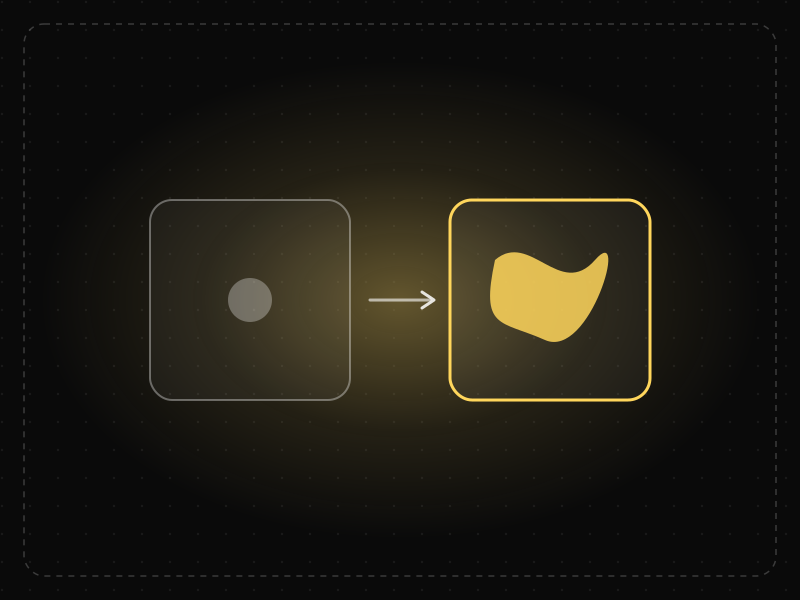
See it in action
The same screen without and with Tesler's Law. Watch both sides play out, then compare the outcome.
The complexity is still there — it's just been handed to every single user.
Detecting and formatting automatically moves the irreducible complexity to the people who build the product.
What to watch: the two meters trade places — complexity doesn't vanish, it moves.
Absorb inherent complexity in the system: detection, defaults, formatting, sensible automation.
Oversimplify by hiding controls experts genuinely need.
Key takeaways
- Decide deliberately who handles complexity: the system or the user.
- Use smart defaults, automation and good engineering to carry the load.
- Over-simplifying can push complexity into confusing edge cases.
Quick facts
- Also known as
- Law of Conservation of Complexity
- Described by
- Larry Tesler
- Year
- 1980s
- Category
- Product strategy
- Related laws
- Occam's Razor, Postel's Law, Cognitive Load
Tesler's Law explained
Tesler's Law, also called the law of conservation of complexity, states that every system has a certain amount of complexity that cannot be removed. The only question is who deals with it: the user or the system.
Designers can move complexity away from users by building smarter systems: automatic defaults, intelligent formatting, sensible assumptions. This requires more effort from engineering and design, but saves effort for every user.
The law warns against oversimplifying: removing visible complexity without handling it elsewhere just pushes the problem back onto users in a different form.
Where it comes from
Attributed to computer scientist Larry Tesler, known for his interaction design work at Xerox PARC and Apple, who argued that an engineer should spend extra time reducing complexity so that millions of users don't each have to deal with it.
How it shows up in apps
Taxes, scheduling, permissions and payments are inherently complex. The best apps handle that complexity behind the scenes so the user sees a short, clear flow.
Tesler's Law examples
An expense app reads receipt photos and fills in amount, date and merchant itself, instead of asking the user to type them.
Email address autocomplete
Email clients remember and suggest contacts, absorbing the complexity of recalling exact addresses.
Tax software
Tax apps ask plain questions and handle the complex rules behind the scenes, so users never see the underlying forms.
Automatic currency and timezone
Travel and scheduling apps detect location and show prices and times in local formats, removing conversions from the user's work.
How to apply Tesler's Law
- Identify the irreducible complexity in each task and decide who should handle it.
- Let the system do the work: defaults, autofill, detection and calculations.
- Expose complexity only to users who need control, through advanced settings.
- Invest engineering effort in absorbing complexity in high-traffic flows.
- Test whether simplifications actually reduce user effort or just hide it.
Want Tesler's Law checked in your own product? Our saas ux audit evaluates it alongside the other principles that shape how users decide, onboard and stay.
Common mistakes
- Oversimplifying an interface so that users lose necessary control.
- Pushing complexity onto users because it is easier to build.
- Hiding complexity in ways that make errors harder to understand and fix.
How to measure it
Measure user effort (steps, inputs, time and errors) for key tasks before and after moving complexity into the system. Support tickets about a feature often reveal complexity that has been pushed to users.
Frequently asked questions
What is Tesler's Law?
Every system has a certain amount of complexity that can't be removed — only moved — so the product should absorb it instead of passing it to users.
Where does Tesler's Law come from?
Attributed to computer scientist Larry Tesler, known for his interaction design work at Xerox PARC and Apple, who argued that an engineer should spend extra time reducing complexity so that millions of users don't each have to deal with it.
How does Tesler's Law apply to app design?
Taxes, scheduling, permissions and payments are inherently complex. The best apps handle that complexity behind the scenes so the user sees a short, clear flow.
Who was Larry Tesler?
Larry Tesler was a computer scientist who worked at Xerox PARC and Apple. He is known for championing modeless interfaces and for popularising cut, copy and paste.
What does conservation of complexity mean?
It means complexity cannot be eliminated, only moved. Good design moves it from users to the system wherever possible.
How do you measure Tesler's Law in a product?
Measure user effort (steps, inputs, time and errors) for key tasks before and after moving complexity into the system. Support tickets about a feature often reveal complexity that has been pushed to users.
Sources
- Saffer, D. (2009). Designing for Interaction (2nd ed.), including an interview with Larry Tesler. New Riders. Find on Google Scholar ↗
Related laws
 Product strategy
Occam's Razor
Among solutions that work equally well, prefer the one with the fewest assumptions and parts — in design, the simplest option that does the job.
 Interaction & speed
Postel's Law
Be liberal in what you accept and conservative in what you send: accept messy user input gracefully, and respond in clear, consistent ways.
 Memory & attention
Cognitive Load
Cognitive load is the amount of mental effort needed to understand and use an interface; when it exceeds what people can handle, they slow down, make mistakes or give up.
Tesler's Law in practice
- Design historyiPhone evolution: every iPhone from 2007 to 2026, and the design decisions that shaped itiPhone evolution from the 3.5-inch original (2007) to the foldable iPhone Duo (2026): every model, the design change it made and why Apple made it.
- Product management25 best books for product managers — what each teaches and who should read itThe 25 best books for product managers, grouped by skill — discovery, strategy, metrics, design, psychology, interviews and leadership — with what each teaches.
- Making moneyApp monetization strategies that don't annoy users — designed with behavioural scienceMonetize your app without wrecking retention: value-first paywalls, honest trials, rewarded ads, anchoring and decoy pricing done ethically, and what to avoid.
- Everyday design scienceWhy the human body is shaped the way it is: the design logic behind every partWhy is every body part shaped the way it is? Domes protect, tubes carry, folds add surface, levers move. The design logic of 164 parts, and which can be moved.
- Design historyWindows evolution: how every version from Windows 1.0 to Windows 11 was designed, and what testing changedWindows evolution from tiled Windows 1.0 (1985) to Windows 11: the Start button, XP's Bliss, Windows 8's missing Start and the tests behind each change.
- Everyday design scienceWho invented infinite scroll? Aza Raskin built it in 2006, and has spent years warning about itAza Raskin invented infinite scroll in 2006 to save clicks, and now regrets it. How it works on the brain, what research shows and how regulators are acting.
Certifications that test it
- Free certification · UX/UI, Design, Research & CreativeProduct Design CertificationCertifies end-to-end product design: framing problems against business goals, designing and shipping solutions with engineering, and measuring their impact.
- Free certification · UX/UI, Design, Research & CreativeDesign Systems CertificationCertifies that you can build, document, govern and scale a design system — tokens, components, documentation, adoption and design–engineering collaboration.
- Free certification · AI & Generative AIAI UX Design CertificationCertifies that you can design AI-powered products people trust — setting expectations, conversational and agent UX, handling errors and uncertainty, and responsible AI.
- Free certification · Product, Project Management & Business AnalysisDesign Leadership CertificationCertifies that you can lead design — build and grow teams, set design strategy, run design operations, measure design's impact and influence the business.
- Free certification · UX/UI, Design, Research & CreativeService Design CertificationCertifies that you can design services end to end — customer journeys, service blueprints, research and co-design, and delivery and measurement across channels.




Get the ideas, not the noise.
Sign up with Google and we’ll send you short UX psychology tips by email — why people tap, stall and leave, and what to do about it. Unsubscribe anytime. Prefer something to keep? Get the free Laws of UX guide as a PDF.