App Store Optimization (ASO) Certification
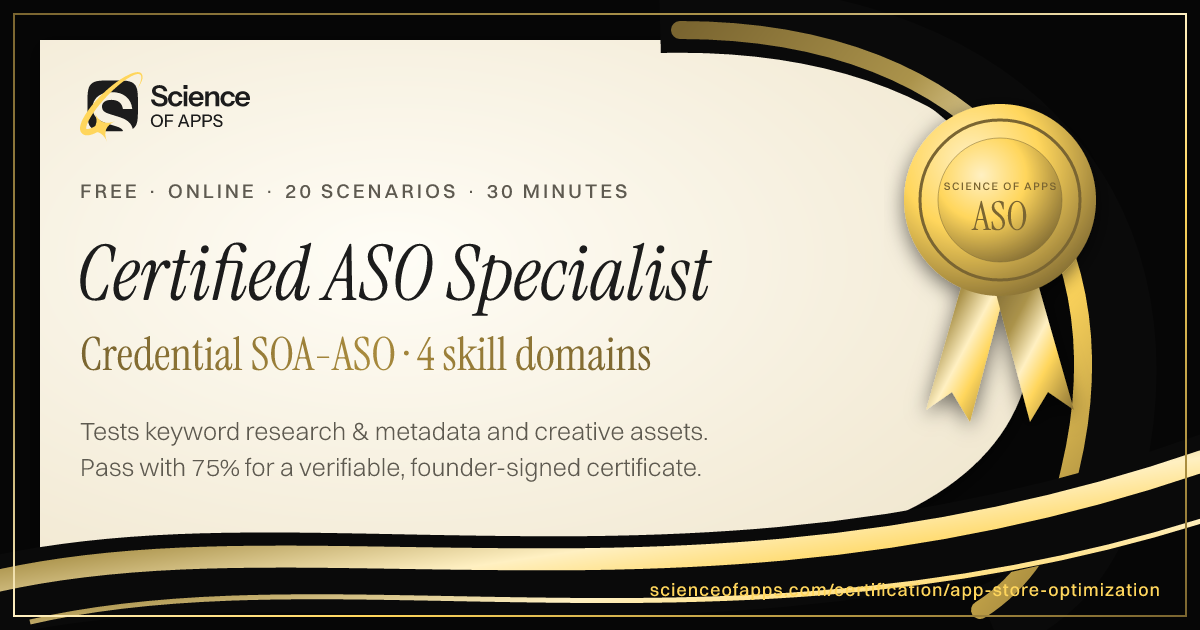
Earn the credential Certified ASO Specialist SOA-ASO. It certifies that you can grow app installs organically — keyword research and metadata, store creative, ratings and reviews, and store experiments, localisation and in-app events on the App Store and Google Play.
- Intermediate difficulty.Assumes hands-on experience in the role.
- 20 scenario questions
- 30 minutes, timed
- 75% to pass · 90% for distinction
- Free no sign-up needed
- LinkedIn-ready · add it to your profile in one clickSee how ↓

 Founder, Science of Apps
What is the App Store Optimization (ASO) Certification?
The App Store Optimization (ASO) Certification is a free, test-based credential from Science of Apps. It certifies that you can grow app installs organically — keyword research and metadata, store creative, ratings and reviews, and store experiments, localisation and in-app events on the App Store and Google Play. Pass the 20-question, 30-minute test with 75% or more to become a Certified ASO Specialist (SOA-ASO). Every question is based on published standards and research — including App Store search (Apple App Store), Creating your product page (Apple App Store), Ratings, reviews and responses (Apple App Store) — and each answer is explained with its source.
Built for your job title
App marketers, ASO specialists, growth managers, product managers and indie developers who want more installs without more ad spend.
- ASO Specialist
- App Marketing Manager
- Mobile Growth Manager
- User Acquisition Manager
- Product Marketing Manager
- Indie App Developer
Land the job, not just the certificate
Career guide · 8 min readHow to get an app store optimization job in 2027: keywords, store listings, creative testing, ratings and the metrics mobile growth teams hire for
How to get an ASO specialist job in 2027: App Store and Google Play keywords, listings, creative tests, ratings, metrics, pay and a 5-week plan.
Read the hiring playbook →What the test covers
Four domains with 5 questions each, drawn from a bank of 10 per domain, so a retake brings questions you haven't seen. Every domain links to the free Laws of UX guides its questions draw on.
- 01
Keyword research & metadata
25%- Use the App Store keyword field and name limits
- Write Google Play descriptions for search
- Target relevant long-tail keywords
Study: Serial Position Effect
- 02
Creative assets
25%- Design screenshots that sell the core value
- Make previews work without sound
- Design icons that read at small sizes
Study: Von Restorff Effect, Aesthetic-Usability Effect, F-Shaped Pattern
- 03
Ratings, reviews & conversion
25%- Ask for ratings at the right moment
- Respond to reviews
- Diagnose impression-to-install conversion
Study: Social Proof, Peak-End Rule
- 04
Experiments, localisation & events
25%- Run product page optimization and Play experiments
- Localise for real local searches
- Use in-app events and custom product pages
Study: Framing Effect
Science of Apps is not affiliated with Apple or Google. App Store is a trademark of Apple Inc.; Google Play is a trademark of Google LLC.
Based on published standards
The questions are original scenarios, and each one names the public standard, official guide or research it draws on — shown under the question while you answer, and linked in your review. These are the sources behind this certification:
- App Store searchApple App Store10 questions
- Creating your product pageApple App Store7 questions
- Ratings, reviews and responsesApple App Store5 questions
- Store listing best practicesAndroid Developers4 questions
- Store listing experimentsGoogle Play Console Help4 questions
- Localize app informationApp Store Connect Help3 questions
- App Review GuidelinesApple2 questions
- Human Interface GuidelinesApple1 question
- Custom product pagesApple App Store1 question
- Product page optimizationApple App Store1 question
- In-app eventsApple App Store1 question
- Custom store listingsGoogle Play Console Help1 question
Try a sample question
Your app's subtitle is "The best app ever made". What's a better use of those 30 characters?
- A list of emojis
- The same words as the app name
- A clear benefit with a key search term, such as "Budget planner & bill tracker"
- Your company's legal name
Show the answer
C. A clear benefit with a key search term, such as "Budget planner & bill tracker" — The subtitle is indexed for search and shown in results. A specific benefit with a relevant keyword helps both ranking and conversion. The real test has 20 questions like this.
How the test works
30 minutes, 20 scenarios
One question per screen, with a progress bar and a countdown. Your progress is saved on this device if you need to pause.
Graded on our server
Answers reach the page only after you submit, so the certificate can only be earned by passing.
Every answer explained
Pass or not, you see every question with the right answer, why, and the source behind it. Pass mark 75%, distinction 90%.
Your certificate
Founder-signed, with a QR code and credential ID. Download PDF or PNG, add to LinkedIn, and it's emailed to you.
What you earn
Pass, then add it to LinkedIn in one click
No typing. The Add to LinkedIn button opens your profile’s Licenses & certifications form already filled in: the certificate name, Science of Apps as the issuer, the issue date, your credential ID and a link recruiters can use to verify it.
- 1Take the 30-minute test
- 2Score 75% or more
- 3Click Add to LinkedIn

Certified ASO Specialist
Science of Apps
Show credential ↗Add a specialism
- SpecialistSOA-CRO
Conversion Rate Optimization (CRO) Certification
Certifies that you can find and fix conversion leaks with evidence — funnel analysis, research, hypothesis design, A/B testing and landing-page and checkout UX.
Difficulty: AdvancedEarn Certified CRO & Growth Designer → - ProfessionalSOA-GM
Growth Marketing Certification
Certifies that you can grow a product sustainably — acquisition channels and unit economics, lifecycle and retention marketing, growth loops and virality, and experiments and attribution.
Difficulty: IntermediateEarn Certified Growth Marketer → - 10 minSOA-DMF
Digital Marketing Fundamentals Certification
Tests the foundations of digital marketing — the funnel, channels (search, social, email, paid), audiences and targeting, content, measurement and budgets.
Difficulty: BeginnerTake the 10-minute test →
Frequently asked questions
What is the App Store Optimization (ASO) Certification?
The App Store Optimization (ASO) Certification is a free, test-based credential from Science of Apps. It certifies that you can grow app installs organically — keyword research and metadata, store creative, ratings and reviews, and store experiments, localisation and in-app events on the App Store and Google Play. Pass the 20-question, 30-minute test with 75% or more to become a Certified ASO Specialist (SOA-ASO). Every question is based on published standards and research — including App Store search (Apple App Store), Creating your product page (Apple App Store), Ratings, reviews and responses (Apple App Store) — and each answer is explained with its source.
How do I get a App Store Optimization certification for free?
Read the four skill domains on this page, study the free guides and sources linked to each, then take the 30-minute test online. There is no fee, course or sign-up. Score 75% or more and you get a Certified ASO Specialist certificate straight away — on screen, as a PDF and by email — with a credential ID anyone can verify.
Are the App Store Optimization (ASO) Certification questions based on real standards?
Yes. The questions are original scenarios written by Science of Apps, and each one is based on a public source you can read: App Store search (Apple App Store); Creating your product page (Apple App Store); Ratings, reviews and responses (Apple App Store); Store listing best practices (Android Developers); Store listing experiments (Google Play Console Help); Localize app information (App Store Connect Help). The source is shown under each question and linked in the answer review. Science of Apps doesn't copy questions from other tests.
What is app store optimization (ASO)?
App store optimization is the work of improving an app's visibility and conversion in the App Store and Google Play — choosing keywords and metadata, designing icons, screenshots and previews, managing ratings and reviews, and testing and localising store listings — to grow organic installs.
Can I take the App Store Optimization (ASO) Certification from any country?
Yes. The certification is online, in English and free everywhere — people take it from India, the US, the UK, Europe, Africa, Latin America and Asia-Pacific. Your certificate is dated with your own local date and can be verified from anywhere at scienceofapps.com/certification/verify/.
Will the App Store Optimization (ASO) Certification help me get a job?
It helps you stand out: it shows employers, in a form they can check, that you can apply keyword research & metadata and creative assets to real product scenarios. Add it to LinkedIn and your CV, and back it with portfolio work that shows the same skills — certifications open conversations, portfolios close them.
How hard is the App Store Optimization (ASO) Certification?
We rate it Intermediate: assumes hands-on experience in the role. It has 20 scenario questions — 5 from each of 4 domains — and a 30-minute limit. You need 75% (15 of 20) to pass and 90% for distinction.
How do I prepare for a ASO Specialist job?
To get an ASO job in 2027, show you can grow installs from the App Store and Google Play: keyword research within each store's metadata rules, listings and screenshots that convert, store experiments, ratings and review management, and clear reporting on impressions, conversion and installs. Search drives most App Store downloads. Optimise one real app and verify the skill with a free test. Our full career guide covers the hiring process, interview loop, pay and a prep plan: scienceofapps.com/blog/app-store-optimization-career-guide/
How much do Science of Apps certifications cost?
Nothing. There is no fee to take a test, to receive the certificate, to have it emailed or to verify it, and no sign-up.
How are the tests graded?
On our server, not in your browser. The answers never reach the page until you submit, so a certificate can only be earned by passing. Each certificate gets a unique credential ID stored by Science of Apps.
What happens if I don't pass?
You see your score for each area and every question with the correct answer and why, with the published source behind it. You can retake after 30 minutes, and the retake draws questions you haven't seen yet.
Do the certificates expire?
No. Every certificate is dated, so it always shows when you passed. Retake a test any time for a newer date or a higher score.
Can I add the certificate to LinkedIn?
Yes. After you pass, Add to LinkedIn opens the Licenses & certifications form with the certificate name, Science of Apps as the issuer, the issue date, your credential ID and the verification link filled in. You can also download it as a PDF or PNG, and it's emailed to you as a PDF.
How can an employer verify my certificate?
Every certificate has a credential ID and a QR code. Scanning it, or entering the ID at scienceofapps.com/certification/verify/, shows the holder's name, the certification, the score and the issue date from our records.
Are these accredited qualifications?
No. They are Science of Apps' own assessments of applied skill. They aren't issued by a university or standards body, and they work best alongside a portfolio that shows the skills in real work.
621 more certifications to collect
Digital Marketing, SEO, AEO & Growth
- Conversion Rate Optimization (CRO) Certification30 min · Advanced
- App Store Optimization (ASO) CertificationYou're here
- Growth Marketing Certification30 min · Intermediate
- Digital Marketing Fundamentals Certification10 min · Beginner
- Search Engine Optimization (SEO) Certification10 min · Beginner
- Technical SEO Certification20 min · Advanced
- On-Page SEO Certification10 min · Beginner
- Off-Page SEO and Link Earning Certification15 min · Intermediate
- Local SEO Certification10 min · Beginner
- E-commerce SEO Certification15 min · Intermediate
- International SEO Certification20 min · Advanced
- SEO Auditing and Troubleshooting Certification20 min · Advanced
- Answer Engine Optimization (AEO) Certification15 min · Intermediate
- Generative Engine Optimization (GEO) Certification15 min · Intermediate
- AI Search Visibility and Citation Readiness15 min · Intermediate
- Structured Data and Schema Markup Certification15 min · Intermediate
- Keyword Research and Search Intent Certification10 min · Beginner
- Content Strategy and Topic Clusters Certification15 min · Intermediate
- AI-Assisted Content Operations Certification15 min · Intermediate
- Content Quality and Editorial Fact-Checking Certification15 min · Intermediate
- Programmatic SEO Strategy Certification20 min · Advanced
- Search Analytics and Google Search Console Certification15 min · Intermediate
- Google Analytics 4 Fundamentals Certification10 min · Beginner
- Google Ads and Paid Search Fundamentals Certification10 min · Beginner
- Paid Social Advertising Certification10 min · Beginner
- Meta Ads Campaign Optimization Certification15 min · Intermediate
- Social Media Marketing Certification10 min · Beginner
- Influencer Marketing Certification10 min · Beginner
- Email Marketing and Automation Certification10 min · Beginner
- Lifecycle Marketing and Retention Certification15 min · Intermediate
- Affiliate Marketing Certification10 min · Beginner
- Marketing Attribution and Measurement Certification20 min · Advanced
- Growth Experimentation Certification15 min · Intermediate
- Brand Strategy and Positioning Certification15 min · Intermediate
- Copywriting and Conversion Copywriting Certification10 min · Beginner
- Content Distribution and Repurposing Certification10 min · Beginner
- YouTube SEO and Channel Growth Certification10 min · Beginner
- Market Research Certification15 min · Intermediate
- E-commerce Analytics Certification15 min · Intermediate
Foundation
AI & Generative AI
- AI UX Design Certification30 min · Advanced
- Prompt Engineering Certification30 min · Intermediate
- AI Product Manager Certification30 min · Advanced
Software Engineering & Web Development
- HTML and CSS Fundamentals Certification10 min · Beginner
- JavaScript Fundamentals Certification10 min · Beginner
- TypeScript Fundamentals Certification15 min · Intermediate
Data Analytics & Business Intelligence
- Product Analytics Certification30 min · Advanced
- Data Literacy Certification10 min · Beginner
- Microsoft Excel Fundamentals Certification10 min · Beginner
UX/UI, Design, Research & Creative
- UX Design Certification30 min · Intermediate
- UI Design Certification30 min · Intermediate
- Product Design Certification30 min · Intermediate
Product, Project Management & Business Analysis
- Product Manager Certification30 min · Intermediate
- Design Leadership Certification30 min · Advanced
- Agile Product Owner Certification30 min · Intermediate
Cybersecurity, IT, Cloud & DevOps
- Cybersecurity Fundamentals Certification10 min · Beginner
- Security Awareness and Phishing Detection Certification10 min · Beginner
- Network Security Fundamentals Certification15 min · Intermediate
Sales, Customer Success & Support
- Sales Fundamentals Certification10 min · Beginner
- Consultative Selling Certification15 min · Intermediate
- B2B Sales Development Representative Certification10 min · Beginner
Human Resources & People Management
- Human Resources Fundamentals Certification10 min · Beginner
- Talent Acquisition and Recruitment Certification10 min · Beginner
- Technical Recruitment Certification15 min · Intermediate
Finance, Accounting, Operations & Entrepreneurship
- Financial Literacy for Professionals Certification10 min · Beginner
- Accounting Fundamentals Certification10 min · Beginner
- Bookkeeping Fundamentals Certification10 min · Beginner
Communication, Leadership & Transferable Skills
- Critical Thinking Test10 min · Beginner
- Attention to Detail Test10 min · Beginner
- Cognitive Bias Test10 min · Beginner
Languages
- English Level Test30 min · Beginner
- American Sign Language (ASL) Foundations Test25 min · Intermediate
- App & Software Localization Test25 min · Intermediate
Healthcare, Education, Legal Operations & Sustainability
- Healthcare Administration Fundamentals Certification10 min · Beginner
- Medical Office Administration Certification10 min · Beginner
- Healthcare Data Privacy Awareness Certification10 min · Beginner
Test Prep, Academics & Aptitude
- SAT Math Practice Test20 min · Advanced
- SAT Reading and Writing Practice Test20 min · Advanced
- ACT Practice Test (English, Math, Reading & Science)20 min · Advanced
Language Exam Prep
- IELTS Academic Practice Test with Band Score20 min · Advanced
- IELTS General Training Practice Test20 min · Advanced
- TOEFL iBT Practice Test20 min · Advanced
Office & Productivity Software
- Microsoft Word Skills Certification15 min · Intermediate
- Microsoft PowerPoint Skills Certification15 min · Intermediate
- Microsoft Outlook Skills Certification10 min · Beginner
Engineering, Architecture, Construction & Safety
- Mechanical Engineering Practice Test (FE-Style)20 min · Advanced
- Electrical Engineering Practice Test (FE-Style)20 min · Advanced
- Civil Engineering Practice Test (FE-Style)20 min · Advanced
Hospitality, Travel & Retail
- Hospitality Management Certification10 min · Beginner
- Food Safety Certification10 min · Beginner
- Hotel Revenue Management Certification15 min · Intermediate
Read before you test
- Career guidesHow to get an app store optimization job in 2027: keywords, store listings, creative testing, ratings and the metrics mobile growth teams hire forHow to get an ASO specialist job in 2027: App Store and Google Play keywords, listings, creative tests, ratings, metrics, pay and a 5-week plan.
- App marketing & ASOApp store optimization (ASO): the complete guide for the App Store and Google PlayA complete ASO guide for 2027: keyword research, titles, Apple's keyword field, descriptions, screenshots, ratings, localisation and testing.
- App marketing & ASOHow to rank your app on the Play Store: what Google rewards in 2027How to rank an app on Google Play: keywords across the listing, conversion assets, ratings, Android vitals, retention and listing experiments.
- App marketing & ASOHow to get app reviews and ratings legitimately — timing, prompts and repliesHow to get more app reviews legitimately: ask at the right moment with the official in-app prompts, reply to reviews, fix what users report.
- App marketing & ASOApp description examples: how to write a store description that convertsHow to write an app store description that converts: a proven structure, example openings, keyword use on Google Play, formatting and pitfalls.
- App marketing & ASOApp marketing strategy: a launch-to-scale playbook for 2027An app marketing strategy in four stages — pre-launch, launch, traction and scale — with the channels, budgets, metrics and gates to move between stages.
Get the ideas, not the noise.
Sign up with Google and we’ll send you short UX psychology tips by email — why people tap, stall and leave, and what to do about it. Unsubscribe anytime. Prefer something to keep? Get the free Laws of UX guide as a PDF.