UX Design Certification
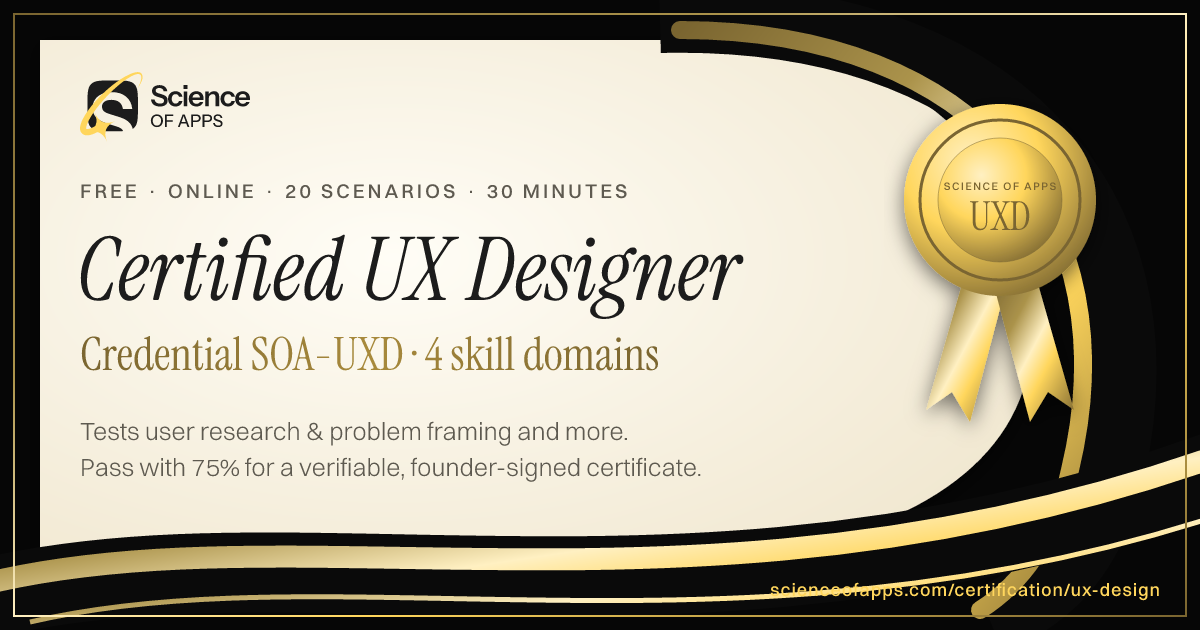
Earn the credential Certified UX Designer SOA-UXD. It certifies that you can take a product problem from user need to a tested, usable flow — research, information architecture, interaction design and usability evaluation.
- Intermediate difficulty.Assumes hands-on experience in the role.
- 20 scenario questions
- 30 minutes, timed
- 75% to pass · 90% for distinction
- Free no sign-up needed
- LinkedIn-ready · add it to your profile in one clickSee how ↓

 Founder, Science of Apps
What is the UX Design Certification?
The UX Design Certification is a free, test-based credential from Science of Apps. It certifies that you can take a product problem from user need to a tested, usable flow — research, information architecture, interaction design and usability evaluation. Pass the 20-question, 30-minute test with 75% or more to become a Certified UX Designer (SOA-UXD). Every question is based on published standards and research — including Design Thinking 101 (Nielsen Norman Group), Service Manual: User research (GOV.UK), Progressive Disclosure (Nielsen Norman Group) — and each answer is explained with its source.
Built for your job title
UX designers, UX/UI designers and career-switchers who want proof of practical UX skill, not just course completion.
- UX Designer
- UX/UI Designer
- User Experience Designer
- Experience Designer
- Junior UX Designer
- Senior UX Designer
- Usability Analyst
Land the job, not just the certificate
Career guide · 17 min readHow to get a UX designer job in 2027: the hiring playbook, from the other side of the desk
How to get a UX designer job in 2027: what recruiters screen for, the interview loop, a portfolio that survives a 30-second look, pay and a 12-week plan.
Read the hiring playbook →What the test covers
Four domains with 5 questions each, drawn from a bank of 10 per domain, so a retake brings questions you haven't seen. Every domain links to the free Laws of UX guides its questions draw on.
- 01
User research & problem framing
25%- Turn a vague brief into a testable problem statement
- Pick the right research method for the question
- Synthesize findings into personas, jobs and journeys
Study: Mental Model, Jakob's Law, Paradox of the Active User
- 02
Information architecture & flows
25%- Structure navigation from users' mental models
- Use card sorting and tree testing
- Design task flows with the fewest decisions
Study: Hick's Law, Chunking, Progressive Disclosure, Recognition over Recall
- 03
Interaction design & usability
25%- Apply usability heuristics to real screens
- Design feedback, errors and empty states
- Size and place targets for touch and pointer
Study: Fitts's Law, Doherty Threshold, Postel's Law, Affordances & Signifiers
- 04
Testing & iteration
25%- Run moderated and unmoderated usability tests
- Prioritize issues by severity and frequency
- Measure success with task and outcome metrics
Study: Peak-End Rule, Cognitive Load, Pareto Principle
Based on published standards
The questions are original scenarios, and each one names the public standard, official guide or research it draws on — shown under the question while you answer, and linked in your review. These are the sources behind this certification:
- Design Thinking 101Nielsen Norman Group3 questions
- Service Manual: User researchGOV.UK2 questions
- Progressive DisclosureNielsen Norman Group2 questions
- Tree TestingNielsen Norman Group2 questions
- Laws of UXJon Yablonski2 questions
- Progress Indicators Make a Slow System Less InsufferableNielsen Norman Group2 questions
- Website Forms Usability: Top 10 RecommendationsNielsen Norman Group2 questions
- Severity Ratings for Usability ProblemsNielsen Norman Group2 questions
- Measuring the User Experience on a Large Scale (HEART framework)Google Research2 questions
- 10 Usability Heuristics for User Interface DesignNielsen Norman Group2 questions
- Mental ModelsNielsen Norman Group1 question
- Card Sorting: Uncover Users' Mental ModelsNielsen Norman Group1 question
- Mobile-App OnboardingNielsen Norman Group1 question
- Memory Recognition and Recall in User InterfacesNielsen Norman Group1 question
- Error-Message GuidelinesNielsen Norman Group1 question
- Why You Only Need to Test with 5 UsersNielsen Norman Group1 question
- Thinking Aloud: The #1 Usability ToolNielsen Norman Group1 question
- ISO 9241-11: Usability — definitions and conceptsISO1 question
- The Peak–End RuleNielsen Norman Group1 question
- Know Your Customers' “Jobs to Be Done”Harvard Business Review (Clayton Christensen et al.)1 question
- When to Use Which User-Experience Research MethodsNielsen Norman Group1 question
- Journey Mapping 101Nielsen Norman Group1 question
- Hamburger Menus and Hidden NavigationNielsen Norman Group1 question
- UX Mapping Methods ComparedNielsen Norman Group1 question
- Skeleton Screens 101Nielsen Norman Group1 question
- Maintain Consistency and Adhere to StandardsNielsen Norman Group1 question
- Pilot Testing: Getting It Right (Before) the First TimeNielsen Norman Group1 question
- Usability Testing 101Nielsen Norman Group1 question
Try a sample question
A food-delivery app's address form fails 1 in 5 orders because people type flat numbers in the wrong field. What do you do first?
- Watch five customers enter their address and see where they hesitate
- Add a red asterisk to every required field
- Move the form to a later step of checkout
- Add a help article about address formats
Show the answer
A. Watch five customers enter their address and see where they hesitate — Observe the behaviour before changing the design. A few usability sessions show which field confuses people and why, so the fix targets the real problem. The real test has 20 questions like this.
How the test works
30 minutes, 20 scenarios
One question per screen, with a progress bar and a countdown. Your progress is saved on this device if you need to pause.
Graded on our server
Answers reach the page only after you submit, so the certificate can only be earned by passing.
Every answer explained
Pass or not, you see every question with the right answer, why, and the source behind it. Pass mark 75%, distinction 90%.
Your certificate
Founder-signed, with a QR code and credential ID. Download PDF or PNG, add to LinkedIn, and it's emailed to you.
What you earn
Pass, then add it to LinkedIn in one click
No typing. The Add to LinkedIn button opens your profile’s Licenses & certifications form already filled in: the certificate name, Science of Apps as the issuer, the issue date, your credential ID and a link recruiters can use to verify it.
- 1Take the 30-minute test
- 2Score 75% or more
- 3Click Add to LinkedIn

Certified UX Designer
Science of Apps
Show credential ↗Add a specialism
- ProfessionalSOA-UID
UI Design Certification
Certifies that you can design clear, consistent, accessible interfaces — visual hierarchy, typography, colour, layout, components and interaction states.
Difficulty: IntermediateEarn Certified UI Designer → - ProfessionalSOA-PD
Product Design Certification
Certifies end-to-end product design: framing problems against business goals, designing and shipping solutions with engineering, and measuring their impact.
Difficulty: IntermediateEarn Certified Product Designer → - ProfessionalSOA-UXR
UX Research Certification
Certifies that you can plan, run and synthesize user research that changes decisions — method choice, recruiting, interviewing, usability testing, surveys and analysis.
Difficulty: IntermediateEarn Certified UX Researcher →
See every UX/UI & design certification and test → New to the laws of UX? Start with Product Design Science →
Frequently asked questions
What is the UX Design Certification?
The UX Design Certification is a free, test-based credential from Science of Apps. It certifies that you can take a product problem from user need to a tested, usable flow — research, information architecture, interaction design and usability evaluation. Pass the 20-question, 30-minute test with 75% or more to become a Certified UX Designer (SOA-UXD). Every question is based on published standards and research — including Design Thinking 101 (Nielsen Norman Group), Service Manual: User research (GOV.UK), Progressive Disclosure (Nielsen Norman Group) — and each answer is explained with its source.
How do I get a UX Design certification for free?
Read the four skill domains on this page, study the free guides and sources linked to each, then take the 30-minute test online. There is no fee, course or sign-up. Score 75% or more and you get a Certified UX Designer certificate straight away — on screen, as a PDF and by email — with a credential ID anyone can verify.
Are the UX Design Certification questions based on real standards?
Yes. The questions are original scenarios written by Science of Apps, and each one is based on a public source you can read: Design Thinking 101 (Nielsen Norman Group); Service Manual: User research (GOV.UK); Progressive Disclosure (Nielsen Norman Group); Tree Testing (Nielsen Norman Group); Laws of UX (Jon Yablonski); Progress Indicators Make a Slow System Less Insufferable (Nielsen Norman Group). The source is shown under each question and linked in the answer review. Science of Apps doesn't copy questions from other tests.
Is a UX design certification worth it?
A UX certification is worth it when it proves skill rather than attendance. Hiring managers look at portfolios first; a test-based credential with a public verification link adds independent proof that you can apply research, IA, interaction design and usability testing to real scenarios.
Can a beginner pass the UX Design Certification?
Beginners who have completed a structured UX course and at least one end-to-end project usually can. The test is scenario-based, so people who have practised research, flows and usability testing on a real problem find it easier than people who have only read about them.
Can I take the UX Design Certification from any country?
Yes. The certification is online, in English and free everywhere — people take it from India, the US, the UK, Europe, Africa, Latin America and Asia-Pacific. Your certificate is dated with your own local date and can be verified from anywhere at scienceofapps.com/certification/verify/.
Will the UX Design Certification help me get a job?
It helps you stand out: it shows employers, in a form they can check, that you can apply user research & problem framing and information architecture & flows to real product scenarios. Add it to LinkedIn and your CV, and back it with portfolio work that shows the same skills — certifications open conversations, portfolios close them.
How hard is the UX Design Certification?
We rate it Intermediate: assumes hands-on experience in the role. It has 20 scenario questions — 5 from each of 4 domains — and a 30-minute limit. You need 75% (15 of 20) to pass and 90% for distinction.
How do I prepare for a UX Designer job?
To get a UX designer job in 2027, show proof, not promises: two or three case studies that start with a real user problem and end with a measured result, a résumé that mirrors the job's wording, and a rehearsed portfolio presentation. Junior roles are scarce, so target product companies and global capability centres, use referrals, and back your skills with a credential employers can verify. Our full career guide covers the hiring process, interview loop, pay and a prep plan: scienceofapps.com/blog/how-to-get-a-ux-designer-job/
How much do Science of Apps certifications cost?
Nothing. There is no fee to take a test, to receive the certificate, to have it emailed or to verify it, and no sign-up.
How are the tests graded?
On our server, not in your browser. The answers never reach the page until you submit, so a certificate can only be earned by passing. Each certificate gets a unique credential ID stored by Science of Apps.
What happens if I don't pass?
You see your score for each area and every question with the correct answer and why, with the published source behind it. You can retake after 30 minutes, and the retake draws questions you haven't seen yet.
Do the certificates expire?
No. Every certificate is dated, so it always shows when you passed. Retake a test any time for a newer date or a higher score.
Can I add the certificate to LinkedIn?
Yes. After you pass, Add to LinkedIn opens the Licenses & certifications form with the certificate name, Science of Apps as the issuer, the issue date, your credential ID and the verification link filled in. You can also download it as a PDF or PNG, and it's emailed to you as a PDF.
How can an employer verify my certificate?
Every certificate has a credential ID and a QR code. Scanning it, or entering the ID at scienceofapps.com/certification/verify/, shows the holder's name, the certification, the score and the issue date from our records.
Are these accredited qualifications?
No. They are Science of Apps' own assessments of applied skill. They aren't issued by a university or standards body, and they work best alongside a portfolio that shows the skills in real work.
621 more certifications to collect
UX/UI, Design, Research & Creative
- UX Design CertificationYou're here
- UI Design Certification30 min · Intermediate
- Product Design Certification30 min · Intermediate
- UX Research Certification30 min · Intermediate
- UX Writing & Content Design Certification30 min · Intermediate
- Accessibility Certification (WCAG)30 min · Advanced
- Design Systems Certification30 min · Advanced
- Behavioral Design Certification30 min · Intermediate
- Figma Certification30 min · Intermediate
- Mobile App Design Certification30 min · Intermediate
- Interaction Design Certification30 min · Intermediate
- Usability Testing Certification30 min · Intermediate
- Information Architecture Certification30 min · Intermediate
- Service Design Certification30 min · Advanced
- UX Psychology Quiz10 min · Beginner
- UX Designer Interview Test15 min · Intermediate
- UX/UI Design Fundamentals Certification10 min · Beginner
- Design Thinking and Problem Framing Certification10 min · Beginner
- Design Critique and Visual Judgment Certification15 min · Intermediate
- UX Portfolio Assessment15 min · Intermediate
- UX Research Operations Certification20 min · Advanced
- Survey Design and Research Bias Certification15 min · Intermediate
- Usability Metrics and Experiment Design Certification20 min · Advanced
- Responsive Web Design Certification10 min · Beginner
- UX Writing for AI Interfaces Certification15 min · Intermediate
- Conversational and Voice UX Certification15 min · Intermediate
- AI Interface Trust and Transparency Certification15 min · Intermediate
- Product Design QA Certification15 min · Intermediate
- Visual Design Fundamentals Certification10 min · Beginner
- Graphic Design Fundamentals Certification10 min · Beginner
- Typography and Layout Assessment15 min · Intermediate
- Brand Identity Design Certification15 min · Intermediate
- Design Handoff and Developer Collaboration Certification15 min · Intermediate
- Creative Brief and Art Direction Certification15 min · Intermediate
- Adobe Photoshop Certification Practice15 min · Intermediate
- Adobe Illustrator Certification Practice15 min · Intermediate
- Adobe Premiere Pro Certification Practice15 min · Intermediate
- Adobe After Effects Certification Practice15 min · Intermediate
- Blender Certification15 min · Intermediate
- 3D Modeling Certification10 min · Beginner
- Video Editing Certification10 min · Beginner
- Motion Graphics Certification15 min · Intermediate
Foundation
AI & Generative AI
- AI UX Design Certification30 min · Advanced
- Prompt Engineering Certification30 min · Intermediate
- AI Product Manager Certification30 min · Advanced
Software Engineering & Web Development
- HTML and CSS Fundamentals Certification10 min · Beginner
- JavaScript Fundamentals Certification10 min · Beginner
- TypeScript Fundamentals Certification15 min · Intermediate
Data Analytics & Business Intelligence
- Product Analytics Certification30 min · Advanced
- Data Literacy Certification10 min · Beginner
- Microsoft Excel Fundamentals Certification10 min · Beginner
Digital Marketing, SEO, AEO & Growth
- Conversion Rate Optimization (CRO) Certification30 min · Advanced
- App Store Optimization (ASO) Certification30 min · Intermediate
- Growth Marketing Certification30 min · Intermediate
Product, Project Management & Business Analysis
- Product Manager Certification30 min · Intermediate
- Design Leadership Certification30 min · Advanced
- Agile Product Owner Certification30 min · Intermediate
Cybersecurity, IT, Cloud & DevOps
- Cybersecurity Fundamentals Certification10 min · Beginner
- Security Awareness and Phishing Detection Certification10 min · Beginner
- Network Security Fundamentals Certification15 min · Intermediate
Sales, Customer Success & Support
- Sales Fundamentals Certification10 min · Beginner
- Consultative Selling Certification15 min · Intermediate
- B2B Sales Development Representative Certification10 min · Beginner
Human Resources & People Management
- Human Resources Fundamentals Certification10 min · Beginner
- Talent Acquisition and Recruitment Certification10 min · Beginner
- Technical Recruitment Certification15 min · Intermediate
Finance, Accounting, Operations & Entrepreneurship
- Financial Literacy for Professionals Certification10 min · Beginner
- Accounting Fundamentals Certification10 min · Beginner
- Bookkeeping Fundamentals Certification10 min · Beginner
Communication, Leadership & Transferable Skills
- Critical Thinking Test10 min · Beginner
- Attention to Detail Test10 min · Beginner
- Cognitive Bias Test10 min · Beginner
Languages
- English Level Test30 min · Beginner
- American Sign Language (ASL) Foundations Test25 min · Intermediate
- App & Software Localization Test25 min · Intermediate
Healthcare, Education, Legal Operations & Sustainability
- Healthcare Administration Fundamentals Certification10 min · Beginner
- Medical Office Administration Certification10 min · Beginner
- Healthcare Data Privacy Awareness Certification10 min · Beginner
Test Prep, Academics & Aptitude
- SAT Math Practice Test20 min · Advanced
- SAT Reading and Writing Practice Test20 min · Advanced
- ACT Practice Test (English, Math, Reading & Science)20 min · Advanced
Language Exam Prep
- IELTS Academic Practice Test with Band Score20 min · Advanced
- IELTS General Training Practice Test20 min · Advanced
- TOEFL iBT Practice Test20 min · Advanced
Office & Productivity Software
- Microsoft Word Skills Certification15 min · Intermediate
- Microsoft PowerPoint Skills Certification15 min · Intermediate
- Microsoft Outlook Skills Certification10 min · Beginner
Engineering, Architecture, Construction & Safety
- Mechanical Engineering Practice Test (FE-Style)20 min · Advanced
- Electrical Engineering Practice Test (FE-Style)20 min · Advanced
- Civil Engineering Practice Test (FE-Style)20 min · Advanced
Hospitality, Travel & Retail
- Hospitality Management Certification10 min · Beginner
- Food Safety Certification10 min · Beginner
- Hotel Revenue Management Certification15 min · Intermediate
Read before you test
- Career guidesHow to get a product designer job in 2027: problem framing, end-to-end flows, working with PMs and engineers, shipping and measuring outcomesHow to get a product designer job in 2027: problem framing, flows, UI craft, research, working with PMs and engineers, metrics, pay and a plan.
- Career guidesUX/UI design fundamentals in 2027: the beginner skills that get you a first design job — process, research basics, wireframes, hierarchy, heuristics and accessibilityUX/UI design fundamentals for 2027: the beginner skills behind a first design job — process, research, wireframes, hierarchy, heuristics and accessibility.
- Templates & tools50 user interview questions that uncover real problems — grouped by goal, with the questions to avoid50 user interview questions for discovery and usability research, grouped by goal, with a simple script and the leading questions to avoid.
- UI/UX designUX designer salary in India: UI, UX and product designer pay by experience (2027)UI/UX designer salary in India by role and experience — UI designer, UX designer and product designer — from AmbitionBox data updated October 2026.
- UI/UX designOnboarding screen examples: 40 patterns that get users to value faster40 app onboarding examples and patterns — welcome, sign-up, personalisation, permissions, empty states and first success — and why each works.
- Law of UX · Interaction & speedSteering LawThe time it takes to move a pointer through a tunnel or path depends on the path's length and width: long, narrow paths are slow and error-prone.

Get the ideas, not the noise.
Sign up with Google and we’ll send you short UX psychology tips by email — why people tap, stall and leave, and what to do about it. Unsubscribe anytime. Prefer something to keep? Get the free Laws of UX guide as a PDF.