Product Analytics Certification
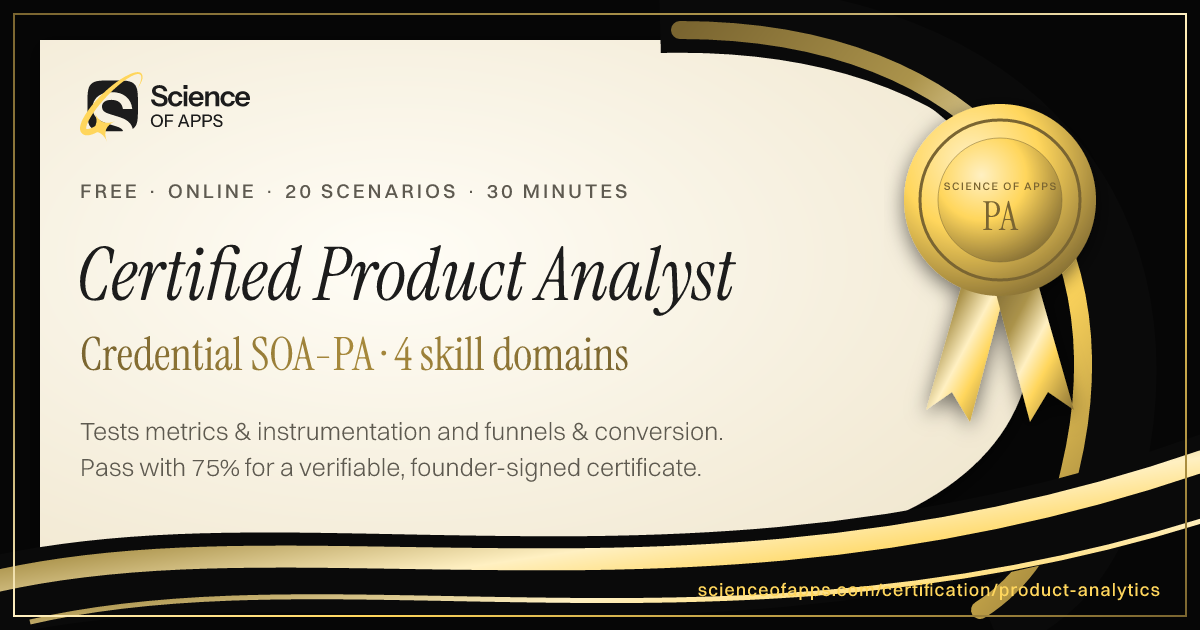
Earn the credential Certified Product Analyst SOA-PA. It certifies that you can turn product data into decisions — metrics and instrumentation, funnels and conversion, retention and cohorts, and A/B testing and statistics.
- Advanced difficulty.Assumes years in the role or deep specialist knowledge.
- 20 scenario questions
- 30 minutes, timed
- 75% to pass · 90% for distinction
- Free no sign-up needed
- LinkedIn-ready · add it to your profile in one clickSee how ↓

 Founder, Science of Apps
What is the Product Analytics Certification?
The Product Analytics Certification is a free, test-based credential from Science of Apps. It certifies that you can turn product data into decisions — metrics and instrumentation, funnels and conversion, retention and cohorts, and A/B testing and statistics. Pass the 20-question, 30-minute test with 75% or more to become a Certified Product Analyst (SOA-PA). Every question is based on published standards and research — including Funnels (PostHog), Retention (PostHog), Trustworthy Online Controlled Experiments (Kohavi, Tang & Xu) — and each answer is explained with its source.
Built for your job title
Product managers, product analysts, growth teams, designers and founders who use tools like PostHog, Amplitude, Mixpanel or Google Analytics.
- Product Analyst
- Product Manager
- Growth Analyst
- Data Analyst
- Growth Product Manager
- UX Analyst
Land the job, not just the certificate
Career guide · 15 min readHow to get a product analyst job in 2027: the metrics, SQL and experiment skills that get you hired
How to get a product analyst job in 2027: what hiring managers test (SQL, metrics, experiments), the interview loop, India and global pay, and a 12-week plan.
Read the hiring playbook →What the test covers
Four domains with 5 questions each, drawn from a bank of 10 per domain, so a retake brings questions you haven't seen. Every domain links to the free Laws of UX guides its questions draw on.
- 01
Metrics & instrumentation
25%- Choose a north star and input metrics
- Plan events and properties
- Use the HEART framework
Study: Goal-Gradient Effect, Pareto Principle
- 02
Funnels & conversion
25%- Build funnels with the right windows
- Find and diagnose drop-off
- Spot Simpson's paradox
Study: Hick's Law, Cognitive Load
- 03
Retention & cohorts
25%- Read retention curves and cohorts
- Find activation metrics
- Measure stickiness at the right frequency
Study: Peak-End Rule, Zeigarnik Effect
- 04
Experimentation & statistics
25%- Avoid peeking and sample ratio mismatch
- Choose guardrail metrics
- Interpret p-values and novelty effects
Study: Cognitive Bias
Based on published standards
The questions are original scenarios, and each one names the public standard, official guide or research it draws on — shown under the question while you answer, and linked in your review. These are the sources behind this certification:
- FunnelsPostHog9 questions
- RetentionPostHog7 questions
- Trustworthy Online Controlled ExperimentsKohavi, Tang & Xu7 questions
- Product analytics docsPostHog5 questions
- The North Star PlaybookAmplitude3 questions
- Measuring the User Experience on a Large Scale (HEART framework)Google Research2 questions
- How Not To Run an A/B TestEvan Miller2 questions
- ExperimentsPostHog2 questions
- Events in Google Analytics 4Google Analytics Help1 question
- Simpson's ParadoxStanford Encyclopedia of Philosophy1 question
- How to find your activation metricPostHog1 question
Try a sample question
Sign-ups rose 30% the week a new ad campaign launched, but week-4 retention for that cohort is half the usual. What do you conclude?
- The campaign brought in lower-intent users; judge it on retained users, not sign-ups
- The product suddenly got worse for everyone
- Retention data is unreliable, so ignore it
- Double the campaign budget
Show the answer
A. The campaign brought in lower-intent users; judge it on retained users, not sign-ups — Cohort retention shows the quality of acquisition. A spike in sign-ups that don't stay can cost more than it brings. The real test has 20 questions like this.
How the test works
30 minutes, 20 scenarios
One question per screen, with a progress bar and a countdown. Your progress is saved on this device if you need to pause.
Graded on our server
Answers reach the page only after you submit, so the certificate can only be earned by passing.
Every answer explained
Pass or not, you see every question with the right answer, why, and the source behind it. Pass mark 75%, distinction 90%.
Your certificate
Founder-signed, with a QR code and credential ID. Download PDF or PNG, add to LinkedIn, and it's emailed to you.
What you earn
Pass, then add it to LinkedIn in one click
No typing. The Add to LinkedIn button opens your profile’s Licenses & certifications form already filled in: the certificate name, Science of Apps as the issuer, the issue date, your credential ID and a link recruiters can use to verify it.
- 1Take the 30-minute test
- 2Score 75% or more
- 3Click Add to LinkedIn

Certified Product Analyst
Science of Apps
Show credential ↗Add a specialism
- 10 minSOA-DLIT
Data Literacy Certification
Tests the everyday ability to read, question and communicate with data — chart reading, averages and percentages, data sources, bias and drawing sound conclusions.
Difficulty: BeginnerTake the 10-minute test → - 10 minSOA-XLF
Microsoft Excel Fundamentals Certification
Tests core Excel skills — cell references, essential formulas, sorting and filtering, tables, basic charts, conditional formatting and PivotTables.
Difficulty: BeginnerTake the 10-minute test → - 15 minSOA-AXL
Advanced Excel and Formulas Certification
Tests advanced Excel — XLOOKUP and INDEX/MATCH, dynamic arrays such as FILTER and UNIQUE, LET and LAMBDA, error handling, Power Query and data modelling.
Difficulty: IntermediateTake the 15-minute test →
Frequently asked questions
What is the Product Analytics Certification?
The Product Analytics Certification is a free, test-based credential from Science of Apps. It certifies that you can turn product data into decisions — metrics and instrumentation, funnels and conversion, retention and cohorts, and A/B testing and statistics. Pass the 20-question, 30-minute test with 75% or more to become a Certified Product Analyst (SOA-PA). Every question is based on published standards and research — including Funnels (PostHog), Retention (PostHog), Trustworthy Online Controlled Experiments (Kohavi, Tang & Xu) — and each answer is explained with its source.
How do I get a Product Analytics certification for free?
Read the four skill domains on this page, study the free guides and sources linked to each, then take the 30-minute test online. There is no fee, course or sign-up. Score 75% or more and you get a Certified Product Analyst certificate straight away — on screen, as a PDF and by email — with a credential ID anyone can verify.
Are the Product Analytics Certification questions based on real standards?
Yes. The questions are original scenarios written by Science of Apps, and each one is based on a public source you can read: Funnels (PostHog); Retention (PostHog); Trustworthy Online Controlled Experiments (Kohavi, Tang & Xu); Product analytics docs (PostHog); The North Star Playbook (Amplitude); Measuring the User Experience on a Large Scale (HEART framework) (Google Research). The source is shown under each question and linked in the answer review. Science of Apps doesn't copy questions from other tests.
What skills does a product analyst need?
A product analyst needs to define meaningful metrics, instrument events, build and diagnose funnels, read retention cohorts, find activation moments and run trustworthy A/B tests — then turn the results into product decisions. This certification tests all four areas with real scenarios.
Can I take the Product Analytics Certification from any country?
Yes. The certification is online, in English and free everywhere — people take it from India, the US, the UK, Europe, Africa, Latin America and Asia-Pacific. Your certificate is dated with your own local date and can be verified from anywhere at scienceofapps.com/certification/verify/.
Will the Product Analytics Certification help me get a job?
It helps you stand out: it shows employers, in a form they can check, that you can apply metrics & instrumentation and funnels & conversion to real product scenarios. Add it to LinkedIn and your CV, and back it with portfolio work that shows the same skills — certifications open conversations, portfolios close them.
How hard is the Product Analytics Certification?
We rate it Advanced: assumes years in the role or deep specialist knowledge. It has 20 scenario questions — 5 from each of 4 domains — and a 30-minute limit. You need 75% (15 of 20) to pass and 90% for distinction.
How do I prepare for a Product Analyst job?
To get a product analyst job in 2027, prove three things: you write clean SQL against event data, you can explain why a metric moved, and you can design and read an A/B test without fooling yourself. Build two or three case studies on real product data, practise metric-diagnosis interviews, and target consumer apps, fintechs and SaaS companies, where product analysts in India typically earn ₹11.5–12.8 lakh. Our full career guide covers the hiring process, interview loop, pay and a prep plan: scienceofapps.com/blog/product-analytics-career-guide/
How much do Science of Apps certifications cost?
Nothing. There is no fee to take a test, to receive the certificate, to have it emailed or to verify it, and no sign-up.
How are the tests graded?
On our server, not in your browser. The answers never reach the page until you submit, so a certificate can only be earned by passing. Each certificate gets a unique credential ID stored by Science of Apps.
What happens if I don't pass?
You see your score for each area and every question with the correct answer and why, with the published source behind it. You can retake after 30 minutes, and the retake draws questions you haven't seen yet.
Do the certificates expire?
No. Every certificate is dated, so it always shows when you passed. Retake a test any time for a newer date or a higher score.
Can I add the certificate to LinkedIn?
Yes. After you pass, Add to LinkedIn opens the Licenses & certifications form with the certificate name, Science of Apps as the issuer, the issue date, your credential ID and the verification link filled in. You can also download it as a PDF or PNG, and it's emailed to you as a PDF.
How can an employer verify my certificate?
Every certificate has a credential ID and a QR code. Scanning it, or entering the ID at scienceofapps.com/certification/verify/, shows the holder's name, the certification, the score and the issue date from our records.
Are these accredited qualifications?
No. They are Science of Apps' own assessments of applied skill. They aren't issued by a university or standards body, and they work best alongside a portfolio that shows the skills in real work.
741 more certifications to collect
Data Analytics & Business Intelligence
- Product Analytics CertificationYou're here
- Data Literacy Certification10 min · Beginner
- Microsoft Excel Fundamentals Certification10 min · Beginner
- Advanced Excel and Formulas Certification15 min · Intermediate
- Excel for Business Analysis Certification15 min · Intermediate
- SQL Fundamentals Certification10 min · Beginner
- Advanced SQL Assessment20 min · Advanced
- Data Cleaning and Preparation Certification15 min · Intermediate
- Data Visualization Fundamentals Certification10 min · Beginner
- Power BI Analyst Assessment15 min · Intermediate
- Tableau Data Visualization Certification15 min · Intermediate
- Google Sheets for Professionals Certification10 min · Beginner
- Python for Data Analysis Certification15 min · Intermediate
- Statistics for Data Analysts Certification15 min · Intermediate
- Business Intelligence Fundamentals Certification10 min · Beginner
- Business Analyst Certification15 min · Intermediate
- Data Storytelling and Presentation Certification10 min · Beginner
- Dashboard Design and KPI Selection Certification15 min · Intermediate
- A/B Testing and Experimentation Certification20 min · Advanced
- Customer and Marketing Analytics Certification15 min · Intermediate
- Data Quality and Governance Certification15 min · Intermediate
- Data Engineering Fundamentals Certification15 min · Intermediate
- Machine Learning Fundamentals Certification15 min · Intermediate
- AI and Machine Learning Model Evaluation Certification20 min · Advanced
- Statistical Reasoning Assessment15 min · Intermediate
- Data-Driven Decision-Making Test10 min · Beginner
- Operations Research Certification20 min · Advanced
- Decision Science & Optimization Certification15 min · Intermediate
- Business Analytics Certification20 min · Intermediate
- Power Query Test20 min · Intermediate
- Big Data Certification20 min · Intermediate
- Data Warehouse Certification20 min · Intermediate
- dbt Certification Test20 min · Intermediate
- PySpark & Apache Spark Test20 min · Intermediate
- Snowflake SnowPro Core Practice Test20 min · Intermediate
- Databricks Data Engineer Associate Practice Test20 min · Intermediate
- ETL & Data Pipeline Test20 min · Intermediate
- Data Modeling Certification20 min · Intermediate
- Predictive Analytics Certification20 min · Intermediate
Foundation
AI & Generative AI
- AI UX Design Certification30 min · Advanced
- Prompt Engineering Certification30 min · Intermediate
- AI Product Manager Certification30 min · Advanced
Software Engineering & Web Development
- HTML and CSS Fundamentals Certification10 min · Beginner
- JavaScript Fundamentals Certification10 min · Beginner
- TypeScript Fundamentals Certification15 min · Intermediate
Digital Marketing, SEO, AEO & Growth
- Conversion Rate Optimization (CRO) Certification30 min · Advanced
- App Store Optimization (ASO) Certification30 min · Intermediate
- Growth Marketing Certification30 min · Intermediate
UX/UI, Design, Research & Creative
- UX Design Certification30 min · Intermediate
- UI Design Certification30 min · Intermediate
- Product Design Certification30 min · Intermediate
Product, Project Management & Business Analysis
- Product Manager Certification30 min · Intermediate
- Design Leadership Certification30 min · Advanced
- Agile Product Owner Certification30 min · Intermediate
Cybersecurity, IT, Cloud & DevOps
- Cybersecurity Fundamentals Certification10 min · Beginner
- Security Awareness and Phishing Detection Certification10 min · Beginner
- Network Security Fundamentals Certification15 min · Intermediate
Sales, Customer Success & Support
- Sales Fundamentals Certification10 min · Beginner
- Consultative Selling Certification15 min · Intermediate
- B2B Sales Development Representative Certification10 min · Beginner
Human Resources & People Management
- Human Resources Fundamentals Certification10 min · Beginner
- Talent Acquisition and Recruitment Certification10 min · Beginner
- Technical Recruitment Certification15 min · Intermediate
Finance, Accounting, Operations & Entrepreneurship
- Financial Literacy for Professionals Certification10 min · Beginner
- Accounting Fundamentals Certification10 min · Beginner
- Bookkeeping Fundamentals Certification10 min · Beginner
Communication, Leadership & Transferable Skills
- Critical Thinking Test10 min · Beginner
- Attention to Detail Test10 min · Beginner
- Cognitive Bias Test10 min · Beginner
Languages
- English Level Test30 min · Beginner
- American Sign Language (ASL) Foundations Test25 min · Intermediate
- App & Software Localization Test25 min · Intermediate
Healthcare, Education, Legal Operations & Sustainability
- Healthcare Administration Fundamentals Certification10 min · Beginner
- Medical Office Administration Certification10 min · Beginner
- Healthcare Data Privacy Awareness Certification10 min · Beginner
Test Prep, Academics & Aptitude
- SAT Math Practice Test20 min · Advanced
- SAT Reading and Writing Practice Test20 min · Advanced
- ACT Practice Test (English, Math, Reading & Science)20 min · Advanced
Language Exam Prep
- IELTS Academic Practice Test with Band Score20 min · Advanced
- IELTS General Training Practice Test20 min · Advanced
- TOEFL iBT Practice Test20 min · Advanced
Office & Productivity Software
- Microsoft Word Skills Certification15 min · Intermediate
- Microsoft PowerPoint Skills Certification15 min · Intermediate
- Microsoft Outlook Skills Certification10 min · Beginner
Engineering, Architecture, Construction & Safety
- Mechanical Engineering Practice Test (FE-Style)20 min · Advanced
- Electrical Engineering Practice Test (FE-Style)20 min · Advanced
- Civil Engineering Practice Test (FE-Style)20 min · Advanced
Hospitality, Travel & Retail
- Hospitality Management Certification10 min · Beginner
- Food Safety Certification10 min · Beginner
- Hotel Revenue Management Certification15 min · Intermediate
Read before you test
- Career guidesGrowth experimentation skills employers want in 2027: hypotheses, test design, statistics, guardrails, velocity and building an experimentation cultureGrowth experimentation skills employers want in 2027: hypotheses, prioritisation, test design, statistics, guardrails, experiment velocity and culture.
- Career guidesHow to get a lifecycle or retention marketing job in 2027: onboarding, activation, retention, win-back and the cohort data that proves impactHow to get a lifecycle or retention marketing job in 2027: onboarding, activation, cohorts, churn, win-back, channel orchestration, holdouts and pay.
- Career guidesHow to get a growth marketing job in 2027: full-funnel thinking, channel economics, experiments and retention — from the hiring sideHow to get a growth marketing job in 2027: funnel metrics, CAC and LTV, channel tests, lifecycle and retention, measurement, pay in India and a plan.
- Career guidesUser onboarding and retention skills employers want in 2027: activation and aha moments, onboarding patterns, habit design, churn reduction and win-backUser onboarding and retention skills employers want in 2027: activation, aha moments, onboarding patterns, habit design, cohorts, churn reduction and win-back.
- Career guidesData-driven decision-making for managers and team leads in 2027: how employers test it and how to get better at itData-driven decision-making for managers, team leads and founders in 2027: framing questions, choosing metrics, weighing evidence, how it's tested and a plan.
- Product managementProduct metrics every PM must know — definitions, formulas and when to use themThe product metrics every PM must know — acquisition, activation, engagement, retention, revenue and quality — with formulas, pitfalls and a metric tree.
Get the ideas, not the noise.
Sign up with Google and we’ll send you short UX psychology tips by email — why people tap, stall and leave, and what to do about it. Unsubscribe anytime. Prefer something to keep? Get the free Laws of UX guide as a PDF.