Mental Model
A mental model is a person's internal picture of how a system works; interfaces feel intuitive when they match it and confusing when they don't.
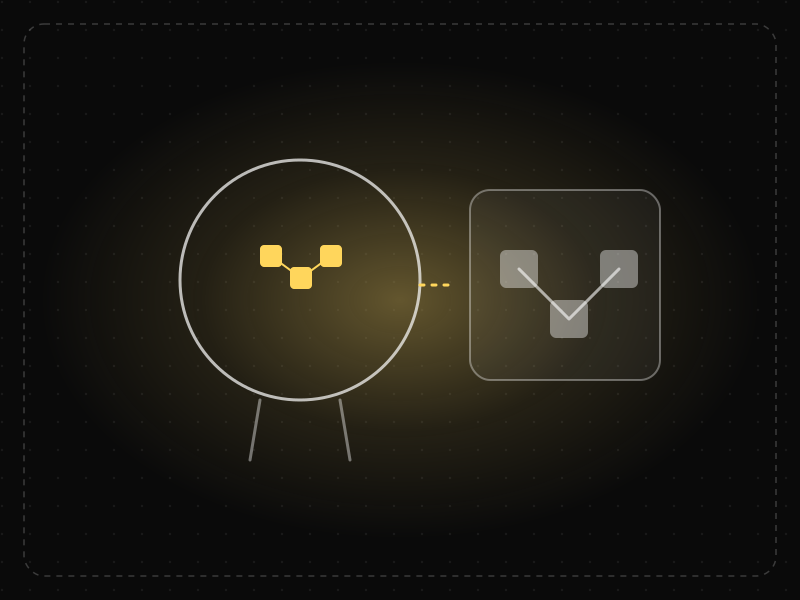
See it in action
The same screen without and with Mental Model. Watch both sides play out, then compare the outcome.
People expect deleted items to be recoverable, like a trash can; permanent deletion breaks that model.
A recoverable delete with Undo matches the trash-can model people already hold.
What to watch: the same action — only one outcome matches what people already believe will happen.
Research how users think the system works, and design to match (or gently correct) that model.
Expose your internal data model or reuse a familiar control for a different behaviour.
Key takeaways
- Learn how users already think about the task before designing the flow.
- Use familiar metaphors and terms from the user's world, not your org chart.
- When the system must work differently, make the difference explicit.
Quick facts
- Also known as
- —
- Described by
- Kenneth Craik
- Year
- 1943
- Category
- Memory & attention
- Often confused with
- Jakob's Law (Mental Model vs Jakob's Law)
Mental Model explained
A mental model is a person's internal understanding of how something works. Users build mental models from past experience with similar products, from the real world and from what the interface tells them.
Usability problems often come from a mismatch between the designer's model of the system and the user's model. When an app behaves in ways that contradict users' expectations, they make errors and feel the product is confusing.
Good design either matches the mental models users already have or helps them build accurate new ones through clear structure, labels, feedback and onboarding.
Where it comes from
Psychologist Kenneth Craik proposed in 1943 that the mind builds 'small-scale models' of reality to predict events. Don Norman applied the idea to design in the 1980s, contrasting the designer's model, the system image and the user's model in The Design of Everyday Things (1988).
How it shows up in apps
Many drop-offs come from a gap between how users expect a feature to work and how it actually works — for example, expecting 'delete' to be undoable or a 'save' to sync everywhere. Mapping that gap explains behavior that analytics alone can't.
Mental Model examples
Users of a notes app assume edits save automatically, like in the other apps they use. Adding a visible 'Saved' indicator after each edit matches that expectation and removes anxiety.
Files and folders
Desktop operating systems borrowed the mental model of physical files and folders, so people could understand digital storage using real-world experience.
Shopping carts
Online stores use a cart because shoppers understand adding items, reviewing them and paying at the end from physical shopping.
Cloud sync confusion
Users often believe deleting a file on one device only removes it there. When sync deletes it everywhere, the mismatch causes data loss and support requests unless the interface explains it clearly.
How to apply Mental Model
- Research how users currently think about the task through interviews, card sorting and observation.
- Use terms and structures users already know rather than internal jargon.
- Show the consequences of actions clearly before and after they happen.
- Use onboarding and empty states to build the right mental model for new concepts.
- Test with real users to find where their expectations and the system diverge.
Want Mental Model checked in your own product? Our saas ux audit evaluates it alongside the other principles that shape how users decide, onboard and stay.
Common mistakes
- Organising navigation around internal teams or database structure instead of user tasks.
- Assuming users understand concepts that only make sense to the people who built the product.
- Changing fundamental behaviour without explaining the new model.
How to measure it
Card sorting and tree testing show whether your information architecture matches users' mental models. In usability tests, asking users to predict what will happen before they act reveals mismatches directly.
Frequently asked questions
What is Mental Model?
A mental model is a person's internal picture of how a system works; interfaces feel intuitive when they match it and confusing when they don't.
Where does Mental Model come from?
Psychologist Kenneth Craik proposed in 1943 that the mind builds 'small-scale models' of reality to predict events. Don Norman applied the idea to design in the 1980s, contrasting the designer's model, the system image and the user's model in The Design of Everyday Things (1988).
How does Mental Model apply to app design?
Many drop-offs come from a gap between how users expect a feature to work and how it actually works — for example, expecting 'delete' to be undoable or a 'save' to sync everywhere. Mapping that gap explains behavior that analytics alone can't.
Who coined the term mental model?
Psychologist Kenneth Craik proposed the idea in his 1943 book The Nature of Explanation. Don Norman later popularised it in interaction design.
How do you research users' mental models?
Common methods include interviews, contextual inquiry, card sorting, tree testing and asking users to think aloud or predict outcomes during usability testing.
How do you measure Mental Model in a product?
Card sorting and tree testing show whether your information architecture matches users' mental models. In usability tests, asking users to predict what will happen before they act reveals mismatches directly.
Sources
- Craik, K. J. W. (1943). The Nature of Explanation. Cambridge University Press. Find on Google Scholar ↗
- Norman, D. A. (1988). The Psychology of Everyday Things (later The Design of Everyday Things). Basic Books. Find on Google Scholar ↗
Related laws
 Interaction & speed
Jakob's Law
Users spend most of their time in other products, so they expect yours to work the same way as the apps and sites they already know.
 Interaction & speed
Paradox of the Active User
Users start using software immediately instead of reading instructions, even when learning first would save them time later.
 Memory & attention
Working Memory
Working memory is the limited mental workspace that temporarily holds and manipulates information while we complete a task.
 Interaction & speed
Affordances & Signifiers
An affordance is what an object lets you do; a signifier is the cue that shows you how. Clear signifiers tell users what is interactive and how to use it.
Mental Model in practice
- Career guidesUX psychology skills employers want in 2027: attention, memory, perception, decision-making and how designers apply them without manipulationUX psychology skills employers want in 2027: attention, memory, perception, decision-making, Hick's and Fitts's laws, cognitive load and ethics.
- Making moneyApp monetization strategies that don't annoy users — designed with behavioural scienceMonetize your app without wrecking retention: value-first paywalls, honest trials, rewarded ads, anchoring and decoy pricing done ethically, and what to avoid.
- Career guidesHow to get an AI agent developer job in 2027: workflows vs agents, tools and MCP, memory, guardrails and production operationsHow to get an AI agent developer job in 2027: workflows vs agents, tool and MCP design, memory, guardrails, oversight, pay and a portfolio plan.
- Career guidesAttention to detail for 2027 jobs: how employers test it, checking data and documents, proofreading, catching errors before they ship, checklists, working under interruptions and proving accuracy on your CVAttention to detail for 2027 jobs: how employers test it, checking data and documents, proofreading, checklists, interruptions and proving accuracy.
- Career guidesUX writing for AI interfaces in 2027: onboarding, prompts and suggestions, uncertainty, errors, disclosures, system prompts and tone for AI productsUX writing for AI interfaces in 2027: onboarding, prompt suggestions, uncertainty, errors, AI disclosures, system prompts and voice for AI products.
- Career guidesHow to get a conversation designer job in 2027: chatbot and voice UX, dialogue flows, intents, repair, handoff, multilingual design and LLM assistantsHow to get a conversation designer job in 2027: chatbot and voice UX, dialogue flows, error repair, human handoff, multilingual design and LLM assistants.





Certifications that test it
- Free certification · UX/UI, Design, Research & CreativeUX Design CertificationCertifies that you can take a product problem from user need to a tested, usable flow — research, information architecture, interaction design and usability evaluation.
- Free certification · UX/UI, Design, Research & CreativeUX Research CertificationCertifies that you can plan, run and synthesize user research that changes decisions — method choice, recruiting, interviewing, usability testing, surveys and analysis.
- Free certification · AI & Generative AIAI UX Design CertificationCertifies that you can design AI-powered products people trust — setting expectations, conversational and agent UX, handling errors and uncertainty, and responsible AI.
- Free certification · Product, Project Management & Business AnalysisProduct Manager CertificationCertifies that you can run product well — discovery, strategy and prioritization, metrics, delivery with design and engineering, and launch.
- Free certification · UX/UI, Design, Research & CreativeMobile App Design CertificationCertifies that you can design native-feeling iOS and Android apps — platform conventions, navigation and gestures, touch ergonomics and accessibility, and performance, offline and permission flows.
- Free certification · UX/UI, Design, Research & CreativeInteraction Design CertificationCertifies that you can design how interfaces behave — usability principles and mental models, feedback and states, forms and input, and motion and timing.






Get the ideas, not the noise.
Sign up with Google and we’ll send you short UX psychology tips by email — why people tap, stall and leave, and what to do about it. Unsubscribe anytime. Prefer something to keep? Get the free Laws of UX guide as a PDF.