 By
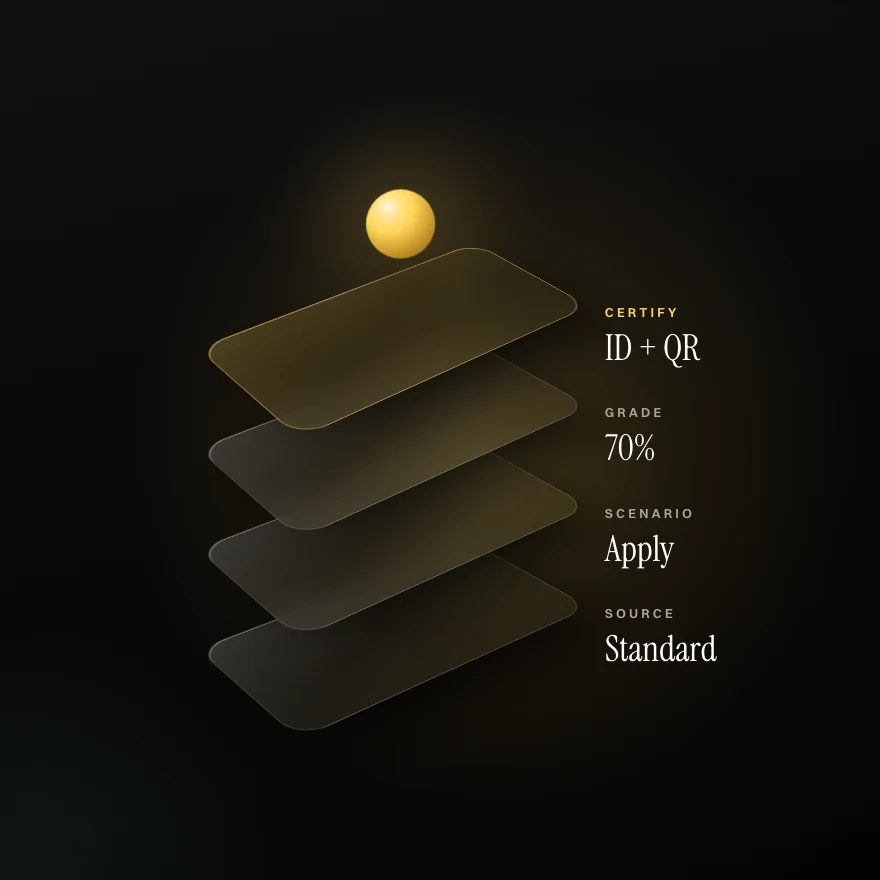
Quick answer: How are certifications created?
- Source — a named published standard.
- Skills — what someone should be able to do.
- Scenarios — apply and analyse, not recall.
- Review — accuracy, clarity, fairness.
- Grade & certify — 70% pass, server-side, ID + QR.
Key takeaways
- Every SOA test starts from a named, published source.
- Questions target application and analysis, not memorized facts.
- Testing itself improves learning (the testing effect).
- Short tests (10–30 minutes) respect learners' time and cognitive load.
- Certificates are verifiable by credential ID and QR code.
The SOA learning design process

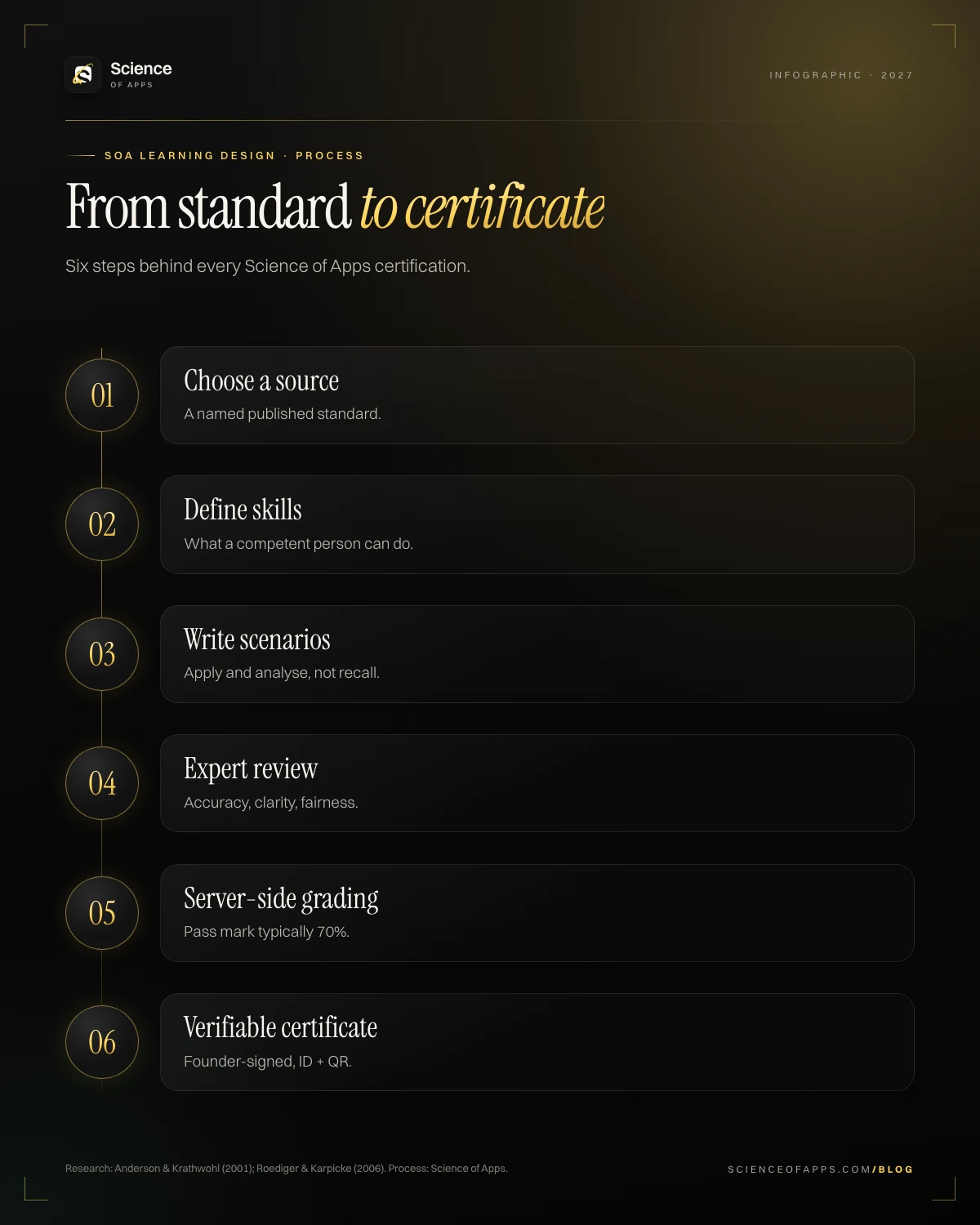
| Step | What we do | Why |
|---|---|---|
| 1. Choose a source | A named standard, framework or body of research | Grounds the test in accepted knowledge |
| 2. Define skills | What a competent person can do | Tests skills, not trivia |
| 3. Write scenarios | Realistic situations at Bloom's apply/analyse levels1 | Mirrors real work |
| 4. Review | Accuracy, clarity, fairness | One best answer |
| 5. Grade | Server-side; pass mark typically 70% | Consistent, tamper-resistant |
| 6. Certify | Founder-signed PDF, credential ID + QR | Verifiable proof |
Why scenarios, not trivia
Recall questions test whether you've memorized a definition. Scenario questions test whether you can use it: "A user abandons sign-up at step three. Which change best reduces friction?" That's the level of Bloom's revised taxonomy (apply, analyse, evaluate) that predicts job performance1. In an age when AI can recall any fact, judgment is what's worth certifying.
Testing as learning
Why 10–30 minutes
Short tests reduce cognitive load and fatigue4, make it easy to start, and fit into busy lives, which is why more people finish them. Longer role certifications combine several skill areas for a fuller picture.
Prove it free: the tests that match this guide
See the design process in action. (Disclosure: Science of Apps publishes these tests.)
Design thinking in our process
As a behavioral UX consultancy, we design tests the way we design products: understand the learner, prototype questions, test with real users, and iterate. Confusing questions are rewritten; questions everyone gets right or wrong are reviewed.
What our design doesn't do
SOA tests are not proctored, so they're not a substitute for high-stakes licensing exams. They're designed as fast, free, verifiable proof of specific skills. Read more in SOA certificate verification and the science of learning.
Frequently asked questions
How are SOA certifications created?
From a named published standard, through defined skills, scenario questions, expert review, server-side grading and a verifiable certificate.
What is learning design?
The process of designing learning experiences and assessments so people reach specific, measurable skills.
Why does SOA use scenario questions?
Scenarios test application and judgment, which matter more on the job than memorized facts.
What is the pass mark for SOA certifications?
Typically 70%, graded on SOA's server.
Why do Science of Apps tests use scenarios instead of trivia?
Recall questions test whether you've memorized a definition. Scenario questions test whether you can use it: "A user abandons sign-up at step three. Which change best reduces friction?" That's the level of Bloom's revised taxonomy (apply, analyse, evaluate) that predicts job performance. In an age when AI can recall any fact, judgment is what's worth certifying.
Sources
- Anderson & Krathwohl (2001): revised Bloom's taxonomy
- Roediger & Karpicke (2006): Test-enhanced learning
- Dunlosky et al. (2013): effective learning techniques
- Sweller (1988): Cognitive load during problem solving
- Science of Apps: free online certifications
- Checked November 11, 2026. Figures that change — fees, salaries, prices — are reviewed every six months; if something is out of date, tell us.
Where to go from here
- CertificationsWhy we built Science of AppsWhy Science of Apps exists: 2,400+ free scenario-based certifications with verifiable certificates, who they're for and how they're built.
- Career guides by Science of Apps for 2027The 2027 certification planner: pick your career goal, get your certificationPlan your 2027 certification by career goal: first job, career change, promotion, higher pay, remote work, AI skills or management, with one pick each.
- Career guides by Science of Apps for 2027The UX design certification roadmap for 2027: from beginner to expertA UX design certification roadmap for 2027: Canva and Google UX Design, front-end skills, research data and AI-assisted design.
- Career guides by Science of Apps for 2027the CFA Program review for 2027: is it worth it, who it's for and the best alternativesCFA Program review for 2027: three levels, 300+ study hours each, who it's worth it for in investment careers, and faster alternatives like FMVA.
- Career guides by Science of Apps for 2027AWS Certified Machine Learning Engineer – Associate review for 2027: is it worth it, who it's for and the best alternativesAWS Certified Machine Learning Engineer – Associate review for 2027: $150, what it tests, who it suits and Google Cloud and Azure alternatives.
- Career guidesItalian for careers in 2027: where Italian is used at work, fashion, design, luxury and food, Italian process roles in India, tourism and teaching, pay in India and CEFR levelsItalian for careers in 2027: fashion, design, luxury and food, Italian process roles in India, tourism, teaching, pay in India and CEFR levels.


Get the ideas, not the noise.
Sign up with Google and we’ll send you short UX psychology tips by email — why people tap, stall and leave, and what to do about it. Unsubscribe anytime. Prefer something to keep? Get the free Laws of UX guide as a PDF.
Prove the skill before you pay for the exam.
1,200+ free, test-based certifications graded on our server. Pass and get a founder-signed certificate with a credential ID employers can verify.