 By
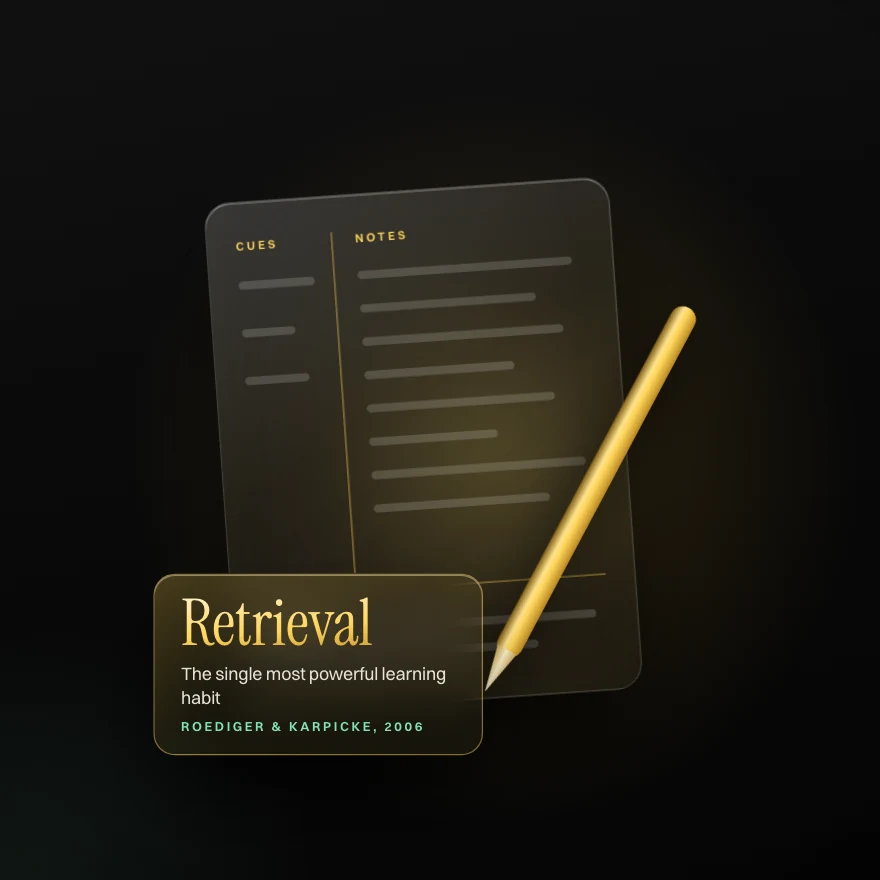
Quick answer: How do people learn?
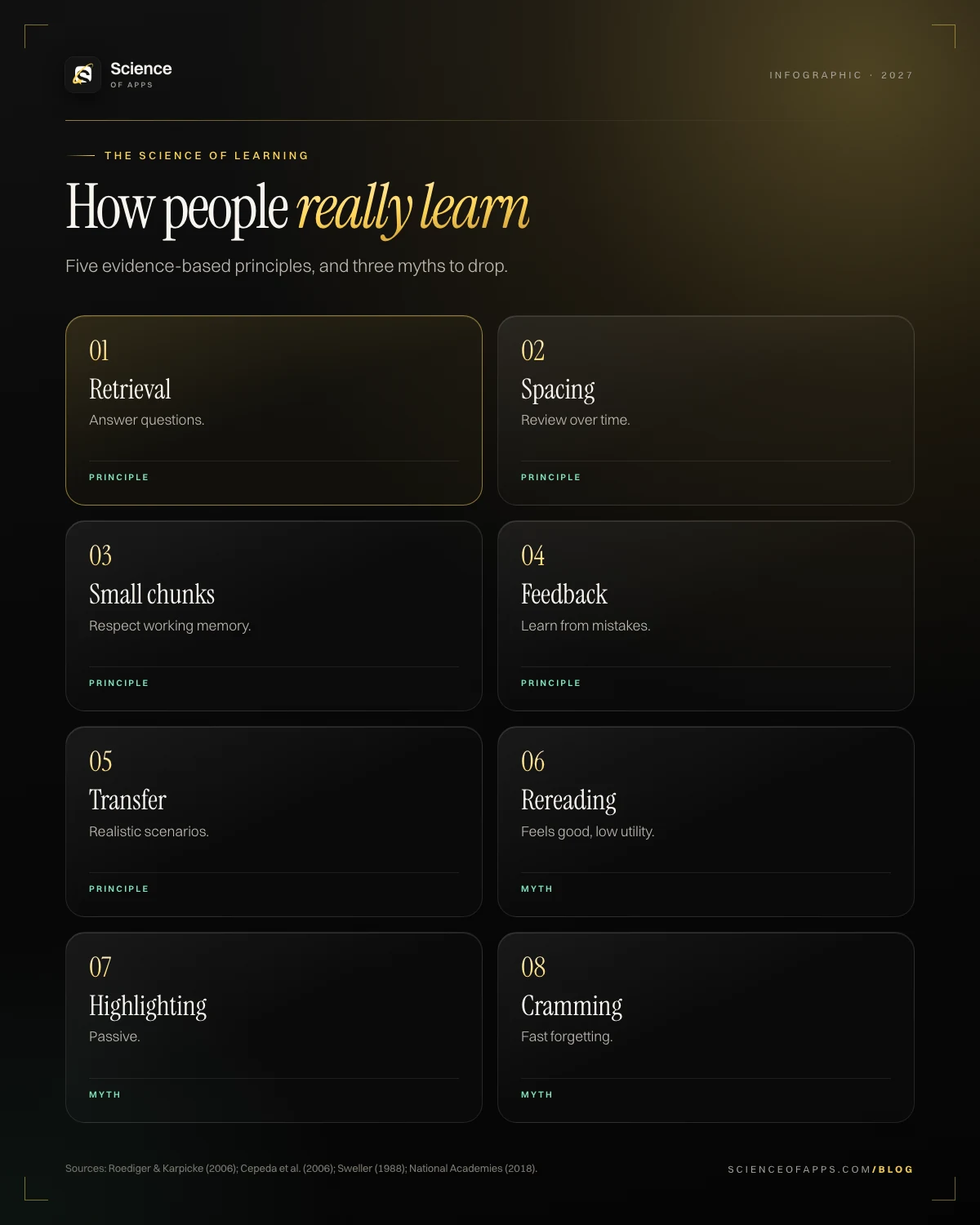
- Retrieval — answering questions builds memory.
- Spacing — review over days and weeks.
- Cognitive load — small, focused chunks.
- Feedback — know what you got wrong, and why.
- Application — use knowledge in realistic scenarios.
Key takeaways
- Retrieval practice and spacing are the most effective study techniques.
- Working memory is limited: small chunks and clear design help.
- Feedback turns mistakes into learning.
- Applying knowledge in context makes it transfer to real work.
- SOA tests are short, scenario-based and graded instantly by design.
Five principles from the science of learning

| Principle | What research shows | How SOA uses it |
|---|---|---|
| Retrieval practice | Recalling strengthens memory more than rereading1 | Every certification is a set of questions |
| Spacing | Reviews spread over time beat cramming2 | Short tests you can retake and revisit |
| Cognitive load | Working memory is limited3 | One scenario at a time, clear wording |
| Feedback | Knowing why you were wrong drives improvement | Instant results |
| Transfer | Learning in realistic contexts helps use it later4 | Workplace scenarios |
How People Learn
The National Academies' How People Learn II (2018) brings together research on memory, motivation, culture and context. Key messages: learners build on prior knowledge, motivation and feeling capable matter, and learning continues across life4. It's a strong case for lifelong, flexible learning, which is what online certifications offer.
Prove it free: the tests that match this guide
Experience the science of learning in a 10–15 minute test. (Disclosure: Science of Apps publishes these tests.)
Learning myths to drop
- "Rereading works." It feels familiar but is low utility5.
- "Highlighting is studying." Passive; use questions instead.
- "Cramming is efficient." Fast forgetting follows.
- "Tests only measure." Tests teach: retrieval is learning.
Apply the science today
- After any lesson, close the material and write what you remember.
- Quiz yourself the next day, then in three days, then a week.
- Learn in 25–45 minute focused sessions.
- Check your skill with a free SOA scenario test.
Go deeper: active recall and spaced repetition, note-taking methods and how SOA designs certifications.
Frequently asked questions
What is the science of learning?
The research field that studies how people learn, covering memory, retrieval, spacing, cognitive load, motivation and transfer.
How do people learn best?
Through retrieval practice, spaced review, manageable chunks, feedback, and applying knowledge in realistic situations.
What is 'How People Learn'?
A National Academies report (How People Learn II, 2018) that summarizes research on how people learn across contexts and ages.
Which learning myths should you drop?
Four common ones. Rereading feels familiar but is a low-utility technique. Highlighting is passive, so turn notes into questions instead. Cramming leads to fast forgetting, so spread reviews over days. And tests don't only measure learning: recalling answers is itself one of the most effective ways to learn.
What is How People Learn?
The National Academies' *How People Learn II* (2018) brings together research on memory, motivation, culture and context. Key messages: learners build on prior knowledge, motivation and feeling capable matter, and learning continues across life. It's a strong case for lifelong, flexible learning, which is what online certifications offer.
Sources
- Roediger & Karpicke (2006): Test-enhanced learning
- Cepeda et al. (2006): Distributed practice
- Sweller (1988): Cognitive load during problem solving
- National Academies: How People Learn II (2018)
- Dunlosky et al. (2013): effective learning techniques
- Science of Apps: free online certifications
- Checked November 11, 2026. Figures that change — fees, salaries, prices — are reviewed every six months; if something is out of date, tell us.
Where to go from here
- Your 2027 certification roadmap — plan your career with soa's certification roadmap
- How SOA designs certifications — inside soa's learning design process
- Career guides by Science of Apps for 2027The best certifications to break into tech in 2027: eight routes for people starting from outsideThe 8 best certifications to break into tech in 2027: Google IT Support, Data Analytics, UX, AWS, Security+, Salesforce, freeCodeCamp and Google AI Essentials.
- CertificationsCertifications to get a job fastThe best certifications to get a job fast in the USA: CompTIA A+, Google certificates, CDL, CNA, AWS and more, with time to complete, cost and demand.
- CertificationsFast certifications that pay well15 fast certifications you can earn in under 30 days that still pay well, with cost, time and salary for each.
- CertificationsBest AI study toolsThe best free AI study tools for certification exams, including ChatGPT prompts, flashcard generators and AI tutors.
- Career guides by Science of Apps for 2027The best certification websites of 2027: ten platforms compared on cost, credibility and what you actually getThe 10 best certification websites of 2027 compared: Coursera, Microsoft Learn, AWS, Google Skillshop, HubSpot, Trailhead, PMI and more, with costs and links.
- Career guides by Science of Apps for 2027Free cybersecurity certifications in 2027: five ways to start in security without paying5 free ways into cybersecurity in 2027: ISC2 Certified in Cybersecurity, Google Cybersecurity aid, Harvard CS50, Microsoft Learn and freeCodeCamp.
Get the ideas, not the noise.
Sign up with Google and we’ll send you short UX psychology tips by email — why people tap, stall and leave, and what to do about it. Unsubscribe anytime. Prefer something to keep? Get the free Laws of UX guide as a PDF.
Prove the skill before you pay for the exam.
1,200+ free, test-based certifications graded on our server. Pass and get a founder-signed certificate with a credential ID employers can verify.