 By
Quick answer: What is active recall and spaced repetition?
- Active recall — retrieve from memory: quiz, flashcards, explain.
- Spaced repetition — review at growing intervals.
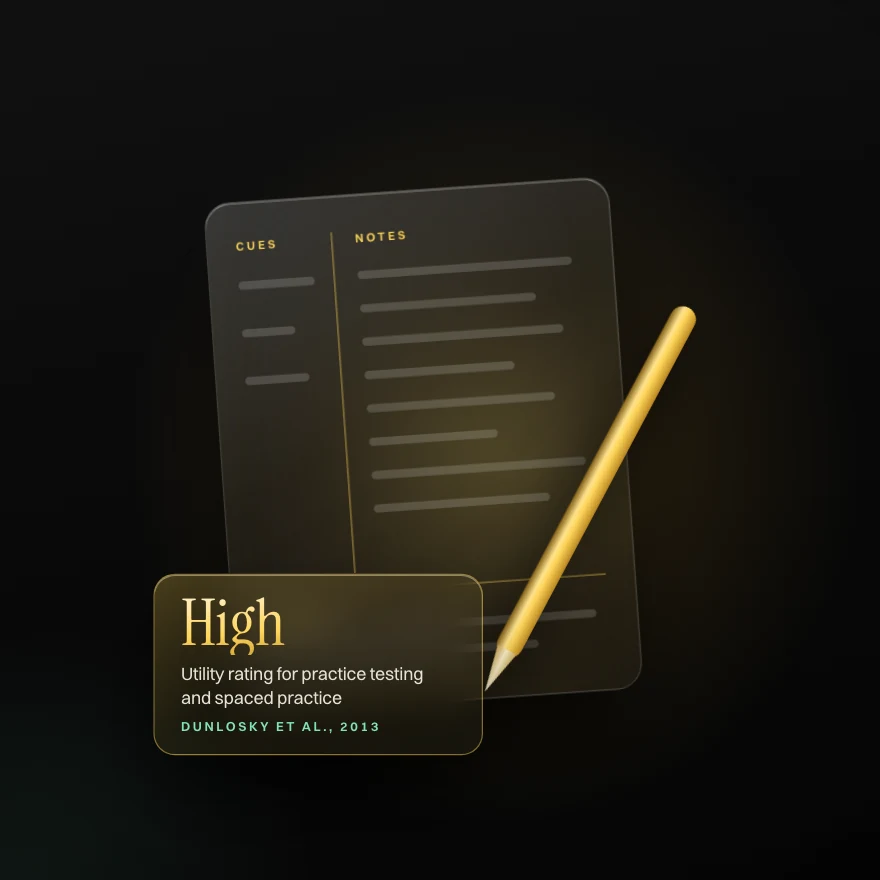
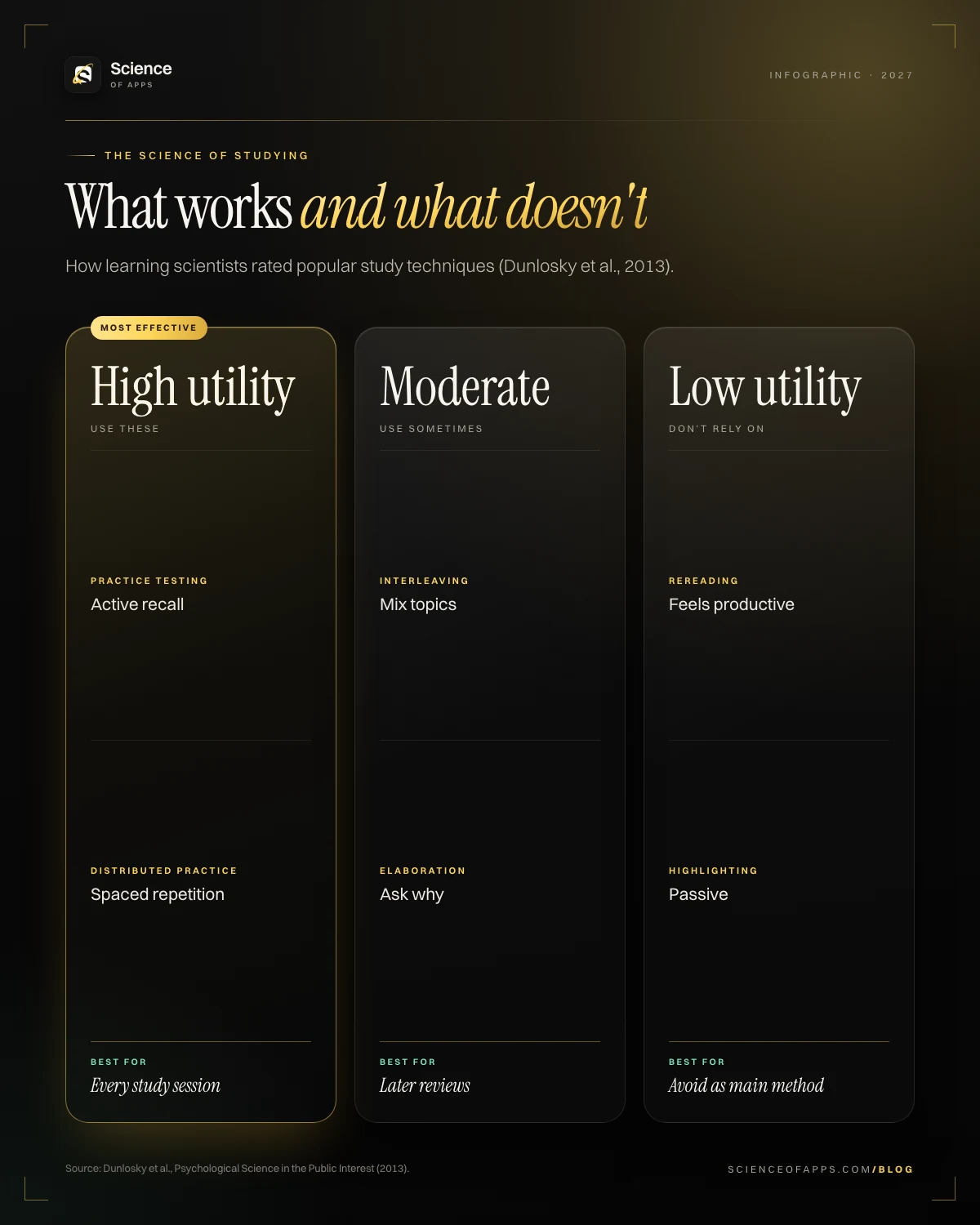
- Evidence — both rated "high utility" (2013 review).
- Tools — Anki, Quizlet, practice tests.
- Avoid — rereading and highlighting alone.
Key takeaways
- Active recall (practice testing) and spaced practice are the two highest-rated study methods.
- Retrieval strengthens memory more than restudying (Roediger & Karpicke, 2006).
- Spacing study over time beats cramming the same hours together.
- Spaced repetition software (Anki) schedules reviews automatically.
- Rereading and highlighting feel productive but are low utility.
What is active recall?

Active recall is any study method that makes you retrieve information from memory: answering practice questions, using flashcards, writing everything you remember about a topic, or explaining it aloud. Each successful retrieval strengthens the memory. In a classic experiment, students who practised recalling a passage remembered much more a week later than students who restudied it, even though the restudy group felt more confident1.
What is spaced repetition?
Spaced repetition means reviewing material at increasing intervals rather than all at once. Forgetting begins soon after learning; reviewing just as you're starting to forget makes the memory stronger and slower to fade. A large meta-analysis of distributed practice found spacing improves long-term retention compared with massed study2.
| Review | When | Method |
|---|---|---|
| 1st | Same day | Quick self-quiz |
| 2nd | Next day | Flashcards |
| 3rd | 3 days later | Practice questions |
| 4th | 1 week later | Mixed quiz |
| 5th | 2–4 weeks later | Full practice test |
What the research says
Dunlosky and colleagues reviewed 10 common study techniques and rated only two as "high utility": practice testing and distributed practice. Summarization, highlighting, rereading and keyword mnemonics were rated low utility3. For a brand named Science of Apps, this is the science we build on: our certifications are scenario tests because answering questions is how people learn and prove skills.
How to use active recall and spaced repetition
- After each lesson, close your notes and write what you remember.
- Turn key facts into question-and-answer flashcards.
- Use Anki or Quizlet to schedule reviews automatically4.
- Mix topics (interleaving) in later reviews.
- Use full practice tests as your final spaced review.
Prove it free: the tests that match this guide
Every SOA test is active recall: you retrieve, then get graded. (Disclosure: Science of Apps publishes these tests.)
Active recall with AI
AI tools can generate quiz questions and flashcards from your notes. The key is to answer before checking. Ask ChatGPT, Claude or NotebookLM to quiz you one question at a time and explain mistakes. See AI study tools.
Common mistakes
- Making flashcards that are too long: keep one idea per card.
- Recognizing instead of recalling: cover the answer.
- Skipping reviews when busy: do a 5-minute review instead.
- Only studying what you already know well.
Pair these methods with the best note-taking methods and the 30-day exam study plan.
Frequently asked questions
What is active recall?
A study method where you retrieve information from memory, using practice questions, flashcards or explaining from memory, instead of rereading.
What is spaced repetition?
Reviewing material at increasing intervals, such as 1 day, 3 days, 1 week and 1 month, to strengthen long-term memory.
What is a spaced repetition system?
Software such as Anki that schedules flashcard reviews automatically based on how well you remember each card.
Is active recall better than rereading?
Yes. Research rates practice testing as high utility and rereading as low utility for long-term learning.
What does research say about active recall and spaced repetition?
Dunlosky and colleagues reviewed 10 common study techniques and rated only two as "high utility": practice testing and distributed practice. Summarization, highlighting, rereading and keyword mnemonics were rated low utility. For a brand named Science of Apps, this is the science we build on: our certifications are scenario tests because answering questions is how people learn and prove skills.
Sources
- Roediger & Karpicke (2006): Test-enhanced learning
- Cepeda et al. (2006): Distributed practice in verbal recall tasks
- Dunlosky et al. (2013): Improving students' learning with effective learning techniques
- Anki spaced repetition software
- Science of Apps: free online certifications
- Checked November 11, 2026. Figures that change — fees, salaries, prices — are reviewed every six months; if something is out of date, tell us.
Where to go from here
- Study motivation that lasts — how to stay motivated and focused when studying for a long certification program
- Failed a certification exam? — failed your certification exam? retake policies, how to analyse your score repor
- Calm exam anxiety — 12 science-backed tips to calm exam anxiety before and during a certification te
- How to make an appHow to build an app like Duolingo: features, psychology, stack and costWhat makes Duolingo work — short lessons, streaks, leagues, adaptive practice — and how to build a learning app like it: MVP, tech stack and cost.
- CertificationsMicrolearning & mobile learningWhy microlearning and mobile learning work: short 2–15 minute lessons, spaced repetition and retrieval practice, and where bite-sized learning falls short.
- How to make an appWhat is a PWA? Progressive web apps explained simplyA PWA is a website that installs and works like an app, offline and with push. How PWAs work, Indian success stories, iPhone limits and when to choose one.
- CertificationsDigital credentials & blockchain certificatesWhat digital credentials and blockchain certificates are, how they prevent fraud and why employers are adopting them.
- CertificationsStudy while working full-timeHow to study for a certification while working full-time: realistic schedules, time-blocking and motivation tips.
- Tech explainedHow does Google Search work? Crawling, indexing, ranking and AI Overviews, explained simplyHow Google Search works in three stages, crawling, indexing and serving, and how PageRank, BERT and AI Overviews fit in. With diagrams and Google's own docs.


Get the ideas, not the noise.
Sign up with Google and we’ll send you short UX psychology tips by email — why people tap, stall and leave, and what to do about it. Unsubscribe anytime. Prefer something to keep? Get the free Laws of UX guide as a PDF.
Prove the skill before you pay for the exam.
1,200+ free, test-based certifications graded on our server. Pass and get a founder-signed certificate with a credential ID employers can verify.