 By
Quick answer: How do I pass a certification exam first time?
- Start with the exam guide — domains, weights, question types.
- One main course — plus official docs.
- Practice testing — half your study time.
- Spaced review — revisit topics over days and weeks.
- Ready signal — 80–85%+ on full practice exams.
Key takeaways
- The official exam guide is your syllabus: study to its domains and weightings.
- Practice testing and spaced practice are the most effective study techniques (Dunlosky et al., 2013).
- Book the exam date early to create a deadline.
- Aim for consistent 80–85%+ on full-length practice exams before sitting.
- On exam day: read carefully, flag and move on, manage time.
The 6-step system to pass any certification exam

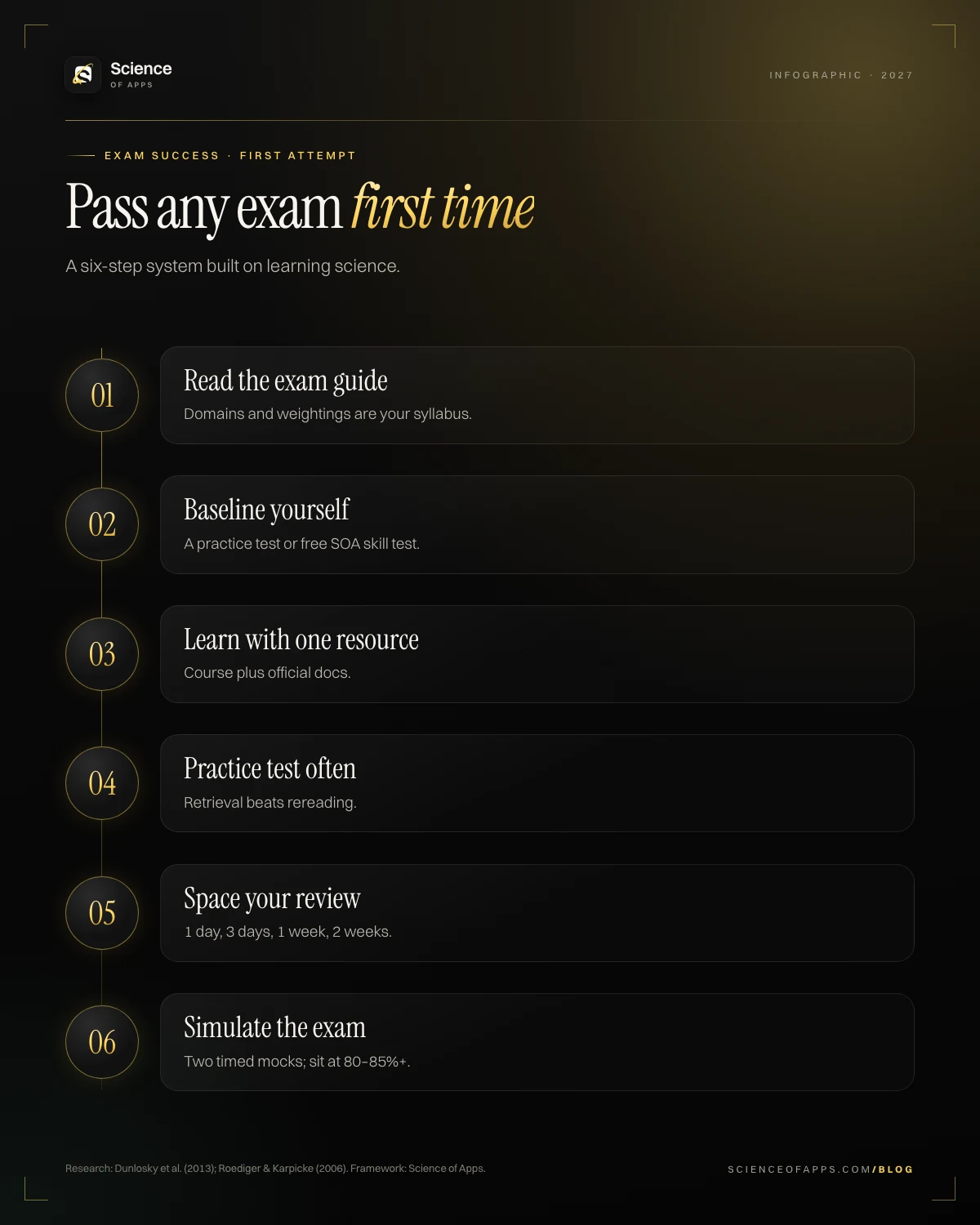
- Download the exam guide. List every domain and its weighting. This is your syllabus.
- Baseline yourself. Take a practice test or a free SOA skill test to find gaps.
- Learn with one main resource. A reputable course plus the vendor's official documentation.
- Practice test early and often. Retrieval practice beats rereading12.
- Space your reviews. Revisit topics after 1 day, 3 days, 1 week and 2 weeks3.
- Simulate the exam. Two full-length timed practice exams in the final week.
Why practice testing works
A landmark review by Dunlosky and colleagues rated 10 popular study techniques. Only two earned "high utility": practice testing and distributed (spaced) practice. Highlighting and rereading were rated low utility1. Roediger and Karpicke showed that students who practised recalling material remembered far more a week later than those who restudied it2. Read more in active recall and spaced repetition.
| Exam | Typical prep (part-time) | Pass mark / format |
|---|---|---|
| AWS Cloud Practitioner | 3–6 weeks | Scaled 700/1000 |
| Microsoft AZ-900 | 2–4 weeks | Scaled 700/1000 |
| CompTIA Security+ | 6–10 weeks | 750 on 100–900 scale |
| PMP | 8–12 weeks | 180 questions, 230 minutes |
| PSM I | 2–3 weeks | 85% (80 questions, 60 min) |
| Microsoft PL-300 | 6–8 weeks | Scaled 700/1000 |

Certification exam tips for exam day
- Read the last line first to see what's really being asked.
- Eliminate clearly wrong answers, then choose the best of the rest.
- Flag and move on if stuck for more than 90 seconds.
- Watch for qualifiers: "most cost-effective", "least operational overhead".
- Review flagged items with remaining time; change answers only with a clear reason.
Prove it free: the tests that match this guide
Put the system into practice: test your study skills, then practise for your exam. (Disclosure: Science of Apps publishes these tests.)
How to pass a licence exam
Licence exams (nursing, trades, real estate, CPA) follow the same principles but carry more weight and stricter rules. Use the official content outline, official practice materials and timed mock exams, and check identification and testing-centre rules well in advance.
Mistakes that cause first-attempt fails
- Watching videos without practising questions.
- Ignoring low-weighted domains completely.
- Booking the exam before scoring consistently on practice tests.
- Cramming the night before instead of sleeping.
Plan your weeks with the 30-day exam study plan.
Frequently asked questions
How do I pass a certification exam on the first try?
Study to the official exam guide, use practice testing and spaced review, book a date, and sit only when you score 80–85%+ on full practice exams.
How long should I study for a certification exam?
Fundamentals exams take 2–6 weeks part-time; associate exams 6–10 weeks; PMP and similar 8–12 weeks.
What are the best certification exam tips?
Read the question's last line first, eliminate wrong answers, flag and move on when stuck, and watch for qualifiers like 'most cost-effective'.
How do I pass the Excel certification exam?
Practise every task in the official skills list in Excel itself, time yourself, and take a practice exam in the same format.
Why does practice testing work?
A landmark review by Dunlosky and colleagues rated 10 popular study techniques. Only two earned "high utility": practice testing and distributed (spaced) practice. Highlighting and rereading were rated low utility. Roediger and Karpicke showed that students who practised recalling material remembered far more a week later than those who restudied it. Read more in active recall and spaced repetition.
Sources
- Dunlosky et al. (2013): Improving students' learning with effective learning techniques
- Roediger & Karpicke (2006): Test-enhanced learning
- Cepeda et al. (2006): Distributed practice in verbal recall tasks
- AWS Certification exam guides
- PMI: PMP exam content outline
- Science of Apps: free online certifications
- Checked November 11, 2026. Figures that change — fees, salaries, prices — are reviewed every six months; if something is out of date, tell us.
Where to go from here
- The 30-day exam study plan — a free 30-day exam study plan template for any certification, with daily goals,
- Study while working full-time — how to study for a certification while working full-time
- The 7 best note-taking methods — Cornell, mind maps, charting and more
- CertificationsThe 30-day exam study planA free 30-day exam study plan template for any certification, with daily goals, review cycles and mock-test checkpoints.
- Career guides by Science of Apps for 2027Self-paced certifications for 2027: nine you can start any day and finish on your schedule9 self-paced certifications for 2027 you can start any day: Google career certificates, AWS, Microsoft, CS50, freeCodeCamp, Kaggle, HubSpot and more.
- Career guides by Science of Apps for 2027How to pass Azure Fundamentals (AZ-900) in 2027: a 3-week study plan and tips that workHow to pass Azure Fundamentals (AZ-900) in 2027: a 3-week study plan, exam format and cost, the best free resources and practice-test tips.
- Career guides by Science of Apps for 2027How to pass Azure Administrator (AZ-104) in 2027: a 10-week study plan and tips that workHow to pass Azure Administrator (AZ-104) in 2027: a 10-week study plan, exam format and cost, the best free resources and practice-test tips.
- Career guides by Science of Apps for 2027How to pass Azure Data Scientist Associate (DP-100) in 2027: a 10-week study plan and tips that workHow to pass Azure Data Scientist Associate (DP-100) in 2027: a 10-week study plan, exam format and cost, the best free resources and practice-test tips.
- Career guides by Science of Apps for 2027How to pass Azure AI Fundamentals (AI-900) in 2027: a 3-week study plan and tips that workHow to pass Azure AI Fundamentals (AI-900) in 2027: a 3-week study plan, exam format and cost, the best free resources and practice-test tips.




Get the ideas, not the noise.
Sign up with Google and we’ll send you short UX psychology tips by email — why people tap, stall and leave, and what to do about it. Unsubscribe anytime. Prefer something to keep? Get the free Laws of UX guide as a PDF.
Prove the skill before you pay for the exam.
1,200+ free, test-based certifications graded on our server. Pass and get a founder-signed certificate with a credential ID employers can verify.