 By
Quick answer: What is the best LMS for corporate training?
- Small teams — TalentLMS, 360Learning.
- Enterprise — Docebo, Cornerstone, Absorb.
- Open source — Moodle Workplace.
- HR suites — Workday, SAP SuccessFactors.
- Must-haves — certification tracking, reporting, integrations.
Key takeaways
- An LMS (learning management system) delivers, tracks and reports on training.
- Pick by company size, existing HR systems and content needs.
- Certification management (expiry tracking, reminders) matters for compliance.
- Integrations with HR, SSO and content libraries save admin time.
- Pilot with one team before rolling out.
What is an LMS training system?

A learning management system hosts and delivers courses, assigns learning to employees, tracks progress and certifications, and reports on completion and skills. Many now include learning experience features: recommendations, skills profiles and mobile learning.
LMS platforms compared
| Platform | Best for | Notable strengths |
|---|---|---|
| TalentLMS | Small and mid-sized teams | Quick setup, simple admin |
| 360Learning | Collaborative learning | Peer-created courses |
| Docebo | Large organizations | AI recommendations, integrations |
| Cornerstone | Enterprise talent management | Broad HR suite, compliance |
| Absorb | Customer and employee training | Usability, reporting |
| Moodle Workplace | Open-source control | Customizable, self-hosted options |
| Workday / SAP SuccessFactors Learning | Companies on those HR suites | Native HR data |
| LinkedIn Learning Hub | Content-led learning | Large course library |
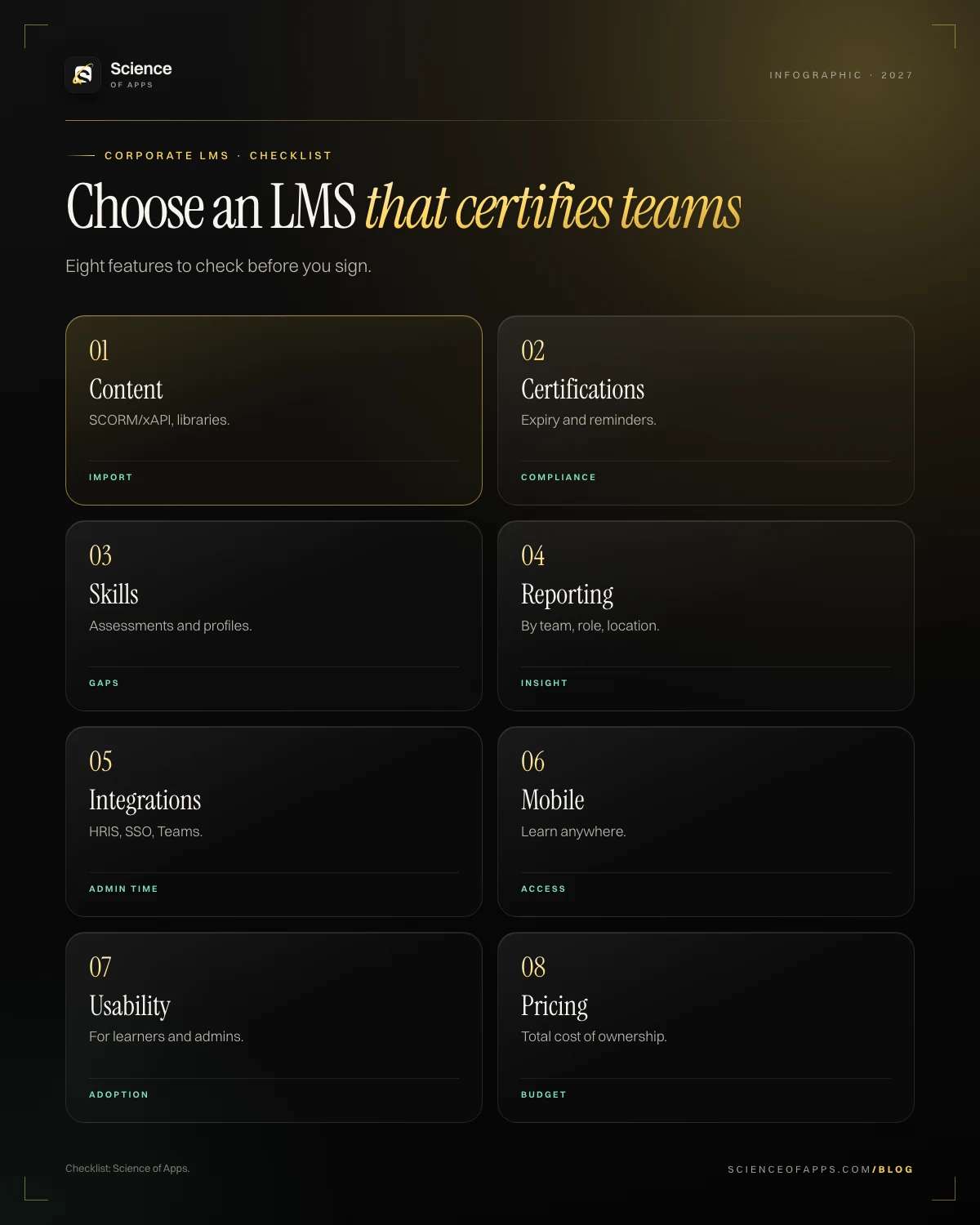
LMS selection checklist
- Content: can you import SCORM/xAPI and connect content libraries?
- Certification management: expiry dates, reminders, recertification.
- Skills tracking and assessments.
- Reporting by team, role and location.
- Integrations: HRIS, SSO, Slack/Teams.
- Mobile learning.
- Ease of use for learners and admins.
- Pricing model and total cost.
Using an LMS for team certifications
Map each role to target certifications, assign learning paths, track exam vouchers and results, and set renewal reminders. Add free skill assessments at the start to baseline teams; Science of Apps' free tests are a quick option.
Prove it free: the tests that match this guide
Skills to run an LMS well. (Disclosure: Science of Apps publishes these tests.)
LMS for small business training
Small businesses can start simply: a lightweight LMS or even a shared plan with free resources (Microsoft Learn, Google Skillshop, HubSpot Academy, Science of Apps) and a spreadsheet to track certifications. Upgrade when admin time becomes the bottleneck.
How to learn LMS administration
Most vendors offer free admin training and certifications. Instructional design and learning analytics skills make LMS administrators more valuable.
Related: upskilling program guide and training ROI.
Frequently asked questions
What is the best LMS for corporate training?
It depends on size: TalentLMS or 360Learning for smaller teams; Docebo, Cornerstone or Absorb for enterprises; Moodle Workplace for open-source control.
What is an LMS training system?
Software that delivers, assigns, tracks and reports on training and certifications for employees.
What should I look for in a corporate LMS?
Content integration, certification management, skills tracking, reporting, HR integrations, mobile access and ease of use.
Can an LMS manage team certifications?
Map each role to target certifications, assign learning paths, track exam vouchers and results, and set renewal reminders. Add free skill assessments at the start to baseline teams; Science of Apps' free tests are a quick option.
Which LMS suits small business training?
Small businesses can start simply: a lightweight LMS or even a shared plan with free resources (Microsoft Learn, Google Skillshop, HubSpot Academy, Science of Apps) and a spreadsheet to track certifications. Upgrade when admin time becomes the bottleneck.
Sources
- TalentLMS
- Docebo
- Cornerstone
- Moodle Workplace
- Science of Apps: free online certifications
- Checked November 11, 2026. Figures that change — fees, salaries, prices — are reviewed every six months; if something is out of date, tell us.
Where to go from here
- Skills vs degree vs experience — skills vs degree vs experience
- Calculate training ROI — how to calculate training roi with a simple formula and a free calculator, plus
- CertificationsCorporate training platforms for teamsCompare the best corporate training platforms for certifying teams: features, pricing, reporting and integrations.
- CertificationsBenefits of employee trainingThe business benefits of employee training and certification: retention, productivity, internal promotion and ROI, plus how to ask your employer to pay.
- CertificationsCalculate training ROIHow to calculate training ROI with a simple formula and a free calculator, plus benchmarks for certification programs.
- CertificationsBuild an upskilling programHow to build an employee upskilling and reskilling programme with certifications: skills gaps, learning paths, protected time and measuring impact.
- ComparisonsSlack vs Teams: which team chat tool fits your company — features, free plans and ecosystems comparedSlack vs Microsoft Teams compared: messaging, meetings, integrations, free plans, AI and external collaboration — with a verdict for each kind of team.
- Career guidesHow to get a learning and development (L&D) job in 2027: training needs analysis, programme design, facilitation, e-learning, career development, measuring impact and AI-powered learningHow to get an L&D job in 2027: training needs analysis, programme design, facilitation, e-learning, career development, measuring impact, AI learning and pay.

Get the ideas, not the noise.
Sign up with Google and we’ll send you short UX psychology tips by email — why people tap, stall and leave, and what to do about it. Unsubscribe anytime. Prefer something to keep? Get the free Laws of UX guide as a PDF.
Prove the skill before you pay for the exam.
1,200+ free, test-based certifications graded on our server. Pass and get a founder-signed certificate with a credential ID employers can verify.