 By
Quick answer: Skills or degree: what matters more?
- Experience — still the strongest signal.
- Degree — opens doors; higher average pay.
- Skills — increasingly tested directly.
- Certifications — fastest proof of specific skills.
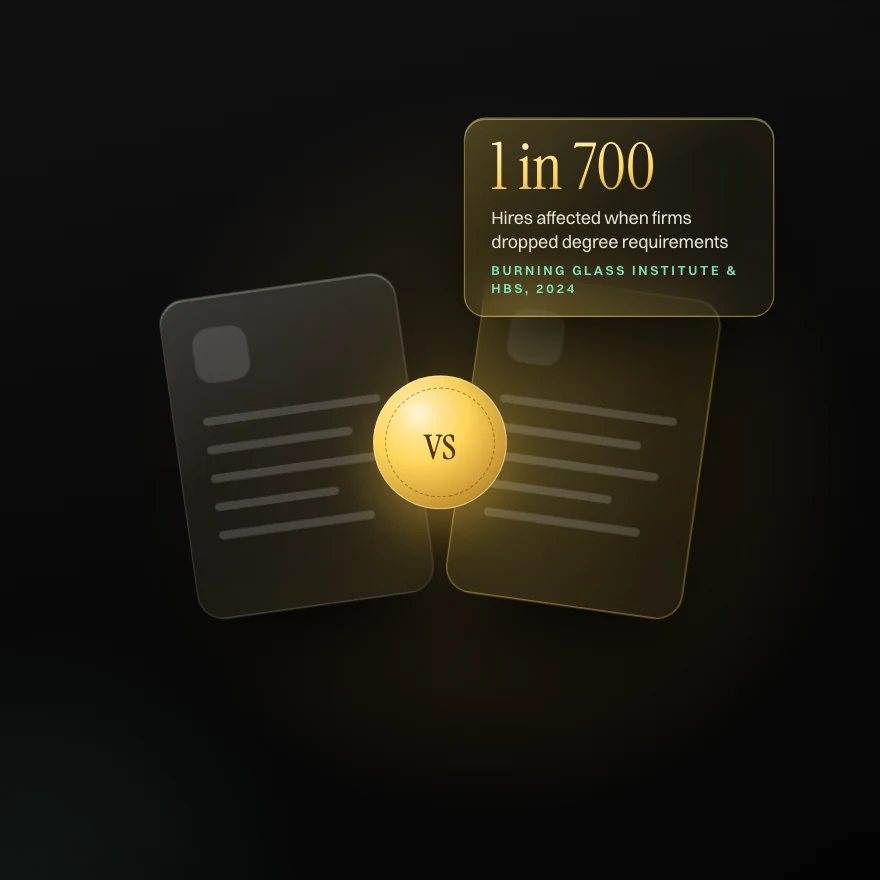
- Reality — degree-requirement removal changed <1 in 700 hires.
Key takeaways
- Experience is still the strongest hiring signal.
- Degrees still correlate with higher pay and lower unemployment (BLS).
- Many employers removed degree requirements, but hiring practice changed slowly.
- Certificates (course completion) and certifications (assessed) are not the same.
- Combine skills proof, experience and credentials for the best result.
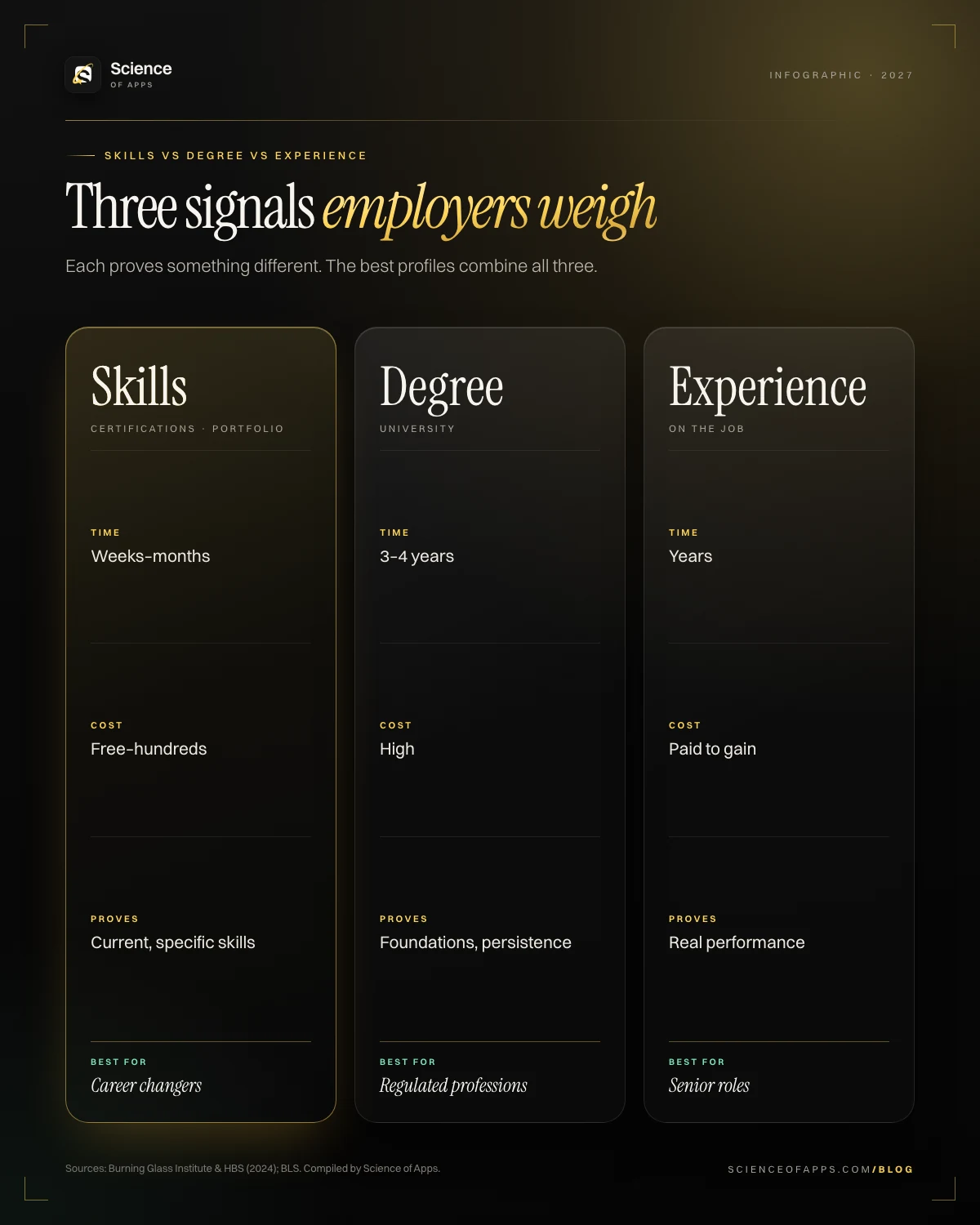
Skills vs degree vs experience

| Skills (certifications, portfolio) | Degree | Experience | |
|---|---|---|---|
| Time to get | Weeks–months | 3–4 years | Years |
| Cost | Free–hundreds | High | Paid to gain it |
| Signal | Specific, current skills | Broad foundation, persistence | Proven performance |
| Best for | Career changers, tech roles | Regulated professions, many graduate roles | Senior roles |
What the data shows
A 2024 report by the Burning Glass Institute and Harvard Business School tracked companies that removed degree requirements and found that the change affected fewer than 1 in 700 hires: many firms dropped the requirement on paper but kept hiring graduates1. Meanwhile, BLS data shows higher median earnings and lower unemployment at each higher level of education2. Degrees still matter; skills-based hiring is growing but gradual.
Are certificates and certifications the same?
No. A certificate usually shows you completed a course or program. A certification shows you passed an assessment against a standard, often with renewal (AWS, PMP, Security+). Both can help; certifications carry more weight with employers.
Certification vs experience
Experience wins when both are present: employers trust what you've done. But certifications help you get the interviews that lead to experience, and help experienced people prove new skills (e.g. a manager adding AI or cloud).
Prove it free: the tests that match this guide
Prove skills directly, whatever your degree or experience. (Disclosure: Science of Apps publishes these tests.)
Skills vs degree: group discussion points
- For skills: faster, cheaper, more current, more inclusive.
- For degrees: broad foundations, critical thinking, networks, required for regulated roles.
- Balanced view: degrees and skills complement each other; lifelong certification keeps skills current.
The best strategy
Whatever your starting point, add proof of skills: a recognized certification, a portfolio project and verifiable credentials. Read more in skills-based hiring.
Frequently asked questions
Is a degree or skills more important?
Both matter: experience is the strongest signal, degrees still open many doors, and verified skills increasingly decide hiring, especially in tech.
Are certificates and certifications the same?
No. A certificate shows course completion; a certification shows you passed an assessment against a standard.
Is certification better than experience?
Experience usually carries more weight, but certifications help you get interviews and prove new skills.
Did skills-based hiring replace degrees?
Not yet. A 2024 Burning Glass Institute and HBS study found removing degree requirements changed fewer than 1 in 700 hires.
Has skills-based hiring actually replaced degree requirements?
A 2024 report by the Burning Glass Institute and Harvard Business School tracked companies that removed degree requirements and found that the change affected fewer than 1 in 700 hires: many firms dropped the requirement on paper but kept hiring graduates. Meanwhile, BLS data shows higher median earnings and lower unemployment at each higher level of education. Degrees still matter; skills-based hiring is growing but gradual.
Sources
- Burning Glass Institute & Harvard Business School: Skills-Based Hiring (2024)
- BLS: Education pays
- U.S. OPM: skills-based hiring
- Science of Apps: free online certifications
- Checked November 11, 2026. Figures that change — fees, salaries, prices — are reviewed every six months; if something is out of date, tell us.
Where to go from here
- Calculate training ROI — how to calculate training roi with a simple formula and a free calculator, plus
- Best LMS for corporate training — compare the best learning platforms for corporate training and team certificatio
- Build an upskilling program — how to build an employee upskilling and reskilling program with certifications,
- CertificationsAccredited vs non-accreditedWhat does 'accredited' really mean for a certification? How accreditation works and why it matters to employers.
- CertificationsCertificate verificationHow employers verify certificates online, which databases they use and how to make your credentials easy to verify.
- CertificationsAre online certificates legit?Are online certificates legit? How to tell real credentials from scams: verification, real assessments, accreditation claims and red flags to check.
- CertificationsCertificate vs diploma vs degreeCertificate vs diploma vs degree: cost, time, salary and employer perception compared, so you can choose the right path.
- CertificationsOnline training platforms employers respectWhich online training platforms do employers actually trust? We ranked them by recruiter feedback, accreditation and job outcomes.
- CertificationsAI in educationHow AI is transforming education and online certification, from AI tutors to adaptive exams and skills verification.
Get the ideas, not the noise.
Sign up with Google and we’ll send you short UX psychology tips by email — why people tap, stall and leave, and what to do about it. Unsubscribe anytime. Prefer something to keep? Get the free Laws of UX guide as a PDF.
Prove the skill before you pay for the exam.
1,200+ free, test-based certifications graded on our server. Pass and get a founder-signed certificate with a credential ID employers can verify.