 By
Quick answer: How do I build an upskilling program?
- Skills needed — map strategy to skills.
- Assess — baseline with skill tests.
- Paths — courses ending in certifications.
- Time — protected learning hours.
- Measure — completion, certification, performance.
Key takeaways
- Upskilling = better at the current role; reskilling = moving to a new role.
- Start from business goals, not course catalogues.
- Baseline skills first: free skill tests show gaps quickly.
- Certifications give programs a clear, measurable finish line.
- Protected time is the biggest predictor of completion.
Upskilling vs reskilling

| Upskilling | Reskilling | |
|---|---|---|
| Goal | Improve skills for current role | Prepare for a different role |
| Example | Analyst learns Power BI (PL-300) | Support agent becomes cloud admin (AZ-104) |
| Time | Weeks | Months |
| Driver | New tools, AI | Roles changing or disappearing |
How to build an employee upskilling program
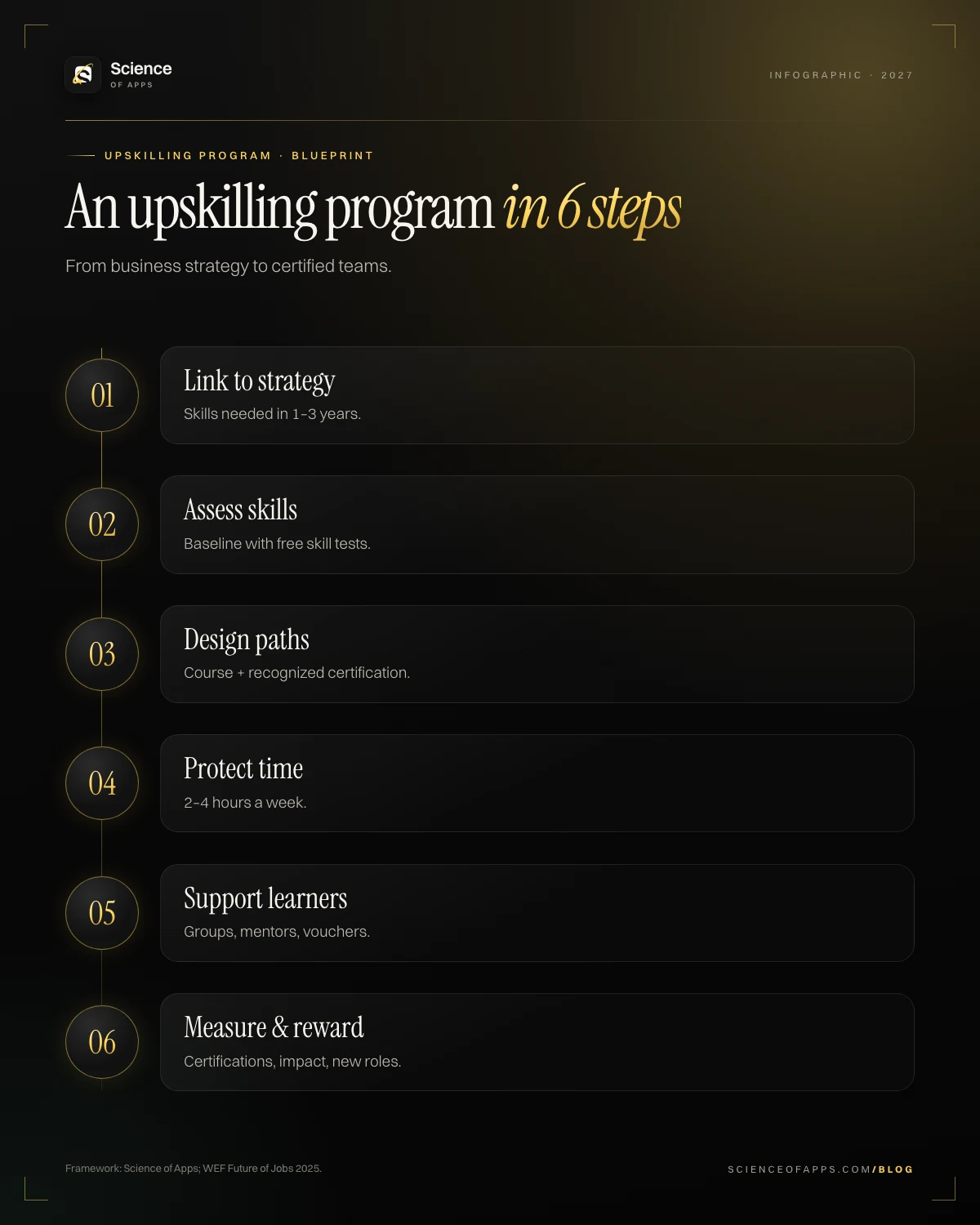
- Link to strategy: which skills will the business need in 1–3 years (AI, cloud, data, security)?
- Assess current skills: use quick, free skill tests to baseline teams.
- Design learning paths: a course plus a recognized certification for each target skill.
- Protect time: e.g. 2–4 hours a week of learning time.
- Support learners: study groups, mentors, exam vouchers.
- Measure: participation, certification pass rates, and on-the-job impact.
- Reward: new projects, roles or pay bands for certified skills.
Why upskilling is important
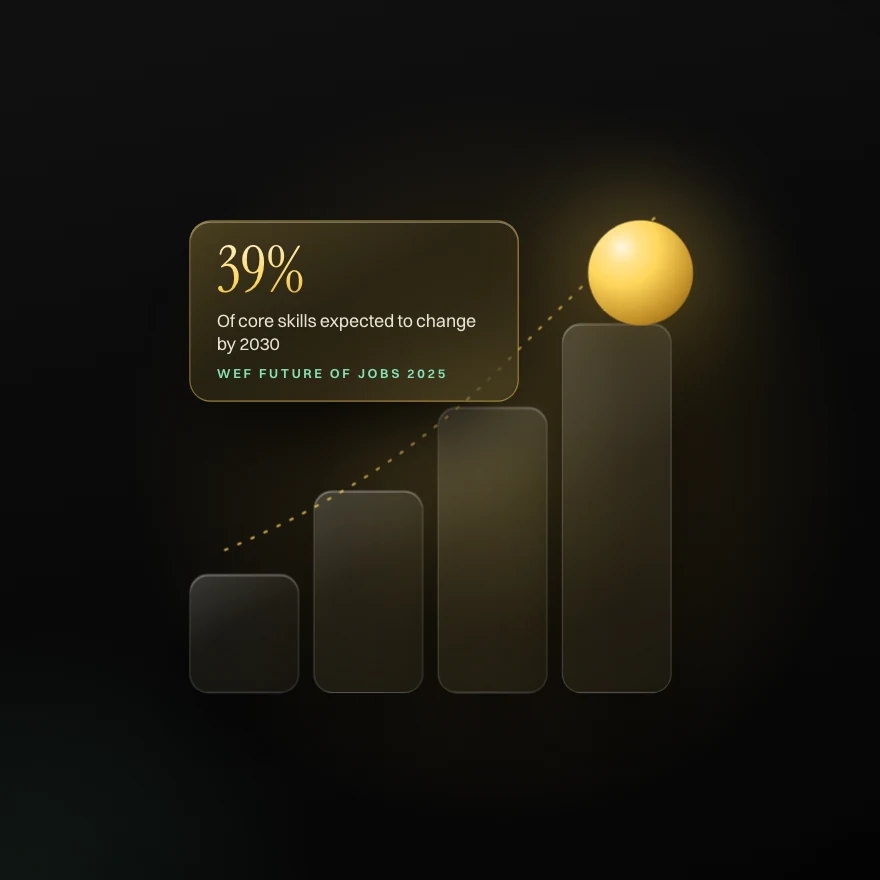
The WEF expects 39% of workers' core skills to change by 2030, and employers rank upskilling their workforce as the leading response1. Reskilling existing employees is often faster and cheaper than hiring, and keeps knowledge of the business in-house.
How to upskill for free
- Microsoft Learn, AWS Skill Builder and Google Cloud Skills Boost (free training tiers).
- Google Skillshop and HubSpot Academy for marketing.
- Science of Apps: 2,403 free certifications and skill tests across 29 categories.
- Internal knowledge-sharing sessions.
Prove it free: the tests that match this guide
Baseline skills free, then design the program. (Disclosure: Science of Apps publishes these tests.)
Choosing an upskilling platform
Look for content that maps to certifications, skills assessment, reporting by team, integration with your HR systems, and mobile access. See best LMS for corporate training.
Measuring success
Track leading indicators (enrolment, weekly activity), outcomes (certifications earned) and business impact (time saved, quality, internal moves). Calculate return with our training ROI guide.
Frequently asked questions
What is the difference between upskilling and reskilling?
Upskilling builds new skills for the current role; reskilling trains people for a different role.
What is the meaning of upskilling?
Learning new or more advanced skills to perform better in your current job, such as an analyst learning Power BI.
Why is upskilling important?
Skills are changing fast (WEF expects 39% of core skills to change by 2030), and upskilling is often faster and cheaper than hiring.
How can I upskill for free?
Use free training from Microsoft Learn, AWS Skill Builder, Google Skillshop, HubSpot Academy and free Science of Apps certifications.
Why is upskilling important?
The WEF expects 39% of workers' core skills to change by 2030, and employers rank upskilling their workforce as the leading response. Reskilling existing employees is often faster and cheaper than hiring, and keeps knowledge of the business in-house.
Sources
- World Economic Forum: Future of Jobs Report 2025
- Microsoft Learn
- AWS Skill Builder
- Science of Apps: free online certifications
- Checked November 11, 2026. Figures that change — fees, salaries, prices — are reviewed every six months; if something is out of date, tell us.
Where to go from here
- Benefits of employee training — the business benefits of employee training and certification, with data on reten
- Calculate training ROI — how to calculate training roi with a simple formula and a free calculator, plus
- Skills vs degree vs experience — skills vs degree vs experience
- Career guidesHow to get a learning and development (L&D) job in 2027: training needs analysis, programme design, facilitation, e-learning, career development, measuring impact and AI-powered learningHow to get an L&D job in 2027: training needs analysis, programme design, facilitation, e-learning, career development, measuring impact, AI learning and pay.
- CertificationsCorporate training platforms for teamsCompare the best corporate training platforms for certifying teams: features, pricing, reporting and integrations.
- Career guides by Science of Apps for 2027The top 10 certifications for laid-off tech workers in 2027: pivot into AI, cloud and securityThe top 10 certifications for laid-off tech workers in 2027: AWS ML Engineer, AI-102, CKA, Security+, CISSP, Databricks GenAI, PMP and more to pivot fast.
- CertificationsCalculate training ROIHow to calculate training ROI with a simple formula and a free calculator, plus benchmarks for certification programs.
- Product managementProduct manager vs project manager: what's the real difference?Product manager vs project manager: goals, responsibilities, skills, metrics, salaries in India and career paths compared — and how the two roles work together.
- CertificationsBest LMS for corporate trainingCompare the best learning platforms for corporate training and team certification, by features, pricing and reporting.
Get the ideas, not the noise.
Sign up with Google and we’ll send you short UX psychology tips by email — why people tap, stall and leave, and what to do about it. Unsubscribe anytime. Prefer something to keep? Get the free Laws of UX guide as a PDF.
Prove the skill before you pay for the exam.
1,200+ free, test-based certifications graded on our server. Pass and get a founder-signed certificate with a credential ID employers can verify.