 By
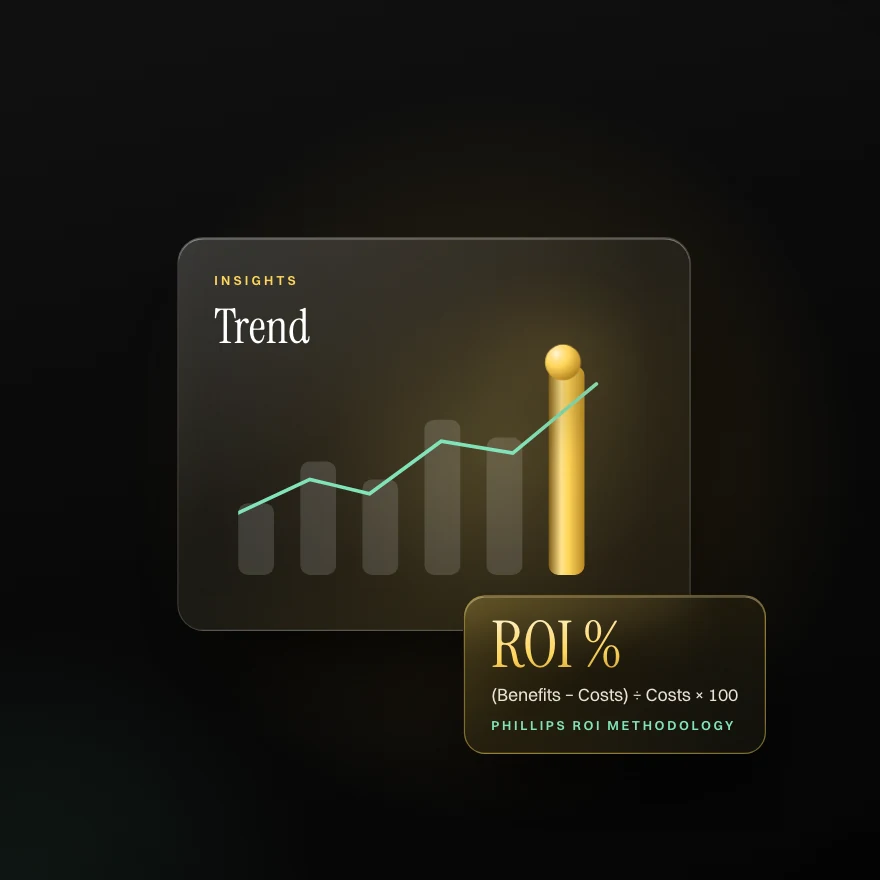
Quick answer: How do I calculate ROI for training?
- Formula — (Benefits − Costs) ÷ Costs × 100.
- Costs — fees, exams, time, admin.
- Benefits — time saved, errors avoided, hiring avoided.
- Isolate — estimate the share due to training.
- Models — Kirkpatrick levels + Phillips ROI.
Key takeaways
- Training ROI (%) = (Benefits − Costs) ÷ Costs × 100.
- Include employee time in costs; it's often the biggest item.
- Benefits come from time saved, quality, retention and avoided hiring.
- Kirkpatrick's four levels measure impact; Phillips adds ROI.
- Certifications provide a clear Level 2 (learning) measure.
The training ROI formula

Training ROI (%) = (Monetary benefits − Training costs) ÷ Training costs × 100
This is the core of the Phillips ROI Methodology, which adds steps to isolate training's effect from other factors and to convert results into money1.
Training ROI calculation example
| Item | Amount |
|---|---|
| Course licences (20 people) | $6,000 |
| Exam fees (20 × $150) | $3,000 |
| Employee time (20 people × 20 h × $25/h) | $10,000 |
| Admin and coordination | $1,000 |
| Total cost | $20,000 |
| Contractor spend avoided | $30,000 |
| Rework and errors reduced | $20,000 |
| Total annual benefit | $50,000 |
| ROI | (50,000 − 20,000) ÷ 20,000 × 100 = 150% |

Illustrative figures; use your own data.
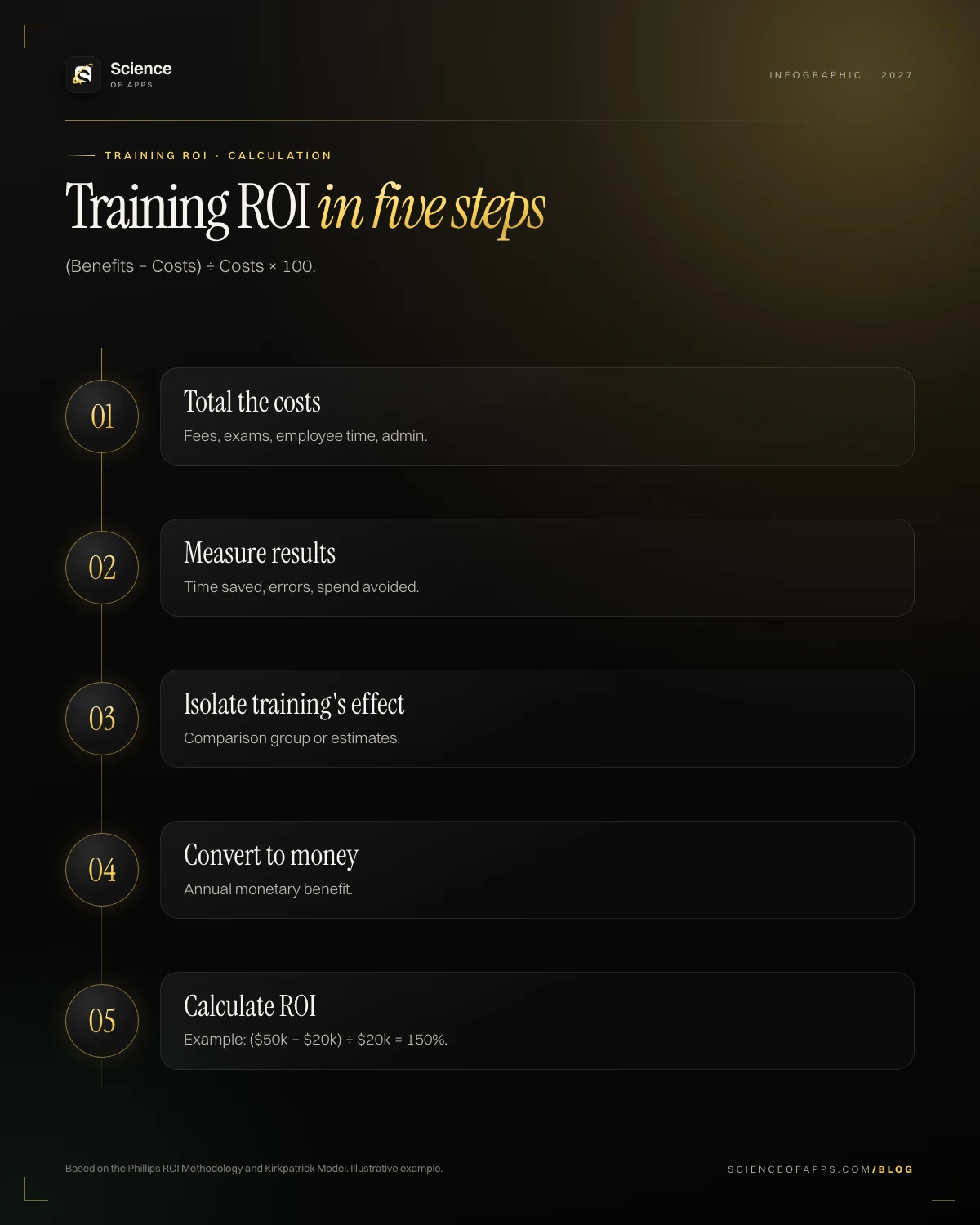
The Kirkpatrick model
| Level | Measures | Example metric |
|---|---|---|
| 1. Reaction | Did learners find it useful? | Survey score |
| 2. Learning | Did they learn? | Certification pass rate |
| 3. Behaviour | Do they apply it? | Manager observation, tool usage |
| 4. Results | Did the business improve? | Cost, quality, revenue |
Source: Kirkpatrick Partners2.
Where training benefits come from
- Time saved on tasks.
- Fewer errors, incidents or rework.
- Lower contractor or consultant spend.
- Avoided hiring costs through internal promotion.
- Better retention.
- Revenue from new capabilities or partner status.
Prove it free: the tests that match this guide
Measure training with credible assessments, at zero cost. (Disclosure: Science of Apps publishes these tests.)
- Learning and Development CertificationCovers training needs analysis, learning design and evaluation.Start free test →
- Training and Development CertificationPlan training with measurable outcomes from the start.Start free test →
- Business Analytics CertificationAnalyse training results and convert them into ROI.Start free test →
Tips for credible training ROI
- Agree on metrics before training starts.
- Use a comparison group where possible.
- Be conservative: ask managers to estimate the share of improvement due to training.
- Report intangible benefits separately.
Lower costs, higher ROI
Reducing cost raises ROI. Free skill assessments and certifications, such as Science of Apps' 2,403 free tests, cut baseline assessment costs to zero. See also benefits of employee training.
Frequently asked questions
How do I calculate ROI for training?
ROI (%) = (monetary benefits − training costs) ÷ training costs × 100, including employee time in costs.
What is a good training ROI?
Any positive ROI means benefits exceed costs; many organizations look for clearly positive results over 12 months.
What is the Kirkpatrick model?
A four-level model for evaluating training: reaction, learning, behaviour and results.
What is the Phillips ROI model?
An extension of Kirkpatrick that adds a fifth level, ROI, converting results to money and isolating training's effect.
What is the training ROI formula?
Training ROI (%) = (Monetary benefits − Training costs) ÷ Training costs × 100 This is the core of the Phillips ROI Methodology, which adds steps to isolate training's effect from other factors and to convert results into money.
Sources
- ROI Institute: the Phillips ROI Methodology
- Kirkpatrick Partners: the Kirkpatrick Model
- Science of Apps: free online certifications
- Checked November 11, 2026. Figures that change — fees, salaries, prices — are reviewed every six months; if something is out of date, tell us.
Where to go from here
- Build an upskilling program — how to build an employee upskilling and reskilling program with certifications,
- Skills vs degree vs experience — skills vs degree vs experience
- Benefits of employee training — the business benefits of employee training and certification, with data on reten
- CertificationsBenefits of employee trainingThe business benefits of employee training and certification: retention, productivity, internal promotion and ROI, plus how to ask your employer to pay.
- CertificationsCorporate training platforms for teamsCompare the best corporate training platforms for certifying teams: features, pricing, reporting and integrations.
- Career guidesHow to get a learning and development (L&D) job in 2027: training needs analysis, programme design, facilitation, e-learning, career development, measuring impact and AI-powered learningHow to get an L&D job in 2027: training needs analysis, programme design, facilitation, e-learning, career development, measuring impact, AI learning and pay.
- Tech stackWhat is an API? A plain-English explanation with a restaurant analogy and real app examplesWhat is an API? A plain-English explanation using a restaurant analogy, with real examples from UPI, maps and login, plus REST, keys, webhooks and security.
- CertificationsBest LMS for corporate trainingCompare the best learning platforms for corporate training and team certification, by features, pricing and reporting.
- CertificationsBuild an upskilling programHow to build an employee upskilling and reskilling programme with certifications: skills gaps, learning paths, protected time and measuring impact.


Get the ideas, not the noise.
Sign up with Google and we’ll send you short UX psychology tips by email — why people tap, stall and leave, and what to do about it. Unsubscribe anytime. Prefer something to keep? Get the free Laws of UX guide as a PDF.
Prove the skill before you pay for the exam.
1,200+ free, test-based certifications graded on our server. Pass and get a founder-signed certificate with a credential ID employers can verify.