 By
Quick answer: Why do companies pay for certifications?
- Skills — faster, better work.
- Retention — people stay where they grow.
- Promotion — cheaper than hiring.
- Compliance — required credentials.
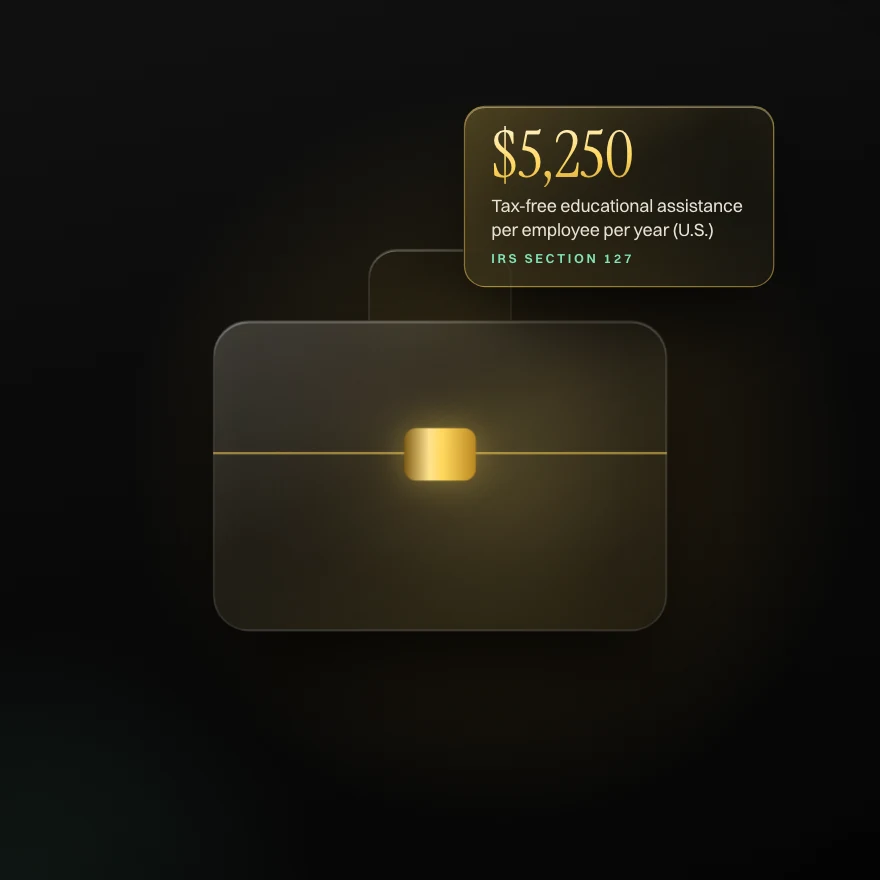
- Tax — up to $5,250/yr tax-free in the U.S. (Section 127).
Key takeaways
- Training improves skills, productivity, retention and internal mobility.
- Certifications give employers a measurable outcome for training spend.
- U.S. employers can give up to $5,250 per employee per year tax-free (Section 127).
- Employers aren't generally required to pay, but many do; required job training rules vary by location.
- Ask with a business case: skill, benefit, cost, timeline.
Benefits of employee training to the organization

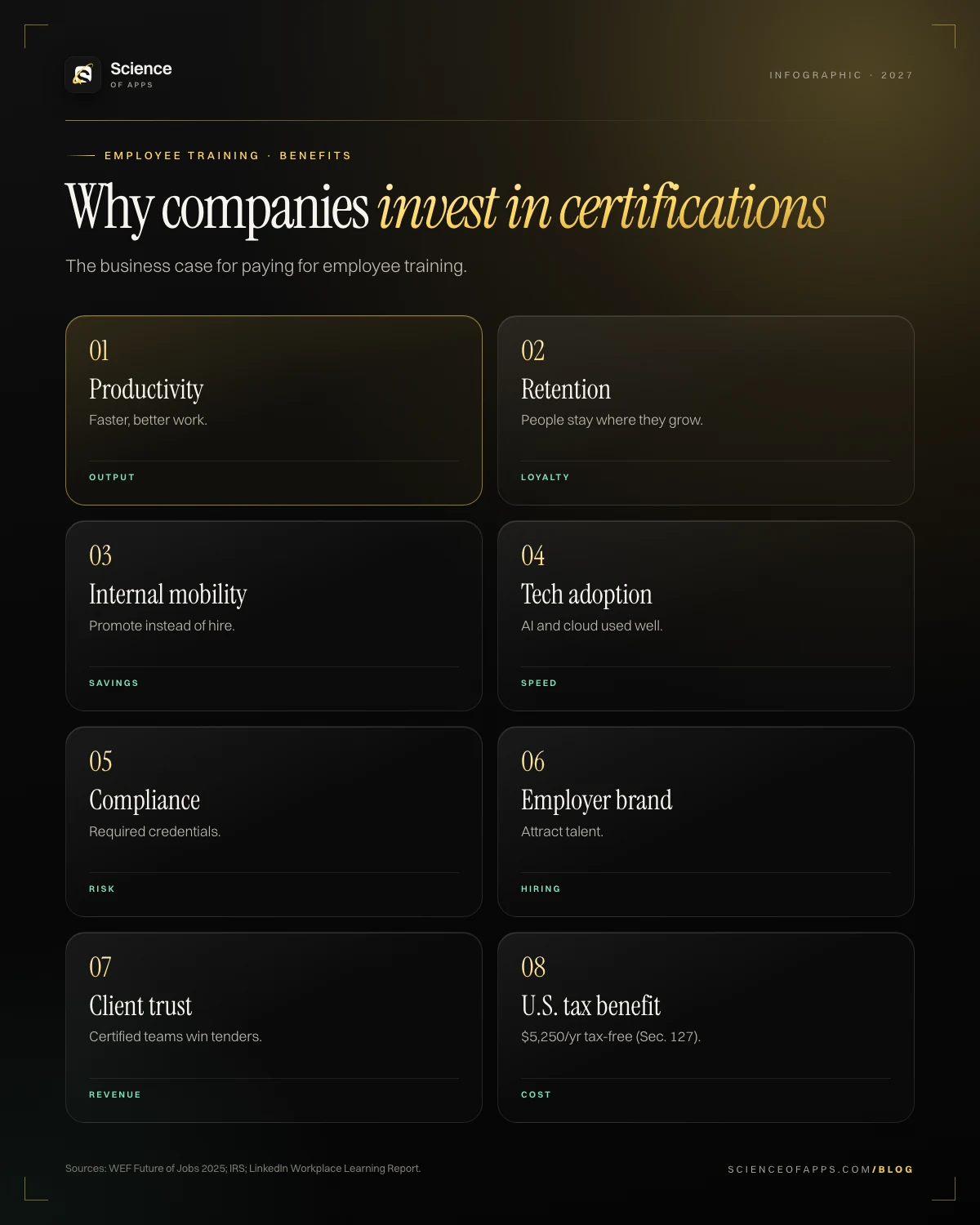
| Benefit | What it means |
|---|---|
| Productivity | Employees work faster and with fewer errors |
| Retention | People stay where they can grow |
| Internal mobility | Promote and redeploy instead of hiring |
| Technology adoption | Teams use new tools (AI, cloud) effectively |
| Compliance and safety | Required credentials and reduced risk |
| Employer brand | Learning opportunities attract talent |
| Client trust | Certified staff for partner status and tenders |
What the research says
The WEF's Future of Jobs Report 2025 expects 39% of workers' core skills to change by 2030 and identifies upskilling as the top workforce strategy for employers1. LinkedIn's Workplace Learning Reports have repeatedly found that employees value learning opportunities and are more likely to stay at companies that invest in their development2.
Do employers pay for certifications?
Many do, through learning budgets, tuition assistance or exam reimbursement, often with conditions such as passing the exam or staying for a period afterwards. In the U.S., Section 127 lets employers provide up to $5,250 per employee per year in tax-free educational assistance3.
Are employers required to pay for certifications?
Generally not, unless a law, contract or the employer requires the certification for the current job; rules on paying for required training and training time vary by country and state. Check local labour law or HR policy.
Prove it free: the tests that match this guide
Use free SOA certifications to train and verify skills across your team. (Disclosure: Science of Apps publishes these tests.)
- Learning and Development CertificationFor L&D leads making the business case.Start free test →
- Training and Development CertificationFor trainers delivering the programs companies pay for.Start free test →
- AI Tools for Workplace Productivity CertificationThe training employers fund most in 2027.Start free test →
How to ask your employer to pay
- Pick a certification tied to your current or next role.
- Explain the business benefit (e.g. reduce cloud costs, meet a client requirement).
- Give the full cost and timeline.
- Offer to share what you learn with the team.
- Agree on any repayment or stay conditions in writing.
Low-cost options for employers
Free, verifiable certifications let companies test skills and upskill at scale before funding expensive exams. Science of Apps offers 2,403 free certifications across 29 categories. See also how to build an upskilling program and training ROI.
Frequently asked questions
What are the benefits of employee training?
Higher productivity, better retention, internal promotion, faster technology adoption, compliance and a stronger employer brand.
Do employers pay for certifications?
Many do through learning budgets, tuition assistance or exam reimbursement, often with conditions.
Are employers required to pay for certifications?
Generally not unless required for the current job by law, contract or employer policy; rules vary by location.
What is company-sponsored certification?
A certification paid for (fully or partly) by the employer, usually tied to the employee's role.
What does research say about employee training?
The WEF's Future of Jobs Report 2025 expects 39% of workers' core skills to change by 2030 and identifies upskilling as the top workforce strategy for employers. LinkedIn's Workplace Learning Reports have repeatedly found that employees value learning opportunities and are more likely to stay at companies that invest in their development.
Sources
- World Economic Forum: Future of Jobs Report 2025
- LinkedIn Learning: Workplace Learning Report
- IRS: educational assistance programs (Section 127)
- Science of Apps: free online certifications
- Checked November 11, 2026. Figures that change — fees, salaries, prices — are reviewed every six months; if something is out of date, tell us.
Where to go from here
- Build an upskilling program — how to build an employee upskilling and reskilling program with certifications,
- Calculate training ROI — how to calculate training roi with a simple formula and a free calculator, plus
- Skills vs degree vs experience — skills vs degree vs experience
- CertificationsCalculate training ROIHow to calculate training ROI with a simple formula and a free calculator, plus benchmarks for certification programs.
- CertificationsCorporate training platforms for teamsCompare the best corporate training platforms for certifying teams: features, pricing, reporting and integrations.
- CertificationsBest tech, business & design certificationsThe best certifications in tech, business, design and marketing, ranked by salary impact, cost and employer demand.
- CertificationsBest LMS for corporate trainingCompare the best learning platforms for corporate training and team certification, by features, pricing and reporting.
- Career guidesBusiness case and ROI skills employers want in 2027: costs and benefits, ROI, payback, NPV and the time value of money, sensitivity analysis, risks and recommendationsBusiness case and ROI skills employers want in 2027: costs, benefits, ROI, payback, NPV, time value of money, sensitivity analysis and clear recommendations.
- Career guides by Science of Apps for 2027Which Certification Has the Best ROI in 2027? — answered for 2027Which certification has the best ROI in 2027? Cost vs US survey pay for AWS, CISSP, CISM and CISA, plus free options, with honest caveats.

Get the ideas, not the noise.
Sign up with Google and we’ll send you short UX psychology tips by email — why people tap, stall and leave, and what to do about it. Unsubscribe anytime. Prefer something to keep? Get the free Laws of UX guide as a PDF.
Prove the skill before you pay for the exam.
1,200+ free, test-based certifications graded on our server. Pass and get a founder-signed certificate with a credential ID employers can verify.