 By
Quick answer: Are courses with job placement worth it?
- Sometimes — if outcomes are published and audited.
- Read the guarantee — refunds often need strict conditions.
- Check placement rates — and how they're calculated.
- Own the credential — employers check the certification, not the promise.
- Free first — test the field with free certifications.
Key takeaways
- "Placement support" usually means career coaching and employer introductions, not a guaranteed job.
- Job-guarantee refunds often require many applications, location flexibility and deadlines.
- Ask for outcomes reported to a standard, such as CIRR-style reporting.
- PMP "with placement" programs provide training hours; PMI awards the PMP itself.
- The FTC warns about job-training schemes that promise guaranteed jobs or income.
What "job placement" really means

| Term | What it usually includes | What to check |
|---|---|---|
| Placement support | Résumé review, mock interviews, job board access | Is there 1:1 coaching? |
| Placement assistance | Introductions to hiring partners | Which employers hired graduates? |
| Job guarantee | Refund if not hired within a set period | Conditions: applications, location, deadlines |
| Income share agreement | Pay a % of salary after hiring | Total cap and minimum salary |
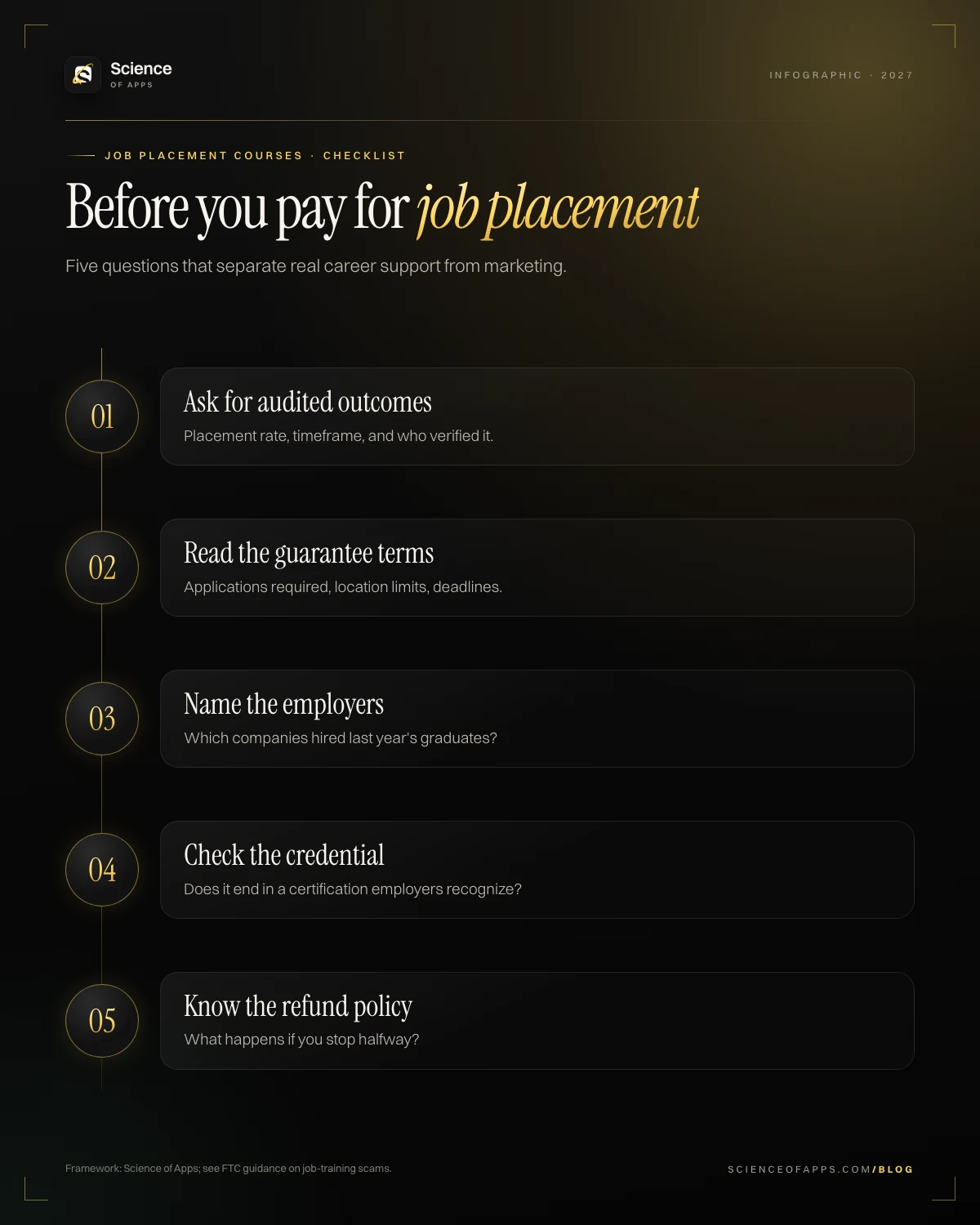
Five questions to ask before you pay
- What percentage of graduates got a job in the field within 6 months, and who audited it?1
- What exactly do I have to do to qualify for the guarantee?
- Which employers hired graduates last year?
- Does the course lead to a recognized certification (AWS, PMP, CompTIA, Salesforce)?
- What's the refund policy if I drop out?
PMP certification with placement
PMP training programs "with placement" provide the 35 contact hours PMI requires plus career support. PMI, not the training provider, awards the PMP after you meet the experience requirements and pass the exam3.
Prove it free: the tests that match this guide
Placement programs screen candidates with skills tests. Practise with the ones they use most. (Disclosure: Science of Apps publishes these tests.)
- General Aptitude TestAptitude rounds are the first filter in most placement drives.Start free test →
- Communication Skills TestPlacement interviews screen hard for communication.Start free test →
- Job Interview TestPrepare for the interview stage of placement programs.Start free test →
- Microsoft Excel Certification Test (Fundamentals)Excel tasks appear in many entry-level placement tests.Start free test →
Red flags
- Guaranteed jobs or salaries with no conditions shown.
- Pressure to pay today.
- Placement rates with no methodology.
- Upfront fees for "job registration". The U.S. FTC warns about schemes like this2.
Which online course is best for getting a job?
The ones that end in a credential employers name: AWS, Microsoft, CompTIA, Salesforce, Google Career Certificates or PMP/CAPM. Prove the skills along the way with free, verifiable Science of Apps certifications.
Frequently asked questions
Which online course is best for a job?
One that leads to a certification employers name in job ads (AWS, Microsoft, CompTIA, Salesforce, PMP/CAPM, Google Career Certificates), plus a portfolio project.
Are job guarantee courses real?
Some are, but refunds usually come with strict conditions. Read the terms and ask for audited outcomes.
Do PMP courses come with placement?
Some training providers add career support, but PMI awards the PMP; the provider can't guarantee it.
What are the red flags in courses that promise job placement?
Be wary of guaranteed jobs or salaries with no conditions shown, pressure to pay today, placement rates with no stated method, and upfront fees for 'job registration', which the U.S. FTC warns about. Before paying, ask what share of graduates got a job in the field within six months, who audited that figure and which employers hired them.
Can you get a PMP certification with placement?
PMP training programs "with placement" provide the 35 contact hours PMI requires plus career support. PMI, not the training provider, awards the PMP after you meet the experience requirements and pass the exam.
Sources
- Council on Integrity in Results Reporting (CIRR)
- U.S. FTC: job training and education scams
- PMI: PMP certification
- Science of Apps: free online certifications
- Checked November 11, 2026. Figures that change — fees, salaries, prices — are reviewed every six months; if something is out of date, tell us.
Where to go from here
- LinkedIn Learning vs Udemy — linkedin learning vs udemy compared, plus 8 alternatives with stronger certifica
- Affordable certifications that pay well — affordable online certifications under $100 that employers respect, with real co
- The best Udemy alternatives — the 10 best udemy alternatives for learners who want recognized certificates, be
- CertificationsMost popular certifications by countryThe most popular certifications and online courses by country: global favourites like AWS and PMP, and local ones such as PRINCE2, NISM and Red Seal.
- CertificationsCertifications to get a job fastThe best certifications to get a job fast in the USA: CompTIA A+, Google certificates, CDL, CNA, AWS and more, with time to complete, cost and demand.
- CertificationsJobs that only need a certification30 well-paying jobs that need only a certification or licence, not a degree: IT support, coding, trades, healthcare and more, with time, cost and pay.
- CertificationsAre certifications worth it?Do certifications help you get hired? What recruiters and hiring data say about when certifications are worth it, and when they aren't.
- Career guides by Science of Apps for 2027Online certification courses: a 2027 buyer's guide to choosing one that's worth your moneyHow to choose an online certification course in 2027: check the issuer, the assessment, the real cost and the job fit, plus 10 safe picks by goal.
- CertificationsOnline courses with lifetime accessWhat 'lifetime access' really means on course platforms such as Udemy, which ones include certificates and whether lifetime access is worth paying for.
Get the ideas, not the noise.
Sign up with Google and we’ll send you short UX psychology tips by email — why people tap, stall and leave, and what to do about it. Unsubscribe anytime. Prefer something to keep? Get the free Laws of UX guide as a PDF.
Prove the skill before you pay for the exam.
1,200+ free, test-based certifications graded on our server. Pass and get a founder-signed certificate with a credential ID employers can verify.