 By
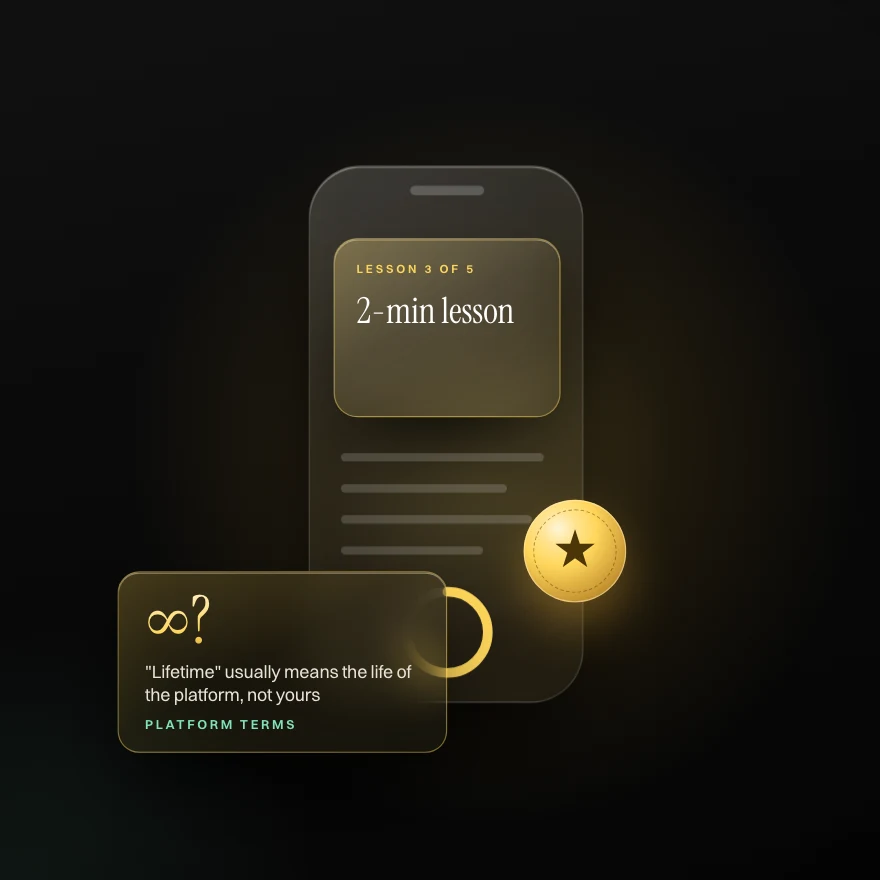
Quick answer: Is lifetime access worth it?
- Good for — reference material you'll revisit.
- Read the terms — access usually lasts while the platform offers the course.
- Subscriptions — access ends when you stop paying.
- Download? — usually not allowed, check the app.
- Real value — the skill and a verifiable certification.
Key takeaways
- "Lifetime access" is defined by the platform's terms, usually the life of the course on that platform.
- Per-course marketplaces (like Udemy) typically include lifetime access to purchases.
- Subscriptions (Coursera Plus, LinkedIn Learning) end access when you stop paying.
- Lifetime access helps for reference courses; for proof, earn a certification.
- Keep your own notes and project files; they're the only truly lifetime copy.
What lifetime access really means

Platforms that sell individual courses often promise lifetime access. Under Udemy's terms, for example, you get access to purchased content for as long as Udemy offers it, and Udemy can remove courses for licensing or policy reasons1. So "lifetime" means the lifetime of the course on that platform.
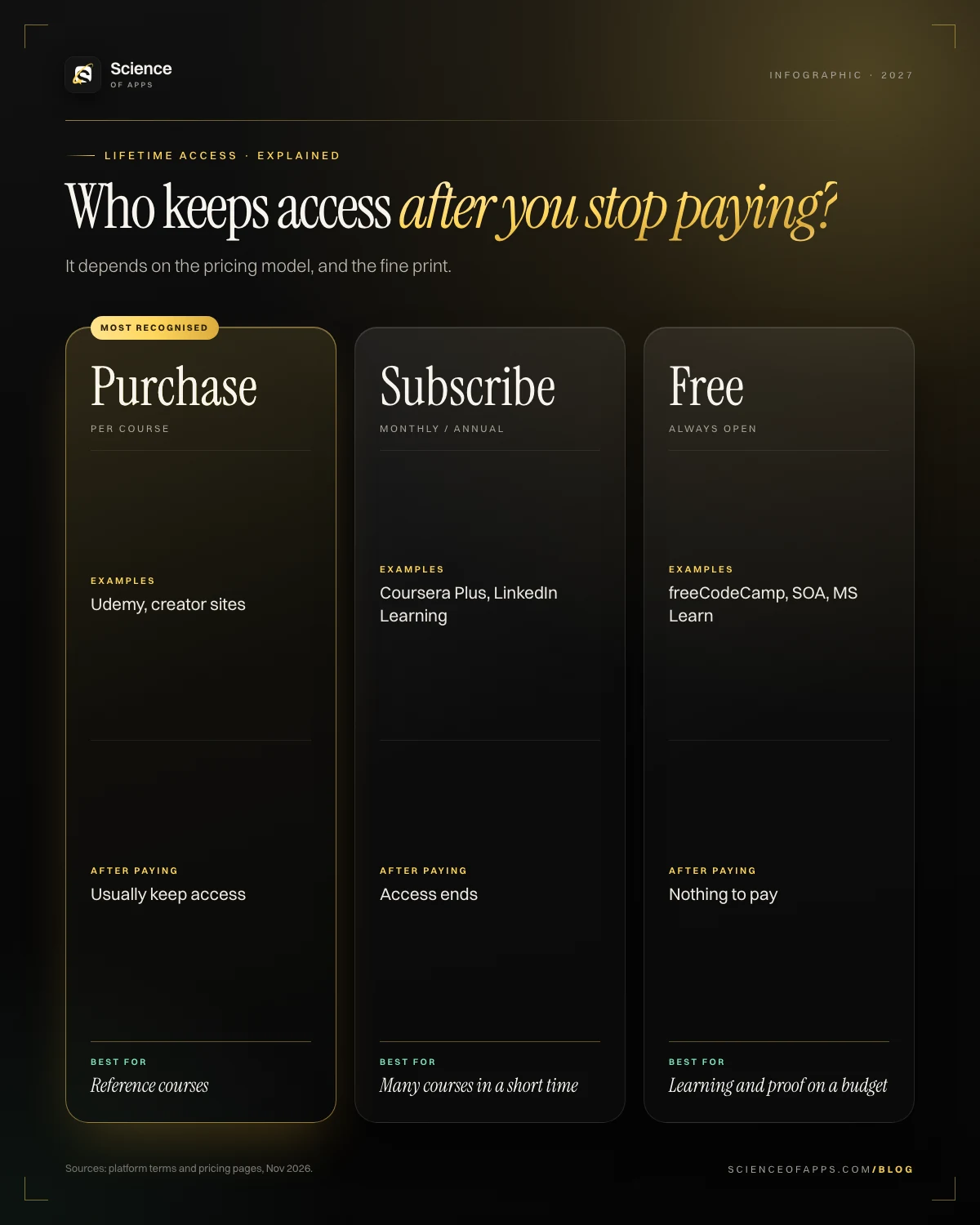
| Model | Examples | Access after you stop paying |
|---|---|---|
| Per-course purchase | Udemy, many creator platforms | Usually yes (per terms) |
| Subscription | Coursera Plus, LinkedIn Learning, Skillshare | No |
| Free | freeCodeCamp, Microsoft Learn, Science of Apps | Always free |
When lifetime access is worth it
- Reference courses you'll revisit (Excel, SQL, design tools).
- Exam-prep courses you may need again for renewal.
- Topics that change slowly.
Prove it free: the tests that match this guide
Lifetime access is only worth it if you can prove what you learned. Test yourself free. (Disclosure: Science of Apps publishes these tests.)
- Study Skills TestCheck the study habits that make lifetime-access courses pay off.Start free test →
- Time Management and Prioritization CertificationFinishing self-paced courses is mostly a time-management problem.Start free test →
- Python Programming CertificationA graded check after a self-paced coding course.Start free test →
When it isn't
- Fast-moving tech where courses go out of date quickly.
- When a subscription would be cheaper for many courses.
- When what you need is a credential, not more content.
Make your learning truly lifetime
- Keep your own notes (see our note-taking methods guide).
- Save project files to your portfolio.
- Earn a verifiable certification so the proof outlives the course.
Frequently asked questions
Does lifetime access mean forever?
It means for as long as the platform keeps offering the course under its terms, not forever in a legal sense.
Which platforms offer lifetime access?
Per-course marketplaces such as Udemy typically include lifetime access to purchased courses. Subscriptions do not.
Is lifetime access worth paying for?
For reference material you'll revisit, yes. For career proof, a certification matters more.
What happens to course access when a subscription ends?
You lose it. Subscriptions such as Coursera Plus, LinkedIn Learning and Skillshare give access only while you pay. Per-course purchases on Udemy and many creator platforms usually stay available under the platform's terms, and free resources such as freeCodeCamp, Microsoft Learn and Science of Apps stay free. Keep your own notes and project files either way.
What does lifetime access mean on online courses?
Platforms that sell individual courses often promise lifetime access. Under Udemy's terms, for example, you get access to purchased content for as long as Udemy offers it, and Udemy can remove courses for licensing or policy reasons. So "lifetime" means the lifetime of the course on that platform.
Sources
- Udemy Terms of Use (lifetime access)
- Coursera Plus pricing
- LinkedIn Learning
- Science of Apps: free online certifications
- Checked November 11, 2026. Figures that change — fees, salaries, prices — are reviewed every six months; if something is out of date, tell us.
Where to go from here
- Affordable certifications that pay well — affordable online certifications under $100 that employers respect, with real co
- The best certification apps — the best apps for learning on your phone and earning real certificates, compared
- Certification courses with job placement — online certification courses that include job placement support
- CertificationsAccredited vs non-accreditedWhat does 'accredited' really mean for a certification? How accreditation works and why it matters to employers.
- CertificationsIs Udemy worth it?Is Udemy worth it in 2027? What a Udemy certificate means to employers, and when a professional certification is the better choice.
- CertificationsMicro-credentials vs degreesWhat micro-credentials are, how they compare with degrees on cost, time and recognition, and whether they will replace traditional college.
- Career guides by Science of Apps for 2027Top 10 certifications and courses for 2027, ranked by what holders earn, and what that number really meansThe top 10 certifications for 2027 ranked by salary: CISSP, CISM, AWS Solutions Architect and CISA lead US pay data. See costs, prerequisites and links.
- CertificationsCertification costs comparedHow much do Coursera, Udemy, edX, LinkedIn Learning and other platforms really cost? Full pricing comparison for 2027.
- CertificationsCertification courses with job placementOnline certification courses that include job placement support: what they really offer, what they cost and red flags to watch for.
Get the ideas, not the noise.
Sign up with Google and we’ll send you short UX psychology tips by email — why people tap, stall and leave, and what to do about it. Unsubscribe anytime. Prefer something to keep? Get the free Laws of UX guide as a PDF.
Prove the skill before you pay for the exam.
1,200+ free, test-based certifications graded on our server. Pass and get a founder-signed certificate with a credential ID employers can verify.