 By
Quick answer: Which cybersecurity certification should I get first?
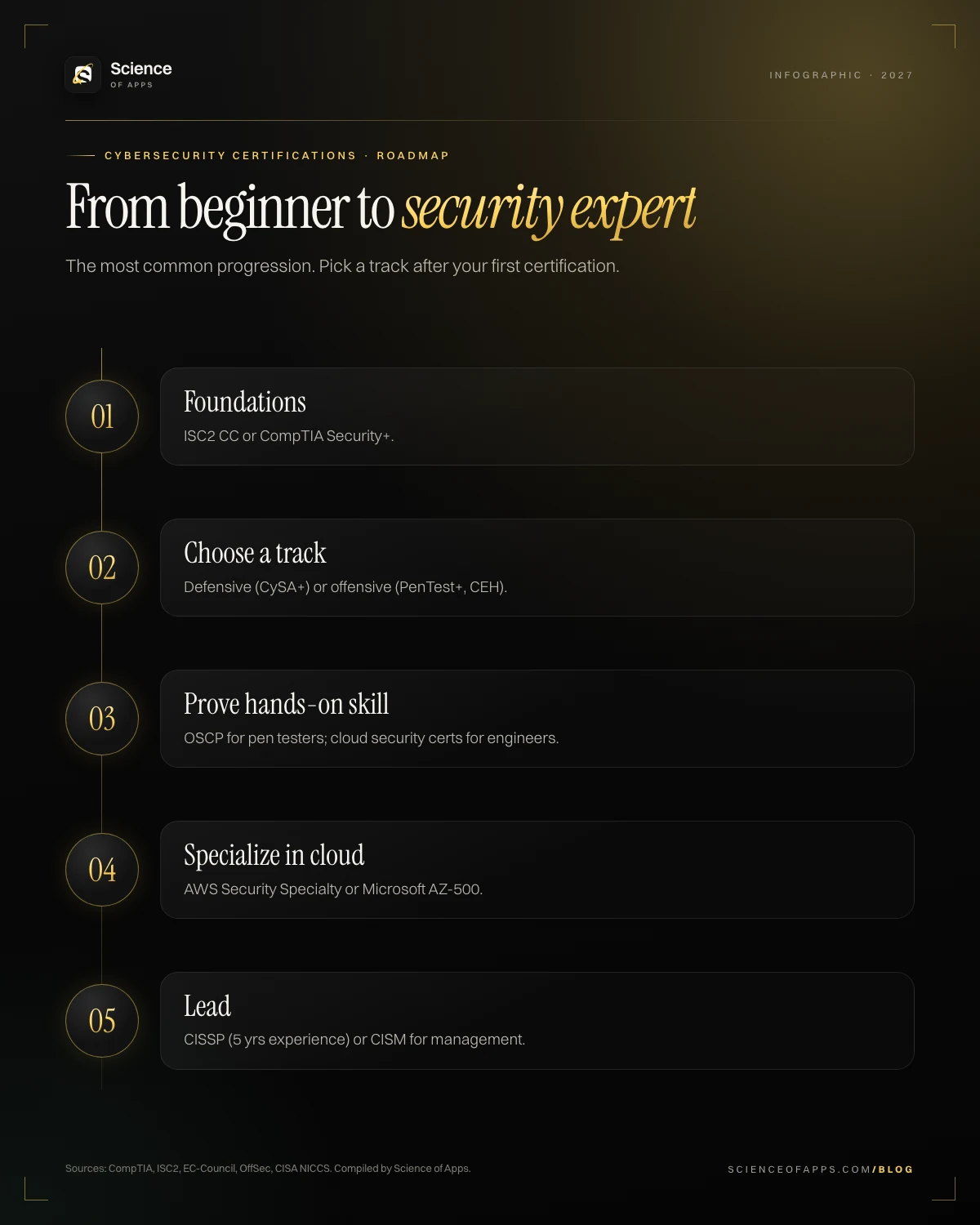
- Beginner — ISC2 CC or CompTIA Security+.
- Analyst — CompTIA CySA+.
- Offensive — PenTest+, CEH, then OSCP.
- Senior — CISSP (5 yrs experience) or CISM.
- Cloud — AWS Security Specialty or AZ-500.
Key takeaways
- Start with Security+ (or ISC2 CC); it's the most requested entry credential.
- Choose a track: defensive (CySA+), offensive (PenTest+, CEH, OSCP) or management (CISM).
- CISSP requires five years of paid security experience (or an associate path).
- Cloud security is a fast-growing specialty: AWS Security Specialty, AZ-500.
- Free starts: Cisco NetAcad Intro to Cybersecurity and Science of Apps security skill tests.
The cybersecurity certifications roadmap

| Level | Certifications | Who it's for |
|---|---|---|
| Beginner | ISC2 CC, CompTIA Security+1 | Career starters, IT staff |
| Analyst | CompTIA CySA+ | SOC analysts |
| Offensive | PenTest+, CEH3, OSCP | Penetration testers |
| Cloud | AWS Security Specialty, AZ-500 | Cloud security engineers |
| Senior | CISSP2, CISM, CISA | Architects, managers, auditors |
Best cybersecurity certifications for beginners
ISC2 Certified in Cybersecurity (CC) covers security principles with no experience required. CompTIA Security+ goes deeper and is named in many job ads and U.S. government roles. Free preparation: Cisco Networking Academy's Introduction to Cybersecurity and Professor Messer's free Security+ videos.
CISSP vs CEH
They target different careers. CEH is an offensive, ethical-hacking credential for practitioners. CISSP is a broad, senior credential for architects and leaders and needs five years of experience across its domains. Most people earn CEH or OSCP earlier, and CISSP later.
Free cybersecurity certifications
- Cisco NetAcad: Introduction to Cybersecurity (free certificate).
- Science of Apps: free security, cloud and DevOps skill tests (289 in the category).
- Vendor training: AWS Skill Builder security courses, Microsoft Learn security paths.
Cybersecurity career paths and certifications
SOC analyst (Security+ → CySA+), penetration tester (PenTest+ → OSCP), cloud security engineer (Security+ → AWS Security Specialty), GRC analyst (Security+ → CISA/CRISC), security architect (CISSP). The U.S. CISA NICCS catalogue maps certifications to roles4.
Why Security+ is the usual first step
Security+ is vendor-neutral, covers the broad baseline employers expect, includes performance-based questions, and is approved for many U.S. Department of Defense roles. For beginners with no IT background, ISC2's Certified in Cybersecurity is a gentler start.
Prove it free: the tests that match this guide
Follow the roadmap with free SOA practice at each stage (independent of the exam bodies). (Disclosure: Science of Apps publishes these tests.)
- Cybersecurity Certification Test (Fundamentals)Beginner stage: check core security concepts before paying for exams.Start free test →
- CompTIA Security+ Practice TestEntry stage: practise for Security+, the roadmap's first big exam.Start free test →
- SOC Certification Test (Security Operations Center)Analyst stage: SOC scenarios match the first security job most people land.Start free test →
- CISSP Practice TestSenior stage: practise for CISSP, the roadmap's leadership credential.Start free test →
OSCP: the hands-on benchmark
OffSec's OSCP requires you to compromise machines in a long practical exam and write a professional report. It's respected because it can't be passed by memorisation alone. Most people attempt it after a year or more of practice.
CISSP requirements
CISSP requires five years of cumulative, paid work experience in two or more of its eight domains (a degree or approved credential can waive one year). Candidates without the experience can pass the exam and become an Associate of ISC2 while they earn it.
Cloud security certifications
As workloads move to the cloud, AWS Security – Specialty, Microsoft AZ-500 and the vendor-neutral CCSP are increasingly requested for security engineers.
Common mistakes
- Chasing advanced certifications (CISSP, OSCP) before the basics.
- Skipping hands-on practice; set up a home lab or use free platforms like TryHackMe's free rooms.
- Collecting certifications without a track. Pick defence, offence, cloud or GRC.
Frequently asked questions
Which cybersecurity certification should I get first?
CompTIA Security+ or ISC2 Certified in Cybersecurity (CC). Security+ is the most requested in entry-level job ads.
CISSP or CEH: which is better?
CEH suits early-career ethical hackers; CISSP suits senior professionals with five years of experience. They serve different career stages.
Are there free cybersecurity certifications?
Cisco NetAcad's Introduction to Cybersecurity and Science of Apps security skill tests are free; most industry exams are paid.
What is the cybersecurity certifications roadmap?
Security+ → CySA+ or PenTest+/CEH → OSCP → CISSP or CISM, with cloud security certifications as a specialty.
What are the best cybersecurity certifications for beginners?
ISC2 Certified in Cybersecurity (CC) covers security principles with no experience required. CompTIA Security+ goes deeper and is named in many job ads and U.S. government roles. Free preparation: Cisco Networking Academy's Introduction to Cybersecurity and Professor Messer's free Security+ videos.
Sources
- CompTIA certifications
- ISC2 certifications (CC, CISSP)
- EC-Council: Certified Ethical Hacker
- CISA NICCS: cybersecurity certifications
- Offensive Security: OSCP
- Science of Apps: free online certifications
- Checked November 11, 2026. Figures that change — fees, salaries, prices — are reviewed every six months; if something is out of date, tell us.
Where to go from here
- Scrum Master: CSM vs PSM vs SAFe — csm vs psm vs safe compared on cost, difficulty, renewal and employer demand
- The best data science certifications — the best data science certifications for 2027, from free options to university p
- The CompTIA certification path — in what order should you take comptia a+, network+ and security+? the complete c
- Career guides by Science of Apps for 2027The cybersecurity certification roadmap for 2027: from first IT job to CISSPA cybersecurity certification roadmap for 2027: Google Cybersecurity or ISC2 CC, A+ and Network+, Security+, then CEH or CCNA, then CISSP, CISM or CISA.
- CertificationsThe Azure certification pathThe Microsoft Azure certification path explained, from AZ-900 Fundamentals to Expert, with costs, prerequisites and study plans.
- Career guides by Science of Apps for 2027The best cybersecurity certifications of 2027: ten from first job to CISOThe 10 best cybersecurity certifications of 2027: CompTIA Security+, ISC2 CC, CISSP, CISM, CISA, CEH, Google Cybersecurity, CCNA and more, with fees.
- Career guides by Science of Apps for 2027Top 5 cybersecurity certifications to get hired in 2027: the ones security job posts nameThe top 5 cybersecurity certifications to get hired in 2027: CompTIA Security+, CISSP, CEH, ISC2 CC and CISM, matched to security job titles.
- CertificationsPower BI PL-300 & Excel certificationHow to earn the Power BI PL-300 and Microsoft Excel certifications: exam format, cost, study plan and career value.
- CertificationsMedical coding certificationHow to get a medical coding certification: CPC vs CCS vs CCA, online programmes, exam fees ($425–$499 for the CPC), study time and salaries.






Get the ideas, not the noise.
Sign up with Google and we’ll send you short UX psychology tips by email — why people tap, stall and leave, and what to do about it. Unsubscribe anytime. Prefer something to keep? Get the free Laws of UX guide as a PDF.
Prove the skill before you pay for the exam.
1,200+ free, test-based certifications graded on our server. Pass and get a founder-signed certificate with a credential ID employers can verify.