CISSP Practice Test
Tests readiness for CISSP across its eight domains — grouped as security and risk management with asset security, architecture and network security, identity, access and security assessment, and security operations and software security — with manager-level scenario questions. Pass to earn CISSP Exam Readiness SOA-CSSP.
- Advanced difficulty.Assumes years in the role or deep specialist knowledge.
- 20 scenario questions
- 20 minutes, timed
- 70% to pass · 90% for distinction
- Free no sign-up needed
- LinkedIn-ready · add it to your profile in one clickSee how ↓

 Founder, Science of Apps
What is the CISSP Practice Test?
The CISSP Practice Test is a free 20-minute skill test from Science of Apps. It tests readiness for CISSP across its eight domains — grouped as security and risk management with asset security, architecture and network security, identity, access and security assessment, and security operations and software security — with manager-level scenario questions. Score 70% or more on its 20 questions to earn a verifiable CISSP Exam Readiness certificate (SOA-CSSP). Every question is based on published standards and research — including CISSP certification (ISC2), SP 800-34 Rev. 1: Contingency Planning Guide (NIST), General Data Protection Regulation (full text) (gdpr-info.eu) — and each answer is explained with its source.
Built for your job title
Security manager, Security architect, CISO or aspiring CISO, Senior security analyst and Security consultant — and anyone who wants quick, verifiable proof of CISSP skills for a CV or LinkedIn.
- Security manager
- Security architect
- CISO or aspiring CISO
- Senior security analyst
- Security consultant
What the test covers
Four skill areas with 5 questions each, drawn from a bank of 10 per area, so a retake brings questions you haven't seen.
- 01
Security and Risk Management with Asset Security
25%- Governance, risk and compliance
- Legal and ethics
- Data classification and handling
- 02
Security Architecture and Network Security
25%- Security models and engineering
- Cryptography
- Network architecture and protocols
- 03
Identity, Access and Security Assessment
25%- Identity and access management
- Federation and authorisation
- Audits and testing
- 04
Security Operations and Software Development Security
25%- Investigations and incident management
- Recovery and resilience
- Secure SDLC
Independent practice test. Science of Apps is not affiliated with, endorsed by or sponsored by ISC2. Product and exam names are trademarks of their owners. Passing earns a Science of Apps certificate, not the official exam credential.
Based on published standards
The questions are original scenarios, and each one names the public standard, official guide or research it draws on — shown under the question while you answer, and linked in your review. These are the sources behind this test:
- CISSP certificationISC233 questions
- SP 800-34 Rev. 1: Contingency Planning GuideNIST3 questions
- General Data Protection Regulation (full text)gdpr-info.eu1 question
- SOC 2: Trust Services CriteriaAICPA & CIMA1 question
- OWASP Top 10OWASP1 question
- SP 800-61r3: Incident Response RecommendationsNIST1 question
Try a sample question
What is the primary goal of information security governance?
- Passing every audit
- Buying the latest security tools
- Aligning security with business objectives
- Eliminating all risk
Show the answer
C. Aligning security with business objectives — Governance ensures security supports the organisation's mission and risk appetite. The real test has 20 questions like this.
How the test works
20 minutes, 20 questions
One question per screen, with a progress bar and a countdown. Your progress is saved on this device if you need to pause.
Graded on our server
Answers reach the page only after you submit, so the certificate can only be earned by passing.
Every answer explained
Pass or not, you see every question with the right answer, why, and the source behind it. Pass mark 70%, distinction 90%.
Your certificate
Founder-signed, with a QR code and credential ID. Download PDF or PNG, add to LinkedIn, and it's emailed to you.
What you earn
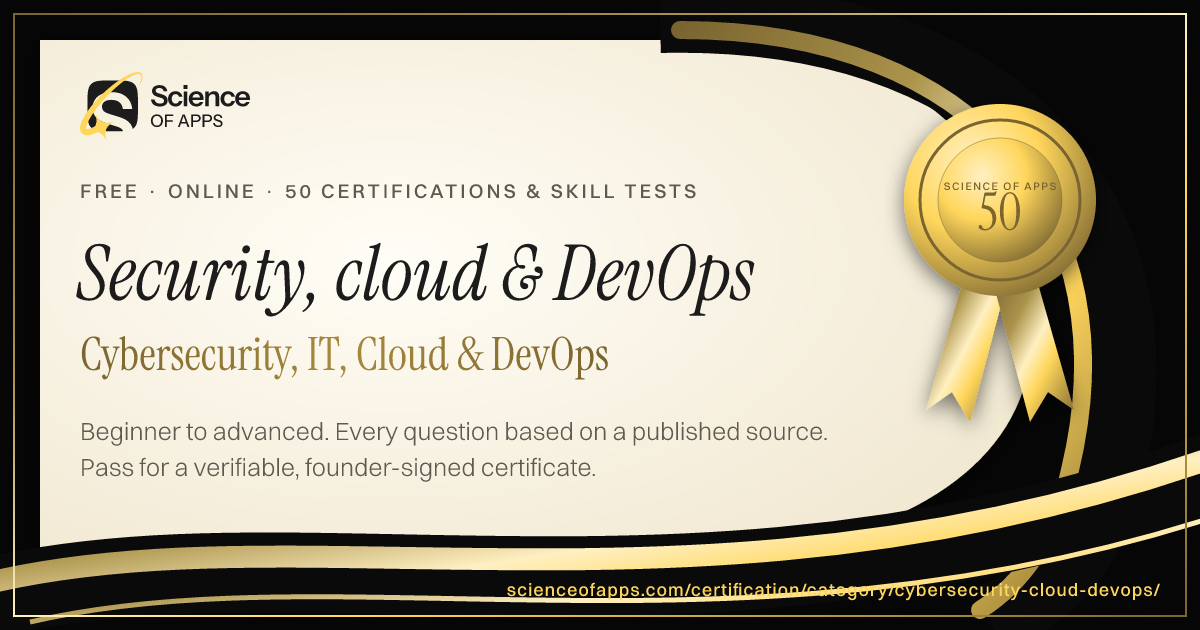
Pass, then add it to LinkedIn in one click
No typing. The Add to LinkedIn button opens your profile’s Licenses & certifications form already filled in: the certificate name, Science of Apps as the issuer, the issue date, your credential ID and a link recruiters can use to verify it.
- 1Take the 20-minute test
- 2Score 70% or more
- 3Click Add to LinkedIn

CISSP Exam Readiness
Science of Apps
Show credential ↗Try another skill test
- 10 minSOA-CYF
Cybersecurity Fundamentals Certification
Tests core cybersecurity — the CIA triad, common threats, NIST CSF 2.0, authentication and MFA, patching, backups, encryption basics and security culture.
Difficulty: BeginnerTake the 10-minute test → - 10 minSOA-SAPD
Security Awareness and Phishing Detection Certification
Tests everyday security awareness — spotting phishing emails, texts and calls, suspicious links and attachments, safe reporting, passwords, MFA fatigue and deepfake scams.
Difficulty: BeginnerTake the 10-minute test → - 15 minSOA-NSF
Network Security Fundamentals Certification
Tests network security — firewalls and segmentation, VPNs and zero trust, TLS, DNS security, common ports, IDS/IPS, Wi-Fi security and DDoS basics.
Difficulty: IntermediateTake the 15-minute test →
Frequently asked questions
What is the CISSP Practice Test?
The CISSP Practice Test is a free 20-minute skill test from Science of Apps. It tests readiness for CISSP across its eight domains — grouped as security and risk management with asset security, architecture and network security, identity, access and security assessment, and security operations and software security — with manager-level scenario questions. Score 70% or more on its 20 questions to earn a verifiable CISSP Exam Readiness certificate (SOA-CSSP). Every question is based on published standards and research — including CISSP certification (ISC2), SP 800-34 Rev. 1: Contingency Planning Guide (NIST), General Data Protection Regulation (full text) (gdpr-info.eu) — and each answer is explained with its source.
How do I take the CISSP Practice Test for free?
Read the four skill areas on this page, then take the 20-minute test online — no fee, course or sign-up. You see every answer explained when you finish. Score 70% or more and you get a CISSP Exam Readiness certificate straight away, on screen, as a PDF and by email, with a credential ID anyone can verify.
Are the CISSP Practice Test questions based on real standards?
Yes. The questions are original scenarios written by Science of Apps, and each one is based on a public source you can read: CISSP certification (ISC2); SP 800-34 Rev. 1: Contingency Planning Guide (NIST); General Data Protection Regulation (full text) (gdpr-info.eu); SOC 2: Trust Services Criteria (AICPA & CIMA); OWASP Top 10 (OWASP); SP 800-61r3: Incident Response Recommendations (NIST). The source is shown under each question and linked in the answer review. Science of Apps doesn't copy questions from other tests.
What does the CISSP Practice Test cover?
Four skill areas with five questions each, drawn from a bank of 10 per area so a retake brings new questions: Security and Risk Management with Asset Security (Governance, risk and compliance, Legal and ethics and Data classification and handling); Security Architecture and Network Security (Security models and engineering, Cryptography and Network architecture and protocols); Identity, Access and Security Assessment (Identity and access management, Federation and authorisation and Audits and testing); Security Operations and Software Development Security (Investigations and incident management, Recovery and resilience and Secure SDLC). Every question is an original scenario based on a published standard, official documentation or research, named under the question.
Who should take the CISSP Practice Test?
Security manager, Security architect, CISO or aspiring CISO, Senior security analyst and Security consultant. It suits anyone who wants a quick, verifiable way to show CISSP skills, from students and career switchers to experienced professionals.
How should I approach CISSP questions?
CISSP rewards a manager's and risk adviser's mindset: protect people first, align security with business objectives, prefer governance and process over quick technical fixes, and choose the "best" answer among several reasonable ones. The exam has eight domains; this practice test samples all of them in four areas.
Is this the official CISSP exam?
No. It is an independent practice test written to the publicly available CISSP content outline, for checking your readiness before you book the real exam. Science of Apps is not affiliated with ISC2, and passing earns a Science of Apps certificate rather than the official credential.
Can I take the CISSP Practice Test from any country?
Yes. The test is online, in English and free everywhere — people take it from India, the US, the UK, Europe, Africa, Latin America and Asia-Pacific. Your certificate is dated with your own local date and can be verified from anywhere at scienceofapps.com/certification/verify/.
How long is the CISSP Practice Test?
20 questions — 5 from each of 4 skill areas — with a 20-minute limit. You need 70% (14 of 20) to pass and 90% for distinction.
How hard is the CISSP Practice Test?
We rate it Advanced: assumes years in the role or deep specialist knowledge. It has 20 scenario questions — 5 from each of 4 skill areas — and a 20-minute limit. You need 70% (14 of 20) to pass and 90% for distinction.
How much do Science of Apps certifications cost?
Nothing. There is no fee to take a test, to receive the certificate, to have it emailed or to verify it, and no sign-up.
How are the tests graded?
On our server, not in your browser. The answers never reach the page until you submit, so a certificate can only be earned by passing. Each certificate gets a unique credential ID stored by Science of Apps.
What happens if I don't pass?
You see your score for each area and every question with the correct answer and why, with the published source behind it. You can retake after 30 minutes, and the retake draws questions you haven't seen yet.
Do the certificates expire?
No. Every certificate is dated, so it always shows when you passed. Retake a test any time for a newer date or a higher score.
Can I add the certificate to LinkedIn?
Yes. After you pass, Add to LinkedIn opens the Licenses & certifications form with the certificate name, Science of Apps as the issuer, the issue date, your credential ID and the verification link filled in. You can also download it as a PDF or PNG, and it's emailed to you as a PDF.
How can an employer verify my certificate?
Every certificate has a credential ID and a QR code. Scanning it, or entering the ID at scienceofapps.com/certification/verify/, shows the holder's name, the certification, the score and the issue date from our records.
Are these accredited qualifications?
No. They are Science of Apps' own assessments of applied skill. They aren't issued by a university or standards body, and they work best alongside a portfolio that shows the skills in real work.
621 more certifications to collect
Cybersecurity, IT, Cloud & DevOps
- Cybersecurity Fundamentals Certification10 min · Beginner
- Security Awareness and Phishing Detection Certification10 min · Beginner
- Network Security Fundamentals Certification15 min · Intermediate
- Identity and Access Management Certification15 min · Intermediate
- Cloud Security Fundamentals Certification15 min · Intermediate
- Application Security Fundamentals Certification15 min · Intermediate
- Privacy and Data Protection Fundamentals Certification10 min · Beginner
- Security Incident Response Certification15 min · Intermediate
- Security Operations Center (SOC) Fundamentals Certification15 min · Intermediate
- Vulnerability Management Certification15 min · Intermediate
- Threat Modeling Certification20 min · Advanced
- Ethical Hacking Fundamentals Certification15 min · Intermediate
- IT Support and Troubleshooting Certification10 min · Beginner
- Linux Fundamentals Certification10 min · Beginner
- Networking Fundamentals Certification10 min · Beginner
- Cloud Computing Fundamentals Certification10 min · Beginner
- AWS Cloud Fundamentals Certification10 min · Beginner
- Microsoft Azure Fundamentals Certification10 min · Beginner
- Google Cloud Fundamentals Certification10 min · Beginner
- Docker and Containers Certification15 min · Intermediate
- Kubernetes Fundamentals Certification15 min · Intermediate
- CI/CD and DevOps Fundamentals Certification15 min · Intermediate
- Infrastructure as Code Certification15 min · Intermediate
- Site Reliability Engineering Fundamentals Certification20 min · Advanced
- Cloud Cost Optimization Certification15 min · Intermediate
- ServiceNow Certification Practice (CSA)20 min · Advanced
- CompTIA A+ Practice Test20 min · Advanced
- CompTIA Network+ Practice Test20 min · Advanced
- CompTIA Security+ Practice Test20 min · Advanced
- CompTIA Linux+ Practice Test20 min · Advanced
- Cisco CCNA Practice Test20 min · Advanced
- ISC2 CC (Certified in Cybersecurity) Practice Test20 min · Advanced
- CISSP Practice TestYou're here
- CISA Practice Test20 min · Advanced
- CISM Practice Test20 min · Advanced
- AWS Solutions Architect Associate Practice Exam20 min · Advanced
- Azure Administrator AZ-104 Practice Test20 min · Advanced
- Google Cloud Certification Practice Exams20 min · Advanced
- Linux Foundation Certification Practice (LFCS)20 min · Advanced
- Kubernetes CKA & CKAD Practice Exam20 min · Advanced
- Terraform Associate Practice Exam20 min · Advanced
- Microsoft 365 Administrator (MS-102) Practice Test20 min · Advanced
- GDPR Certification15 min · Intermediate
- Privacy Operations & DSAR Certification15 min · Intermediate
- ISO 27001 Certification Training15 min · Intermediate
- ISO 27001 Lead Auditor Practice Exam15 min · Intermediate
- SOC 2 Compliance Certification15 min · Intermediate
- GRC Certification (Governance, Risk & Compliance)20 min · Advanced
- Business Continuity Management Certification (ISO 22301)15 min · Intermediate
- Disaster Recovery Planning Certification15 min · Intermediate
Foundation
AI & Generative AI
- AI UX Design Certification30 min · Advanced
- Prompt Engineering Certification30 min · Intermediate
- AI Product Manager Certification30 min · Advanced
Software Engineering & Web Development
- HTML and CSS Fundamentals Certification10 min · Beginner
- JavaScript Fundamentals Certification10 min · Beginner
- TypeScript Fundamentals Certification15 min · Intermediate
Data Analytics & Business Intelligence
- Product Analytics Certification30 min · Advanced
- Data Literacy Certification10 min · Beginner
- Microsoft Excel Fundamentals Certification10 min · Beginner
Digital Marketing, SEO, AEO & Growth
- Conversion Rate Optimization (CRO) Certification30 min · Advanced
- App Store Optimization (ASO) Certification30 min · Intermediate
- Growth Marketing Certification30 min · Intermediate
UX/UI, Design, Research & Creative
- UX Design Certification30 min · Intermediate
- UI Design Certification30 min · Intermediate
- Product Design Certification30 min · Intermediate
Product, Project Management & Business Analysis
- Product Manager Certification30 min · Intermediate
- Design Leadership Certification30 min · Advanced
- Agile Product Owner Certification30 min · Intermediate
Sales, Customer Success & Support
- Sales Fundamentals Certification10 min · Beginner
- Consultative Selling Certification15 min · Intermediate
- B2B Sales Development Representative Certification10 min · Beginner
Human Resources & People Management
- Human Resources Fundamentals Certification10 min · Beginner
- Talent Acquisition and Recruitment Certification10 min · Beginner
- Technical Recruitment Certification15 min · Intermediate
Finance, Accounting, Operations & Entrepreneurship
- Financial Literacy for Professionals Certification10 min · Beginner
- Accounting Fundamentals Certification10 min · Beginner
- Bookkeeping Fundamentals Certification10 min · Beginner
Communication, Leadership & Transferable Skills
- Critical Thinking Test10 min · Beginner
- Attention to Detail Test10 min · Beginner
- Cognitive Bias Test10 min · Beginner
Languages
- English Level Test30 min · Beginner
- American Sign Language (ASL) Foundations Test25 min · Intermediate
- App & Software Localization Test25 min · Intermediate
Healthcare, Education, Legal Operations & Sustainability
- Healthcare Administration Fundamentals Certification10 min · Beginner
- Medical Office Administration Certification10 min · Beginner
- Healthcare Data Privacy Awareness Certification10 min · Beginner
Test Prep, Academics & Aptitude
- SAT Math Practice Test20 min · Advanced
- SAT Reading and Writing Practice Test20 min · Advanced
- ACT Practice Test (English, Math, Reading & Science)20 min · Advanced
Language Exam Prep
- IELTS Academic Practice Test with Band Score20 min · Advanced
- IELTS General Training Practice Test20 min · Advanced
- TOEFL iBT Practice Test20 min · Advanced
Office & Productivity Software
- Microsoft Word Skills Certification15 min · Intermediate
- Microsoft PowerPoint Skills Certification15 min · Intermediate
- Microsoft Outlook Skills Certification10 min · Beginner
Engineering, Architecture, Construction & Safety
- Mechanical Engineering Practice Test (FE-Style)20 min · Advanced
- Electrical Engineering Practice Test (FE-Style)20 min · Advanced
- Civil Engineering Practice Test (FE-Style)20 min · Advanced
Hospitality, Travel & Retail
- Hospitality Management Certification10 min · Beginner
- Food Safety Certification10 min · Beginner
- Hotel Revenue Management Certification15 min · Intermediate
Read before you test
- Career guidesHow to start a cybersecurity career in 2027: the CIA triad, threats and controls, networks, identity, vulnerabilities, incident basics and the entry-level roles that hireHow to start a cybersecurity career in 2027: CIA triad, threats and controls, networks, identity, vulnerabilities, incidents, entry roles and pay in India.
- Career guidesHow to become a software architect in 2027: the trade-off thinking, design skills and evidence that get you the roleHow to become a software architect in 2027: styles, trade-offs, cloud patterns, decision records and the design interview, with pay in India.
- Career guidesHow to start a career in risk management in 2027: identifying and assessing risks, risk registers and heat maps, controls, risk appetite, key risk indicators, enterprise risk frameworks like COSO and reportingHow to start a risk management career in 2027: risk registers, heat maps, controls, risk appetite, key risk indicators, COSO ERM, reporting and risk pay.
- Product management25 best books for product managers — what each teaches and who should read itThe 25 best books for product managers, grouped by skill — discovery, strategy, metrics, design, psychology, interviews and leadership — with what each teaches.
- Career guidesSecure coding skills for developer jobs in 2027: the vulnerabilities interviews ask about and the habits employers wantSecure coding skills for developer jobs in 2027: injection, XSS, broken access control, secrets and supply chain, with examples and a plan.
- Career guidesHow to get an identity and access management job in 2027: authentication, MFA and passkeys, SSO, least privilege, access reviews, privileged access and identity governanceHow to get an identity and access management job in 2027: MFA, passkeys, SSO, least privilege, access reviews, privileged access, governance and pay in India.

Get the ideas, not the noise.
Sign up with Google and we’ll send you short UX psychology tips by email — why people tap, stall and leave, and what to do about it. Unsubscribe anytime. Prefer something to keep? Get the free Laws of UX guide as a PDF.