 By

Quick answer: CSM vs PSM vs SAFe: which is best?
- Best value — PSM I: $200 exam, no course needed.
- Training & network — CSM: 2-day course included.
- Large enterprises — SAFe Scrum Master.
- Renewal — PSM never expires; CSM renews every 2 years.
- Difficulty — PSM I is generally considered harder.
Key takeaways
- PSM I costs $200 per attempt with no course or renewal required.
- CSM requires a course from a Scrum Alliance trainer; courses range from $250 to $2,495.
- SAFe Scrum Master is for organizations using the Scaled Agile Framework.
- Employers usually accept either CSM or PSM; SAFe matters where SAFe is used.
- Free Scrum certification options are limited; free practice tests and SOA agile skill tests help you prepare.
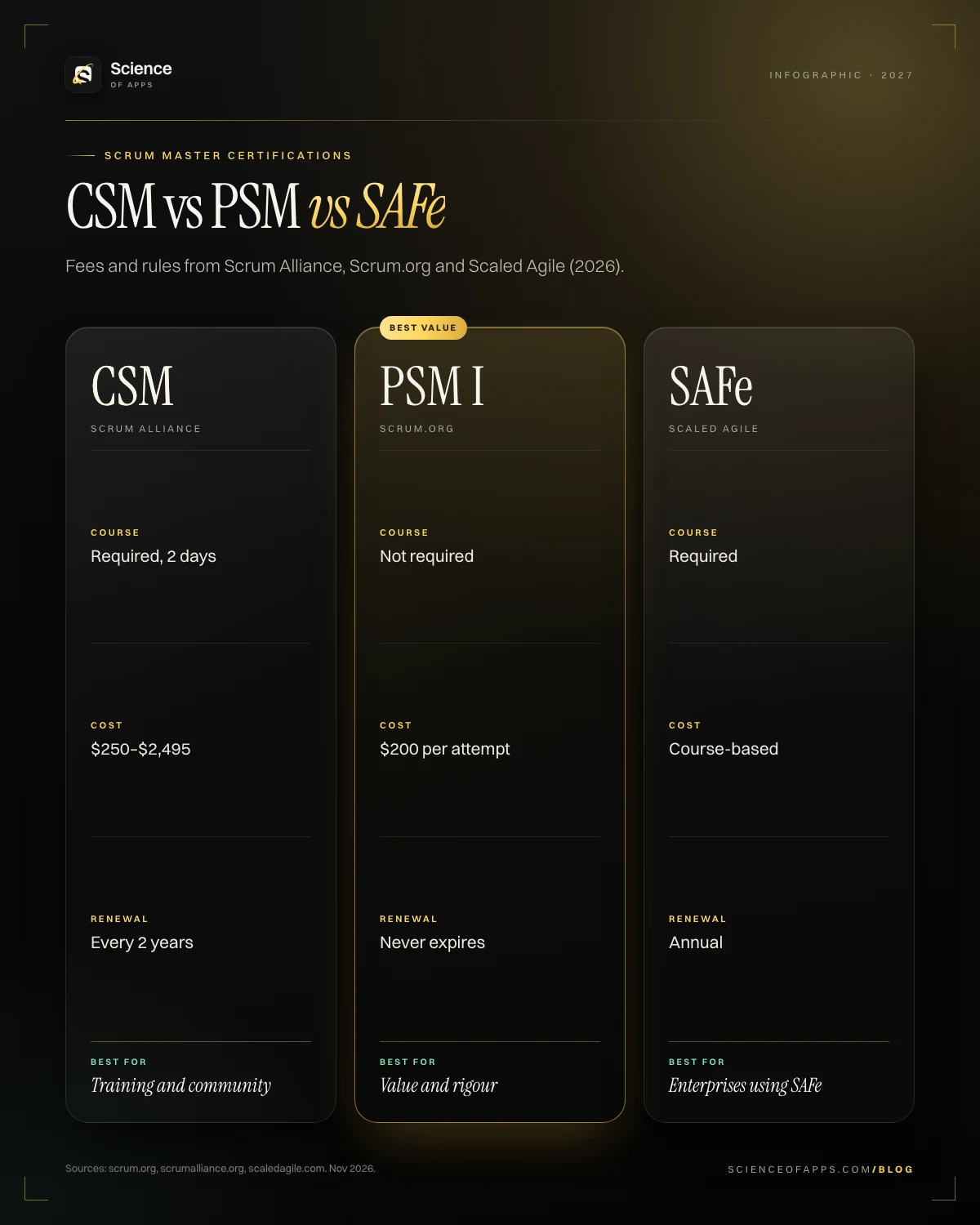
CSM vs PSM vs SAFe compared

| CSM | PSM I | SAFe Scrum Master | |
|---|---|---|---|
| Issuer | Scrum Alliance | Scrum.org | Scaled Agile |
| Course required | Yes (2 days) | No | Yes |
| Cost | $250–$2,495 course incl. exam2 | $200 per attempt1 | Course-based |
| Exam | 50 questions | 80 questions, 60 minutes, 85% to pass | Online exam |
| Renewal | Every 2 years (fee + SEUs) | None, lifetime | Annual |
| Best for | Training + community | Value, rigour | SAFe enterprises |
PSM I: the value choice
Scrum.org's PSM I costs $200 per attempt and requires no course. The exam has 80 questions in 60 minutes with an 85% pass mark, and the certification doesn't expire. It's generally considered harder than the CSM test because there's no course and the bar is high.
CSM: training and community
Scrum Alliance's CSM includes a live course with a certified trainer, which many people value for interaction and networking. Course prices vary widely by country and trainer. CSM renews every two years with education units and a fee.
SAFe vs CSM
SAFe certifications teach Scrum within the Scaled Agile Framework used by large enterprises. If job ads mention SAFe, it's worth it; otherwise CSM or PSM is more portable.
Scrum Master certification cost and free options
There's no fully free official Scrum Master certification. Cheap preparation is easy: the Scrum Guide is free, Scrum.org offers free open assessments, and free Science of Apps agile and product certifications let you prove related skills.
After your first Scrum certification
Consider PSM II, A-CSM, PMI-ACP or a product owner certification. Project managers often pair Scrum with the PMP; see PMP vs CAPM vs PRINCE2.
Exam details
- PSM I: 80 questions, 60 minutes, 85% to pass, online, open book; certification never expires.
- CSM: complete a course with a Certified Scrum Trainer, then pass a 50-question online test; renew every two years with education units.
- SAFe Scrum Master: course plus online exam, focused on Scrum within the Scaled Agile Framework; annual renewal.
Prove it free: the tests that match this guide
Check your Scrum knowledge before you pay for CSM, PSM or SAFe. (Disclosure: Science of Apps publishes these tests.)
- Agile Certification Test (Fundamentals)Agile and Scrum fundamentals first.Start free test →
- Scrum Master Certification TestScrum Master scenarios for CSM and PSM candidates.Start free test →
- SAFe Scrum Master Practice TestFor candidates choosing SAFe for large, scaled-agile organizations.Start free test →
- PSPO I Practice Test (Professional Scrum Product Owner)If you're leaning towards product ownership.Start free test →
Which is harder?
PSM I is generally considered harder because there's no course and the pass mark is 85%. CSM is more accessible because the course prepares you directly for the test.
Which do employers ask for?
Most job ads ask for "CSM or PSM" interchangeably. SAFe appears mainly in large enterprises (banking, government, telecom) that run SAFe. Experience facilitating real Scrum teams matters more than which credential you hold.
How to pass PSM I
- Read the Scrum Guide several times; it's the source of truth.
- Take Scrum.org's free open assessments until you score 100% consistently.
- Learn the reasoning behind accountabilities, events and artefacts.
- Book the exam when practice scores stay above 95%.
Scrum Master vs Product Owner certification
Scrum Masters facilitate the team and process; Product Owners own the backlog and value. Choose PSPO or CSPO if you're moving toward product management.
Frequently asked questions
CSM or PSM: which is better?
PSM I is cheaper ($200, no course, no renewal) and considered more rigorous; CSM includes training and community but costs more and renews every two years. Employers usually accept either.
How much does Scrum Master certification cost?
PSM I costs $200 per attempt. CSM courses (including the exam) range from about $250 to $2,495 depending on trainer and country.
Is there a free Scrum Master certification?
No official one, but the Scrum Guide and Scrum.org open assessments are free for preparation.
SAFe or CSM?
Choose SAFe if your organization or target employers use the Scaled Agile Framework; otherwise CSM or PSM is more portable.
Which is harder?
PSM I is generally considered harder because there's no course and the pass mark is 85%. CSM is more accessible because the course prepares you directly for the test.
Which do employers ask for?
Most job ads ask for "CSM or PSM" interchangeably. SAFe appears mainly in large enterprises (banking, government, telecom) that run SAFe. Experience facilitating real Scrum teams matters more than which credential you hold.
Sources
- Scrum.org: Professional Scrum Master I
- Scrum Alliance: Certified ScrumMaster
- Scaled Agile: SAFe Scrum Master
- The Scrum Guide
- Science of Apps: free online certifications
- Checked November 11, 2026. Figures that change — fees, salaries, prices — are reviewed every six months; if something is out of date, tell us.
Where to go from here
- The CompTIA certification path — in what order should you take comptia a+, network+ and security+? the complete c
- Cybersecurity certifications roadmap — the best cybersecurity certifications from beginner to expert, including securit
- PMP vs CAPM vs PRINCE2 — eligibility, fees and where each one counts
- Career guides by Science of Apps for 2027CSM vs PSM I in 2027: which should you choose?CSM vs PSM I in 2027: course vs exam-only, renewal, cost and which Scrum Master certification suits you. With costs, pros, cons and alternatives.
- Career guides by Science of Apps for 2027Certified ScrumMaster (CSM) review for 2027: is it worth it, who it's for and the best alternativesCertified ScrumMaster review for 2027: two-day course plus test, cost by trainer, renewal, job value and how it compares with PSM I.
- CertificationsCertificate vs diploma vs degreeCertificate vs diploma vs degree: cost, time, salary and employer perception compared, so you can choose the right path.
- Career guides by Science of Apps for 2027The agile and Scrum certification roadmap for 2027: from beginner to expertAn agile and Scrum certification roadmap for 2027: Google PM basics, PSM I or CSM, PMI-ACP with experience, then PMP for hybrid leadership.
- Career guides by Science of Apps for 2027The best agile and Scrum certifications of 2027: six for Scrum Masters, agile PMs and teamsThe 6 best agile and Scrum certifications of 2027: PSM I, Certified ScrumMaster, PMI-ACP, Google PM, ITIL 4 and Jira skills, with fees and formats.
- Career guides by Science of Apps for 2027Top 5 agile and Scrum certifications to get hired in 2027: the ones agile job posts nameThe top 5 agile and Scrum certifications to get hired in 2027: Certified ScrumMaster, PSM I, PMI-ACP, PMP and ITIL 4, matched to agile job titles.






Get the ideas, not the noise.
Sign up with Google and we’ll send you short UX psychology tips by email — why people tap, stall and leave, and what to do about it. Unsubscribe anytime. Prefer something to keep? Get the free Laws of UX guide as a PDF.
Prove the skill before you pay for the exam.
1,200+ free, test-based certifications graded on our server. Pass and get a founder-signed certificate with a credential ID employers can verify.