 By
Quick answer: Should I use Dealroom or Crunchbase?
- Dealroom: from €250 per seat a month; 3-seat minimum; 3-day trial.
- Crunchbase: free account; Pro $49/mo annual (first year) or $99 monthly; Business from $199/mo.
- Dealroom suits: investors, governments, corporates studying ecosystems.
- Crunchbase suits: founders, sales teams, small funds.
- Free alternatives: Tracxn Lite, Owler Community, SEC EDGAR.
Key takeaways
- Dealroom's three-seat minimum puts it out of reach for most early founders.
- Crunchbase's free account covers managing your own profile.
- Dealroom's strength is ecosystem-level analysis; Crunchbase's is self-serve lookups.
- Try free alternatives before paying for either.
- Neither helps customers find your product.
Dealroom and Crunchbase both track startups and funding, but they're sold to different people in different ways. Dealroom is seat-based intelligence for organisations studying whole ecosystems; Crunchbase is a self-serve database anyone can open. This comparison sets out prices and fit from each company's own pricing pages, read on 17 November 2026. Jump to the comparison, Dealroom, Crunchbase or the verdict.
At a glance
| Dealroom | Crunchbase | |
|---|---|---|
| Built for | Investors, governments, corporates | Founders, sales teams, small funds |
| Pricing | From €250 per seat a month | Free; Pro $49/mo annual (first year) or $99 monthly |
| Minimum | 3 seats | 1 seat |
| Free option | 3-day trial | Free account (5 results per search, no exports) |
| Team plan | Seat-based | Business from $199/mo billed annually |
Table: Dealroom vs Crunchbase (each company's pricing page, checked 17 Nov 2026)
Dealroom
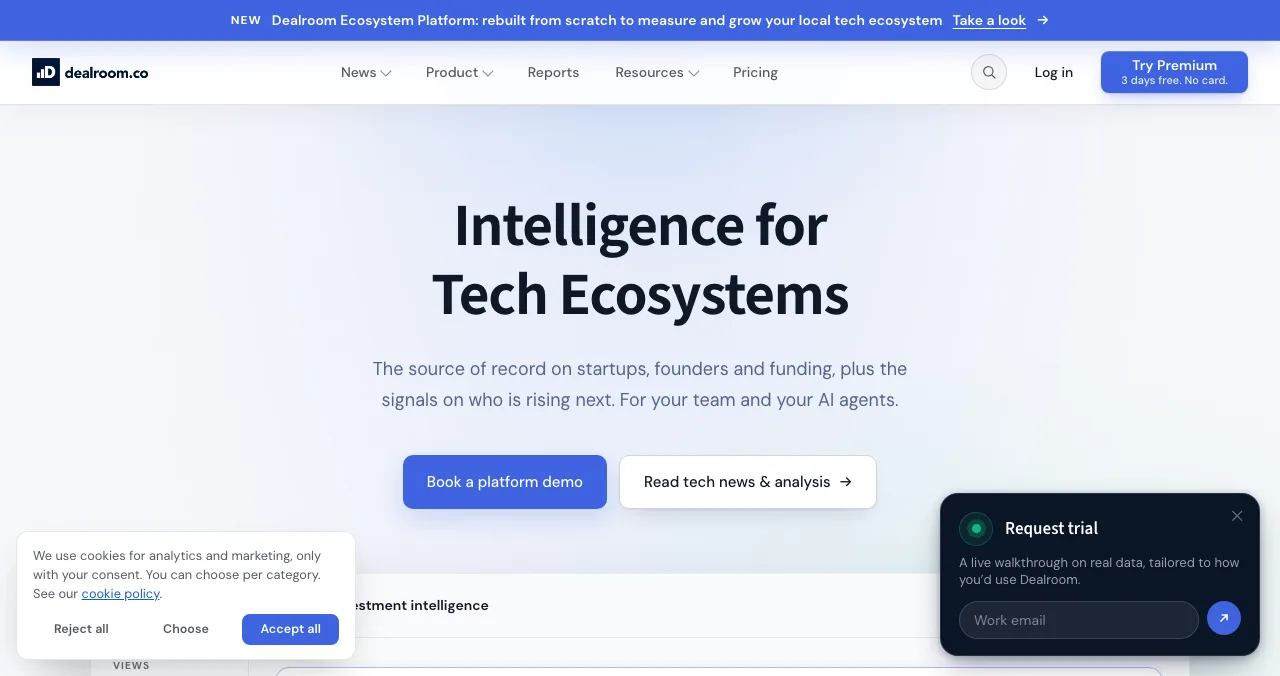
Ecosystem, startup and funding data for teams. At three seats minimum, the entry cost is at least €750 a month before any discounts.
Crunchbase
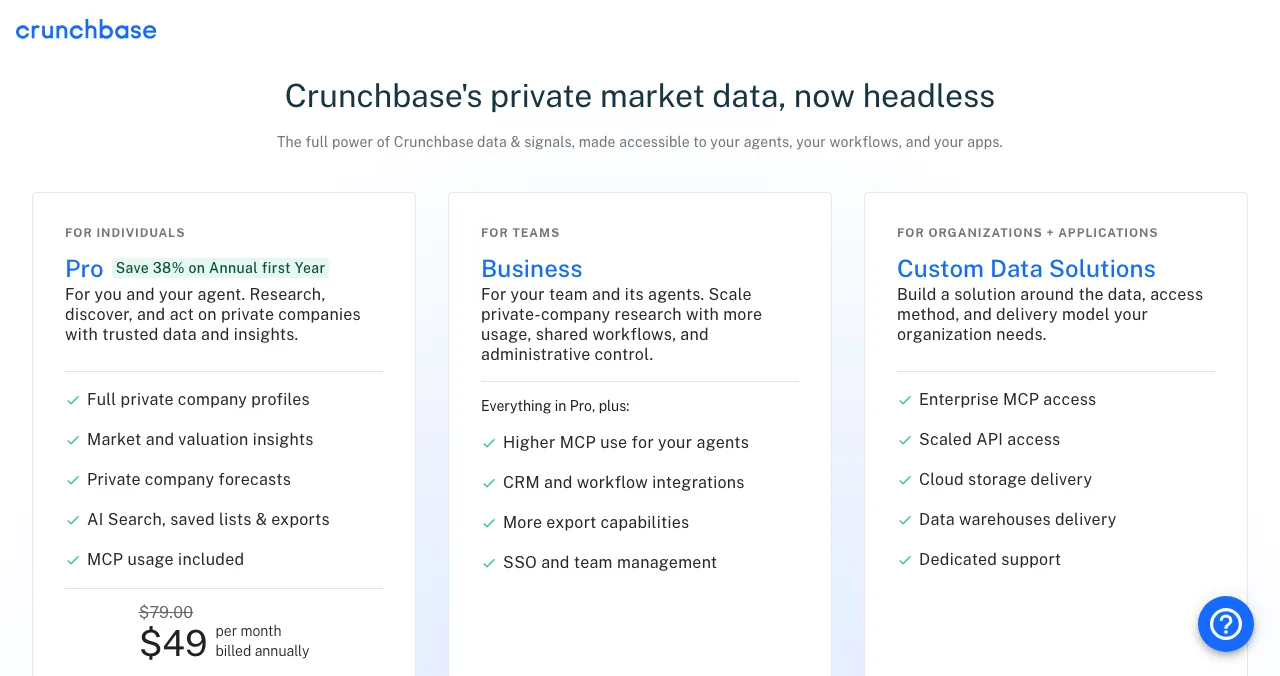
A free account for profiles and light search; Pro and Business for more. See what Crunchbase is.
The verdict

Choose Dealroom when
- You're an investor, government or corporate team
- You study whole ecosystems and sectors
- You can buy three or more seats
- You want sales-led onboarding
Choose Crunchbase when
- You're a founder, salesperson or small fund
- You want a free account or one seat
- You need occasional lookups and exports
- You manage your own company profile

Ready to be found?
How we compared them
Prices come from Dealroom's and Crunchbase's pricing pages and Crunchbase's Knowledge Center, read on 17 November 2026. Science of Apps runs the Launchpad and has no relationship with either company.
Key terms, defined
- Seat: one user licence.
- Seat minimum: the fewest licences you can buy.
- Ecosystem data: data on startups, investors and funding across a region or sector.
- Trial: temporary free access.
- Self-serve: buy without a sales call.
Frequently asked questions
How much does Dealroom cost?
Dealroom's pricing page (17 November 2026) lists plans from €250 per seat a month with a three-seat minimum, and a three-day trial.
Is Dealroom free?
There's a three-day trial but no free plan listed. Free alternatives include Tracxn Lite, Owler's Community plan and SEC EDGAR.
What's the difference between Dealroom and Crunchbase?
Dealroom is seat-based ecosystem and funding intelligence for teams such as investors, governments and corporates. Crunchbase is a self-serve company database with a free account and individual plans.
Which should a founder use?
Usually Crunchbase or a free alternative. Dealroom's minimum of three seats at €250 each a month is aimed at organisations.
Should my startup be on Dealroom?
Being accurately represented in startup databases helps investors and ecosystem analysts find you. Check your entry and keep public facts consistent with your other profiles.
What are Dealroom alternatives?
Crunchbase, Tracxn, PitchBook (enterprise, price on request), Owler and SEC EDGAR for US filings.
Sources
- Dealroom — Pricing per seat (checked 17 Nov 2026)
- Crunchbase — Product pricing: Pro, Business and Custom Data Solutions (checked 17 Nov 2026)
- Crunchbase Knowledge Center — Free account vs paid subscriptions (checked 17 Nov 2026)
- Tracxn — Pricing: Lite and Premium (checked 17 Nov 2026)
- Science of Apps — Launchpad: launch your product free
- Checked November 17, 2026. Figures that change — fees, salaries, prices — are reviewed every six months; if something is out of date, tell us.
Where to go from here
- Crunchbase alternatives — nine options
- Crunchbase vs PitchBook — the enterprise option
- Startup databases — the full landscape
- Science of Apps - LaunchpadCrunchbase vs PitchBook: who each is built for, what each costs, and why most founders need one and not the otherCrunchbase vs PitchBook: Crunchbase is self-serve from $49 a month with a free account; PitchBook is enterprise, price on request. Who should use which.
- Science of Apps - LaunchpadStartup databases compared: Crunchbase, Tracxn, PitchBook, Dealroom, Owler, SEC EDGAR, Apollo and Wellfound, with free tiers, prices and who each suits8 startup databases compared for 2027: Crunchbase, Tracxn, PitchBook, Dealroom, Owler, SEC EDGAR, Apollo, Wellfound, with free tiers and prices.
- Science of Apps - LaunchpadThe best Crunchbase alternatives in 2027, free and paid, sorted by the job you need doneThe best Crunchbase alternatives for 2027: free options (Tracxn Lite, Owler, SEC EDGAR, Apollo) and paid ones (PitchBook, Dealroom), with prices checked.
- Science of Apps - LaunchpadCrunchbase pricing in 2027: what the free account includes, what Pro and Business cost, and whether you need to payCrunchbase pricing for 2027, checked: the free account's limits, Pro at $49 a month billed annually or $99 monthly, Business from $199, and the 7-day trial.
- Science of Apps - LaunchpadThe top 5 websites to launch your startup for free, checked against each site's own rulesThe 5 best free websites to launch a startup: Science of Apps Launchpad, Product Hunt, Show HN, Uneed and Peerlist, with costs, rules and who each one suits.
- Science of Apps - LaunchpadBetaList review for 2027: how it works now that every submission is paid, who it suits, and the free alternativesA 2027 BetaList review: how submissions work now that all are paid, the refund rule, what it features, who it suits and the free alternatives.
Get the ideas, not the noise.
Sign up with Google and we’ll send you short UX psychology tips by email — why people tap, stall and leave, and what to do about it. Unsubscribe anytime. Prefer something to keep? Get the free Laws of UX guide as a PDF.
Launch day ends. Your listing shouldn't.
Data platforms track your funding; a free Launchpad profile helps customers find your product, ranked by relevance and never by payment, plus a product test with a detailed report.