 By
Quick answer: What is Crunchbase and how does it work?
- What it is: a database of private companies, funding rounds, investors and people.
- Who uses it: founders, sales teams, investors, journalists, researchers.
- Free account: create and edit profiles; 5 results per search; no exports.
- Pro: $49/month billed annually (first year) or $99 monthly; 2,000 export rows a month.
- Business: from $199/month billed annually.
- For startups: create and maintain your company profile.
Key takeaways
- Crunchbase is where many investors and journalists first check a startup.
- Every startup should claim and keep its profile current; it's free.
- The free tier is fine for occasional lookups, not research at scale.
- Crunchbase now pitches AI search and an MCP connection for assistants.
- Funding data describes you as a company; buyers find you by your product elsewhere.
Before an investor takes your call or a journalist writes your name, there's a good chance they've looked you up on Crunchbase. It's the default reference for private companies, funding rounds and investors, and increasingly a source AI assistants can draw on. This explainer covers what it is, who uses it, what a free account can and can't do, and what the paid plans cost, from Crunchbase's own pricing and help pages as read on 17 November 2026. Jump to what it covers, pricing or using it as a startup.
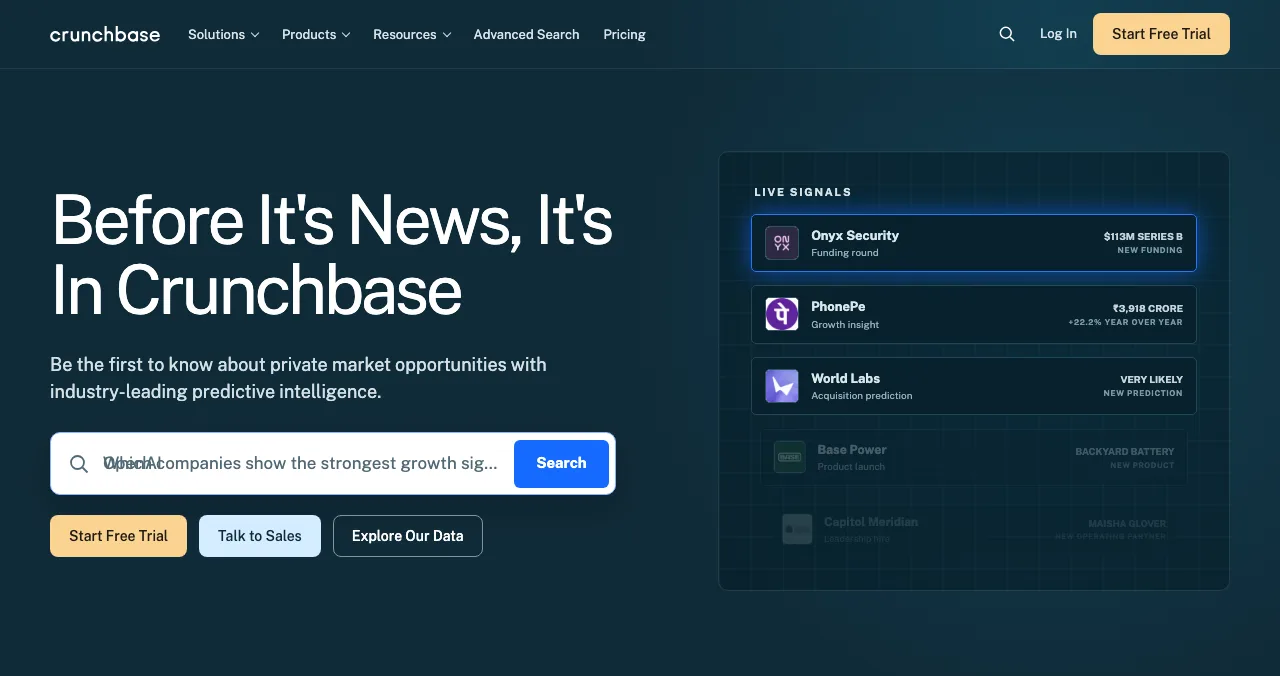
What Crunchbase covers
| Data | Examples |
|---|---|
| Companies | Description, location, industry, size |
| Funding rounds | Stage, amount, date, investors |
| Investors | Portfolio, rounds led |
| People | Founders, executives, board members |
| Events | Acquisitions, IPOs, news |
Table: What Crunchbase tracks
Crunchbase now describes itself as private-market data "for you and your agent", with AI search and an MCP connection for assistants like ChatGPT and Claude.
Crunchbase pricing
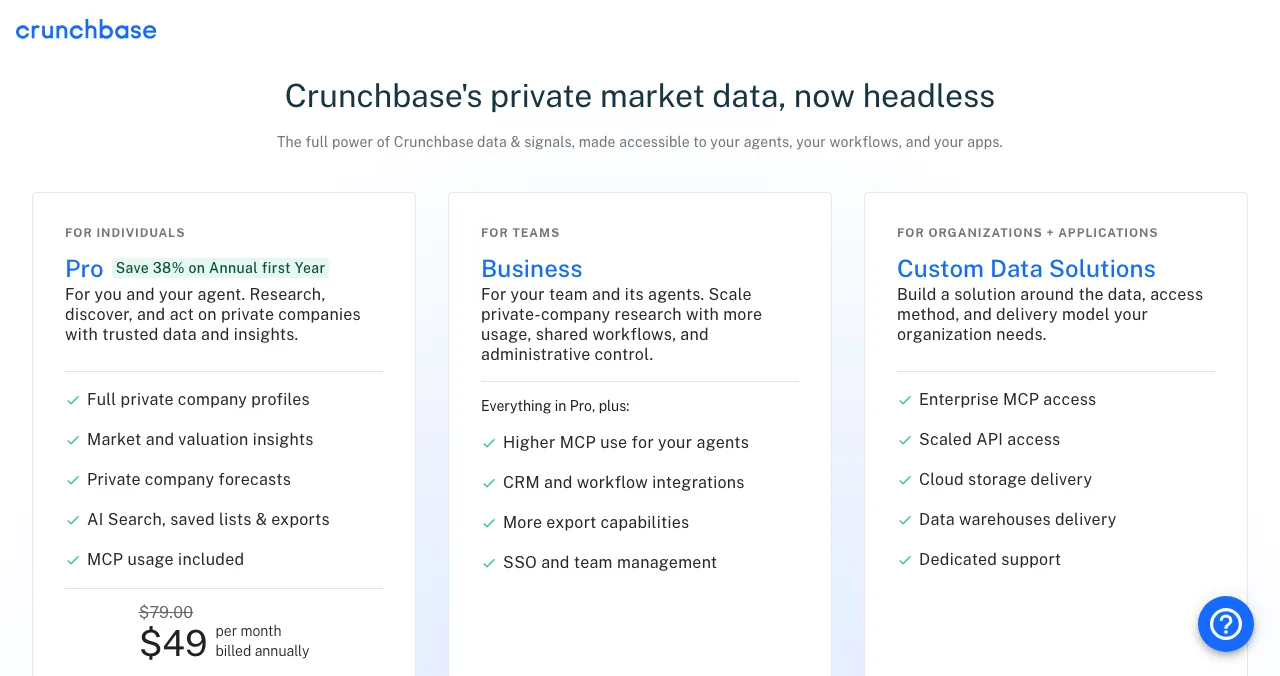
| Plan | Price | Key limits |
|---|---|---|
| Free | $0 | Create and edit profiles; 5 results per search; no exports |
| Pro | $49/mo billed annually (first year; normally $79) or $99 monthly | One seat; 2,000 export rows a month |
| Business | From $199/mo billed annually | Teams, CRM integrations; 5,000 export rows a month |
| Custom Data Solutions | Sales | API, bulk data, warehouse delivery |
Table: Crunchbase plans (Crunchbase pricing page and help centre, checked 17 Nov 2026)
Using Crunchbase as a startup

- Create or claim your profile — free; see how to get listed.
- Use your standard one-liner — the same as on your site and directories.
- Add funding, founders and links — accurate and sourced.
- Update after every milestone — rounds, launches, hires.
- Use free search sparingly — or a free alternative like Tracxn Lite.
Crunchbase alternatives
| Alternative | Free option | Best for |
|---|---|---|
| Tracxn | Lite plan | Startup discovery by sector |
| Owler | Community plan | Competitor tracking |
| SEC EDGAR | Free | US filings, including Form D |
| Dealroom | 3-day trial | Ecosystem data (from €250/seat/mo) |
| PitchBook | — | Deep private-capital research (price on request) |
Table: Crunchbase alternatives (each vendor's page, checked 17 Nov 2026)
More in Crunchbase alternatives.
Ready to be found?
How we know
Prices and free-tier limits come from Crunchbase's pricing page and Knowledge Center; alternatives from each vendor's pricing page; all read on 17 November 2026. Science of Apps runs the Launchpad and has no relationship with Crunchbase.
Key terms, defined
- Private company: a company whose shares aren't publicly traded.
- Funding round: an investment event, such as seed or Series A.
- Export rows: records you can download from a search.
- MCP: Model Context Protocol, a way to connect data to AI assistants.
- Profile: a company's page in the database.
Frequently asked questions
What is Crunchbase used for?
Looking up private companies, their funding rounds, investors, acquisitions and key people: for prospecting, investment research, competitive analysis, journalism and checking out a startup.
Is Crunchbase free?
There's a free account that can create and edit profiles, but search shows up to five results, insights are limited and exports aren't included. Pro and Business are paid.
How much does Crunchbase Pro cost?
Crunchbase's pricing page (17 November 2026) lists Pro at $49 a month billed annually for the first year (normally $79), or $99 billed monthly, with a free trial and 2,000 export rows a month.
Should my startup be on Crunchbase?
Yes. A current profile helps investors, partners, journalists and AI assistants confirm basic facts about you. Creating and editing a profile is free.
Where does Crunchbase get its data?
From a mix of sources including company and community contributions, partners and its own research. Treat any single database as a starting point and verify important facts.
What are alternatives to Crunchbase?
Tracxn (free Lite plan), Owler (free Community plan), SEC EDGAR (free US filings), Dealroom (from €250 per seat a month) and PitchBook (price on request).
Sources
- Crunchbase — Product pricing: Pro, Business and Custom Data Solutions (checked 17 Nov 2026)
- Crunchbase Knowledge Center — Free account vs paid subscriptions (checked 17 Nov 2026)
- Crunchbase Knowledge Center — How do I create a Crunchbase profile?
- Tracxn — Pricing: Lite and Premium (checked 17 Nov 2026)
- Science of Apps — Launchpad: launch your product free
- Checked November 17, 2026. Figures that change — fees, salaries, prices — are reviewed every six months; if something is out of date, tell us.
Where to go from here
- Is Crunchbase free? — the free tier in detail
- How to get listed on Crunchbase — create your profile
- Crunchbase alternatives — nine options
- Science of Apps - LaunchpadCrunchbase vs PitchBook: who each is built for, what each costs, and why most founders need one and not the otherCrunchbase vs PitchBook: Crunchbase is self-serve from $49 a month with a free account; PitchBook is enterprise, price on request. Who should use which.
- Science of Apps - LaunchpadStartup databases compared: Crunchbase, Tracxn, PitchBook, Dealroom, Owler, SEC EDGAR, Apollo and Wellfound, with free tiers, prices and who each suits8 startup databases compared for 2027: Crunchbase, Tracxn, PitchBook, Dealroom, Owler, SEC EDGAR, Apollo, Wellfound, with free tiers and prices.
- Science of Apps - LaunchpadCB Insights vs Crunchbase compared for founders, investors and corporate teams: what each covers, how pricing works (self-serve vs request a quote) and which one a startup needsCB Insights vs Crunchbase: enterprise intelligence priced on request vs self-serve company data with a free account. Which fits founders, investors and teams.
- Science of Apps - LaunchpadCrunchbase API pricing in 2027: why there's no public price, what happened to the free Basic API, what Pro and Business include instead, and cheaper or free alternatives for startup dataCrunchbase API pricing isn't public: API access is a custom licence via sales, and the free Basic API is gone. What Pro includes, and cheaper alternatives.
- Science of Apps - LaunchpadHow to get your startup listed on Crunchbase: register, authenticate, create the profile and make it completeHow to add your company to Crunchbase in 2027: register free, connect a social account, create the profile, verify you work there and fill in every field.
- Science of Apps - LaunchpadCrunchbase vs the Science of Apps Launchpad: a free company profile investors look up, or a free product listing customers find, with your product tested. What each does, what it costs and which to set up firstCrunchbase is where investors look you up; the Launchpad is where customers find your product. What each costs, what it does, and why most startups need both.


Get the ideas, not the noise.
Sign up with Google and we’ll send you short UX psychology tips by email — why people tap, stall and leave, and what to do about it. Unsubscribe anytime. Prefer something to keep? Get the free Laws of UX guide as a PDF.
Launch day ends. Your listing shouldn't.
Crunchbase describes your funding; a free Launchpad profile describes your product and ranks for the problem you solve, never by payment, plus a product test with a detailed report.