 By
Quick answer: Is CB Insights better than Crunchbase?
- CB Insights: enterprise research; pricing on request.
- Crunchbase: self-serve; free account, Pro from $49/mo (annual, first year).
- Founders: use Crunchbase; keep your profile accurate.
- Corporates and funds: CB Insights for market maps and analyst views.
- Customers: neither; list where buyers search.
Key takeaways
- They answer different questions: market strategy vs company lookup.
- Only Crunchbase lets founders create and edit their own profile for free.
- CB Insights adds analyst judgement and market-level research.
- Price transparency differs: published vs on request.
- Neither replaces being findable by your customers.
"CB Insights or Crunchbase?" sounds like a choice between two versions of the same thing. It isn't. CB Insights sells market intelligence to corporate strategy and deal teams: analyst ratings, competitive landscapes, signals about which companies are likely to raise or be acquired. Crunchbase is a company database anyone can open, where founders create and edit their own profiles. Which one you need depends on whether you're researching a market, looking up companies or trying to be found. We compared both from their own pricing pages as read on 17 November 2026. Jump to the comparison, pricing or which to use.
- CB Insights pricing
- On request
- Crunchbase's free account
- $0
- Crunchbase Pro, billed annually, first year
- $49/mo
- Companies CB Insights says it narrows down from
- 13M
CB Insights vs Crunchbase at a glance
| CB Insights | Crunchbase | |
|---|---|---|
| Built for | Strategy, corporate development and deal teams | Founders, sales teams, investors, researchers |
| Core strength | Analyst judgement, market maps, signals | Company and funding lookup, lists, alerts |
| Pricing | Request pricing (seat- or consumption-based) | Free; Pro $49/mo annual (first year); Business from $199 |
| Free option | Not advertised on pricing page | Free account with limited search |
| Founder can edit own profile | No founder form advertised | Yes, with a free account |
| AI access | Terminal agents; MCP and API for data | AI search on the site |
Table: CB Insights vs Crunchbase (each company's pricing pages, checked 17 Nov 2026)
What CB Insights is
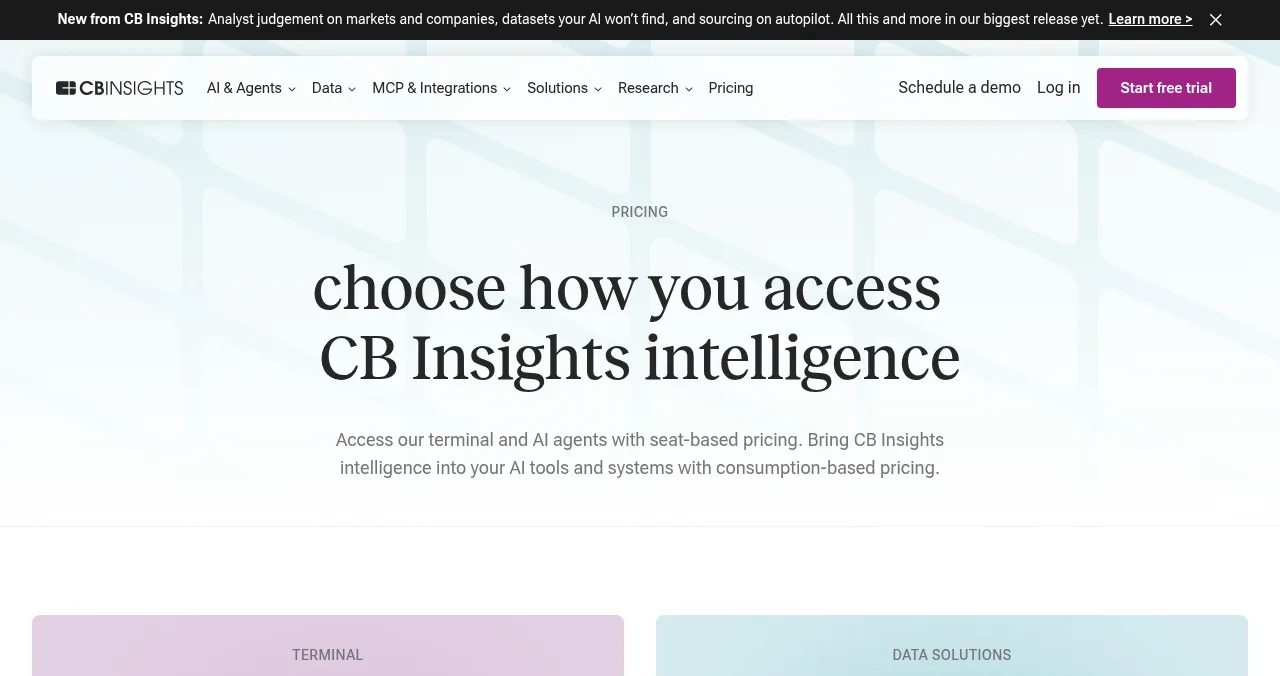
CB Insights' pricing page offers two routes. Terminal is seat-based, "great for strategy and deal teams", with a web terminal, mobile app, browser extension and an individual MCP connection for AI assistants. Data Solutions is consumption-based, for teams building AI agents or embedding data, via MCP, API, data feeds and third-party data platforms. Its pitch is going "from 13m companies to the few that matter", with analyst ratings, rankings, market analysis, competitive landscapes and signals such as likely fundraising windows and exit probability.
What Crunchbase is
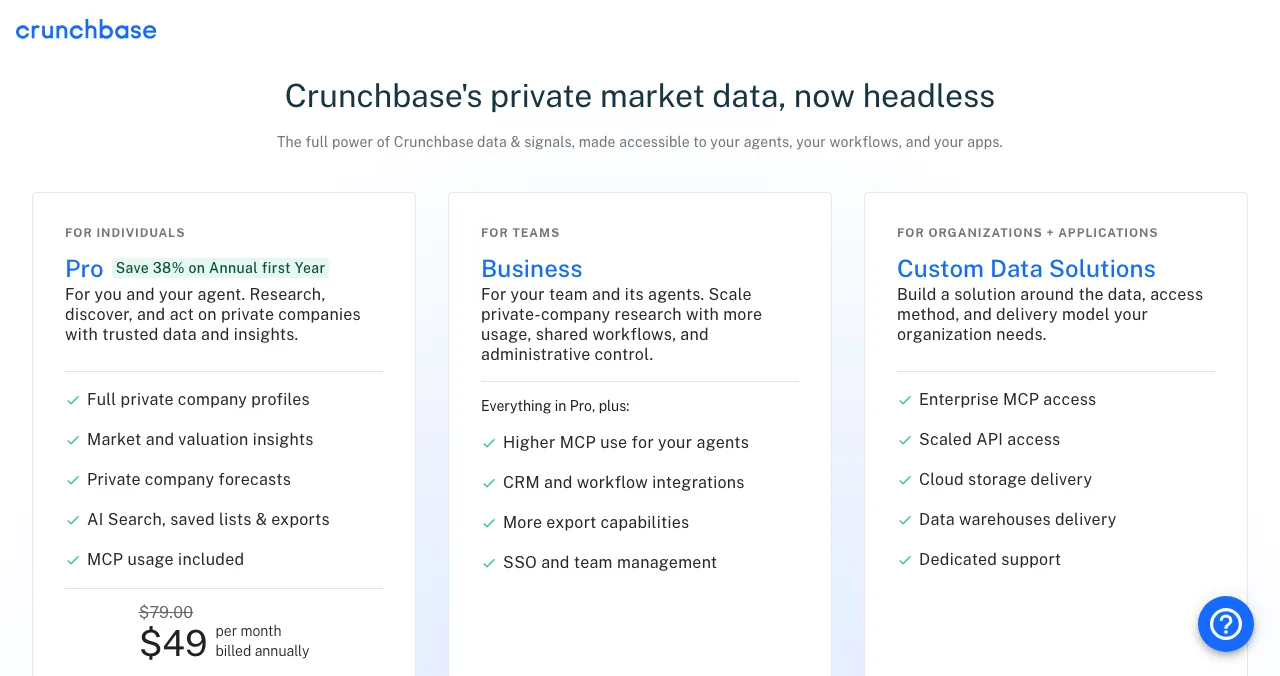
Crunchbase is a self-serve company and funding database. The free account is limited (up to five results per search, no exports) but lets you create and edit company profiles. Pro costs $49 a month billed annually for the first year (normally $79) or $99 month to month, with a 7-day trial; Business starts at $199 a month. More in is Crunchbase free?.
Pricing compared
| Plan type | CB Insights | Crunchbase |
|---|---|---|
| Free | — | Free account, limited |
| Individual | Request pricing (Terminal seat) | Pro: $49/mo annual first year, or $99 monthly |
| Team | Request pricing | Business: from $199/mo |
| Data and API | Consumption-based, request pricing | Custom data solutions |
Table: CB Insights vs Crunchbase pricing (checked 17 Nov 2026)
Which should you use?

Choose CB Insights when
- You need market-level research and analyst views
- You're mapping a sector for M&A or partnerships
- You'll pipe data into internal AI agents
Choose Crunchbase when
- You need to look up companies and funding quickly
- You want transparent, self-serve pricing
- You're a founder managing your own profile
Mistakes

- Buying enterprise data for a seed-stage question — the free tools may be enough
- Leaving your Crunchbase profile stale — investors check it
- Inconsistent facts across databases — anyone checking will compare them
- Treating a database as marketing — customers don't browse them
Ready to be found?
How we know
CB Insights' plans and features come from its pricing page; Crunchbase's prices from its product pricing page and Knowledge Center; all read on 16–17 November 2026. Neither CB Insights' prices nor its full feature list by plan are published, so we describe only what its page states.
Key terms, defined
- Market intelligence: research on markets, competitors and trends.
- Seat-based pricing: paying per user.
- Consumption-based pricing: paying for how much data or API usage you consume.
- Market map: a visual of companies in a sector, grouped by category.
- MCP: Model Context Protocol, a standard for connecting AI assistants to tools and data.
Frequently asked questions
Is CB Insights better than Crunchbase?
For different jobs. CB Insights is built for strategy and deal teams that want analyst ratings, market maps and AI agents over its data, priced on request. Crunchbase is a self-serve company database with a free account. A founder usually needs Crunchbase; a corporate strategy team may need CB Insights.
How much does CB Insights cost?
CB Insights doesn't publish prices. Its pricing page offers seat-based access to its terminal and consumption-based data solutions (MCP, API, data feeds), each with a 'Request Pricing' button, as checked on 17 November 2026.
Is CB Insights free?
It doesn't advertise a free plan on its pricing page. Its site shows a 'Start free trial' button and offers demos.
How much does Crunchbase cost?
Crunchbase has a free account with limited search. Pro costs $49 a month billed annually for the first year (normally $79) or $99 month to month, with a 7-day free trial; Business starts at $199 a month, as checked on 17 November 2026.
Can I list my startup on CB Insights?
CB Insights' pricing page doesn't describe a founder profile form like Crunchbase's. Focus on keeping your website, Crunchbase profile and press consistent, since that's what anyone researching you will compare.
What about Crunchbase vs PitchBook?
PitchBook is enterprise private-capital research for investment firms and banks, priced on request. Crunchbase is self-serve and cheaper. See our Crunchbase vs PitchBook comparison.
Sources
- CB Insights — Pricing (checked 17 Nov 2026)
- Crunchbase — Product pricing (checked 17 Nov 2026)
- Crunchbase Knowledge Center — Free account vs paid subscriptions (checked 17 Nov 2026)
- Science of Apps — Launchpad: launch your product free
- Checked November 17, 2026. Figures that change — fees, salaries, prices — are reviewed every six months; if something is out of date, tell us.
Where to go from here
- Crunchbase vs PitchBook — the other enterprise option
- Get listed on Crunchbase — for founders
- Startup databases — every option
- Science of Apps - LaunchpadCrunchbase vs PitchBook: who each is built for, what each costs, and why most founders need one and not the otherCrunchbase vs PitchBook: Crunchbase is self-serve from $49 a month with a free account; PitchBook is enterprise, price on request. Who should use which.
- Science of Apps - LaunchpadDealroom vs Crunchbase: seat-based ecosystem data from €250 a seat versus self-serve plans from $49, and which one fits founders, investors and governmentsDealroom vs Crunchbase: Dealroom from €250 per seat a month with a 3-seat minimum; Crunchbase self-serve from $49 with a free account. Who each suits.
- Science of Apps - LaunchpadStartup databases compared: Crunchbase, Tracxn, PitchBook, Dealroom, Owler, SEC EDGAR, Apollo and Wellfound, with free tiers, prices and who each suits8 startup databases compared for 2027: Crunchbase, Tracxn, PitchBook, Dealroom, Owler, SEC EDGAR, Apollo, Wellfound, with free tiers and prices.
- Science of Apps - LaunchpadCrunchbase vs the Science of Apps Launchpad: a free company profile investors look up, or a free product listing customers find, with your product tested. What each does, what it costs and which to set up firstCrunchbase is where investors look you up; the Launchpad is where customers find your product. What each costs, what it does, and why most startups need both.
- Science of Apps - LaunchpadGust vs F6S vs Crunchbase: which startup platform to join for funding, accelerators, perks or visibility, compared by the job each does and what it costsGust vs F6S vs Crunchbase compared by job: Gust for incorporation and angel groups, F6S for accelerators and perks, Crunchbase for investor visibility.
- Science of Apps - LaunchpadWellfound alternatives for founders: where else to hire, and where else to be seen, with what Wellfound itself now costs and what happened to AngelList TalentWellfound alternatives for founders: Work at a Startup, Cutshort and Peerlist for hiring, Crunchbase and Tracxn for investors, plus Wellfound's own free plan.




Get the ideas, not the noise.
Sign up with Google and we’ll send you short UX psychology tips by email — why people tap, stall and leave, and what to do about it. Unsubscribe anytime. Prefer something to keep? Get the free Laws of UX guide as a PDF.
Launch day ends. Your listing shouldn't.
CB Insights and Crunchbase are where investors and analysts look; a free, permanent Launchpad profile is where customers find you by the problem you solve, ranked by relevance, never payment.