 By
Quick answer: Which startup platform should I join?
- Gust: incorporation and equity tools ($450–$3,500/yr), angel groups, accelerators.
- F6S: free; accelerators, grants, software deals, jobs.
- Crunchbase: free profile investors check; paid research plans.
- Most founders: Crunchbase, plus F6S or Gust for the job at hand.
- For users: none of these; list where customers search.
Key takeaways
- Pick by job: incorporate, apply, be looked up, or be found by users.
- Gust's paid plans are legal and equity tooling for US C-corps.
- F6S is free to join; judge each programme on its own terms.
- A Crunchbase profile is the one most investors will check.
- Keep facts identical across every profile.
Early-stage founders get told to "get on Gust, F6S and Crunchbase" as if they were three versions of the same thing. They aren't. One sells incorporation and equity paperwork and connects you to angel groups; one is a free community for applying to programmes and claiming software discounts; one is the database investors use to look you up. Joining the wrong one wastes an afternoon; paying for the wrong one wastes more. This comparison sorts them by job, from each platform's own pages as read on 17 November 2026. Jump to the comparison, Gust, F6S or Crunchbase.
- Founders on Gust (Gust's figure)
- 800k+
- F6S members (F6S's figure)
- 6.7M
- Gust's entry plan
- $450/yr
- F6S membership and a Crunchbase profile
- $0
Gust vs F6S vs Crunchbase at a glance
| Gust | F6S | Crunchbase | |
|---|---|---|---|
| Main job | Incorporate, manage equity, apply to angels and accelerators | Apply to accelerators, grants, funding; software deals | Be looked up by investors; research companies |
| Cost | Plans $450, $1,250, $3,500 a year | Free to join | Free profile; Pro from $49/mo (annual) |
| Scale (own figures) | 800k+ founders; 300+ accelerators; 750+ angel groups | 6.7M members; 15.7k opportunities | Widely used company database |
| Best for | US Delaware C-corps raising from angels | Founders applying to many programmes | Every startup that might raise |
Table: Gust vs F6S vs Crunchbase (each platform's own pages, checked 17 Nov 2026)
Gust: incorporation, equity and angel groups
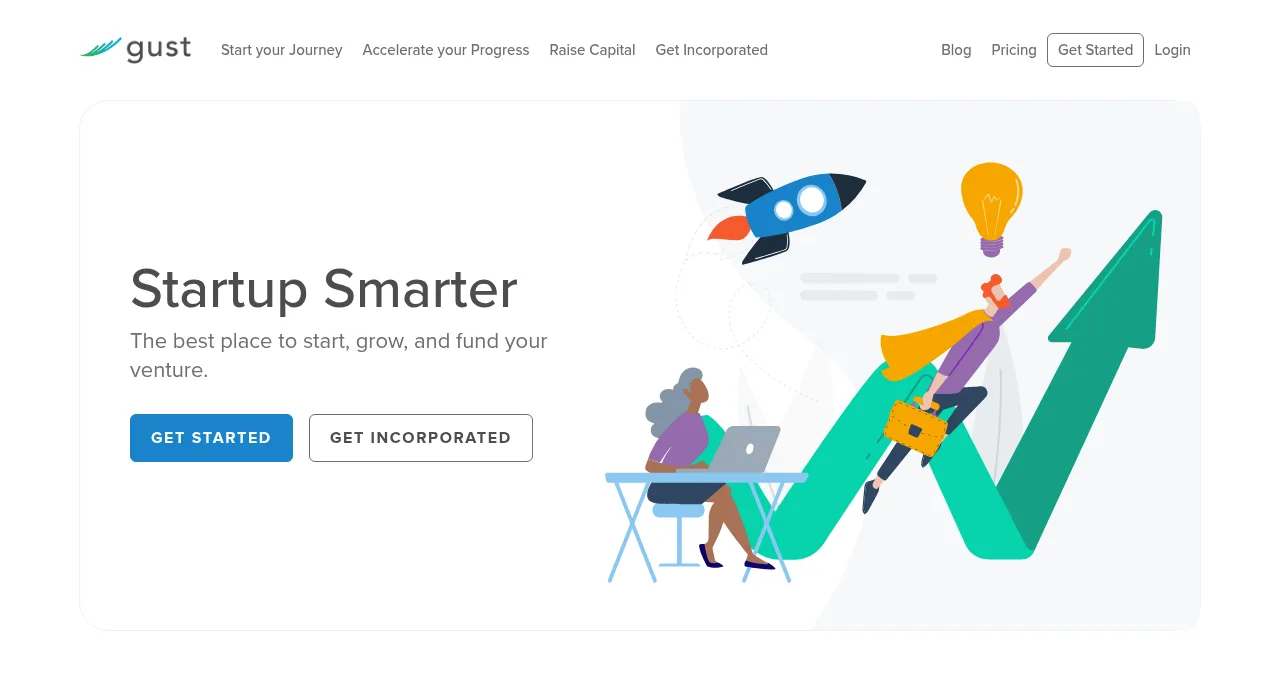
Gust says it has a community of over 800,000 founders, matches with 300+ accelerators and lets you apply to 750+ angel investment groups, using a Gust Company Profile. Its paid plans are legal and equity tooling for a US Delaware C-corporation:
| Plan | Price | Includes |
|---|---|---|
| Start | $450/year | Incorporation, post-incorporation setup, founder stock with 83(b), cap table, banking, Delaware registered agent |
| Accelerate | $1,250/year | Start plus IP assignment, NDAs, contractor and advisor agreements, SAFEs, convertible notes, cap table modelling |
| Raise | $3,500/year | Both plus option plan, 409A valuation, option issuance and exercise |

Table: Gust plans (Gust pricing page, checked 17 Nov 2026)
Best for: founders forming a US C-corp, or applying to angel groups and accelerators that take applications through Gust. Indian founders with a private limited company won't need the incorporation plans.
F6S: programmes, grants and perks
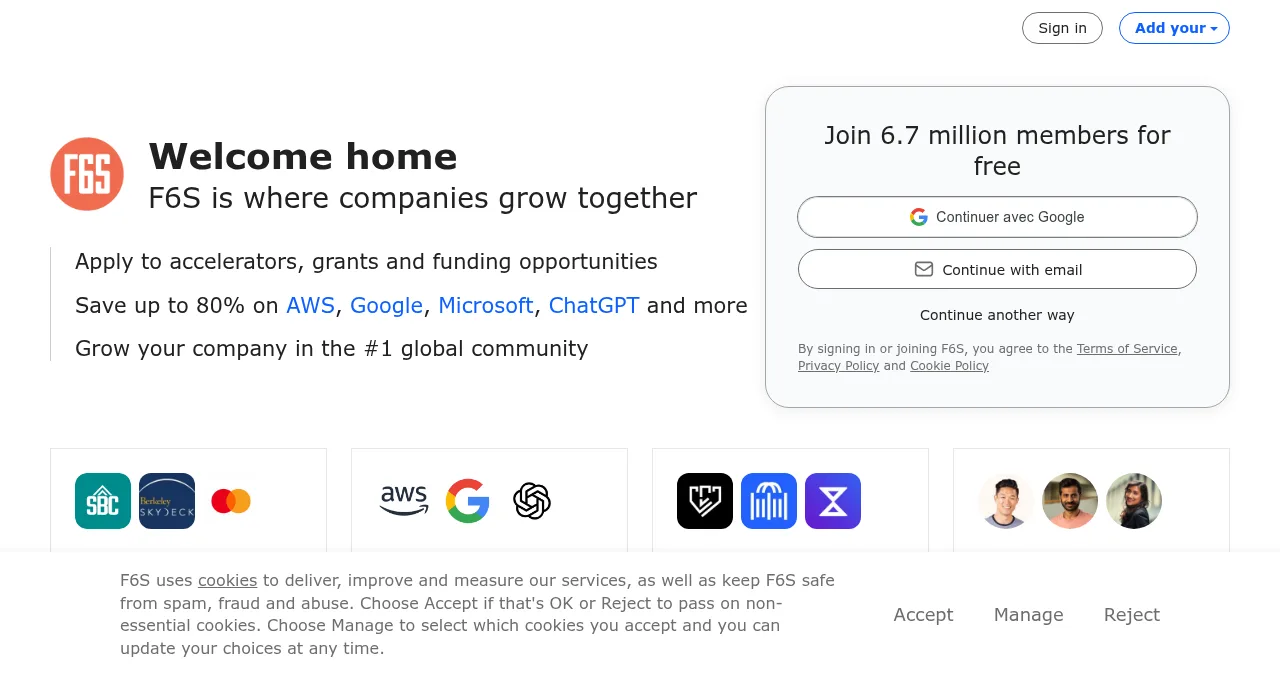
F6S is free to join. It says it has 6.7 million members, lists 15.7k accelerators, grants and funding opportunities, offers software savings of up to 80% (with providers including AWS, Google, Microsoft and ChatGPT) and has a startup jobs board. Best for: founders applying to many programmes and claiming software perks. See our F6S review.
Crunchbase: where investors look you up
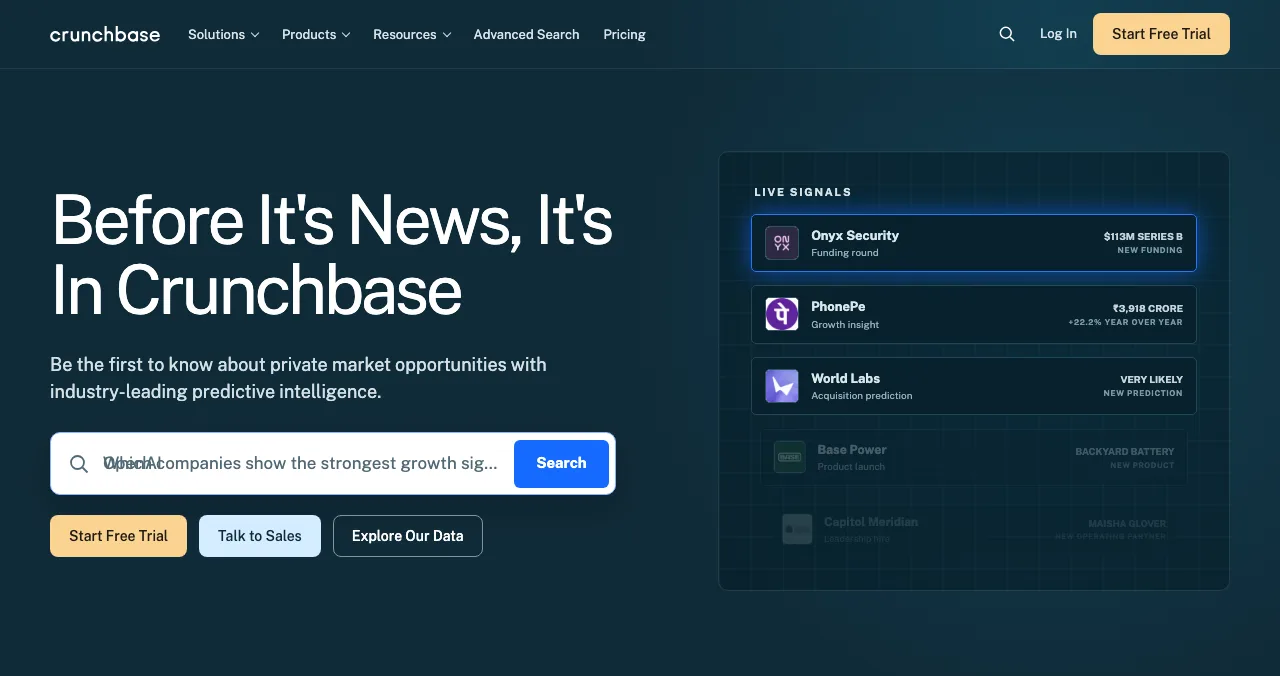
Crunchbase's free account lets you create and edit your company's profile; research beyond a few results needs Pro ($49 a month billed annually for the first year, normally $79, or $99 month to month) or Business (from $199 a month). Best for: every startup that might raise or be written about. Step-by-step: how to get listed on Crunchbase.
Which should you join?
Mistakes

- Paying for incorporation tools you don't need — check your legal structure first
- Applying to every programme on F6S — judge each on its own terms
- A stale Crunchbase profile — update it after every round or launch
- Different facts on each platform — one name, one one-liner, one logo
Ready to be found?
How we know
Figures and prices come from Gust's homepage and pricing page, F6S's homepage and Crunchbase's pricing page, read on 16–17 November 2026. Member and opportunity counts are each platform's own claims. This isn't legal or tax advice.
Key terms, defined
- Delaware C-corp: a US company type preferred by many US investors.
- Cap table: a record of who owns what share of a company.
- SAFE: a simple agreement for future equity, a common early investment contract.
- 409A valuation: a US independent valuation used to price stock options.
- Angel group: a network of individual investors who invest together.
Frequently asked questions
Which startup platform should I join?
Crunchbase first, because investors and journalists look companies up there and the profile is free. Then F6S if you want to apply to accelerators, grants or software deals, or Gust if you're forming a US Delaware C-corp or applying to angel groups that use it.
What is Gust?
A platform for starting, running and funding a startup. It says it has 800,000+ founders, connects to 300+ accelerators and 750+ angel investment groups, and sells incorporation and equity plans from $450 a year.
How much does Gust cost?
Gust's plans were $450 a year (Start: Delaware incorporation, cap table, registered agent), $1,250 a year (Accelerate: adds legal agreements, SAFEs, notes) and $3,500 a year (Raise: adds option plan and 409A valuation), as checked on 17 November 2026.
Is F6S free?
Joining F6S is free. It says it has 6.7 million members, lists 15.7k accelerators, grants and funding opportunities, and offers software discounts of up to 80% with providers such as AWS, Google, Microsoft and ChatGPT.
Is Crunchbase free for founders?
Yes, a free account lets you create and edit your company's profile. Searching beyond a few results needs a paid plan: Pro from $49 a month billed annually for the first year.
Do I need all three?
Rarely. Keep a Crunchbase profile accurate, then use F6S or Gust only for the specific programme, deal or legal setup you need.
Sources
- Gust — homepage (checked 17 Nov 2026)
- Gust — Pricing (checked 17 Nov 2026)
- F6S — homepage (checked 17 Nov 2026)
- Crunchbase — Product pricing (checked 17 Nov 2026)
- Science of Apps — Launchpad: launch your product free
- Checked November 17, 2026. Figures that change — fees, salaries, prices — are reviewed every six months; if something is out of date, tell us.
Where to go from here
- F6S review — and alternatives
- Get listed on Crunchbase — step by step
- Places to launch a startup — for customers
- Science of Apps - LaunchpadHow to find angel investors for free: angel networks and platforms in India (IAN Group, LVX), free databases (Crunchbase, Gust, F6S), warm introductions and an outreach planHow to find angel investors free: angel networks like IAN Group and LVX, free databases like Crunchbase and Gust, and warm intros that get replies.
- Science of Apps - LaunchpadCB Insights vs Crunchbase compared for founders, investors and corporate teams: what each covers, how pricing works (self-serve vs request a quote) and which one a startup needsCB Insights vs Crunchbase: enterprise intelligence priced on request vs self-serve company data with a free account. Which fits founders, investors and teams.
- Science of Apps - LaunchpadWellfound alternatives for founders: where else to hire, and where else to be seen, with what Wellfound itself now costs and what happened to AngelList TalentWellfound alternatives for founders: Work at a Startup, Cutshort and Peerlist for hiring, Crunchbase and Tracxn for investors, plus Wellfound's own free plan.
- Science of Apps - LaunchpadStartup databases compared: Crunchbase, Tracxn, PitchBook, Dealroom, Owler, SEC EDGAR, Apollo and Wellfound, with free tiers, prices and who each suits8 startup databases compared for 2027: Crunchbase, Tracxn, PitchBook, Dealroom, Owler, SEC EDGAR, Apollo, Wellfound, with free tiers and prices.
- Science of Apps - LaunchpadDealroom vs Crunchbase: seat-based ecosystem data from €250 a seat versus self-serve plans from $49, and which one fits founders, investors and governmentsDealroom vs Crunchbase: Dealroom from €250 per seat a month with a 3-seat minimum; Crunchbase self-serve from $49 with a free account. Who each suits.
- Science of Apps - LaunchpadAn honest F6S review: what the free F6S membership gives founders (programmes, grants, software deals, jobs), how to judge its opportunities, and the best alternatives by jobAn honest F6S review: free membership, 15.7k listed accelerators and grants, software deals up to 80% off, how to vet programmes, and F6S alternatives by job.



Get the ideas, not the noise.
Sign up with Google and we’ll send you short UX psychology tips by email — why people tap, stall and leave, and what to do about it. Unsubscribe anytime. Prefer something to keep? Get the free Laws of UX guide as a PDF.
Launch day ends. Your listing shouldn't.
Gust, F6S and Crunchbase face investors and programmes; a free, permanent Launchpad profile faces customers searching for the problem you solve, ranked by relevance, never payment.