 By
Quick answer: Where can I find angel investors?
- Networks: IAN Group, LVX (India); Gust's 750+ angel groups.
- Research: a free Crunchbase account for investors' past deals.
- Best route: warm intros from founders they've backed.
- List: 30–50 relevant angels, not 500 random ones.
- Proof: a live product link and a few real numbers.
Key takeaways
- Relevance beats volume: angels back what they understand.
- Warm introductions get read; cold mass emails mostly don't.
- Networks have formal application processes; follow them.
- Founders an angel backed are the best intro source.
- Your traction does more than any list.
"Can someone share a list of angel investors?" is one of the most common requests in Indian founder groups, and the lists that get shared are usually outdated spreadsheets with hundreds of names and no context. Angels don't respond to being one row of 500. They respond to relevance, a trusted introduction and a product they can see working. This guide shows where angels actually are (networks, platforms and databases), how to build your own short list for free, and how to approach them, using each platform's own pages as read on 17 November 2026. Jump to where to find angels, building your list or the outreach.
- Angel groups listed on Gust (Gust's figure)
- 750+
- Investors on LVX (its figure)
- 36K+
- Invested via the IAN platform (its figure)
- ₹1,500+ Cr
- Relevant angels worth a focused list
- 30–50
Where angel investors are
| Source | What it is | Cost to founders | Best for |
|---|---|---|---|
| IAN Group | Indian early-stage investing platform (formerly Indian Angel Network) | Apply via its site | Indian startups seeking angel and early-stage capital |
| LVX (formerly LetsVenture) | Indian private-market platform with angels, family offices and funds | Founder assessment and application on its site | Indian startups preparing to raise |
| Gust | Platform listing 750+ angel groups and 300+ accelerators | Free profile; paid legal plans optional | Applying to angel groups that use Gust |
| Crunchbase | Company and investor database | Free account, limited search | Researching who invested in companies like yours |
| Founder communities | Groups where founders share intros | Free | Warm introductions |
Table: Where to find angel investors (each platform's own pages, checked 17 Nov 2026)
IAN Group (formerly Indian Angel Network)
IAN Group describes 20+ years of early-stage investing in India, with ₹1,500+ crore invested, 273+ companies backed across 28 sectors and a $100M IAN Alpha fund. Its evergreen IAN Angel Fund leads and co-leads rounds; recent announcements on its homepage included ₹12.5 crore and ₹4 crore rounds.
LVX (formerly LetsVenture)
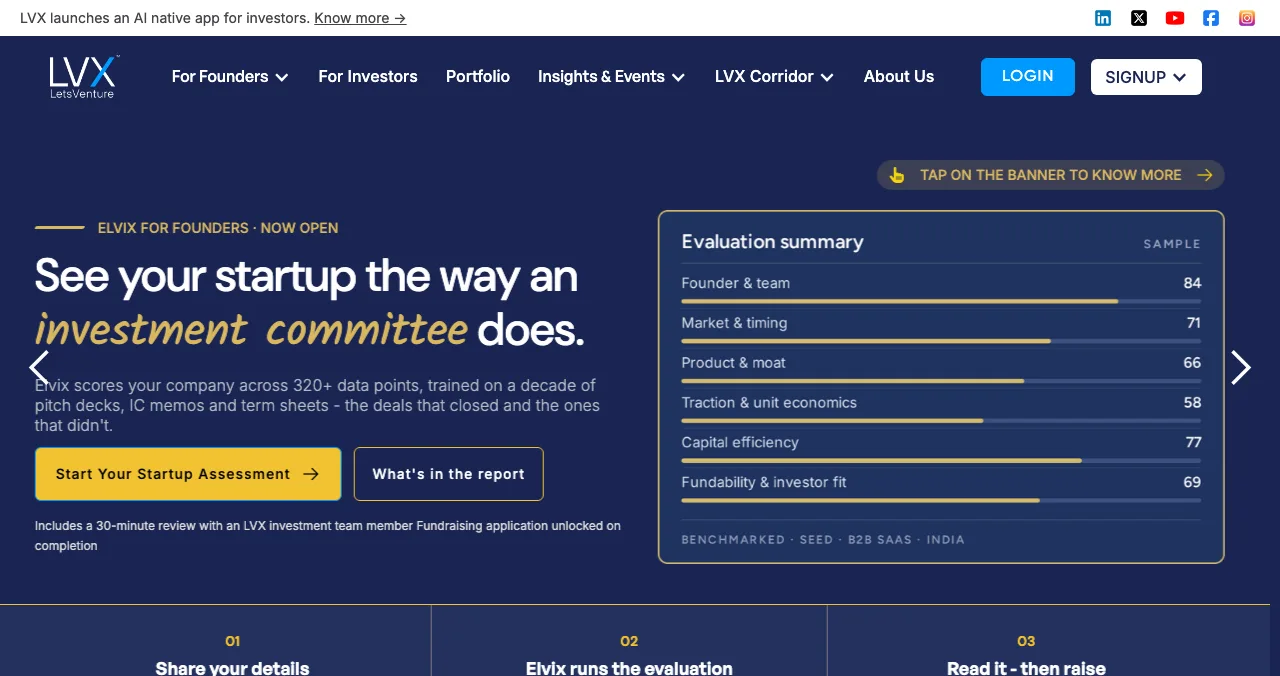
LVX reported 36K+ platform investors, 300+ family offices and funds, ₹1,160+ crore committed and 715+ deals. For founders it offers Elvix, which scores a company across 320+ data points and includes a 30-minute review with an LVX investment team member; completing it unlocks the fundraising application.
Gust and Crunchbase
Gust lists 750+ angel investment groups you can apply to with a Gust Company Profile. A free Crunchbase account lets you research which investors backed companies like yours, and keeps your own profile accurate for when angels look you up.
Building your own angel list, free

- Find 20 companies like yours — same sector or customer, a stage or two ahead.
- Note who invested early — on Crunchbase, company announcements and founders' posts.
- Check each angel's recent activity — are they still investing, and in what?
- Find a mutual connection — ideally a founder they backed.
- Keep it to 30–50 names — with a one-line reason each is relevant.
The outreach
Ask for an introduction, and make it easy to forward. Send the introducer a short note they can pass on unchanged:
[Company]: [one line on what you do, for whom] Traction: [2–3 real numbers, e.g. "40 paying clinics, ₹1.2 lakh MRR, 18% month-on-month"] Raising: [amount] to [what it achieves] Why [angel]: [their relevant investment or expertise] Product: [link to a live page]
Keep the deck for when they ask. YC's Aaron Harris advises founders to aim for clarity and concision in seed decks; see our guide to pitch deck feedback.
Mistakes

- Mass emailing a bought list — irrelevant and easily ignored
- Paying someone to "guarantee" funding — be very wary of fees for introductions
- No product link — angels want to see it working
- Vague numbers — "great traction" says nothing
- Not following up — one polite follow-up after a week is normal
Ready to raise?
How we know
Figures for IAN Group, LVX and Gust come from their homepages, read on 17 November 2026, and are their own claims. The list-building method, outreach template and the 30–50 range are our editorial guidance. This isn't investment or legal advice.
Key terms, defined
- Angel investor: an individual who invests their own money in early startups.
- Angel network: a group of angels who review and invest in deals together.
- Warm introduction: an intro from someone the investor knows and trusts.
- Traction: evidence of demand, such as users, revenue or growth.
- Family office: a firm managing a wealthy family's investments.
Frequently asked questions
Where can I find angel investors?
Angel networks and platforms (in India, IAN Group and LVX; globally, angel groups listed on Gust), investor profiles on Crunchbase, founder communities, and introductions from founders who've raised from angels. Start with angels who've invested in your sector and stage.
How do I find angel investors in India for free?
Apply through angel networks' founder pages (IAN Group, LVX), research angels' past deals on Crunchbase's free account, ask founders in your sector who backed them, and attend demo days and community events where angels show up.
Is there a free list of angel investors?
No complete free list exists that stays accurate. Build your own: start from companies like yours, see who invested in them on Crunchbase, check each angel's recent activity, and note a mutual connection for an introduction.
How do I approach an angel investor?
Through a warm introduction where possible. Send the introducer a short, forwardable note: what you do in one line, two or three traction numbers, how much you're raising, and a link to the product. Keep the deck for when they ask.
What is LVX?
LVX, formerly LetsVenture, is an Indian private-market investing platform. Its homepage reported 36K+ platform investors, 300+ family offices and funds and 715+ deals, and offers founders an assessment called Elvix with a review by its investment team.
How many angels should I contact?
A focused list of 30–50 relevant angels is easier to research and follow up properly than hundreds of cold emails. Expect most to pass; that's normal.
Sources
- IAN Group (formerly Indian Angel Network) — homepage (checked 17 Nov 2026)
- LVX (formerly LetsVenture) — homepage (checked 17 Nov 2026)
- Gust — homepage (checked 17 Nov 2026)
- Crunchbase — Product pricing (checked 17 Nov 2026)
- Y Combinator — How to build your seed round pitch deck (Aaron Harris)
- Checked November 17, 2026. Figures that change — fees, salaries, prices — are reviewed every six months; if something is out of date, tell us.
Where to go from here
- Startup valuation — before you raise
- Crunchbase alternatives — investor databases
- Startup accelerator list — the other route
- Science of Apps - LaunchpadGust vs F6S vs Crunchbase: which startup platform to join for funding, accelerators, perks or visibility, compared by the job each does and what it costsGust vs F6S vs Crunchbase compared by job: Gust for incorporation and angel groups, F6S for accelerators and perks, Crunchbase for investor visibility.
- Startups in IndiaAngel investors in India: the main networks and platforms, and how to pitch them wellAngel investors in India: the leading angel networks and platforms, how angel rounds work, what angels look for, and a pitching process that gets replies.
- Science of Apps - LaunchpadStartup databases compared: Crunchbase, Tracxn, PitchBook, Dealroom, Owler, SEC EDGAR, Apollo and Wellfound, with free tiers, prices and who each suits8 startup databases compared for 2027: Crunchbase, Tracxn, PitchBook, Dealroom, Owler, SEC EDGAR, Apollo, Wellfound, with free tiers and prices.
- Science of Apps - LaunchpadHow to list your startup in India in 2027: DPIIT recognition, startup databases, media and launch platformsHow to list your startup in India in 2027: free DPIIT recognition via NSWS, Tracxn and Crunchbase profiles, YourStory, Google Business and launch platforms.
- Science of Apps - LaunchpadHow to get your first 100 users without paid ads: a channel-by-channel plan founders can start todayHow to get your first 100 users without paid ads in 2027: your network, communities, launch sites, directories, content and one-to-one outreach, step by step.
- Science of Apps - LaunchpadWellfound alternatives for founders: where else to hire, and where else to be seen, with what Wellfound itself now costs and what happened to AngelList TalentWellfound alternatives for founders: Work at a Startup, Cutshort and Peerlist for hiring, Crunchbase and Tracxn for investors, plus Wellfound's own free plan.






Get the ideas, not the noise.
Sign up with Google and we’ll send you short UX psychology tips by email — why people tap, stall and leave, and what to do about it. Unsubscribe anytime. Prefer something to keep? Get the free Laws of UX guide as a PDF.
Launch day ends. Your listing shouldn't.
Angels look you up before replying; a free, permanent Launchpad profile with verifiable badges and community vouches shows a real product and early traction, ranked by relevance, never payment.