 By
Quick answer: Which accelerators should I apply to?
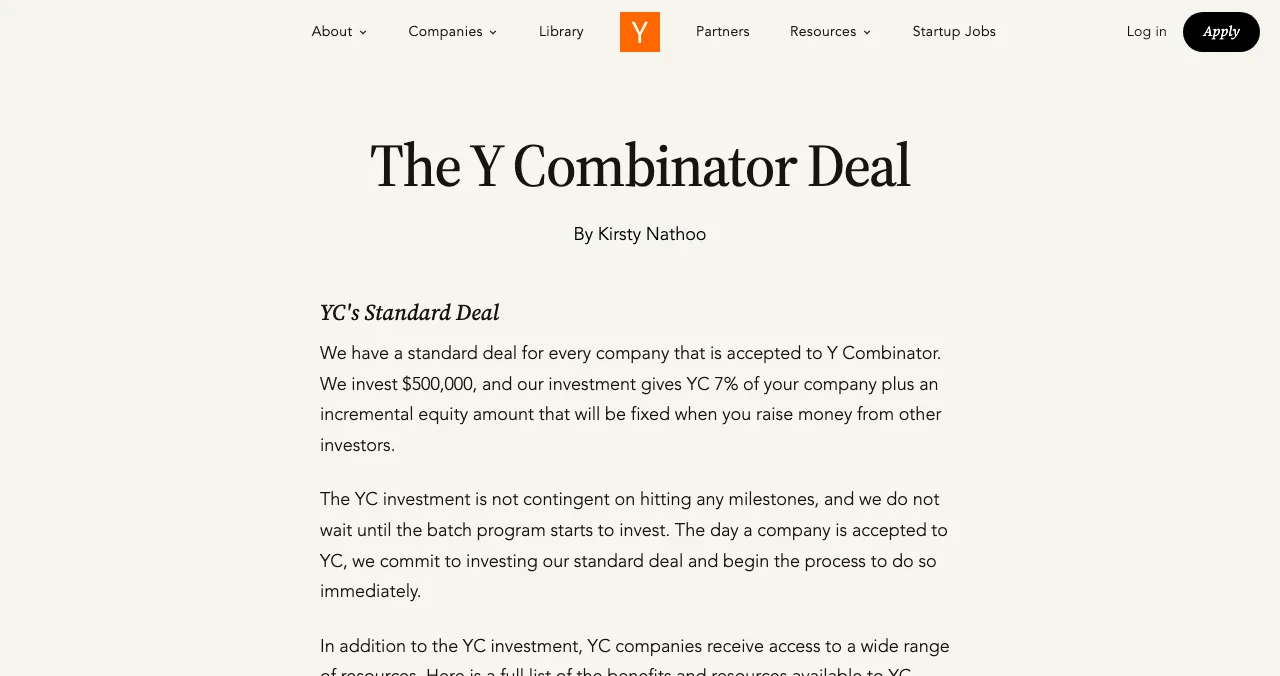
- Y Combinator: $500k: $125k for 7%, $375k on an uncapped MFN SAFE.
- Techstars: three-month programmes; Spring 2027 applications open.
- Antler India: day-zero backing; 115+ India portfolio companies.
- Surge by Peak XV: $500k to $5M seed.
- Equity-free: Google for Startups Accelerator India (closed now).
Key takeaways
- Compare the deal, not the brand: cash, equity and what's included.
- Check application status on the official page before you plan.
- Equity-free programmes trade money for mentoring and credits.
- Government schemes have fixed windows that close.
- A live product and real users strengthen every application.
Most accelerator lists online are copied from older lists: dead programmes, deadlines from three years ago, terms nobody checked. This one is short on purpose. Each entry was checked on its official page on 17 November 2026 for what it offers and whether applications are open, with an Indian focus alongside the global names. If a programme's page didn't state a figure, we don't give one. Jump to the comparison, the list or how to choose.
Startup accelerators and seed programmes
 Add a free profile
Y Combinator Best known
$500k standard deal; batches and Demo Day.
$500k7% + MFN SAFE
Techstars
City and sector programmes, three months each.
Spring 2027 openGlobal
Antler India
Backing founders at day zero, even pre-team.
Day zeroIndia
Surge by Peak XV
Seed capital plus full-stack operator support.
$500k–$5MSeed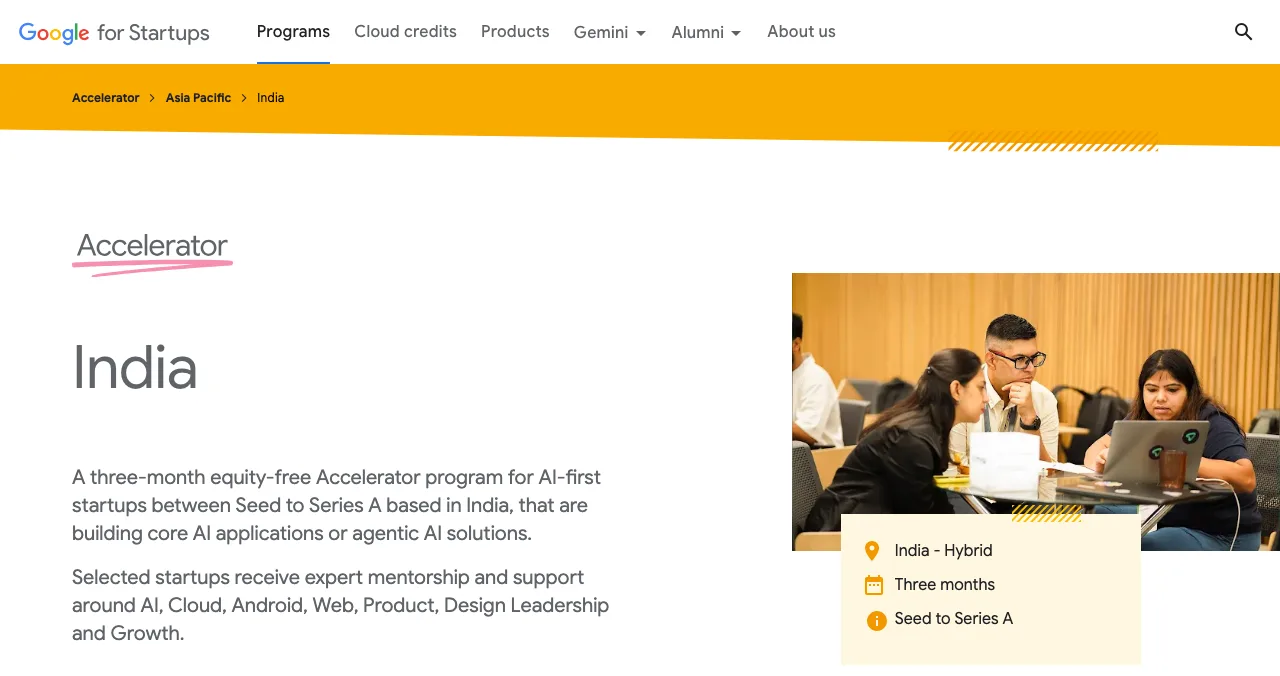
Google for Startups India
Equity-free, three months, AI-first startups.
Equity-freeClosed now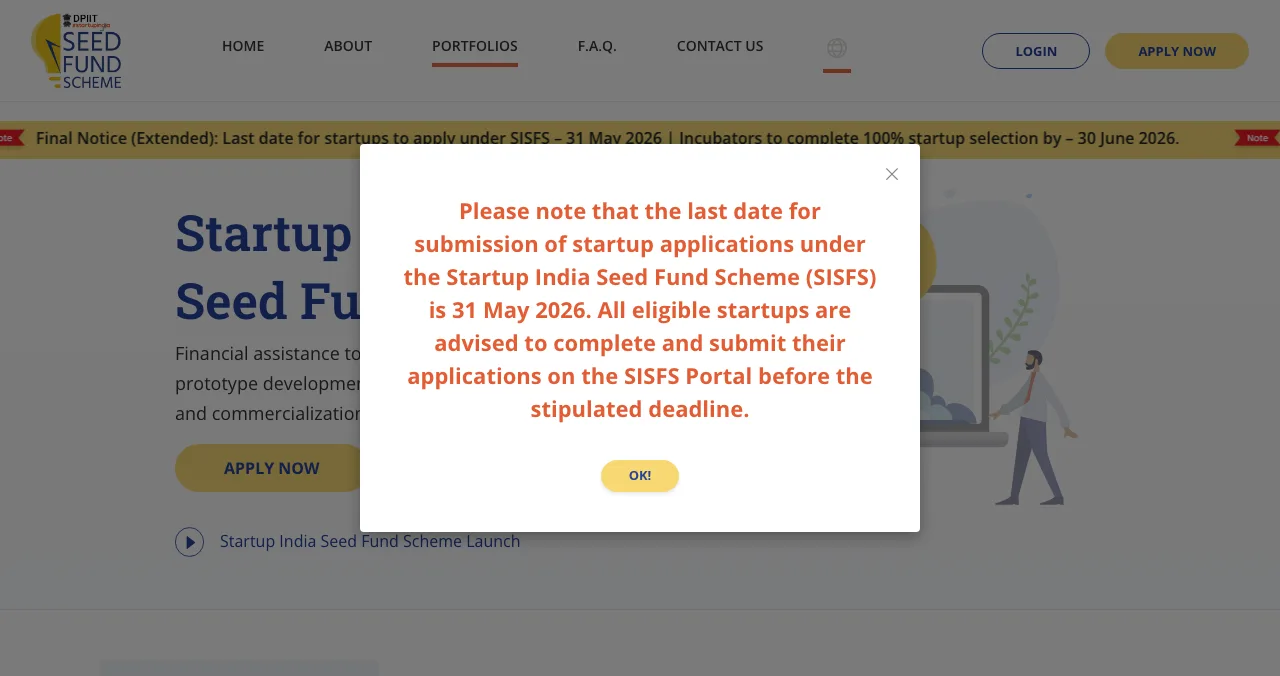
Startup India Seed Fund
Government seed funding through incubators.
Window closed 31 May 2026Government
Startup accelerators compared
| Programme | Money | Equity | Focus | Status (17 Nov 2026) |
|---|---|---|---|---|
| Y Combinator | $500,000 | 7% plus MFN SAFE conversion | Any sector, global | See YC's apply page |
| Techstars | Capital (amount not stated on the page we checked) | Programme terms | City and sector programmes | Spring 2027 open |
| Antler India | Pre-seed capital | Programme terms | Day-zero founders | Apply on its site |
| Surge by Peak XV | $500k to $5M seed | Investment terms | Seed; 17+ nationalities in its community | Apply on its site |
| Google for Startups Accelerator: India | None | Equity-free | AI-first, seed to Series A | Closed; register interest |
| Startup India Seed Fund | Seed funding via incubators | Scheme terms | Indian startups, via incubators | Last date was 31 May 2026 |
Table: Startup accelerators and seed programmes compared (each programme's official page, checked 17 Nov 2026)
The list
1. Y Combinator: the standard deal
YC invests $500,000 in every accepted company: $125,000 converts into a fixed 7%, and $375,000 goes in on an uncapped MFN SAFE that converts on the terms of your next SAFE round. YC also gets a pro rata right. It says the investment isn't contingent on milestones, starts the day you're accepted, and that it charges no fees. Its directory shows 5,000+ funded companies. Best for: founders who want the strongest network and are ready to move fast. See the YC startup directory.
2. Techstars: city and sector programmes
Techstars runs three-month, mentorship-driven programmes in cities (Boston, New York, London, Tokyo and more) and sectors (health, finance, space and defence, critical infrastructure), plus Techstars Anywhere. Its page said applications were open for Spring 2027 programmes. Best for: founders who fit a specific city or sector programme.
3. Antler India: day-zero founders
Antler says it backs founders "at day 0", with 115+ India portfolio companies, 12,000+ founders supported globally and 27+ offices. Best for: very early founders, including those still forming a team.
4. Surge by Peak XV: seed with operators
Surge says it invests from $500k up to $5M in seed capital from Peak XV, with co-investors welcome, and embeds operators across hiring, product, policy, engineering and go-to-market. It reports 170+ companies and 400+ founders. Best for: seed-stage founders who want a large fund's support early.
5. Google for Startups Accelerator: India — equity-free
A three-month, hybrid, equity-free programme for AI-first startups in India from seed to Series A, in cohorts of 10–15, with mentoring from Google experts, early access to AI products and Cloud credits for eligible startups. Applications were closed when we checked; you can register interest. Best for: AI startups wanting expertise without giving equity.
6. Startup India Seed Fund Scheme: government seed funding
SISFS provides funding for proof of concept, prototypes, product trials, market entry and commercialisation, disbursed through eligible incubators. Its portal showed a final notice: the last date for startups to apply was 31 May 2026, with incubator selection by 30 June 2026. Best for: watching for the next window; see Startup India registration to prepare.
How to choose an accelerator

- The deal — money, equity and any fees, in writing
- The fit — stage, sector and location they actually back
- The network — named alumni you can contact
- The status — open, closed or rolling, on the official page
- What you give up — time, equity, relocation
Mistakes

- Trusting old lists — check status on the official page
- Comparing brand, not terms — read the deal
- Applying with no product link — show it working
- Ignoring equity-free options — when you don't need cash yet
Ready to apply?
How we know
Every term, figure and status comes from the programme's official page, read on 17 November 2026; figures are each programme's own claims. Where a page didn't state an amount (Techstars' investment, Antler's cheque size), we left it out. This isn't financial or legal advice.
Key terms, defined
- Accelerator: a fixed-length programme of mentoring, usually with investment.
- SAFE: a simple agreement for future equity.
- MFN: "most favoured nation", taking the best terms of a later SAFE round.
- Pro rata right: the right to invest in later rounds to keep your share.
- Equity-free: support that doesn't take ownership in your company.
Frequently asked questions
Which accelerators should I apply to?
Apply where the deal and focus fit your stage: Y Combinator for the strongest network and a standard $500k deal; Techstars for sector or city programmes; Antler if you're very early or still forming a team; Surge for seed rounds with a large fund's operator support; Google for Startups if you're an AI-first startup that wants equity-free support.
What is the Y Combinator deal?
YC invests $500,000: $125,000 for a fixed 7% and $375,000 on an uncapped MFN SAFE, plus a pro rata right. YC says it charges no fees, and the investment isn't contingent on milestones.
Are there equity-free accelerators in India?
Yes. Google for Startups Accelerator: India describes itself as a three-month equity-free programme for AI-first startups from seed to Series A. Applications were closed on 17 November 2026; you can register interest for future cohorts.
Is the Startup India Seed Fund still open?
The SISFS portal showed a final notice that the last date for startups to apply was 31 May 2026, with incubators completing selection by 30 June 2026. Check the portal for any new scheme or extension.
What's the difference between an accelerator and an incubator?
Accelerators usually run fixed-length cohorts with investment and an end event like Demo Day. Incubators tend to offer longer, more flexible support such as space and mentoring, sometimes without investment. Names are used loosely, so read each programme's terms.
How do I make my accelerator application stronger?
Show progress: a working product, real users or revenue, and a clear one-line description. Link to a live product page and keep your Crunchbase and other profiles consistent with what you write.
Sources
- Y Combinator — The Y Combinator Standard Deal (checked 17 Nov 2026)
- Techstars — Accelerators (checked 17 Nov 2026)
- Antler — India (checked 17 Nov 2026)
- Surge by Peak XV (checked 17 Nov 2026)
- Google for Startups — Accelerator: India (checked 17 Nov 2026)
- Startup India Seed Fund Scheme (checked 17 Nov 2026)
- Checked November 17, 2026. Figures that change — fees, salaries, prices — are reviewed every six months; if something is out of date, tell us.
Where to go from here
- Find angel investors free — the other route
- Startup valuation — understand the deal
- Crunchbase alternatives — investor databases
- Science of Apps - LaunchpadThe Y Combinator startup directory explained: what's in it, how to search YC startups, Launch YC, and how non-YC founders can get the same kind of visibilityHow the Y Combinator startup directory works: search and filter YC companies by batch and hiring status, what Launch YC is, and how non-YC startups get found.
- Science of Apps - LaunchpadFree directory submission sites in 2027: a quality-checked list, and the directory links Google calls spamA quality-checked list of free directory submission sites for 2027, from Google Business Profile to SaaSHub, plus the low-quality directories to avoid.
- Startups in IndiaGovernment schemes for startups in India: grants, seed funds, credit guarantees and tax benefitsGovernment schemes for startups in India: Seed Fund grants, Fund of Funds, the credit guarantee, tax holiday, BIRAC and Mudra — who qualifies and how to apply.
- Science of Apps - LaunchpadFree startup directories in 2027: 16 checked sites to submit your startup to, grouped by what you want (investors, customers, a launch, India) with each one's rules16 free startup directories checked for 2027, grouped by goal: investors, customers, launch day and India, with each site's rules and the ones to skip.
- Science of Apps - LaunchpadThe top 5 websites to launch your startup for free, checked against each site's own rulesThe 5 best free websites to launch a startup: Science of Apps Launchpad, Product Hunt, Show HN, Uneed and Peerlist, with costs, rules and who each one suits.
- Science of Apps - LaunchpadFree tools for startups to launch with: the $0 stack by stage (validate, collect interest, launch, get found, measure, prove trust) with each free tier checkedFree tools for startups to launch with, by stage: Tally, LaunchList, Product Hunt, Launchpad, Search Console, Clarity, PageSpeed and WAVE.



Get the ideas, not the noise.
Sign up with Google and we’ll send you short UX psychology tips by email — why people tap, stall and leave, and what to do about it. Unsubscribe anytime. Prefer something to keep? Get the free Laws of UX guide as a PDF.
Launch day ends. Your listing shouldn't.
Accelerators want to see a real product; a free, permanent Launchpad profile with verifiable badges is a link you can add to every application, ranked by relevance, never payment.