 By
At a glance: Great Zimbabwe
- Location
- Masvingo Province, Zimbabwe
- Built
- c. 11th–15th century CE
- Type
- Stone-walled royal city · Royal
- Style
- Zimbabwe Plateau dry-stone architecture
- Commissioned by
- Rulers of the Kingdom of Zimbabwe (Shona ancestors)
- Architects & builders
- Not recorded
- Materials
- Granite blocks laid without mortar
- Size
- Great Enclosure walls up to about 11 m high; conical tower about 10 m
Great Zimbabwe: what it is
The city grew rich from cattle and from controlling gold exports to the Swahili coast; Chinese porcelain and Persian glass found here show its reach across the Indian Ocean world. At its peak it may have housed around 10,000–18,000 people.
It has three main parts: the Hill Complex, a royal and ritual centre on a granite hill; the Great Enclosure in the valley; and the Valley Ruins, where much of the population lived.
Great Zimbabwe, then and now
Real images only: an earlier view and a recent photograph, each credited and linked to its original file. Switch between them or compare side by side.
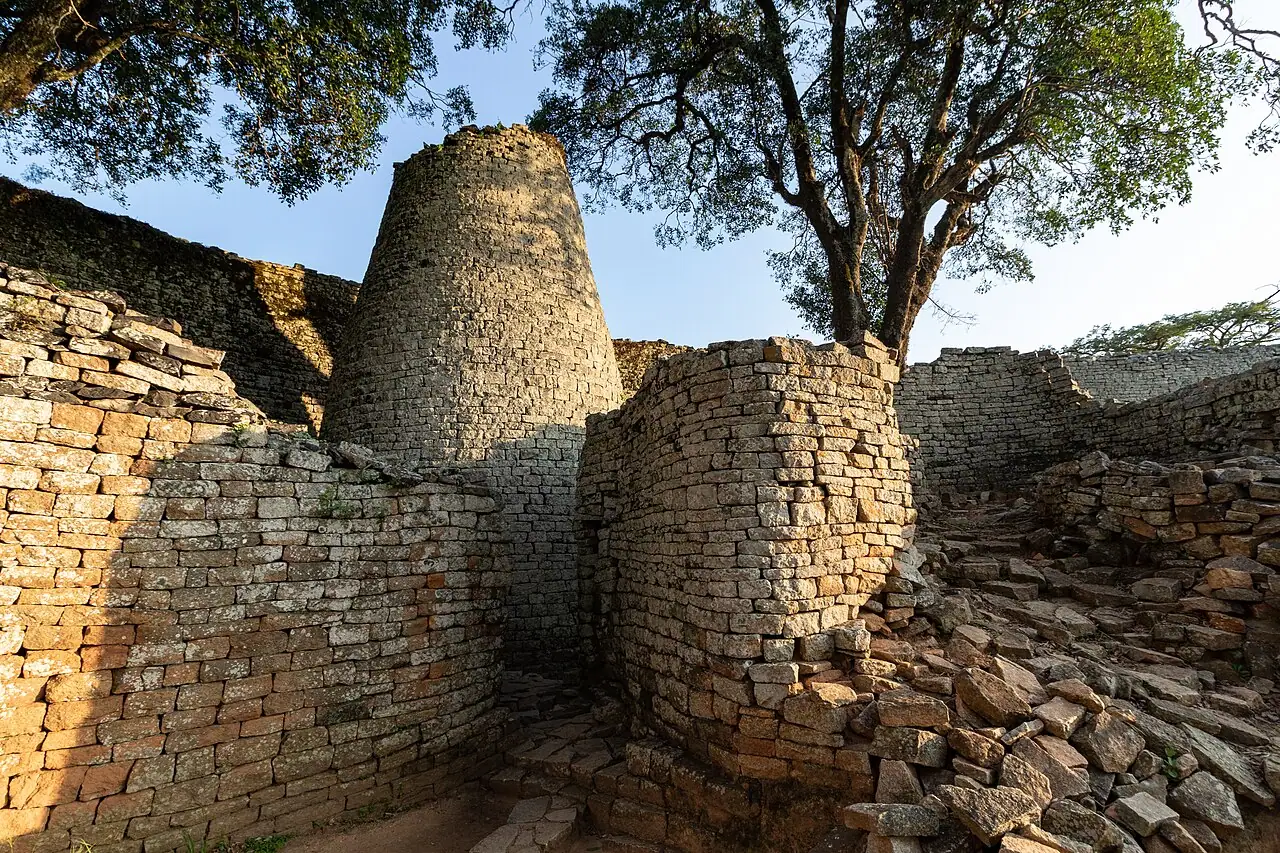
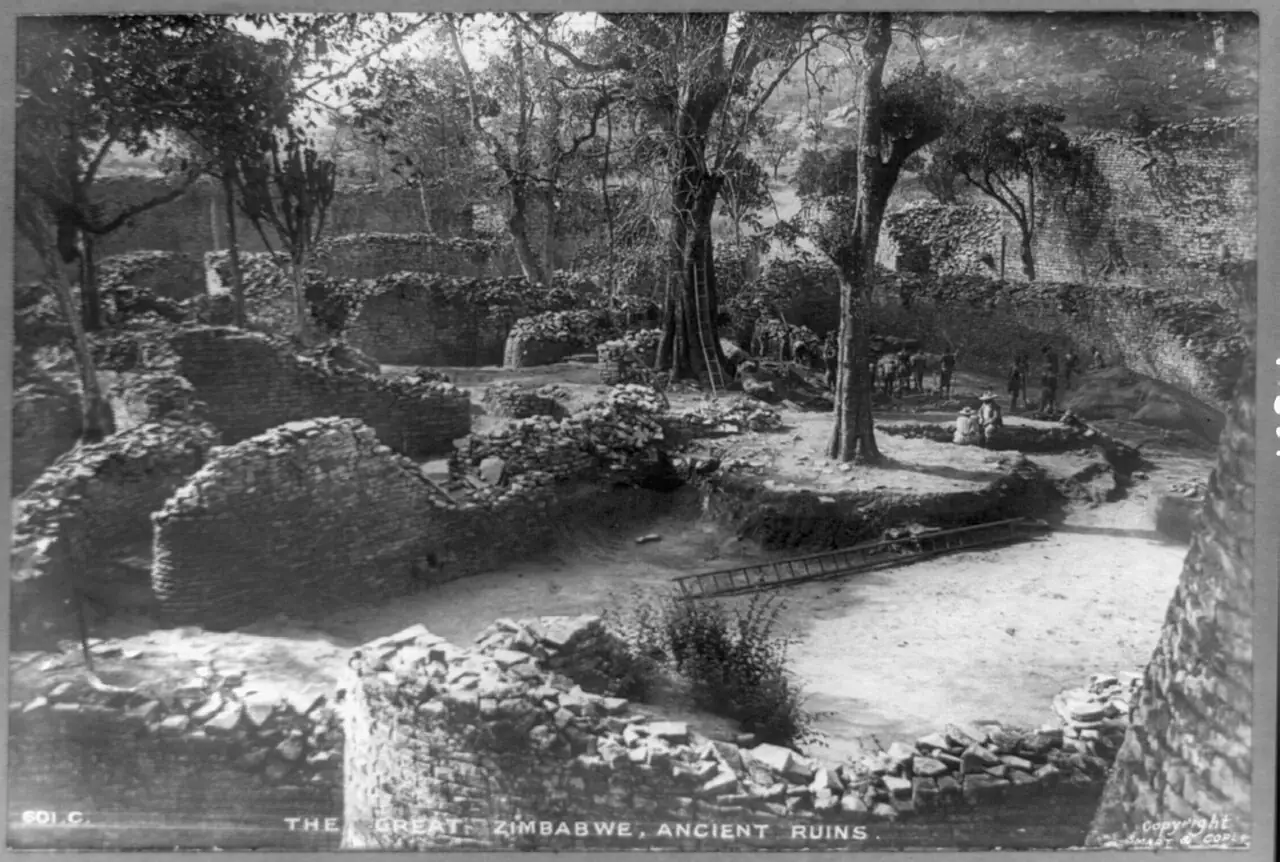 Then · c. 1900Now · TodayMove across the image to compare
Great Zimbabwe: how it was designed
- 01
Walls that follow curves
Rather than straight lines and corners, the walls sweep in long curves, adapting to the boulders of the hill and enclosing space like a series of rooms open to the sky.
- 02
Mortarless precision
Granite naturally splits into slabs; builders shaped them into regular blocks and laid them in courses that lean slightly inward, stable without mortar for centuries.
- 03
Decoration in the stone
Chevron and herringbone patterns along the top of the Great Enclosure's wall, and the solid conical tower inside it, show that the builders used stonework as display, not only defence.
Construction timeline
Building in stone begins on the hill.
The Great Enclosure is built and the city reaches its peak.
The city declines as trade and power shift to other states.
German explorer Karl Mauch visits and wrongly links it to the Queen of Sheba.
Archaeologists David Randall-MacIver and Gertrude Caton-Thompson show the builders were African.
The new nation takes the name Zimbabwe; the site is inscribed by UNESCO.
How the design changed
Damaged by treasure hunters
Around 1902 Richard Hall, hired to 'preserve' the site, cleared metres of archaeological deposits, destroying evidence of who lived there.
Birds returned home
Carved soapstone birds taken from the Hill Complex in the 19th century were held abroad; most have since returned, and the bird is now on Zimbabwe's flag.
Who built it
The builders were ancestors of the Shona-speaking peoples of the Zimbabwe plateau. Rhodesia's colonial government pressured guides and writers to suggest foreign builders well into the 1970s; archaeological evidence has been clear on African origin since the early 20th century.
Where it is
Masvingo Province, Zimbabwe · 20.2700° S, 30.9330° E · Open in OpenStreetMap. Nearest in this guide: Lalibela (3,699 km), Abu Simbel (4,738 km), Karnak (5,117 km).
 3,699 km4,738 km5,117 kmGreat Zimbabwe
Drag to pan, use + and − or double-click to zoom, and tap any pin for a preview.
Built around the same time
| Monument | Country | Built | Gap |
|---|---|---|---|
| Angkor Wat | Cambodia | c. 1113–1150 CE | 13 years later |
| Notre-Dame de Paris | France | 1163–c. 1345; restored 1845–1864 and 2019–2024 | 63 years later |
| Leaning Tower of Pisa | Italy | 1173–1372 | 73 years later |
| Rock-Hewn Churches of Lalibela | Ethiopia | Late 12th – early 13th century (traditional dating) | 81 years later |
Great Zimbabwe: questions people ask
Who built Great Zimbabwe?
The ancestors of the Shona people built it between about the 11th and 15th centuries. Claims of foreign builders were colonial myths disproved by archaeology.
How were the walls of Great Zimbabwe built?
With shaped granite blocks laid in courses without mortar, leaning slightly inward for stability, some walls reaching about 11 metres high.
Why was Great Zimbabwe abandoned?
In the 15th century, probably because of shifting gold trade routes and pressure on local resources, power moved to other centres such as Khami and Mutapa.
What does 'Zimbabwe' mean?
It is usually explained as Shona for 'houses of stone' or 'venerated houses'. The country was named after the site at independence in 1980.
Sources & image credits
- UNESCO World Heritage Centre — Great Zimbabwe National Monument
- Wikipedia — Great Zimbabwe
- Current photograph: Conical Tower - Great Enclosure III (33736918448).jpg by Andrew Moore from Johannesburg, South Africa, CC BY-SA 2.0 — original on Wikimedia Commons · licence.
- Historic image: The Great Zimbabwe, ancient ruins LCCN89714067.jpg by Frank and Frances Carpenter Collection, Public domain — original on Wikimedia Commons.
- Coordinates from Wikidata. Images resized and converted to WebP; otherwise unaltered. Checked October 25, 2026.
More to wander into
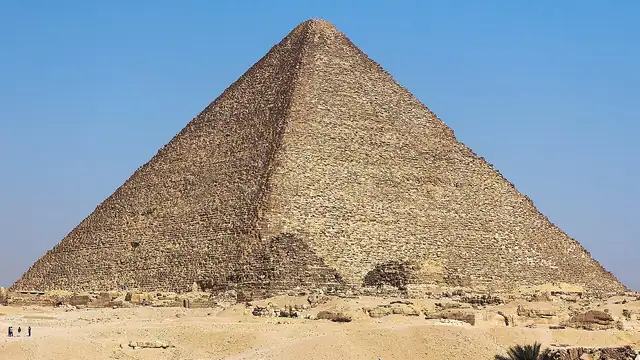
- World monument · c. 2600–2560 BCEGreat Pyramid of GizaKhufu's tomb, the tallest structure on Earth for almost 4,000 years.
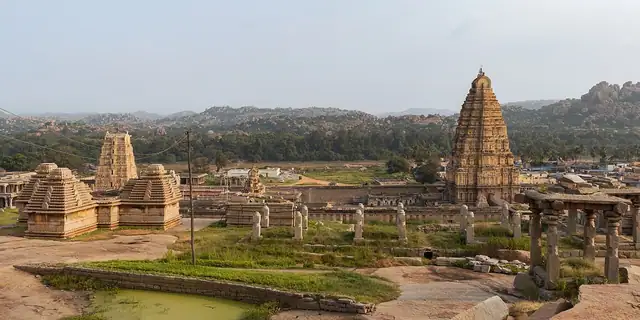
- World monument · Mainly 14th–16th century (Vijayanagara Empire, 1336–1565)Hampi (Group of Monuments)A sacked imperial capital of granite temples, stone chariots and singing pillars.
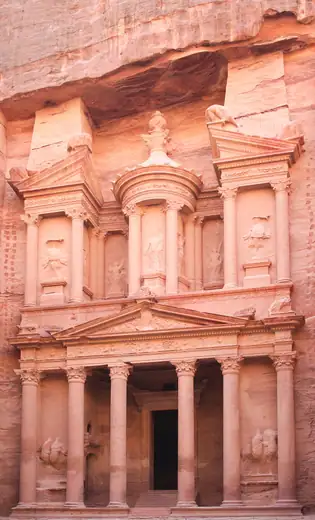
- World monument · Al-Khazneh: about the 1st century CEPetra — Al-Khazneh (the Treasury)A royal tomb carved top-down into a rose-red cliff, at the end of a narrow gorge.
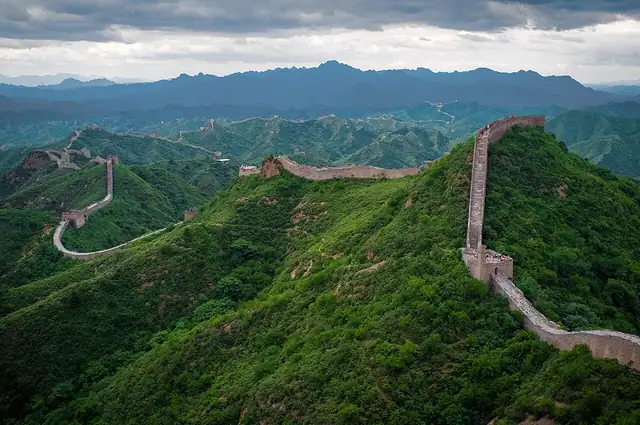
- World monument · 7th century BCE – 1644 CE (most visible parts Ming, 1368–1644)Great Wall of ChinaTwo thousand years of walls, from rammed earth to Ming brick.
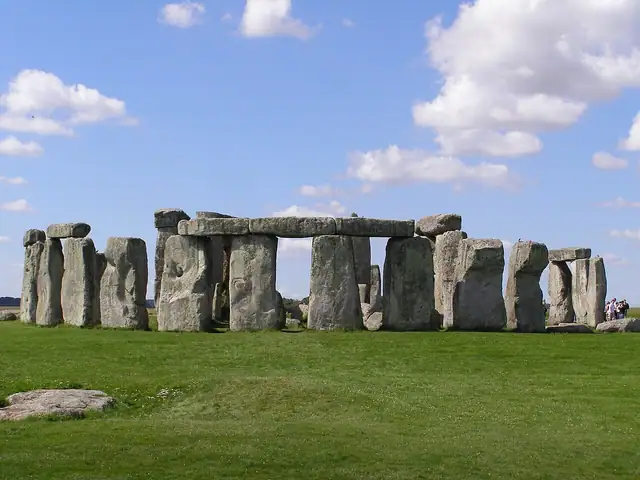
- World monument · c. 3000–1600 BCE (in stages)StonehengeA Neolithic stone circle aligned on the solstices, its stones locked with carpentry joints.
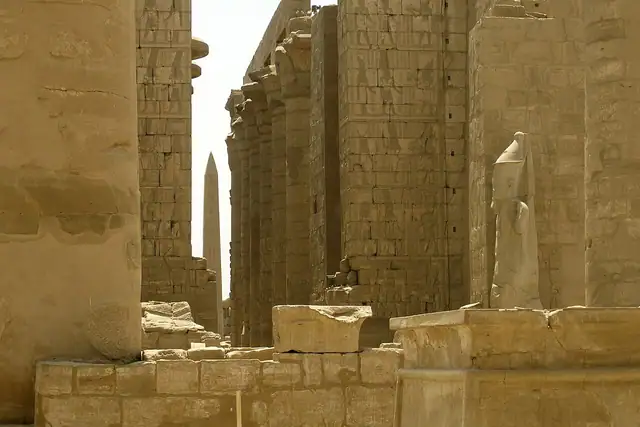
- World monument · c. 1971 BCE – 1st century BCEKarnak Temple ComplexA temple that grew for 2,000 years, with a forest of 134 stone columns.
Get the ideas, not the noise.
Sign up with Google and we’ll send you short UX psychology tips by email — why people tap, stall and leave, and what to do about it. Unsubscribe anytime. Prefer something to keep? Get the free Laws of UX guide as a PDF.