 By
Quick answer: What is a GTM strategy?
- Customer: one narrow segment you can name and reach.
- Promise: the problem, and why you solve it better.
- Price: a real number, tested early.
- Channels: one or two that reach that segment.
- Motion: self-serve or founder-led sales; measure weekly.
Key takeaways
- A GTM strategy is a set of choices, not a list of every channel.
- Narrow segments make every other box easier.
- Self-serve and sales-led products need different plans.
- Founders should sell first; it's how the plan gets real data.
- Rewrite the canvas every few weeks as you learn.
Most early go-to-market documents are 30 slides long and say "SMBs and enterprises, via content, paid, partnerships and outbound". That's not a strategy; it's a list of everything. A useful GTM strategy for a startup is a set of choices narrow enough to act on next Monday: this customer, this promise, this price, these two channels. This template puts those choices on one page, with a worked example and a 90-day plan, drawing on Y Combinator's founder guidance as read on 17 November 2026. Jump to the canvas, the example or the 90-day plan.
- Boxes on the one-page GTM canvas
- 8
- Customer segment to start with
- 1
- Channels, at most, at first
- 2
- Days in the first plan
- 90
What is a GTM strategy?
A go-to-market strategy is the plan for reaching your first paying customers. It answers who buys, why, for how much, how they hear about you and how they buy. A marketing plan executes it; a launch is one moment inside it. For a startup the plan is a hypothesis, and its main job is to be tested quickly.
The one-page GTM canvas
| Box | The question | Good answer is |
|---|---|---|
| 1. Customer | Who exactly buys first? | Narrow enough to list 50 by name |
| 2. Problem | What hurts, in their words? | Something they already spend time or money on |
| 3. Promise | What do you do better? | One sentence with a concrete difference |
| 4. Proof | Why should they believe it? | A demo, a result, an early customer |
| 5. Price | What do they pay, and how? | A real number you've said out loud |
| 6. Channels | Where do you reach them? | One or two places they already are |
| 7. Motion | How do they buy? | Self-serve, or founder-led sales |
| 8. Metrics | How do you know it works? | Weekly numbers, one per stage |
Table: The one-page go-to-market canvas for startups (editorial template)
A worked example

1. Customer
Independent physiotherapy clinics in Pune and Bengaluru with 2–5 therapists.
2. Problem
No-shows and WhatsApp back-and-forth to reschedule appointments.
3. Promise
Patients book and reschedule themselves on WhatsApp; reminders cut no-shows.
4. Proof
A two-week pilot at three clinics with before-and-after no-show counts.
5. Price
₹2,000 a month per clinic, paid monthly by UPI autopay.
6. Channels
Founder visits and clinic-owner WhatsApp groups; a Launchpad listing for search.
7. Motion
Founder-led sales: demo, free pilot, then paid monthly.
8. Metrics
Demos booked, pilots started, pilots converted, clinics still paying after 60 days.
The example is illustrative, not a real company. Notice what it leaves out: no ads, no "content strategy", no second segment. Each box narrows the next.
Self-serve or sales-led?

Self-serve fits when
- The price is low enough to buy without a meeting
- Users can reach value alone in minutes
- Many small customers find you through search and communities
Founder-led sales fits when
- The buyer isn't the user, or several people must approve
- The price is high or the setup needs your help
- You need deep feedback from each early customer
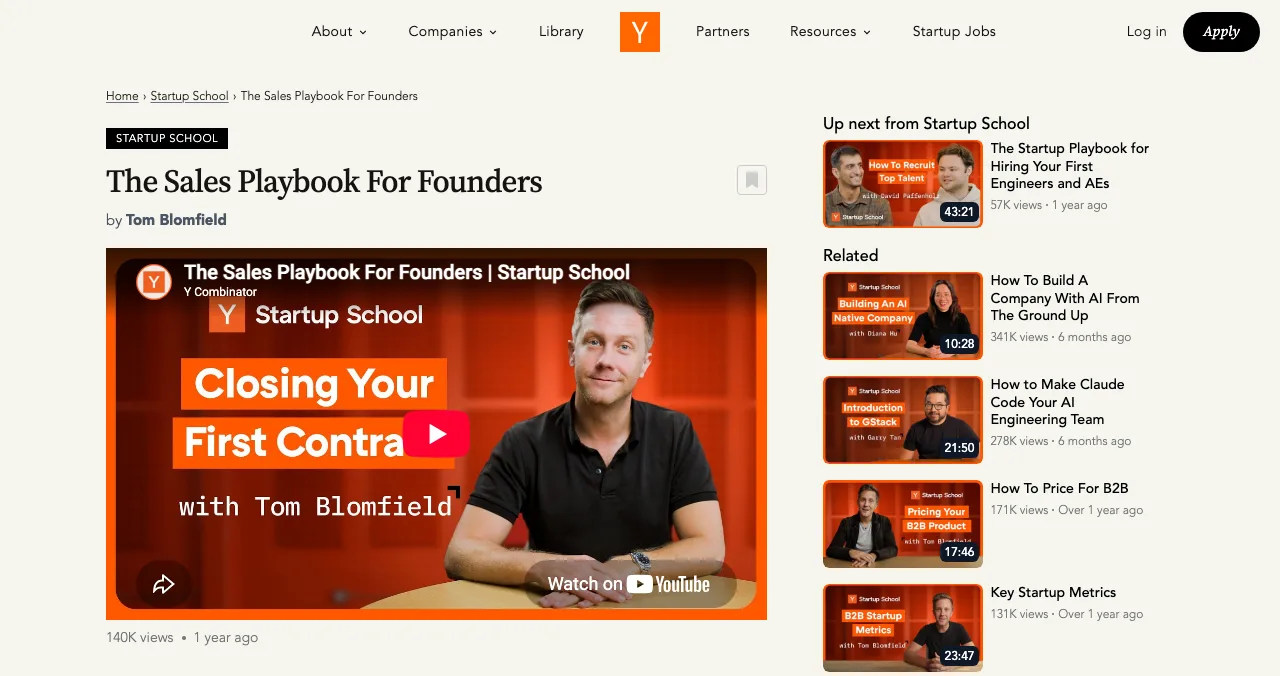
For B2B, YC's Tom Blomfield describes an early sales process that moves from design partners to free pilots, then paid pilots, then recurring contracts, with success metrics agreed up front. Founders run it themselves before hiring salespeople, because that's how the GTM plan gets real data.
Picking channels
Research into well-known consumer apps' first 1,000 users found most relied on one strategy and none succeeded with more than three (first 1,000 users). Pick the channels where your segment already gathers, and judge each by the customers it brings, not the attention.
| Motion | Channels that often fit early |
|---|---|
| Self-serve SaaS | Launch sites, communities, search, a free tool |
| Founder-led B2B | Warm intros, targeted outreach, industry groups, events |
| Consumer app | Communities, campuses or local groups, creators, referrals |
| Developer tool | Show HN, GitHub, docs, developer communities |
Table: Early channels by GTM motion (editorial guidance)
The 90-day GTM plan
- Days 1–14
Fill the canvas
Talk to 20 people in the segment; write one sentence per box.
- Days 15–30
Soft launch
Ten users or three pilots; watch them use it; fix what blocks value.
- Days 31–45
Public launch
Launch on a few sites at once; announce to your network.
- Days 46–75
Run two channels
Weekly effort on the two best channels; one price test.
- Days 76–90
Review and rewrite
Which box was wrong? Update the canvas and set the next 90 days.
For the launch weeks themselves, see the product launch strategy and where to launch.
Mistakes

- "Everyone" as the customer — you can't reach everyone with no budget
- No price — "we'll figure it out later" hides whether anyone will pay
- Too many channels — two done well beat six done once
- Hiring sales before founders have sold — the playbook doesn't exist yet
- A plan that never changes — rewrite it as the data comes in
Ready to take it to market?
How we know
The founder-led sales sequence comes from Y Combinator's Sales Playbook for Founders by Tom Blomfield; the channel finding from Lenny Rachitsky's 2020 research; both read on 17 November 2026. The canvas, the worked example (illustrative, not a real company) and the 90-day plan are our editorial templates.
Key terms, defined
- Go-to-market (GTM) strategy: the plan for reaching and selling to your first customers.
- Segment: a narrow group of customers with the same problem.
- Motion: how customers buy: self-serve or sales-led.
- Design partner: an early customer who shapes the product in exchange for access.
- Pilot: a time-limited trial with agreed success measures.
Frequently asked questions
What is a GTM strategy?
A go-to-market strategy is the plan for bringing a product to its first customers: the target segment, the problem and promise, pricing, the channels that reach those customers, how they buy, and the metrics that show it's working.
What should a startup's go-to-market strategy include?
Eight things: the target customer, their problem, your promise, proof, price, channels, the buying motion (self-serve or sales-led) and the metrics you'll track. For an early startup, all eight fit on one page.
What's the difference between a GTM strategy and a marketing plan?
A GTM strategy decides who you sell to, what you promise, how you price and how they buy. A marketing plan is the activity that follows: the posts, launches and campaigns that execute the channels the GTM strategy picked.
What is a launch strategy for SaaS?
It's the part of the GTM plan that covers the launch itself: a soft launch with early users, a public launch on a few sites, then steady channels. Our product launch strategy guide covers it step by step.
Should a B2B startup use founder-led sales?
Usually, at first. Y Combinator's Tom Blomfield describes an early B2B sales process built on design partners, free then paid pilots and recurring contracts, which founders run themselves before hiring salespeople.
How often should I update my GTM strategy?
Every few weeks early on, whenever the data changes your answer to a box: a different segment converts better, a channel stops working, or customers pay more or less than you priced.
Sources
- Y Combinator — The Sales Playbook For Founders (Tom Blomfield; checked 17 Nov 2026)
- Y Combinator — How to launch (again and again)
- Lenny's Newsletter — How the biggest consumer apps got their first 1,000 users (2020)
- Paul Graham — Do Things that Don't Scale (July 2013)
- Science of Apps — Launchpad: launch your product free
- Checked November 17, 2026. Figures that change — fees, salaries, prices — are reviewed every six months; if something is out of date, tell us.
Where to go from here
- Product launch strategy — the launch itself
- App marketing strategy — launch to scale
- Places to launch a startup — channels
- Science of Apps - LaunchpadHow to launch a SaaS product in 2027: from private beta to public launch to the first paying customersHow to launch a SaaS in 2027, step by step: private beta, pricing, onboarding that activates, a permanent page, launch days, and turning trials into customers.
- Science of Apps - LaunchpadHow to validate a startup idea in 7 days: a day-by-day plan to find out whether people will use and pay for itHow to validate a startup idea in 7 days: define the problem, find people who have it, run 10+ interviews, test demand with a page and a price, then decide.
- Science of Apps - LaunchpadHow to market a SaaS in 2027: positioning, being found by buyers, content that gets cited, launches and a product that convertsHow to market a SaaS in 2027: sharp positioning, alternatives directories, search and AI visibility, launches, founder-led sales and a trial that converts.
- Science of Apps - LaunchpadThe startup launch checklist for 2027: everything to do before, during and after launch, in orderA startup launch checklist for 2027: product, page, visibility, assets, launch-day and follow-up items, in order, with the platform rules that matter.
- Science of Apps - LaunchpadHow to get your first 100 users without paid ads: a channel-by-channel plan founders can start todayHow to get your first 100 users without paid ads in 2027: your network, communities, launch sites, directories, content and one-to-one outreach, step by step.
- Science of Apps - LaunchpadPre-launch marketing for startups: a six-week plan from waitlist to launch day, with the channels, assets and rules that matterPre-launch marketing for startups: a 6-week plan with a waitlist, building in public, early adopters, launch assets and a scheduled launch date.



Get the ideas, not the noise.
Sign up with Google and we’ll send you short UX psychology tips by email — why people tap, stall and leave, and what to do about it. Unsubscribe anytime. Prefer something to keep? Get the free Laws of UX guide as a PDF.
Launch day ends. Your listing shouldn't.
A free, permanent Launchpad profile is a channel that keeps working after launch day: people find you by the problem you solve, ranked by relevance and never by payment.