 By
Quick answer: How do I go from 100 to 1,000 users?
- Look back: which channel brought your first 100 users?
- Pick one or two: most apps grew from a single strategy.
- Fix activation first: more sign-ups won't help a leaky product.
- Do things that don't scale: recruit users by hand, longer than feels right.
- Add a permanent page: something every post and mention can link to.
Key takeaways
- 1,000 users is mostly 10× of what already worked, not 10 new channels.
- Narrow the target user before you widen the funnel.
- Word of mouth starts with users who reached a real result.
- Track users who stay, not sign-ups.
- What works for 1,000 often stops working at 10,000; that's fine.
Your first 100 users came from somewhere specific: a Reddit thread, your old colleagues, a Product Hunt launch, a WhatsApp group, a cold email you rewrote six times. The temptation at 100 is to add channels: start a newsletter, try TikTok, buy some ads. The evidence points the other way. Lenny Rachitsky interviewed founders and read accounts of how well-known consumer apps got their first 1,000 users, and found that most did it with one strategy. This playbook shows how to find yours and push it ten times further. Jump to the seven strategies, the playbook or mistakes.
- Strategies behind well-known apps' first 1,000 users
- 7
- Strategy most of them relied on
- 1
- The most any of them succeeded with
- 3
- What 100 → 1,000 means for the channel that worked
- 10×
Start with the channel that brought your first 100
Your first 1,000 users are usually ten times more of what already worked. Before adding anything, list your first 100 users and where each came from. If you can't tell, ask them; it's a five-minute message and it's the most useful data you have.

- Group by source — community, outreach, launch site, friends, search, press
- Mark who stayed — users who came back in week two, not just sign-ups
- Find the winner — the source with the most users who stayed
- Find the reason — what made those users try it: a post, a demo, an intro
The seven strategies for the first 1,000 users
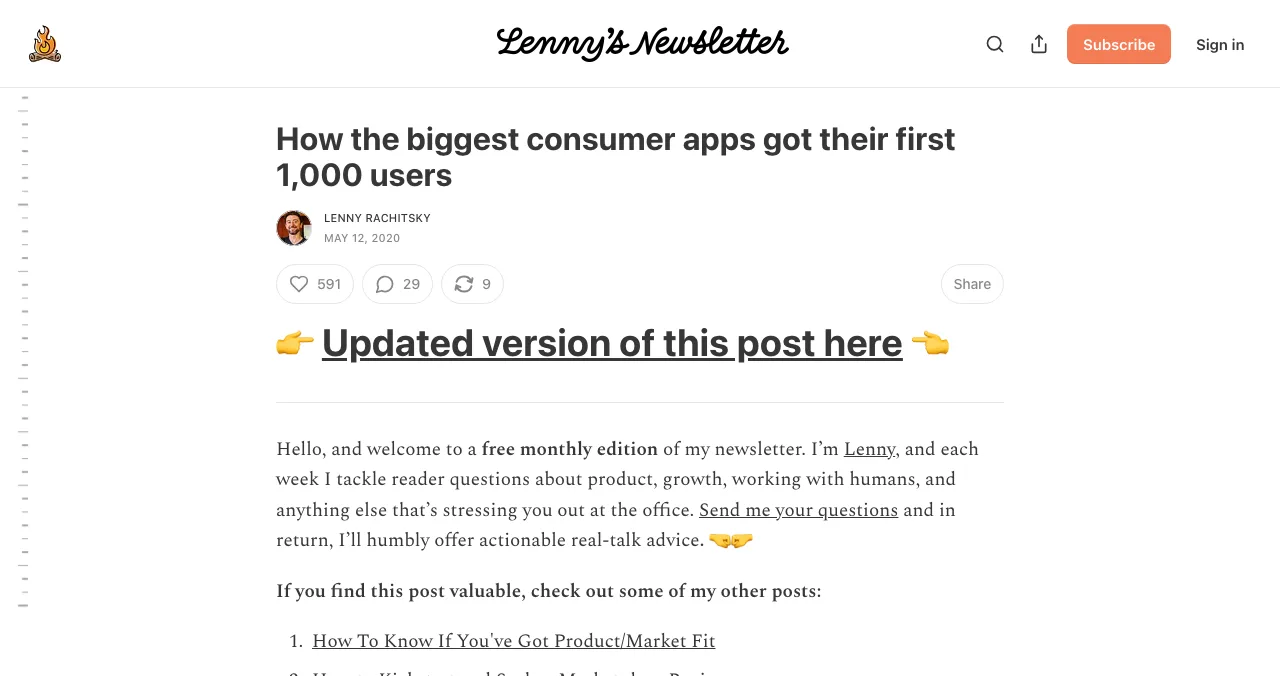
Rachitsky's 2020 research grouped every account he collected into seven strategies. His takeaways: most startups found early users through a single strategy, a few used a handful, none succeeded with more than three, and the most popular ones involve going to users directly. (He has since published an updated version; the original is linked below.)
| Strategy | Example from the research | Works best for |
|---|---|---|
| 1. Go where users are, offline | Tinder on college campuses; DoorDash flyers at Stanford | Local, campus and marketplace products |
| 2. Go where users are, online | Communities and forums your users already use | Most software and B2B tools |
| 3. Invite your friends | Founders' own networks | Social and collaborative products |
| 4. Create FOMO for word of mouth | Waitlists and invite-only access | Products people show off |
| 5. Leverage influencers | Creators your users follow | Consumer apps with a visual "wow" |
| 6. Get press | A story a publication wants to tell | Products with a genuinely new angle |
| 7. Build a community pre-launch | An audience gathered before launch | Founders who build in public |
Table: The seven strategies for a consumer app's first 1,000 users (Lenny Rachitsky, 12 May 2020; checked 17 Nov 2026)
For B2B products the same logic holds with a sales flavour: founder-led outreach to a narrow segment, design partners and referrals from the first happy customers. See how to get your first SaaS customers.
The 100 → 1,000 playbook

- Narrow the user — describe the user who stayed in one sentence; target only them for now.
- Fix activation — watch five new users try the product; remove what stops them reaching a first result.
- Pick one or two channels — the source of your best users, plus at most one experiment.
- Multiply the effort 10× — ten communities instead of one; 50 outreach messages a week instead of five; a launch on several sites, not one.
- Keep doing things that don't scale — onboard users personally; reply to every message.
- Turn users into referrers — ask happy users for an intro, a review or a post, at the moment they get a result.
- Review weekly — new users who stayed, by channel; stop what isn't working after a fair test.
- Weeks 1–2
Look back and fix
Source every user; watch new users; fix the biggest activation drop-off.
- Weeks 3–6
Push one channel
10× the effort on the winner; one small experiment on the side.
- Weeks 7–10
Add referrals
Ask at the moment of success; give users something worth sharing.
- Weeks 11–12
Review
Users who stayed by channel; keep, scale or stop.
An example 12-week plan; adjust the pace to your own growth rate.
Do things that don't scale, for longer
Paul Graham's 2013 essay "Do Things that Don't Scale" says the most common unscalable thing founders have to do at the start is to recruit users manually, and that startups take off because founders make them take off. Between 100 and 1,000 users, that still applies. The difference is volume: you're doing the same personal work, but with a list, a schedule and templates you rewrite for each person.
Fix the leak before you widen the funnel
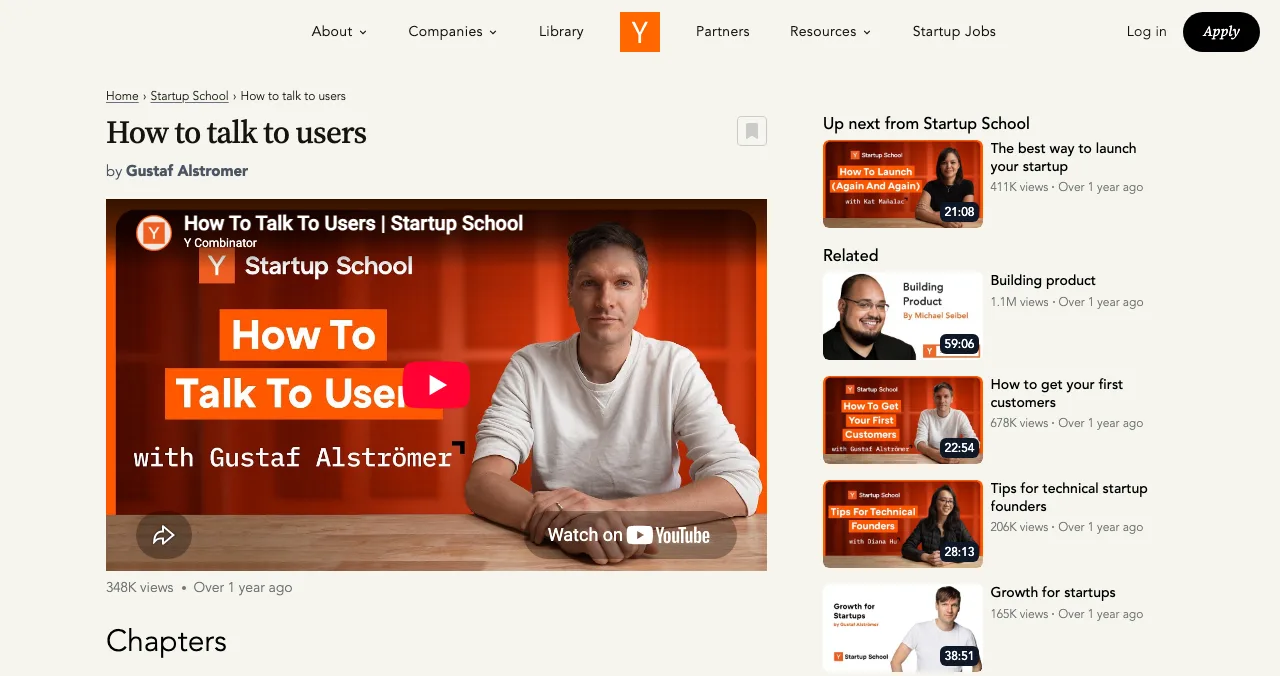
If half your new users never reach a first result, 1,000 sign-ups is really 500. Watch real users go through sign-up and the first task; YC's guidance on talking to users is a good script. Then fix the biggest drop-off. Our startup launch checklist covers the basics to check first.
Mistakes between 100 and 1,000 users

- Adding channels instead of deepening one — none of the apps in the research succeeded with more than three
- Counting sign-ups — count users who came back
- Buying ads too early — they amplify a product people already want
- Stopping the manual work — personal onboarding still converts best
- No link to share — every mention needs one permanent page to point to
Ready for the next 900?
How we know
The seven strategies and the "one strategy, never more than three" finding come from Lenny Rachitsky's May 2020 research post, read on 17 November 2026; it covers well-known consumer apps, so B2B founders should adapt it. The quote on recruiting users is from Paul Graham's July 2013 essay. The playbook and the 12-week plan are our editorial recommendation.
Key terms, defined
- Activation: a new user reaching their first real result.
- Retained user: someone who comes back after their first visit.
- Channel: a repeatable way users find you.
- Things that don't scale: manual work founders do early to win users.
- Referral: a new user brought by an existing one.
Frequently asked questions
How do I go from 100 to 1,000 users?
Find the channel that brought most of your first 100 (a community, outreach, a launch, friends of users) and multiply the effort there, while fixing whatever stops new users reaching a first result. Lenny Rachitsky's research found most apps reached 1,000 users through one strategy.
How long does it take to get 1,000 users?
It varies widely by product and market; there is no reliable average. Set a weekly target from your current growth rate and judge the channel after a few weeks of consistent effort rather than after one post.
What are the best ways to get your first 1,000 users?
Lenny Rachitsky's 2020 research lists seven: go where users are offline, go where they are online, invite friends, create FOMO for word of mouth, use influencers, get press, and build a community before launch.
Should I run ads to get my first 1,000 users?
Usually not first. Ads amplify a product people already want; before you know who sticks and why, they mostly buy sign-ups who leave. Use them to test a message or audience cheaply, not as the main channel.
What are 'things that don't scale'?
Paul Graham's term for manual work founders do early, such as recruiting users one by one and onboarding them personally. He says it's the most common unscalable thing founders have to do, and that startups take off because founders make them.
How do I get my first 100 customers?
Start with people you can reach directly: communities where your users already gather, warm introductions and personal outreach. See our guide to the first 100 users for the step-by-step version.
Sources
- Lenny's Newsletter — How the biggest consumer apps got their first 1,000 users (Lenny Rachitsky, 12 May 2020; checked 17 Nov 2026)
- Paul Graham — Do Things that Don't Scale (July 2013)
- Y Combinator — How to Talk to Users
- Science of Apps — Launchpad: launch your product free
- Checked November 17, 2026. Figures that change — fees, salaries, prices — are reviewed every six months; if something is out of date, tell us.
Where to go from here
- Get your first 100 users — the step before
- Places to launch a startup — launch channels
- Product-market fit — how to tell
- Science of Apps - LaunchpadHow to get your first 100 users without paid ads: a channel-by-channel plan founders can start todayHow to get your first 100 users without paid ads in 2027: your network, communities, launch sites, directories, content and one-to-one outreach, step by step.
- Science of Apps - LaunchpadHow to get your first users for a new app: the store listing, launch sites, communities, direct outreach and a web page that keeps bringing people inHow to get users for a new app, free: fix the store listing, launch on Product Hunt and Peerlist, reach people directly, and add a permanent web page.
- Science of Apps - LaunchpadHow to get your first SaaS customers: from design partners to paid plans, without a sales teamHow to get your first paying SaaS customers in 2027: design partners, founder-led sales, communities, launch sites, directories and a trial that works.
- App marketing & ASOHow to get app downloads: a playbook for your first 1,000 usersA practical playbook for your first 1,000 app downloads: pre-launch waitlist, communities, founder-led outreach, ASO basics, referrals and small paid tests.
- Science of Apps - LaunchpadHow to find startup ideas: the common mistakes, YC's seven recipes for generating ideas, and how to test one before you buildHow to find startup ideas: the mistakes to avoid and YC's seven recipes, from your own expertise to broken industries, plus how to test an idea fast.
- Science of Apps - LaunchpadHow to find early adopters: who they are, the ten places they gather, and how to turn them into your first users and championsHow to find early adopters for a startup: who they are, where they gather (communities, launch sites, BetaList), how to approach them and keep them.




Get the ideas, not the noise.
Sign up with Google and we’ll send you short UX psychology tips by email — why people tap, stall and leave, and what to do about it. Unsubscribe anytime. Prefer something to keep? Get the free Laws of UX guide as a PDF.
Launch day ends. Your listing shouldn't.
A free, permanent Launchpad profile where people find you by the problem you solve, ranked by relevance and never by payment, plus a free report on your landing page, discoverability and speed.