 By
Quick answer: How do I get my first SaaS customers?
- Design partners (customers 1–5): people with the problem who help shape the product, ideally paying a little.
- Founder-led outreach (5–20): short, specific messages to a narrow list of ideal buyers.
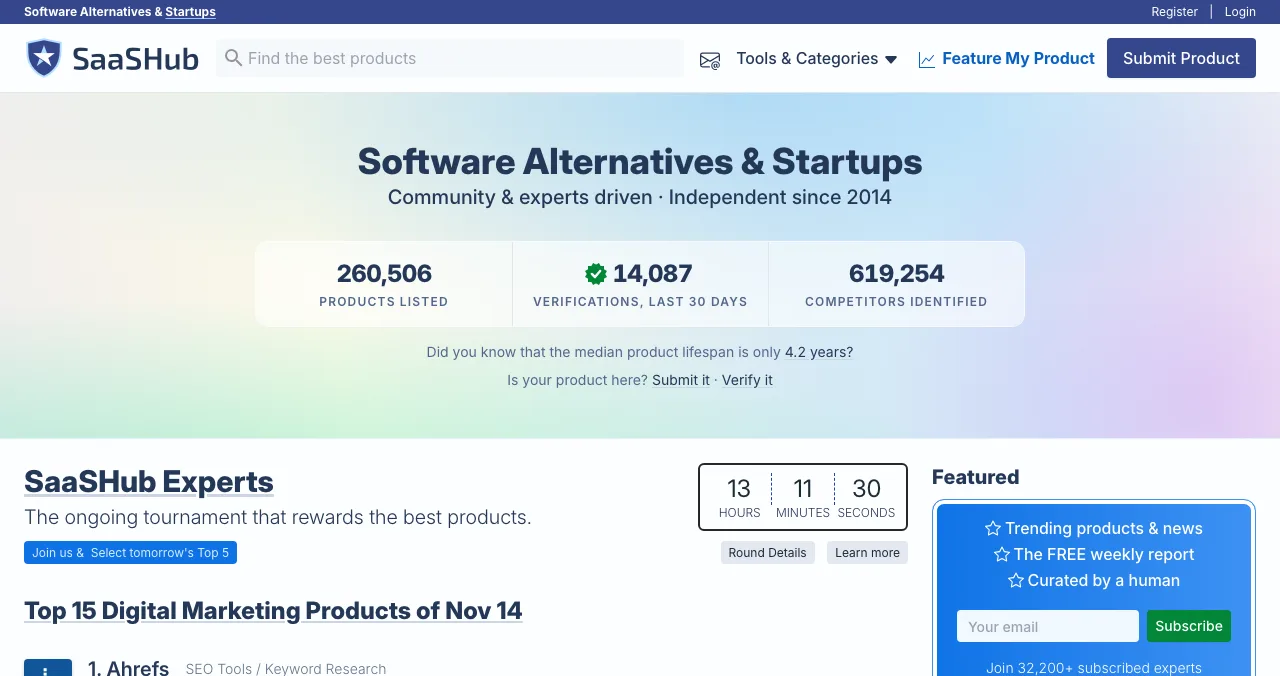
- Where buyers already look: communities, launch sites, SaaSHub and AlternativeTo.
- A trial that works: sign-up to first result fast, visible pricing, clear trial terms.
- Follow-up: talk to every trial user; ask why non-buyers didn't buy.
Key takeaways
- The first customers are sold by founders, one conversation at a time.
- Design partners shorten the path to product-market fit and often become the first paying customers.
- Charge early: even a small price tells you whether the value is real.
- Buyers comparing tools use alternatives directories; be listed where they look.
- The trial is a sales tool: if users don't reach a result quickly, no channel will save it.
The first SaaS customers aren't acquired; they're recruited. A founder finds someone with an expensive problem, works closely with them, and asks for money before the product feels finished. Channels and launches come later and amplify what already works. This playbook covers the path from the first design partner to the first 20 paying customers, with the tools and platform rules that matter (checked on their own pages, 16–17 November 2026). Jump to design partners, outreach, where buyers look or the trial.
- Design partners to start with
- 5–10
- Narrow niche to sell into first
- 1
- Cost of most early channels
- $0
- Number that predicts revenue early: trials reaching a real result
- 1
Customers 1–5: design partners

- Pick one narrow buyer. "Finance teams at 50–200 person SaaS companies", not "businesses".
- Find people with the problem now. People who've complained about it, built spreadsheets for it, or hired for it.
- Offer a partnership, not a product. Early access, a direct line to you and influence on the roadmap, for regular feedback and, ideally, a discounted price.
- Solve their problem by hand if needed. Do things that don't scale until the product catches up.
- Ask for a reference once they're getting value.
Customers 5–20: founder-led outreach

- A tight list — 100 people who clearly have the problem beats 1,000 who might
- A specific first line — about their situation, not your product
- One question, not a pitch — "How are you handling X today?"
- A demo only when invited — show the one workflow they care about
- A clear next step — a trial with their data, or a paid pilot
For finding contacts, Apollo's pricing page describes a free plan for "founders and early-stage teams". Keep volumes small and messages personal; mass outreach burns your reputation.
Where buyers already look
| Channel | Why buyers are there | Rule to know |
|---|---|---|
| SaaSHub, AlternativeTo | Comparing alternatives to a tool they use | Released products only on SaaSHub; list competitors |
| Industry communities | Discussing the problem | Help first; read the rules |
| Indie Hackers | Founders buying tools for their own startups | Share progress, not ads |
| Product Hunt, Peerlist | Early adopters trying new tools | Never ask for upvotes |
| A permanent profile | Searching for the problem on Google and AI assistants | Same description everywhere |
Table: Inbound channels for early SaaS customers (each site's own pages, checked 16–17 Nov 2026)
Make the trial do the selling
A trial that doesn't reach a real result loses the customer, however good your outreach was.

- Sign-up in under a minute — email or social sign-in; details later
- Their data, not an empty screen — imports, templates or a guided first task
- A result on day one — the first report, invoice or insight (Nielsen H1: show progress)
- Pricing visible and simple — two or three plans, one recommended (Hick's Law)
- Trial terms stated — length, card or no card, how to cancel
- Checkout that works on mobile — and keeps details on errors
Once your listing is live, Science of Apps tests the whole journey end to end, including the paywall, upgrade and checkout, and hands you a detailed report ranking what to fix first.
Follow up like a founder

- Email every new trial personally — ask what they're trying to do.
- Watch who reaches a result — and help the ones who don't.
- Ask non-buyers one question — "What would have made this worth paying for?"
- Turn customers into references — a quote, a case study, an introduction.
Mistakes that delay the first customers

- Selling to everyone — a narrow niche converts faster and refers better
- Giving it away free forever — you learn less, and switching to paid is harder
- Pitching before listening — ask about their process first
- A trial with an empty first screen — users leave before seeing value
- Hiding pricing — B2B buyers want a range before a demo
Ready for your first customers?
How we know
Channel rules come from SaaSHub's submission guidelines, Product Hunt's help centre and Apollo's pricing page, read on 16–17 November 2026. The design-partner and outreach approach is our editorial guidance; we don't quote outreach response rates because they vary too much to be useful. Science of Apps runs the Launchpad mentioned above.
Key terms, defined
- Design partner: an early customer who shapes the product in exchange for early access and influence.
- Founder-led sales: selling done personally by the founders, before a sales team exists.
- Paid pilot: a short, paid trial with defined success criteria.
- Activation: a trial user reaching the first real result.
- Alternatives directory: a site where buyers compare software by the tools it replaces.
Frequently asked questions
How do I get my first SaaS customers?
Start with 5–10 design partners who have the problem, then run founder-led outreach to a narrow list of ideal buyers, show up in communities where they talk, launch on sites that fit your audience, and list in alternatives directories like SaaSHub and AlternativeTo. Make sure the trial gets users to a real result fast.
What is a design partner?
An early customer who has the problem, uses early versions, gives detailed feedback and, ideally, pays a discounted price in return for influence over the roadmap. Design partners de-risk the product and often become references.
Should I charge my first customers?
Yes, if you can. A price, even a small one, tests whether the value is real and attracts more serious feedback. Offer founder pricing or a discount for early commitment rather than free forever.
How do I find my first SaaS customers without a network?
Pick a narrow niche, find where those buyers talk (industry communities, LinkedIn, forums), help there for a few weeks, and message people one to one about their problem. Launch sites and alternatives directories bring inbound interest once you're live.
How many outreach messages does it take?
It varies widely by market and message quality; there's no reliable rate to quote. Short, specific messages to people who clearly have the problem do far better than generic ones, so spend time on the list and the first line.
Why do trial users not convert?
Most often because they didn't reach a real result during the trial: sign-up friction, an empty first screen, unclear next steps or a confusing paywall. Talk to them, watch sessions and test the full journey from sign-up to checkout.
Sources
- SaaSHub — Submit a product: guidelines (checked 17 Nov 2026)
- Product Hunt Help Center — How to promote your launch (and what to avoid) (checked 17 Nov 2026)
- Indie Hackers — Homepage
- Apollo.io — Pricing: free plan for founders (checked 17 Nov 2026)
- Nielsen Norman Group — 10 usability heuristics for user interface design
- Science of Apps — Launchpad: launch your product free
- Checked November 17, 2026. Figures that change — fees, salaries, prices — are reviewed every six months; if something is out of date, tell us.
Where to go from here
- How to launch a SaaS — beta to public launch
- Where to launch a SaaS — 14 sites by layer
- How to get your first 100 users — the free channels in order
- Science of Apps - LaunchpadHow to get your first 100 users without paid ads: a channel-by-channel plan founders can start todayHow to get your first 100 users without paid ads in 2027: your network, communities, launch sites, directories, content and one-to-one outreach, step by step.
- Science of Apps - LaunchpadHow to market a SaaS in 2027: positioning, being found by buyers, content that gets cited, launches and a product that convertsHow to market a SaaS in 2027: sharp positioning, alternatives directories, search and AI visibility, launches, founder-led sales and a trial that converts.
- Science of Apps - LaunchpadHow to launch a SaaS product in 2027: from private beta to public launch to the first paying customersHow to launch a SaaS in 2027, step by step: private beta, pricing, onboarding that activates, a permanent page, launch days, and turning trials into customers.
- Science of Apps - LaunchpadHow to market a startup with no money: the free channels that work, in the order to use them, and what each costs in time insteadHow to market a startup with no money: direct outreach, communities, free launch sites, directories, content and AI search, in order, with the time each costs.
- Science of Apps - LaunchpadSites like AppSumo for SaaS founders: how AppSumo deals and lifetime deals work, the deal marketplaces still live in 2027, what each publishes about vendor terms, and the free route to early users before any lifetime dealSites like AppSumo in 2027: DealMirror, DealFuel and others checked, how AppSumo deals and lifetime deals pay, and the free route to early users first.
- Science of Apps - LaunchpadWhere to launch a SaaS in 2027: 14 launch sites and directories, by stage, with fees and rules checkedWhere to launch your SaaS in 2027: 14 launch sites and directories by stage, from Product Hunt and Uneed to SaaSHub and AlternativeTo, with fees checked.
Get the ideas, not the noise.
Sign up with Google and we’ll send you short UX psychology tips by email — why people tap, stall and leave, and what to do about it. Unsubscribe anytime. Prefer something to keep? Get the free Laws of UX guide as a PDF.
Launch day ends. Your listing shouldn't.
A permanent, free page buyers find by the problem your SaaS solves, plus your product tested end to end, including the trial, paywall and checkout, with a detailed report.