 By
Quick answer: How do I find early adopters for my startup?
- Who they are: they have the problem, know it, are looking, and tolerate rough edges.
- Best sign: they've already built a workaround.
- Where: problem communities, launch sites (BetaList, Product Hunt, Peerlist), introductions.
- Approach: ask about their problem; offer to solve it personally.
- Keep them: fast replies, visible fixes, credit for their input.
Key takeaways
- Early adopters are defined by urgency, not by age or tech-savviness.
- Workarounds are the clearest signal: spreadsheets, scripts, hired help.
- Go to where they already look for solutions; don't wait for them to find you.
- Doing things that don't scale (personal onboarding) wins the first ones.
- Treat them as collaborators; they become your first referrals.
Your first users won't be "the market". They'll be a handful of people whose problem is bad enough that they'll put up with your unfinished product to get it solved. Those are early adopters, and they're easier to find than founders think, because they're already looking. This playbook covers who they are, the places they gather, how to approach them without pitching, and how to keep them, drawing on Y Combinator's advice on talking to users and the launch sites' own rules, checked on 17 November 2026.
Who early adopters are

- They have the problem — regularly, not once
- They know they have it — they can describe it
- They're actively looking — searching, asking, trying tools
- They've built a workaround — a spreadsheet, a script, hired help
- They tolerate rough edges — the problem hurts more than your bugs
The workaround is the strongest sign: someone who has spent effort on a bad solution will try a better one.
Ten places to find them
| Place | Why they're there |
|---|---|
| Communities about the problem | They ask for help there |
| Comment threads on competitor launches | They're evaluating options |
| People complaining about existing tools | Dissatisfied and looking |
| Your customer interviews | Ask "who else should I talk to?" |
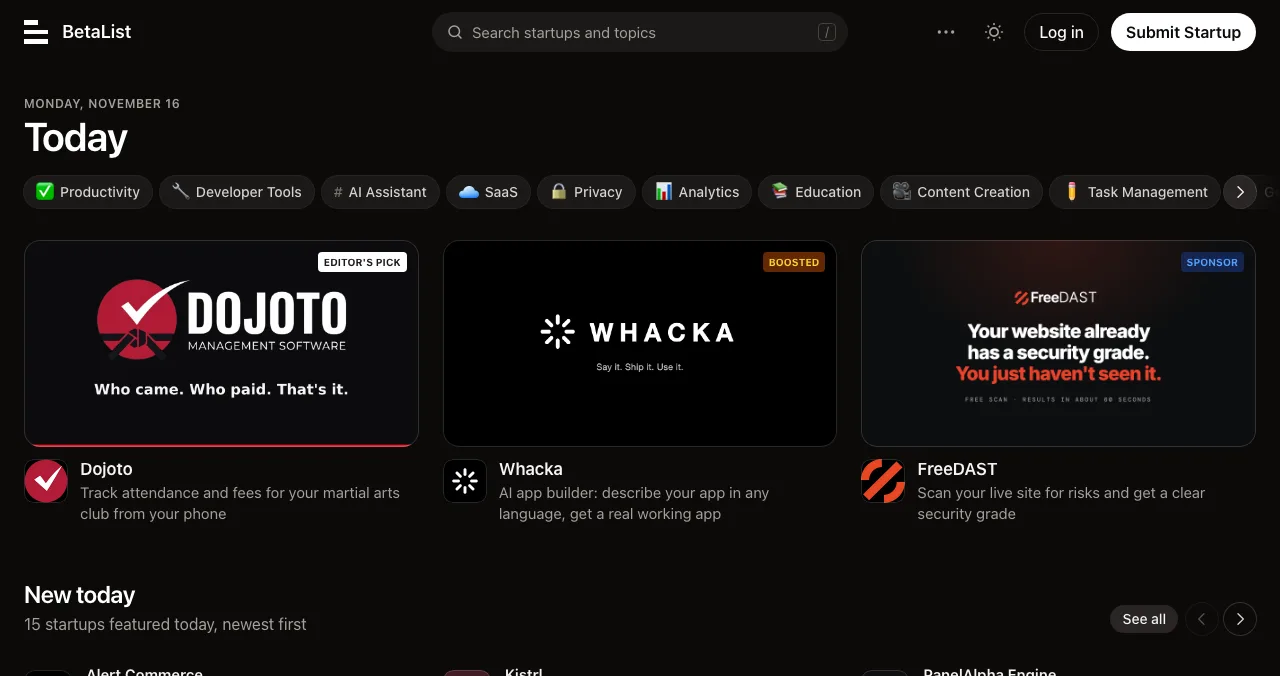
| BetaList | Early adopters browsing new startups |
| Product Hunt | Early adopters, makers, product people |
| Peerlist Launchpad | Builders, every Monday |
| Indie Hackers | Founders sharing and testing |
| Your own network's introductions | Warm, trusted |
| A permanent profile found by the problem | People searching for a fix |
Table: Where early adopters gather (launch sites' own descriptions, checked 17 Nov 2026)
How to approach them

- Lead with their problem — "I saw you're handling X with a spreadsheet. How's that going?"
- Ask, don't pitch — what they do today, what it costs (see the interview script).
- Offer to solve it personally — "I'm building something for this; can I set you up?"
- Onboard them yourself — a call, a shared screen, no self-serve maze.
- Ask for a small commitment — weekly use, feedback, an introduction.
How to keep them

- Reply within hours — they're doing you a favour
- Ship their top request — and tell them
- Credit them — in changelogs, with permission
- Give them a direct line — a chat group or email
- Invite them to your launch day — to try and give feedback, never to upvote
Mistakes

- Targeting "everyone" — early adopters are a narrow, urgent group
- Cold pitching — ask about the problem first
- Self-serve only — the first ones need a human
- Ignoring their feedback — they leave, and they talk

Ready to be found?
How we know
Launch-site descriptions come from BetaList's, Product Hunt's and Peerlist's own pages, read on 17 November 2026; the approach draws on Y Combinator's Startup School and The Mom Test. The ten-places table is our editorial summary.
Key terms, defined
- Early adopter: one of the first people to use a new product.
- Workaround: a makeshift solution people use until a better one exists.
- Doing things that don't scale: manual effort to win the first users.
- Champion: a user who recommends you to others.
- Commitment: time, reputation or money a user gives.
Frequently asked questions
Who are early adopters?
People who have the problem you solve, know they have it, are actively looking for a solution, and will accept an unfinished product because the problem hurts enough. Many have already built a workaround.
Where can I find early adopters?
In communities where people discuss the problem, among people using workarounds, on launch sites like BetaList, Product Hunt and Peerlist, in founder communities such as Indie Hackers, and through introductions from people you interview.
How do I approach early adopters?
Ask about their problem first: how they handle it today and what it costs. If it's a fit, offer to set them up personally. Avoid a cold pitch.
How many early adopters do I need?
Enough to learn and get a few strong references: often ten to a few dozen engaged users who use the product regularly and tell you what's broken.
Is BetaList good for finding early adopters?
It can be: BetaList features startups new to its audience, including pre-launch and beta ones, if selected. Every submission is paid, with an automatic refund if you're not selected.
How do I keep early adopters engaged?
Reply fast, ship their top requests visibly, tell them when you've fixed something they raised, and give them credit. They'll become your first referrals and launch-day supporters.
Sources
- BetaList — Help and FAQ (checked 17 Nov 2026)
- Product Hunt Help Center — How Product Hunt works (checked 17 Nov 2026)
- Peerlist Help Center — How do I launch a project on Peerlist Launchpad? (checked 17 Nov 2026)
- Y Combinator Startup Library — How to talk to users (Gustaf Alströmer)
- Rob Fitzpatrick — The Mom Test (book site)
- Checked November 17, 2026. Figures that change — fees, salaries, prices — are reviewed every six months; if something is out of date, tell us.
Where to go from here
- Your first 100 users — the next stage
- Customer interview script — what to ask them
- Where to find beta testers — testing with them
- Science of Apps - LaunchpadThe best BetaList alternatives in 2027: ten places to find early adopters, most of them freeThe best BetaList alternatives for 2027: free and cheap places to find early adopters, from Peerlist and Uneed to Indie Hackers and Microlaunch, checked.
- Science of Apps - LaunchpadHow to get your first 100 users without paid ads: a channel-by-channel plan founders can start todayHow to get your first 100 users without paid ads in 2027: your network, communities, launch sites, directories, content and one-to-one outreach, step by step.
- Science of Apps - LaunchpadHow to get your first users for a new app: the store listing, launch sites, communities, direct outreach and a web page that keeps bringing people inHow to get users for a new app, free: fix the store listing, launch on Product Hunt and Peerlist, reach people directly, and add a permanent web page.
- Science of Apps - LaunchpadHow to market a startup with no money: the free channels that work, in the order to use them, and what each costs in time insteadHow to market a startup with no money: direct outreach, communities, free launch sites, directories, content and AI search, in order, with the time each costs.
- Science of Apps - LaunchpadWhere to find beta testers: your waitlist, communities, BetaList, Peerlist and more, plus how to recruit, run and learn from a betaWhere to find beta testers for an app or SaaS: waitlists, interviewees, communities, BetaList and launch sites, with how to recruit and run the beta.
- Science of Apps - LaunchpadThe top 5 websites to launch your startup for free, checked against each site's own rulesThe 5 best free websites to launch a startup: Science of Apps Launchpad, Product Hunt, Show HN, Uneed and Peerlist, with costs, rules and who each one suits.





Get the ideas, not the noise.
Sign up with Google and we’ll send you short UX psychology tips by email — why people tap, stall and leave, and what to do about it. Unsubscribe anytime. Prefer something to keep? Get the free Laws of UX guide as a PDF.
Launch day ends. Your listing shouldn't.
Early adopters search for fixes: a free, permanent Launchpad profile helps them find you by the problem you solve, ranked by relevance and never by payment, plus a product test with a detailed report.