 By
Quick answer: What questions should I ask in a customer interview?
- Ask about the past: 'Tell me about the last time…'.
- Ask about actions and costs: 'What did you do?', 'What did it cost?'.
- Avoid: 'Would you use…?', 'Do you like…?', 'How much would you pay?'.
- Talk less: listen far more than you speak.
- Close: ask for a commitment: an intro, a pilot, a pre-order.
- After: write notes within the hour; look for patterns across five or more.
Key takeaways
- People are kind to founders; questions about opinions and the future invite compliments, not truth.
- Past behaviour is the best evidence: what they did, spent and tried.
- Don't pitch until the end, if at all; the pitch ruins the data.
- A commitment (time, reputation or money) is the real signal of interest.
- Interviews validate the problem; testing validates the product.
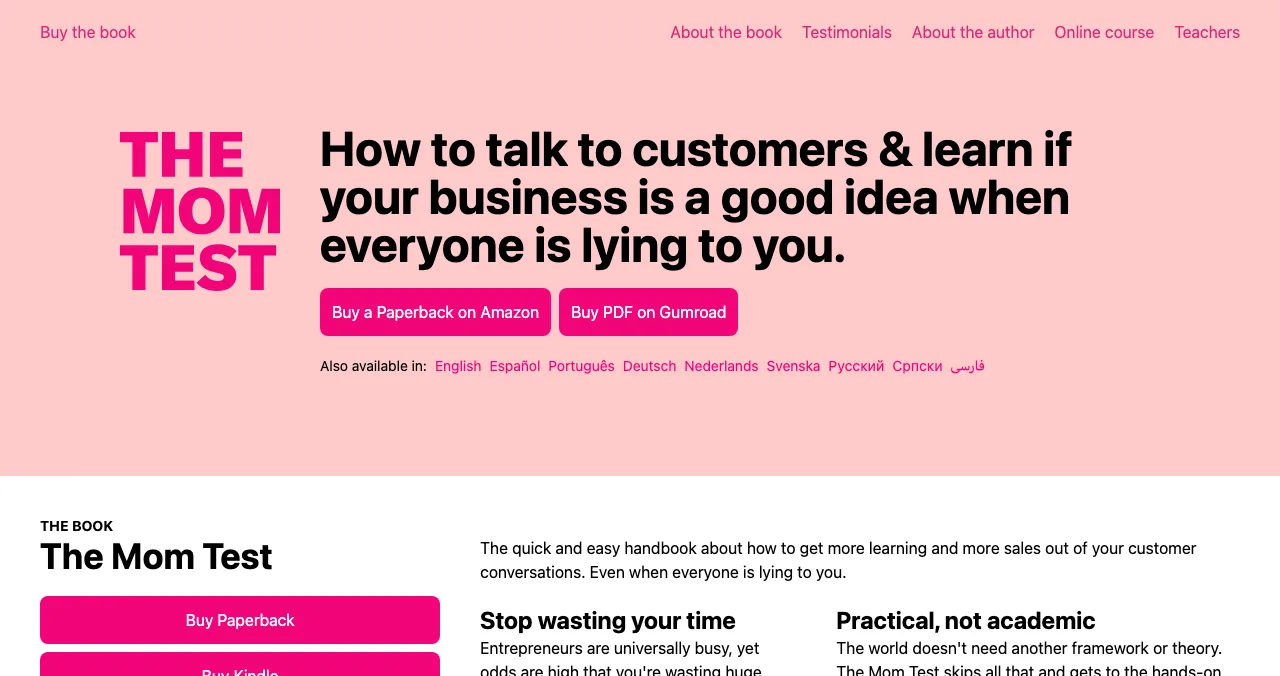
Every founder has had the interview that felt brilliant: the person loved the idea, said they'd definitely use it, asked when it launches. Then they never signed up. Nothing went wrong in that conversation except the questions. Rob Fitzpatrick's The Mom Test and Y Combinator's Startup School talks make the same point: ask about people's lives and past behaviour, not your idea. This script turns that into questions you can use tomorrow. Jump to the script, questions to avoid or the notes template.
The three rules
| Rule | In practice |
|---|---|
| Talk about their life, not your idea | Ask how they handle the problem today |
| Ask about specifics in the past, not generics or the future | "Last time" beats "usually" and "would" |
| Talk less, listen more | Let silences run; don't fill them with your pitch |
Table: The Mom Test's core rules (Rob Fitzpatrick, The Mom Test)
The script

- Set up (1 minute) — "I'm researching how people handle [problem]. I'm not selling anything today. Is it OK if I take notes?"
- Context — "Walk me through your role and a typical week."
- The last time — "Tell me about the last time you had to [problem]. What happened?"
- What they did — "What did you do about it? What tools or people did you use?"
- The cost — "What did it cost you, in time, money or stress?"
- What they've tried — "Have you looked for a better way? What did you try, and why did you stop?"
- Priority — "Where does this rank among the problems you're dealing with this month?"
- Close — "Who else should I talk to?" and, if it fits, "Can I show you an early version next month?"
Questions to avoid
| Avoid | Why | Ask instead |
|---|---|---|
| "Would you use this?" | A guess about the future | "What did you do last time?" |
| "Do you like my idea?" | Invites a compliment | "How do you handle it today?" |
| "How much would you pay?" | A hypothetical number | "What do you spend on it now?" |
| "Wouldn't it be great if…?" | Leading | "What's the hardest part?" |
| "Would you buy it if it had X?" | Feature fishing | "Why did you stop using the last tool?" |
Table: Questions that invite polite lies, and better ones
Signals that matter

- They've already tried to solve it — searched, hacked a spreadsheet, paid someone
- They can name the cost — hours, money, missed deals
- They bring it up before you do
- They commit something — an intro, a meeting, a pilot, a pre-order
Compliments, "sounds cool" and "let me know when it launches" are not signals.
The notes template
| Field | What to write |
|---|---|
| Who | Role, company type, segment |
| The last time | What happened, in their words |
| Current solution | Tools, workarounds, people |
| Cost | Time, money, risk |
| Tried and abandoned | And why |
| Commitment | What they agreed to |
| Surprise | What you didn't expect |
Table: Customer interview notes template
Write notes within the hour, then compare across five or more interviews in the same segment.
Mistakes

- Pitching in the first five minutes
- Interviewing only friends and family
- Counting compliments as validation
- Asking the same leading question until you hear yes
- Not writing notes straight away
Ready to test what you build?
How we know
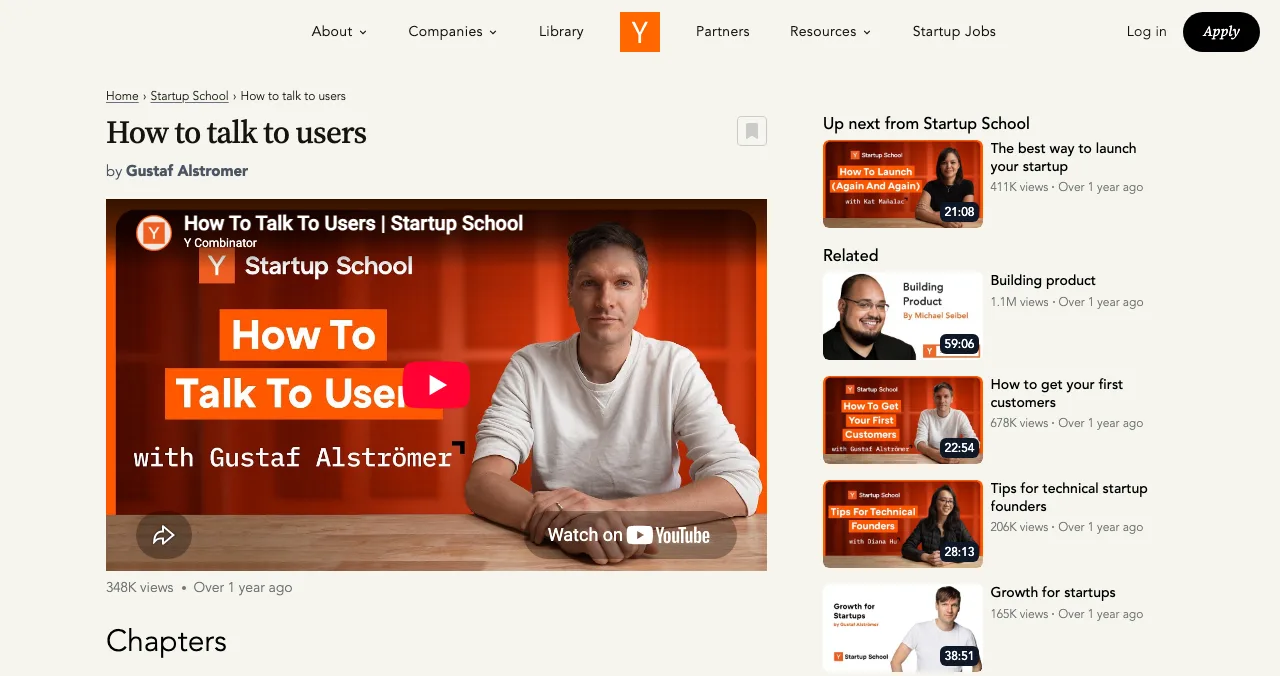
The rules and question style follow Rob Fitzpatrick's The Mom Test and Y Combinator's Startup School talks on talking to users (Gustaf Alströmer; Eric Migicovsky). The script and templates are our adaptation for early-stage founders.
Key terms, defined
- Customer discovery: learning about customers' problems before building.
- The Mom Test: a method for asking questions people can't lie about.
- Leading question: a question that suggests its answer.
- Commitment: time, reputation or money a prospect gives up.
- Segment: a group of customers with the same problem and context.
Frequently asked questions
What questions should I ask in a customer interview?
Questions about real, recent behaviour: 'Tell me about the last time you had this problem', 'What did you do about it?', 'What have you tried?', 'What did it cost you in time or money?', and 'Who else should I talk to?'.
What questions should I avoid?
Hypotheticals and opinions: 'Would you use this?', 'Do you like my idea?', 'How much would you pay?'. The Mom Test argues they invite polite, unreliable answers because people want to be kind.
What is The Mom Test?
A short book by Rob Fitzpatrick on how to talk to customers and learn whether your business is a good idea 'when everyone is lying to you'. Its core rules: talk about their life, not your idea; ask about specifics in the past; talk less and listen more.
How many customer interviews should I do?
Enough to see patterns repeat; many founders find themes emerge after five to ten interviews with people in the same segment. Keep going while you're still surprised.
Should I pitch my product in a customer interview?
Not until the end, if at all. Pitching turns the conversation into feedback on your idea, which is exactly the opinion data you want to avoid.
How do I know an interview went well?
You learned facts about their behaviour you didn't know, and it ended with a commitment: an introduction, a follow-up meeting, a pilot or a pre-order. Compliments alone mean little.
Sources
- Rob Fitzpatrick — The Mom Test (book site)
- Y Combinator Startup Library — How to talk to users (Gustaf Alströmer)
- Y Combinator — Eric Migicovsky: How to Talk to Users (Startup School)
- Science of Apps — Product investigation: what we investigate and how
- Checked November 17, 2026. Figures that change — fees, salaries, prices — are reviewed every six months; if something is out of date, tell us.
Where to go from here
- Validate a startup idea — where interviews fit
- Get feedback on a startup idea — honest feedback sources
- How to find early adopters — who to interview
- Templates & tools50 user interview questions that uncover real problems — grouped by goal, with the questions to avoid50 user interview questions for discovery and usability research, grouped by goal, with a simple script and the leading questions to avoid.
- Science of Apps - LaunchpadHow to get honest feedback on your startup idea: 10 places that work, and the questions that get useful answersHow to get honest feedback on a startup idea in 2027: customer interviews, r/roastmystartup, Indie Hackers, Peerlist, Show HN and the questions to ask.
- Science of Apps - LaunchpadCold outreach for startups: who to contact, emails that get replies, follow-ups, and the CAN-SPAM and Gmail rules that keep you out of spamCold outreach for startups: who to email, a short template that gets replies, follow-ups, and the CAN-SPAM and Gmail sender rules to follow.
- How to make an appHow to validate an app idea before you write a single line of codeValidate an app idea in two weeks without code: problem interviews, demand signals, landing-page and fake-door tests, pre-sales and a concierge MVP.
- Science of Apps - LaunchpadHow to launch a startup in 2027: from a validated problem to a working product, a public launch and your first customersHow to launch a startup in 2027, step by step: validate the problem, build a small product, test it, publish a permanent page, launch and win first users.
- Science of Apps - LaunchpadHow to launch an open source project: a README that converts, the launch sites developers read, and how to turn first users into contributorsHow to launch an open source project in 2027: a README that converts, Show HN, DevHunt and Product Hunt, and turning first users into contributors.

Get the ideas, not the noise.
Sign up with Google and we’ll send you short UX psychology tips by email — why people tap, stall and leave, and what to do about it. Unsubscribe anytime. Prefer something to keep? Get the free Laws of UX guide as a PDF.
Launch day ends. Your listing shouldn't.
Interviews tell you about the problem; a product test shows how strangers handle your solution. List free on the Launchpad and get your product tested end to end with a detailed report.