 By
Quick answer: How do I launch a startup?
- 1. Validate: talk to people with the problem about what they do today.
- 2. Build small: the smallest product that solves the problem for one type of user.
- 3. Test it: a stranger should reach a real result without your help.
- 4. Make it findable: a permanent page, Search Console and consistent profiles.
- 5. Launch in waves: network, communities, Product Hunt or Peerlist, directories.
- 6. Win first customers: follow up personally, charge early, fix weekly.
Key takeaways
- A startup launch is a sequence, not a day: validation, product, testing, visibility, launches and follow-up.
- The cheapest time to find problems is before launch; strangers forgive less than friends.
- Free launch sites and directories are enough to find early users; paid channels come after you know what works.
- Your permanent page is the hub every launch, post and directory links to.
- Judge the launch by users who come back and pay, not by rank or upvotes.
"How do I launch a startup?" has a short answer and a long one. The short one: find a real problem, build something small that solves it, make sure strangers can use it, and put it in front of the people who have the problem. The long one is this guide: six steps from validation to first customers, linking to the detailed playbooks for each, with platform rules checked on their own pages on 16–17 November 2026. Jump to validate, build, test, be findable, launch or first customers.
- Steps from problem to first customers
- 6
- To run the launch itself, not one day
- 4–6 weeks
- Cost of the main launch sites and directories
- $0
- Metric that matters: users who come back
- 1
The six steps at a glance
| Step | Goal | Done when |
|---|---|---|
| 1. Validate | A real, painful problem | People describe it the same way and already spend time or money on it |
| 2. Build small | The smallest product that solves it | One type of user gets a real result |
| 3. Test | Strangers can use it | A new user reaches a result without help |
| 4. Be findable | One permanent home on the web | Page live; site indexed; profiles consistent |
| 5. Launch in waves | Attention from the right people | Network, communities, launch sites, directories |
| 6. First customers | Revenue and retention | Users come back and some pay |
Table: How to launch a startup, step by step
Step 1: Validate the problem
Talk to 10–20 people who have the problem about what they did the last time it happened, not about your idea. Look for people already spending time or money on workarounds. Our guides on getting feedback on your idea and validating an app idea cover the questions to ask.
Step 2: Build the smallest useful product

- One user type — the narrowest group with the sharpest problem
- One job done well — the core task, end to end
- Real, not a mock-up — something people can use without you
- Measurable — know when a user reaches the first result
Step 3: Test it like a stranger
Product Hunt notes that products "ship broken more often than you'd think". Before any launch, sign up in a clean browser and on a phone, complete the main task, and watch a few people who've never seen it try.
Step 4: Make it findable
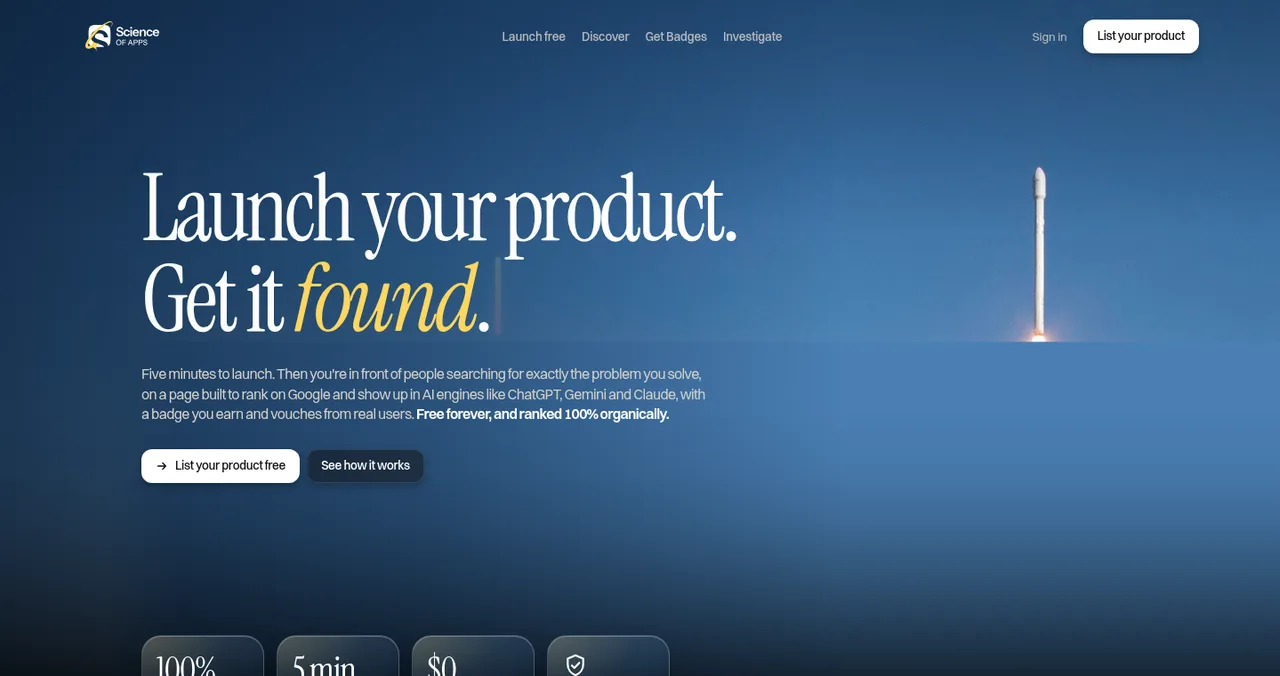

- A permanent product page — a free Science of Apps Launchpad profile, found by the problem you solve
- Your site indexed — verify Google Search Console and Bing Webmaster Tools; submit a sitemap
- AI search allowed — OAI-SearchBot, Claude-SearchBot and PerplexityBot not blocked
- Consistent profiles — the same name and one-liner on Crunchbase, LinkedIn and directories
Details in organic visibility for startups.
Step 5: Launch in waves
- Wave 1
Your network
Personal messages to people with the problem; your first 10–20 users.
- Wave 2
Communities
Help first where your users talk; share what you've built and learned.
- Wave 3
Launch sites
Peerlist on a Monday, then Product Hunt (or Show HN and DevHunt for developer tools).
- Wave 4
Directories
SaaSHub and AlternativeTo for software, AI directories for AI tools, Google Business Profile for local businesses.
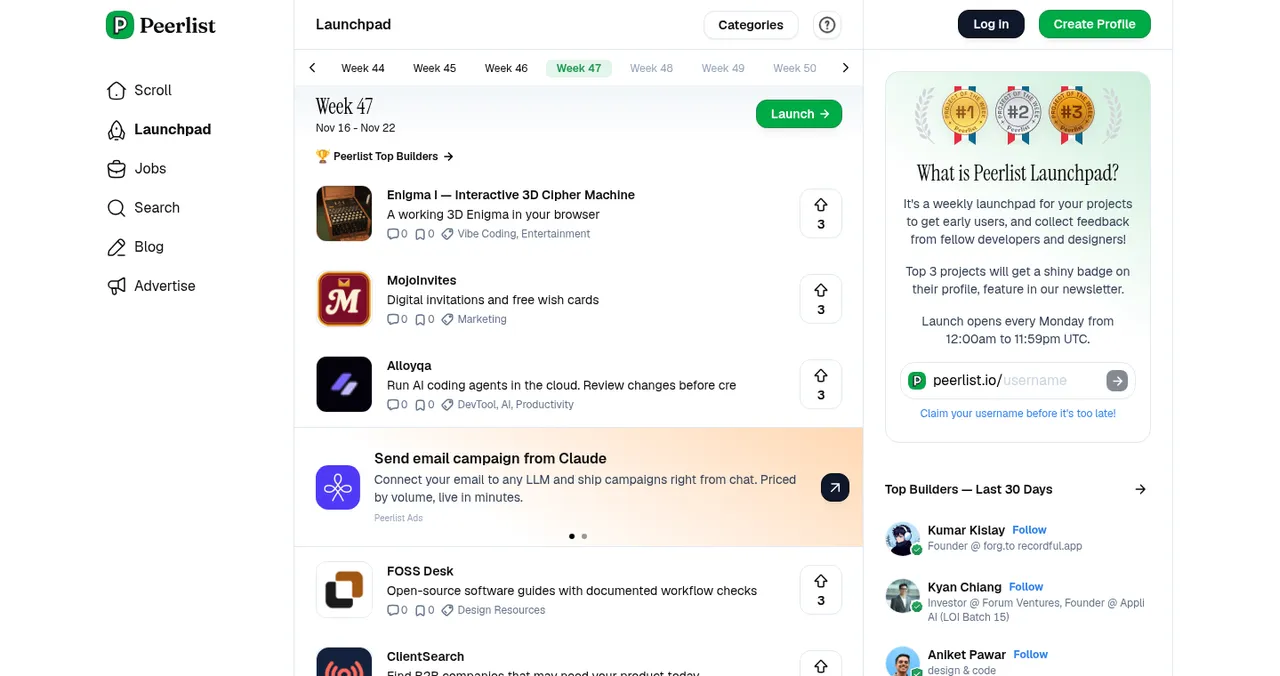
Which sites suit your product: top websites to launch a startup. Launch-day rules: how to launch on Product Hunt.
Step 6: Win your first customers

- Email every new user personally — ask what they're trying to do.
- Help the ones who get stuck — and fix what stopped them.
- Charge early — even a small price tells you whether the value is real.
- Ask for reviews and introductions — your first users are your best marketing.
- Relaunch when you ship something big — a new wave on a new site.
More in your first 100 users and, for B2B, your first SaaS customers.
Startup launch mistakes

- Skipping validation — building for a problem nobody pays to solve
- Building too much — every extra feature delays learning
- Launching untested — strangers leave at the first broken step
- One big launch day — plan waves over weeks
- No permanent page — launch traffic needs somewhere to land
- Counting upvotes — count users who come back
New users judge you fast: a clear first screen lowers cognitive load, and early reviews are social proof for the next wave.
Ready to launch?
How we know
Platform rules come from Product Hunt's help centre, Show HN's guidelines, Peerlist's help centre, SaaSHub's guidelines and Google Search Console, read on 16–17 November 2026. The six-step sequence is our editorial framework. Science of Apps runs the Launchpad mentioned above.
Key terms, defined
- Validation: evidence that a problem is real and people will use or pay for a solution.
- MVP (minimum viable product): the smallest product that solves the core problem for one type of user.
- Launch wave: one round of launch activity aimed at one audience.
- Permanent page: the product page every launch links to, which keeps working after launch day.
- Retention: users coming back after their first use.
Frequently asked questions
How do I launch a startup?
Validate the problem with people who have it, build the smallest product that solves it, test the full journey with strangers, publish a permanent product page and make your site findable, launch in waves (network, communities, launch sites, directories), then turn early users into customers through personal follow-up.
How long does it take to launch a startup?
It varies with what you're building. A software MVP can be built in weeks to a few months; validation and the first customers often take as long again. Plan the launch itself over four to six weeks rather than one day.
Where should I launch my startup?
Your own network and communities first, then launch sites that match your audience: Product Hunt for broad tech audiences, Peerlist and Uneed for builders, Show HN and DevHunt for developer tools. Add a permanent Science of Apps Launchpad profile and reviewed directories like SaaSHub.
Do I need money to launch a startup?
Not for the launch itself: the main launch sites and directories are free or have free options. You need money (or time) to build the product and live while you find customers; many founders start lean and raise or charge once they've proved demand.
What's the most common startup launch mistake?
Launching a product strangers can't use: confusing onboarding, broken sign-up or an unclear first screen. Launch traffic is impatient, so test the full journey before you go public.
What should I do after launch day?
Reply to everyone, email every new user personally, measure who reached a real result and came back, ship the most-requested fix within a week, and plan a second launch wave on a different site.
Sources
- Product Hunt Help Center — What kind of products get featured (checked 17 Nov 2026)
- Product Hunt Help Center — Launch FAQ and myths (checked 17 Nov 2026)
- Hacker News — Show HN guidelines
- Peerlist Help Center — How do I launch a project on Peerlist Launchpad?
- Google Search Console — About
- SaaSHub — Submit a product: guidelines (checked 17 Nov 2026)
- Science of Apps — Launchpad: launch your product free
- Checked November 17, 2026. Figures that change — fees, salaries, prices — are reviewed every six months; if something is out of date, tell us.
Where to go from here
- How to start a startup in India — incorporation and India specifics
- Product launch strategy — the five decisions behind a launch
- Your first 100 users — the free channels in order
- Science of Apps - LaunchpadHow to launch a SaaS product in 2027: from private beta to public launch to the first paying customersHow to launch a SaaS in 2027, step by step: private beta, pricing, onboarding that activates, a permanent page, launch days, and turning trials into customers.
- Science of Apps - LaunchpadProduct launch strategy for 2027: how to plan, run and follow up a launch that brings users, not just a spikeA product launch strategy for 2027: set goals, size the launch, build a permanent page, sequence launch days, run launch week and follow up, step by step.
- Science of Apps - LaunchpadHow to get your first 100 users without paid ads: a channel-by-channel plan founders can start todayHow to get your first 100 users without paid ads in 2027: your network, communities, launch sites, directories, content and one-to-one outreach, step by step.
- Science of Apps - LaunchpadHow to validate a startup idea in 7 days: a day-by-day plan to find out whether people will use and pay for itHow to validate a startup idea in 7 days: define the problem, find people who have it, run 10+ interviews, test demand with a page and a price, then decide.
- Science of Apps - LaunchpadHow to get your first users for a new app: the store listing, launch sites, communities, direct outreach and a web page that keeps bringing people inHow to get users for a new app, free: fix the store listing, launch on Product Hunt and Peerlist, reach people directly, and add a permanent web page.
- Science of Apps - LaunchpadHow to launch on Product Hunt in 2027: the rules, the timing, the page and an hour-by-hour plan for launch dayHow to launch on Product Hunt in 2027, step by step: eligibility, scheduling, your launch page, promotion rules and an hour-by-hour launch-day plan.
Get the ideas, not the noise.
Sign up with Google and we’ll send you short UX psychology tips by email — why people tap, stall and leave, and what to do about it. Unsubscribe anytime. Prefer something to keep? Get the free Laws of UX guide as a PDF.
Launch day ends. Your listing shouldn't.
Step five of every launch: a permanent, free page found by the problem you solve, plus your product tested end to end with a detailed report on what to fix before you go public.