 By
Quick answer: Where can I find beta testers for my app?
- Warmest: your waitlist and the people you interviewed.
- Next: introductions from them; communities about the problem.
- Launch sites: BetaList (paid; refunded if not selected), Peerlist, Indie Hackers.
- Recruit strangers: friends are too kind.
- Run it: watch sessions, track where people stall, fix and re-test.
- Plus: a structured product test catches what testers don't report.
Key takeaways
- The best beta testers have the problem; enthusiasm for tech isn't enough.
- Five people who use it weekly beat fifty who sign up and vanish.
- Watching behaviour reveals more than surveys.
- Set beta exit criteria before you start.
- Testers miss things; combine them with a systematic test.
A beta is only as good as its testers. Twenty friends who sign up to be supportive will tell you it's great; five strangers with the problem will show you, in ten minutes, the step where everyone gets stuck. This guide covers where to find testers who'll tell you the truth, from warmest to coldest, and how to run a beta that ends in a public launch, with launch-site rules as read on 17 November 2026. Jump to where, how to recruit or how to run it.
Where to find beta testers
| Source | Warmth | Cost | Note |
|---|---|---|---|
| Your waitlist | Warm | Free | Already raised a hand |
| People you interviewed | Warm | Free | They described the problem |
| Their introductions | Warm | Free | "Who else has this problem?" |
| Problem communities | Cool | Free | Contribute before asking |
| Indie Hackers | Cool | Free | Founders willing to try things |
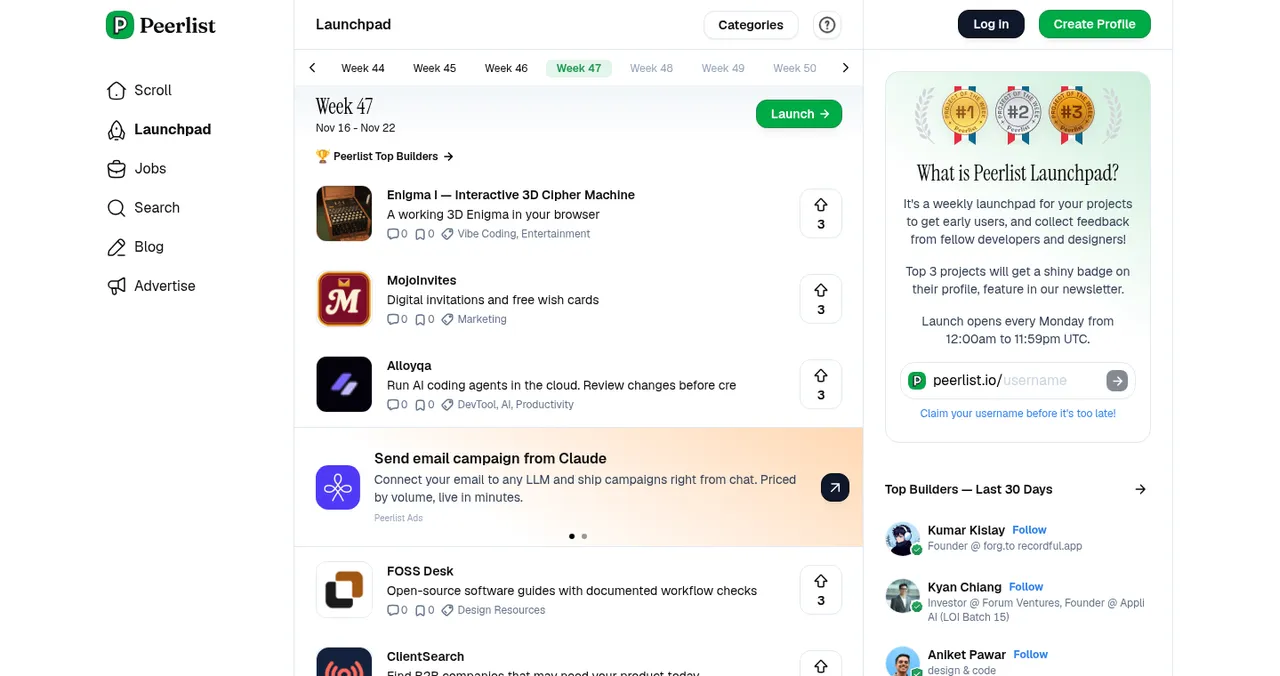
| Peerlist Launchpad | Cool | No fee mentioned | Builders; Mondays |
| BetaList | Cool | Paid; refunded if not selected | Pre-launch and beta startups |
| Open-beta launch on Product Hunt | Cold | Free | Only if anyone can sign up |
Table: Where to find beta testers (site rules checked 17 Nov 2026)
How to recruit

- Define the tester — who has the problem, in what context.
- Write a short invitation — the problem, what you're asking, how long, what they get.
- Screen with two questions — "How do you handle X today?" and "When did it last happen?"
- Onboard personally — a short call or message thread.
- Set expectations — it's unfinished; you want honest problems.
How to run the beta

- Exit criteria first — what must be true to go public
- Watch real sessions — where do people pause or leave?
- One feedback channel — a chat group or email
- Fix blockers before features
- Re-test with new people — old testers learned your workarounds
- Close the loop — tell testers what you changed
Mistakes

- Friends only — kind, not useful
- Surveys instead of observation
- Too many testers too early — you can't support them
- No end date — see beta vs public launch

Ready for your beta?
How we know
Site rules come from BetaList's, Peerlist's and Product Hunt's own pages, read on 17 November 2026; the recruiting approach draws on Y Combinator's advice on talking to users. The tables are our editorial summaries.
Key terms, defined
- Beta tester: someone who uses an unfinished product to find problems.
- Open beta: anyone can join.
- Closed beta: invite-only.
- Exit criteria: conditions for ending a beta.
- Blocker: a problem that stops people reaching the core value.
Frequently asked questions
Where can I find beta testers for free?
Your waitlist, people you've interviewed and their introductions, communities where the problem is discussed, Indie Hackers and Peerlist. BetaList charges for submissions, with an automatic refund if you're not selected.
How many beta testers do I need?
Fewer than you'd think: a small group of engaged testers who match your target user, using it regularly, reveals most blocking problems. Add more when the same issues stop repeating.
Should I pay beta testers?
Usually not for early SaaS betas; the value of solving their problem is the incentive. Offering a discount or extended free plan after the beta is common and fair.
Can I use friends and family as beta testers?
For catching obvious bugs, yes. For learning whether strangers understand and value the product, no: they're too kind and too familiar with you.
How do I run a beta test?
Set exit criteria, onboard testers personally, watch a few sessions, track where people stall, fix the blockers, re-test with new people, and keep a channel for quick feedback.
Can I launch my beta on Product Hunt?
An open beta anyone can use, yes. Product Hunt says closed betas usually aren't a good fit.
Sources
- BetaList — Help and FAQ (checked 17 Nov 2026)
- Peerlist Help Center — How do I launch a project on Peerlist Launchpad? (checked 17 Nov 2026)
- Product Hunt Help Center — What kind of products get featured (checked 17 Nov 2026)
- Y Combinator Startup Library — How to talk to users (Gustaf Alströmer)
- Science of Apps — Product investigation: what we investigate and how
- Checked November 17, 2026. Figures that change — fees, salaries, prices — are reviewed every six months; if something is out of date, tell us.
Where to go from here
- Beta launch vs public launch — when to open up
- How to find early adopters — the people to recruit
- BetaList review — is it worth it?
- Science of Apps - LaunchpadThe best BetaList alternatives in 2027: ten places to find early adopters, most of them freeThe best BetaList alternatives for 2027: free and cheap places to find early adopters, from Peerlist and Uneed to Indie Hackers and Microlaunch, checked.
- Science of Apps - LaunchpadHow to get your first 100 users without paid ads: a channel-by-channel plan founders can start todayHow to get your first 100 users without paid ads in 2027: your network, communities, launch sites, directories, content and one-to-one outreach, step by step.
- Science of Apps - LaunchpadThe best product launch platforms in 2027, matched to what you're launching: SaaS, AI, developer tools, apps and pre-launch, with costs and rulesThe best product launch platforms in 2027 by use case: Product Hunt, Science of Apps Launchpad, DevHunt, Peerlist, Uneed, BetaList, Show HN and more.
- Science of Apps - LaunchpadHow to find early adopters: who they are, the ten places they gather, and how to turn them into your first users and championsHow to find early adopters for a startup: who they are, where they gather (communities, launch sites, BetaList), how to approach them and keep them.
- Science of Apps - LaunchpadHow to get your first users for a new app: the store listing, launch sites, communities, direct outreach and a web page that keeps bringing people inHow to get users for a new app, free: fix the store listing, launch on Product Hunt and Peerlist, reach people directly, and add a permanent web page.
- Science of Apps - LaunchpadHow to run a launch week, and why launching is a habit, not a day: every kind of launch a startup can do, from silent launches to feature dropsHow to run a launch week and launch repeatedly: silent launches, communities, Hacker News, Product Hunt, request-access waitlists and feature drops, in order.

Get the ideas, not the noise.
Sign up with Google and we’ll send you short UX psychology tips by email — why people tap, stall and leave, and what to do about it. Unsubscribe anytime. Prefer something to keep? Get the free Laws of UX guide as a PDF.
Launch day ends. Your listing shouldn't.
Alongside your beta testers: list free on the Launchpad and get your product tested end to end in a real browser on desktop and mobile, with a detailed report.