 By
Quick answer: How do I run a launch week for my startup?
- The idea: launching is continuous, not one moment.
- Launch week: one release or announcement a day, each to a different channel.
- Launch types: silent page, friends and family, strangers, communities, HN and Product Hunt, request access, bloggers, features.
- Write like you talk: no marketing robot language.
- Build your own list: add everyone you talk to, then ask them to share.
Key takeaways
- If your first launch is ignored, that's normal; launch again.
- Different channels reveal whether you're talking to the right users.
- Every new feature is another launch.
- Community posts work when they're human, specific and invite questions.
- Kat Mañalac says early-stage startups shouldn't pay for blogger or influencer placements.
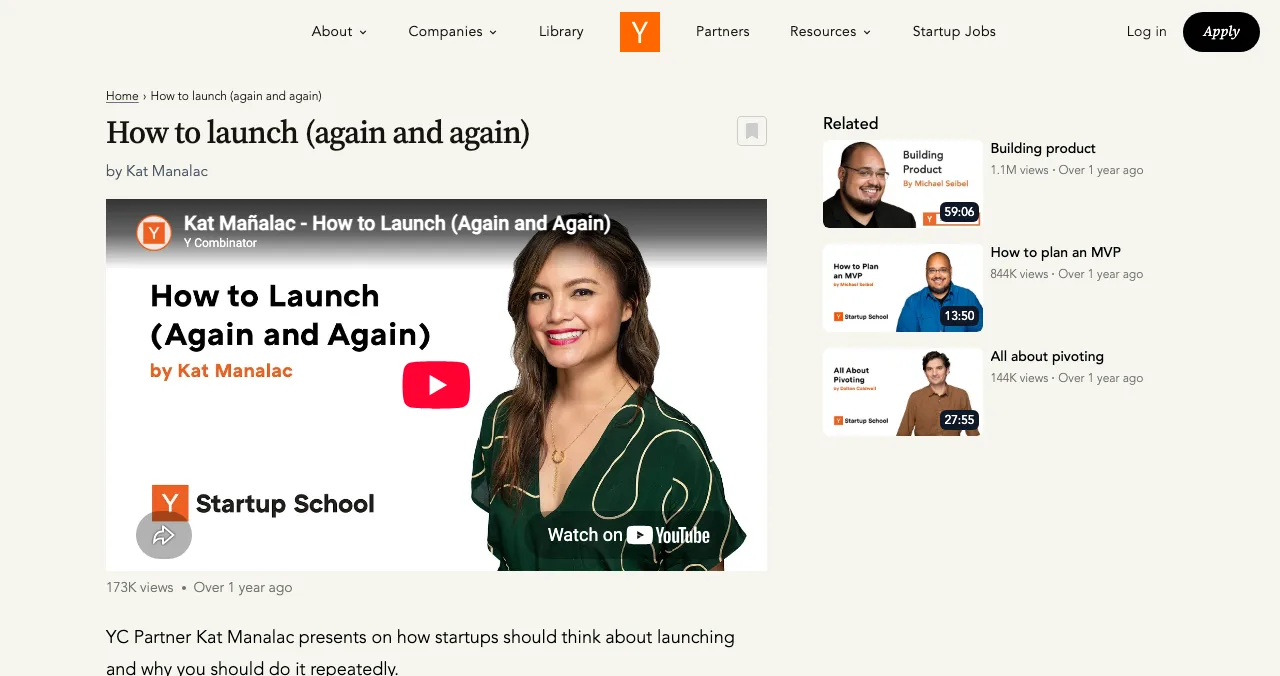
Most founders treat launch day like a wedding: months of planning for a single moment. Y Combinator's Kat Mañalac argues that's exactly backwards. Most first launches get ignored, and a startup that spent six months preparing may not survive to try again. Her advice is to launch continually, in every form available, and a launch week is the concentrated version of that idea. This playbook covers both, from her Startup School talk and launch-site rules as read on 17 November 2026. Jump to the kinds of launch, a launch week plan or community posts.
Every kind of launch
| Launch | What it is |
|---|---|
| Silent launch | A page with domain, name, short description, contact and a call to action |
| Friends and family | Watch them use it, then move on quickly |
| Strangers | Find people with the problem in the moment |
| Online communities | Plan a launch for every community you're part of |
| Hacker News and Product Hunt | Learn each community's rules first |
| Request access | A waitlist, with ways to skip the line by sharing |
| Bloggers and lists | Ask to be added to "best X" lists; don't pay early on |
| Pre-orders | For hardware and physical products |
| New features and products | Every release is another launch |
Table: Kinds of launch (Kat Mañalac, YC Startup Library)
A launch week plan
- Monday
Community launch
Post in a community you belong to; write like you talk.
- Tuesday
Show HN or Peerlist
Something people can try now.
- Wednesday
A feature drop
Ship one improvement; post the changelog.
- Thursday
Product Hunt
The big day, scheduled in advance.
- Friday
Recap and thanks
Results, lessons, what's next; email your list.
Writing community posts

- Learn the rules first — every community and subreddit has its own
- Write like you talk — no marketing robot language or jargon
- Introduce yourself — what you're building, why, how you found the problem
- Tee up questions — say what you're expert in and happy to answer
- Ask for feedback — never for upvotes
Build your own list
Kat Mañalac's last piece of advice: add everyone you talk to about your startup to an update list, and when you launch, ask them to help spread the word. "You would be really surprised by who comes out of the woodwork to help when you ask for it."

Ready to launch again?
How we know
Launch types and advice come from Kat Mañalac's "How to launch (again and again)" in YC's Startup Library; launch-site rules from Product Hunt's help centre and the Show HN guidelines, read on 17 November 2026. The five-day plan is our editorial adaptation.
Key terms, defined
- Launch week: five days of releases or announcements.
- Silent launch: a simple public page before a full launch.
- Request access: a waitlist people join to get in.
- Feature drop: a launch of a new capability.
- Update list: an email list of everyone following your progress.
Frequently asked questions
What is a launch week?
Five consecutive days, each with a new release or announcement aimed at a different channel or audience, so a startup gets several moments of attention instead of one.
Why launch more than once?
YC's Kat Mañalac says most first launches get little attention, and if a launch took six months to prepare, a startup may not survive to try again. Launching continually lets you practise the pitch, test channels and reach the right users.
What kinds of launches can a startup do?
A silent launch (a simple landing page), friends and family, launching to strangers, online communities, Hacker News and Product Hunt, request-access waitlists, bloggers, pre-orders for hardware, and new feature or product launches.
How should I post in online communities?
Learn each community's rules, write like you talk, introduce yourself, say what you're building and why, and invite specific questions. Avoid marketing language and jargon.
Do Hacker News and Product Hunt launches convert?
Kat Mañalac says YC's look at launch conversion found TechCrunch, Product Hunt and Hacker News launches 'starting to even out' in impact on sign-ups and customers.
What should a launch week include?
A theme, one shippable item per day, a channel per day, a post per day written in advance, and someone available to reply all day.
Sources
- Y Combinator Startup Library — How to launch (again and again) (Kat Mañalac)
- Product Hunt Help Center — How to promote your launch (and what to avoid) (checked 17 Nov 2026)
- Hacker News — Show HN guidelines (checked 17 Nov 2026)
- Science of Apps — Launchpad: launch your product free
- Checked November 17, 2026. Figures that change — fees, salaries, prices — are reviewed every six months; if something is out of date, tell us.
Where to go from here
- How to launch a startup — the full plan
- Soft launch vs hard launch — launching in stages
- After a Product Hunt launch — the next launch
- Science of Apps - LaunchpadProduct Hunt vs Indie Hackers vs Hacker News: three very different communities, what each rewards, and where your startup should go firstProduct Hunt vs Indie Hackers vs Hacker News: a launch day, a founder community and a Show HN thread compared, with the rules and which to use first.
- Science of Apps - LaunchpadProduct Hunt pre-launch: the pre-launch dashboard, building your audience weeks ahead, and the waitlists and listings that work alongside itProduct Hunt pre-launch, explained: the pre-launch dashboard, building an audience weeks ahead, a waitlist, BetaList and a draft listing while you build.
- Science of Apps - LaunchpadHow to use Indie Hackers to launch and grow: what the community rewards, what to post, and how it fits with Product Hunt and Show HNHow to use Indie Hackers to launch: what the founder community rewards, posts that work, mistakes that get ignored, and where it fits with other launches.
- Science of Apps - LaunchpadPre-launch marketing for startups: a six-week plan from waitlist to launch day, with the channels, assets and rules that matterPre-launch marketing for startups: a 6-week plan with a waitlist, building in public, early adopters, launch assets and a scheduled launch date.
- Science of Apps - LaunchpadWhat to do after a Product Hunt launch: a 30-day plan to turn one day of attention into users, reviews and a better productWhat to do after a Product Hunt launch: keep replying, follow up, measure, ship feedback, collect reviews, launch elsewhere and plan your relaunch.
- Science of Apps - LaunchpadHow to launch on Product Hunt in 2027: the rules, the timing, the page and an hour-by-hour plan for launch dayHow to launch on Product Hunt in 2027, step by step: eligibility, scheduling, your launch page, promotion rules and an hour-by-hour launch-day plan.

Get the ideas, not the noise.
Sign up with Google and we’ll send you short UX psychology tips by email — why people tap, stall and leave, and what to do about it. Unsubscribe anytime. Prefer something to keep? Get the free Laws of UX guide as a PDF.
Launch day ends. Your listing shouldn't.
Every launch needs a home: a free, permanent Launchpad profile your launch week links to, ranked by relevance and never by payment, plus a product test with a detailed report.