 By
Quick answer: How do I use Indie Hackers to launch my startup?
- What it is: a community of founders sharing strategies and revenue numbers.
- What works: real numbers, honest lessons, specific questions, helping others.
- What doesn't: adverts, link drops, vague announcements.
- Best use: build in public for months, then share your launch as a story.
- Pair it with: Show HN when try-able, Product Hunt when polished.
Key takeaways
- Indie Hackers is a relationship, not a launch day.
- Specific numbers and failures get more engagement than polished announcements.
- Help others first; people return the favour when you launch.
- A launch post should teach something, not just announce.
- Keep a permanent page for the people who arrive after the thread fades.
Most founders discover Indie Hackers the same way: a post with a real revenue number, an honest failure or a lesson that saves them a month. That's what the community runs on. It isn't a launch leaderboard and it doesn't reward announcements; it rewards founders who show their working. This guide covers what to post, what gets ignored and how Indie Hackers fits beside Product Hunt and Show HN, based on Indie Hackers' own description and the posts on its homepage, read on 17 November 2026.
What Indie Hackers is
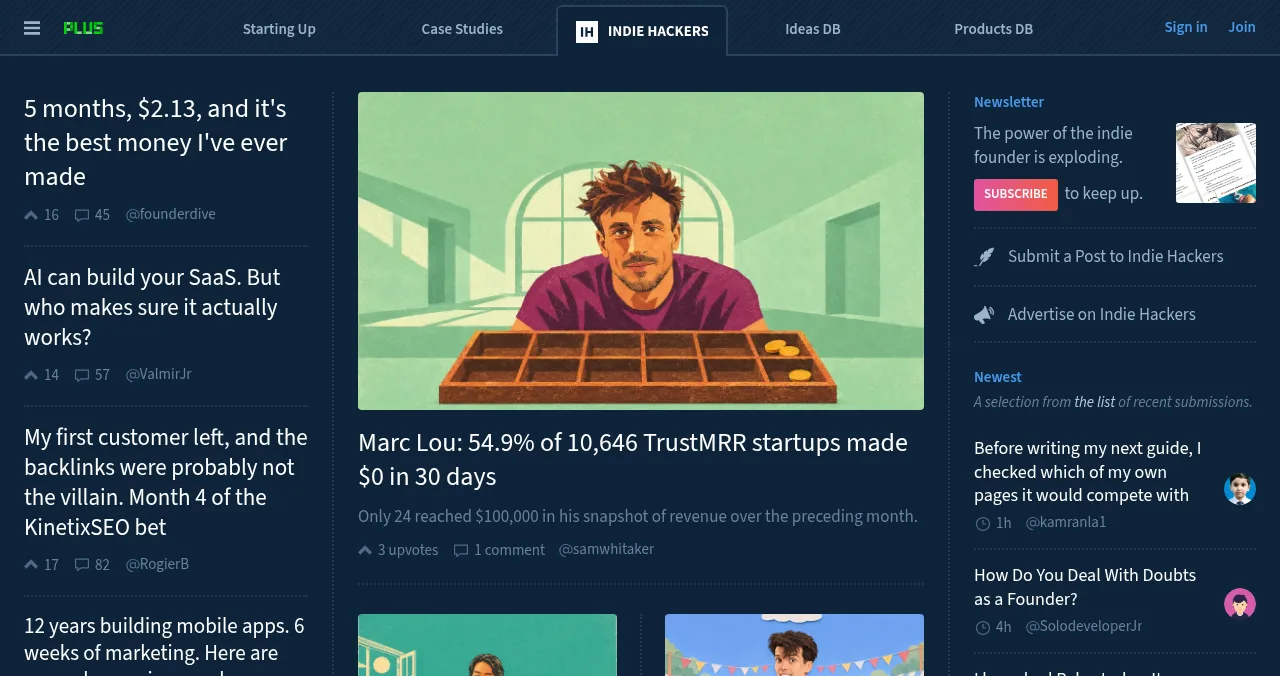
Indie Hackers calls itself a place to "work together to build profitable online businesses", where founders share "the strategies and revenue numbers behind their companies and side projects". On the homepage we read, posts covered real numbers from failures and successes, customer retention, marketing experiments and why a waitlist isn't the same as demand.
What works

- Real numbers — revenue, sign-ups, conversion, costs
- Honest lessons — what failed and why
- Specific questions — "how would you price this?" beats "thoughts?"
- Helping others first — thoughtful replies build your name
- Launch write-ups that teach — what you did, what happened, what you'd change
What gets ignored

- Link drops — a URL with no story
- Adverts — features and superlatives
- Vague updates — no numbers, no decision
- Hit-and-run accounts — posting only when launching
A build-in-public plan
- Month 1
Introduce yourself
What you're building, for whom, and why; ask one specific question.
- Months 1–3
Monthly updates
Numbers, decisions, one lesson each time; reply to every comment.
- Launch week
The launch story
How you launched (Show HN, Product Hunt), what happened, the numbers.
- After
The retro
What worked, what didn't, what you'd do differently.
How it fits with other launches
| Indie Hackers | Show HN | Product Hunt | |
|---|---|---|---|
| Rhythm | Ongoing | A thread | One day |
| Rewards | Honesty and numbers | Something to try | A usable, clear product |
| Best moment | While building and after | When try-able | When polished |
Table: Where Indie Hackers fits (each site's own pages, checked 17 Nov 2026)
A permanent page alongside it

Ready to build in public?
How we know
Indie Hackers' description and the themes of its homepage posts come from the site, read on 17 November 2026; Product Hunt and Show HN rules from their own guides the same day. The build-in-public plan is our editorial recommendation. Science of Apps runs the Launchpad and has no relationship with Indie Hackers.
Key terms, defined
- Indie hacker: a founder building a profitable business, often solo.
- Build in public: sharing progress, numbers and decisions openly.
- Launch retro: a write-up of what a launch taught you.
- Link drop: posting a URL with no context.
- Side project: a product built alongside a job or other work.
Frequently asked questions
What is Indie Hackers?
Indie Hackers describes itself as a place to work together to build profitable online businesses, where developers and founders share the strategies and revenue numbers behind their companies and side projects.
Can I launch my product on Indie Hackers?
You can share it, but treat it as a story rather than an advert: what you built, why, the numbers so far and what you learned. Indie Hackers isn't a daily launch leaderboard like Product Hunt.
What should I post on Indie Hackers?
Progress updates with real numbers, lessons from things that failed, specific questions where you need help, and launch write-ups that teach something. Posts on the homepage often lead with numbers and honest experiences.
How is Indie Hackers different from Product Hunt?
Product Hunt is a 24-hour launch day with editorial featuring and a leaderboard. Indie Hackers is an ongoing founder community, better for building in public, feedback and lessons over time.
Is building in public on Indie Hackers worth it?
Often, for solo founders and small teams: it builds an audience who know your story before launch day. It takes consistency and honesty; one post rarely changes much.
What gets ignored on Indie Hackers?
Link drops, generic announcements, posts that are only adverts, and accounts that never take part in other discussions.
Sources
- Indie Hackers — homepage (checked 17 Nov 2026)
- Product Hunt Help Center — How to promote your launch (and what to avoid) (checked 17 Nov 2026)
- Hacker News — Show HN guidelines (checked 17 Nov 2026)
- Science of Apps — Launchpad: launch your product free
- Checked November 17, 2026. Figures that change — fees, salaries, prices — are reviewed every six months; if something is out of date, tell us.
Where to go from here
- Product Hunt vs Indie Hackers vs Hacker News — which to use when
- Your first 100 users — channels beyond communities
- Show HN guide — the technical launch
- Science of Apps - LaunchpadProduct Hunt vs Indie Hackers vs Hacker News: three very different communities, what each rewards, and where your startup should go firstProduct Hunt vs Indie Hackers vs Hacker News: a launch day, a founder community and a Show HN thread compared, with the rules and which to use first.
- Science of Apps - LaunchpadWhat is indie hacking? What the term means, where it came from, how indie hackers pick ideas, build, launch and grow without investors, and where they launch their productsIndie hacking means building a profitable internet business on your own terms, funded by customers, not VCs. What it means, how indie hackers launch and grow.
- Science of Apps - LaunchpadIndie Hackers vs the Science of Apps Launchpad: a founder community for building in public, or a permanent product listing for users, with your product tested. What each is for and how to use bothIndie Hackers is where founders share the journey; the Launchpad is where users find the product. What each does, what works on each, and how to use both.
- Science of Apps - LaunchpadHow to launch a side project: where to post it (Show HN, Product Hunt, Indie Hackers, a permanent listing), how to launch on limited hours, and the signals it could be a startupHow to launch a side project on limited hours: where to post it (Show HN, Product Hunt, Indie Hackers, a listing) and signs it could be a startup.
- Science of Apps - LaunchpadStartup review: where founders can get an honest review of their startup free, from structured product reviews to Show HN, Indie Hackers and real users, and how to ask so people tell the truthWhere to get an honest startup review free: a structured product review, Show HN, Indie Hackers, Product Hunt and real users, and how to ask for feedback.
- Science of Apps - LaunchpadThe Product Hunt launch mistakes that kill your ranking, or your launch, and how to avoid each oneThe Product Hunt launch mistakes that hurt ranking or get launches removed: asking for upvotes, new-account votes, vague taglines, broken flows and more.






Get the ideas, not the noise.
Sign up with Google and we’ll send you short UX psychology tips by email — why people tap, stall and leave, and what to do about it. Unsubscribe anytime. Prefer something to keep? Get the free Laws of UX guide as a PDF.
Launch day ends. Your listing shouldn't.
Pair your Indie Hackers story with a free, permanent Launchpad profile, ranked by relevance and never by payment, plus your product tested end to end with a detailed report.