 By
Quick answer: Can you launch on Indie Hackers?
- Indie Hackers: a free founder community built on sharing strategies and revenue numbers.
- Launchpad: a free, permanent product listing that users find by the problem they have.
- Audience: Indie Hackers readers are mostly builders; Launchpad visitors are looking for a product.
- Only the Launchpad tests your product and hands you a detailed report.
- Use both: the journey on Indie Hackers, the product on the Launchpad, linked to each other.
Key takeaways
- Indie Hackers rewards honesty and numbers, not announcements.
- A post fades from the feed; a product listing stays findable.
- Founders are a great audience for feedback and a narrow one for customers, unless you sell to founders.
- Your product report gives you real findings to write about in public.
- Link the two: the story points to the product, the product page credits the story.
"Indie hackers" is searched about 27,100 times a month worldwide, and "indiehackers" another 3,600 (Google Keyword Planner, global 12-month average). Many of those searches come from founders with something to launch, wondering whether Indie Hackers is the place. It's a great place, for a different job. Indie Hackers is where founders tell each other the truth about building a business. The Science of Apps Launchpad is where your product gets a permanent page users can find, and a test of what they'll meet. This comparison uses each site's own pages, checked on 18 November 2026. Jump to the comparison, what to post where or the plan.
Science of Apps Launchpad vs Indie Hackers
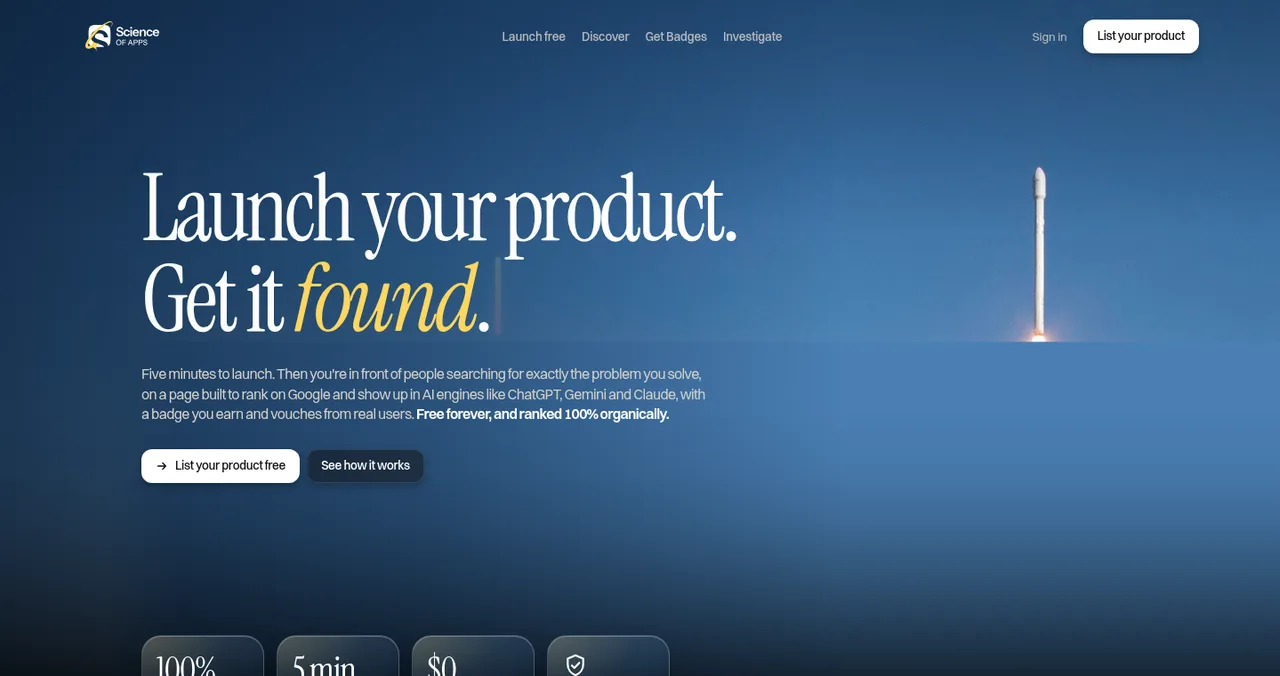 List free
Science of Apps Launchpad For the product
A free, permanent product listing found by problem, plus your product tested with a detailed report.
Free foreverFor users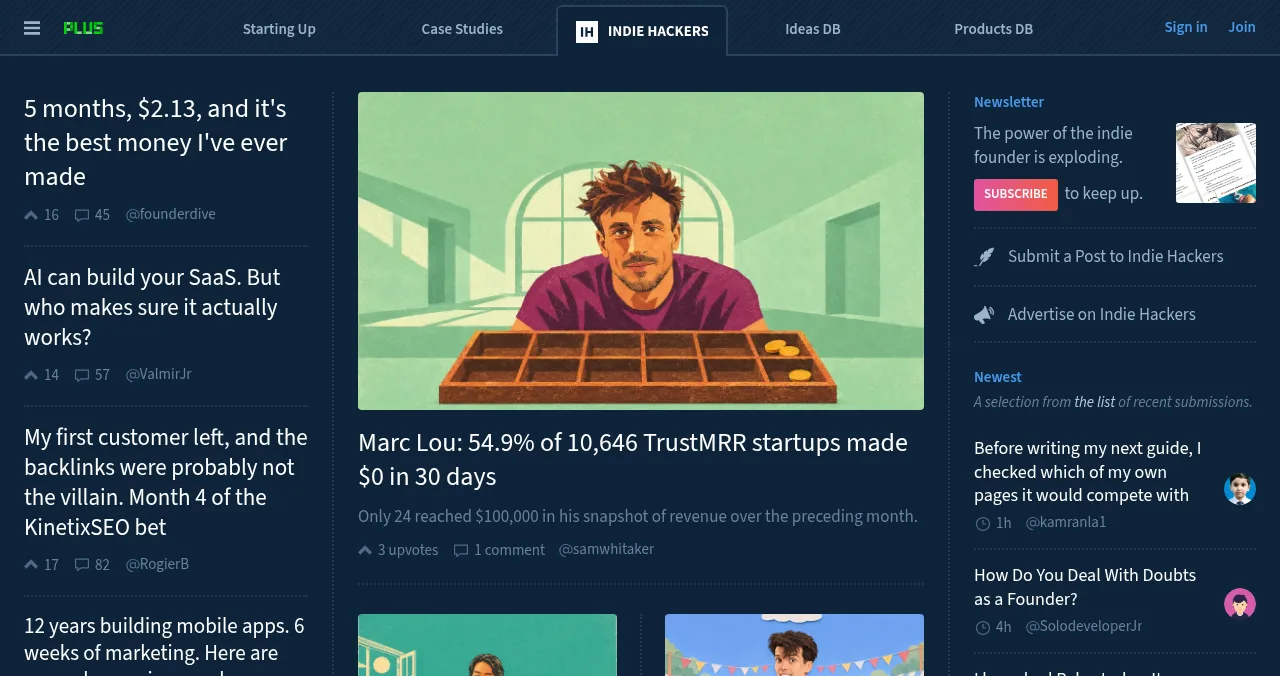
Indie Hackers
A founder community for sharing strategies, revenue numbers and lessons.
FreeFor founders
Indie Hackers vs the Launchpad, side by side
The short version: Indie Hackers is a conversation; the Launchpad is a product page. One builds your reputation among founders, the other builds your product's discoverability among users.
| Science of Apps Launchpad | Indie Hackers | |
|---|---|---|
| What it is | Product discovery platform with permanent listings | Founder community of posts, comments and progress updates |
| Cost | Free, forever | Free |
| Who reads it | People looking for a product to solve a problem | Founders, developers and makers building businesses |
| What you publish | A product listing: screenshots, video, founder, badges | Stories, numbers, questions, lessons |
| How long it's visible | Permanent, found by problem | A post rises and fades in the feed |
| What wins | Relevance, editorial picks, vouches and follows; never payment | Honest numbers, useful lessons, taking part |
| Product test and report | Yes: baseline check, then detailed reports | No; you get comments and advice |
Table: Science of Apps Launchpad vs Indie Hackers (each site's own pages, checked 18 Nov 2026)
Science of Apps Launchpad: the product's permanent home
- Cost
- Free, forever
- Audience
- People searching by problem
- Visible for
- Permanent
- Ranking
- Relevance, never payment
- Included
- A product test and detailed report
- Cost: free to list, forever; revenue comes from optional reports and an optional, labelled Premium listing, and paying never changes organic ranking.
- Getting listed: six short steps, automated checks and a human moderator.
- Being found: by the problem you solve, through search, collections and editorial picks, with earned badges (Featured, Verified, Community favourite, Editor's pick) and vouches from real users.
- Accepts: startups, SaaS, mobile apps, AI products, developer tools, browser extensions, games and open-source projects.
The part that feeds your build-in-public posts
Indie Hackers readers love specifics. The Launchpad gives you some: a free baseline check of your landing page, discoverability and speed when you go live, and a full investigation if you want one.
- Areas of your product tested
- 22
- Automatic measurements, desktop and mobile
- 39
- Expert checks behind your login
- 74
- Verdicts that rank what to fix first
- 5
Find out what new users actually hit
List free, then order the report that fits: the first impression, or the full diagnosis with a 90-day plan.

 Economy
See what new customers see
- Store listing and homepage, screen by screen
- Scorecard against 60 Laws of UX
- Customers, competitors and the fixes worth most
PremiumThe full diagnosis and the plan
- Every screen, every finding, every flow
- All 60 laws with evidence and fixes
- 8 strategy chapters and a 90-day roadmap
Researched from your live product and fact-checked against the evidence. Private to your team unless you share it.
"Here are the three critical findings from our product report and what we changed" is exactly the kind of post Indie Hackers readers engage with.
Best for: the page users land on, and evidence about what to fix.
Indie Hackers: where founders share the journey
- Cost
- Free
- What it is
- Founder community
- Known for
- Revenue numbers and lessons
- Best format
- A story, not an advert
- Catch
- Founders aren't always your buyers
Indie Hackers describes itself as a place to "work together to build profitable online businesses", where developers share the strategies and revenue numbers behind their companies and side projects. What it does better than any product directory is community: honest feedback, people who've solved your exact problem, and an audience that follows your progress for months.
- Cost: free to read, join and post.
- What works: progress updates with real numbers, lessons from failures, specific questions, and launch write-ups that teach something.
- What gets ignored: link drops, generic announcements and accounts that never take part in anyone else's thread.
- Launching there: share the launch as a story. It's not a daily leaderboard like Product Hunt or a Show HN post.
Best for: building in public, feedback from other founders, and products sold to founders and developers. Our Indie Hackers guide covers posting in detail.
What should you post where?
| You want to… | Use | How |
|---|---|---|
| Be found by users next month | Launchpad listing | Clear one-liner, screenshots, a short video |
| Get honest feedback on positioning | Indie Hackers | Post the landing page with a specific question |
| Share launch results | Indie Hackers | Numbers, what worked, what didn't |
| Show proof to new visitors | Launchpad listing | Badges, vouches, followers |
| Sell to founders and developers | Both | Story on Indie Hackers, link to your listing |
| Sell to a non-founder audience | Launchpad first | Indie Hackers for learning, not leads |
Table: What to post on Indie Hackers and what to list on the Launchpad
How to use both: a four-week plan
- Week 1
List and listen
List on the Launchpad; read the baseline check. Join Indie Hackers and comment helpfully on five threads.
- Week 2
Fix and share the why
Fix the critical findings; post on Indie Hackers about the problem you're solving and one question.
- Week 3
Launch
Launch day elsewhere if it fits; post the launch story on Indie Hackers with numbers and a link to your listing.
- Week 4
Report back
Share what changed: sign-ups, activation, one lesson. Ask users who stayed to vouch on your listing.
Mistakes to avoid

- Treating Indie Hackers as an ad slot — announcements without a story get ignored
- Expecting founders to be your customers — unless you sell to founders, they're advisers
- Linking every post to a different page — one product page gathers every signal
- Sharing vanity numbers — readers want revenue, retention and lessons
- Writing in public about a product nobody has tested — check the first-run experience first
The more choices you put in front of a curious reader, the longer they take to decide, which is Hick's law at work: a listing with one clear call to action converts Indie Hackers readers better than a homepage with six.
Ready to list?
How we compared them
Indie Hackers is described from its own homepage, read on 18 November 2026 (screenshot captured on 17 November). Product Hunt's and Hacker News's rules come from their help pages, read on 18 November. The Launchpad's terms come from its homepage, investigation page and pricing page, read on 18 November 2026. Search volumes are Google Keyword Planner's global 12-month averages. Science of Apps runs the Launchpad and has no relationship with Indie Hackers.
Key terms, defined
- Building in public: sharing progress, numbers and decisions openly while you build.
- Founder community: a forum where founders help each other, such as Indie Hackers.
- Product listing: a permanent page about what a product does, for people who might use it.
- Vouch: on the Science of Apps Launchpad, a public endorsement from a real user.
- Product investigation: a structured test of a live product, with each finding backed by evidence.
Frequently asked questions
Can you launch on Indie Hackers?
You can share a launch there, but Indie Hackers isn't a launch leaderboard like Product Hunt. It describes itself as a place to work together to build profitable online businesses, where founders share the strategies and revenue numbers behind their companies. Write the launch as a story: what you built, why, the numbers so far and what you learned.
What is Indie Hackers?
Indie Hackers is an online community for founders and developers building profitable online businesses and side projects. Members share revenue numbers, strategies, failures and lessons, ask for advice and follow each other's progress. It's free to read and join, and it's best known for building in public.
Is Indie Hackers good for getting users?
It's good for getting feedback, early supporters and other founders' attention. If your product is for founders, developers or indie makers, some readers will become users. If you sell to dentists or teachers, Indie Hackers will help you think, not sell; list the product where your buyers search, such as the Science of Apps Launchpad.
How is the Science of Apps Launchpad different from Indie Hackers?
Indie Hackers is a community of posts and conversations between founders. The Launchpad is a product discovery platform: a free, permanent listing for your product, found by the problem it solves, ranked by relevance and community interest rather than payment, with your live product tested and a detailed report on what to fix.
What should I post on Indie Hackers when I launch?
A post with real numbers and a lesson: how you found the idea, what you shipped, how many people signed up, what you got wrong and what you'll try next. Ask one specific question. Link to your product page once, near the end. Posts that only announce a product tend to be ignored.
Is Indie Hackers free?
Yes, reading and joining Indie Hackers is free, and posting your story or questions costs nothing. The Science of Apps Launchpad is free to list on too, forever; it earns money only from optional reports and an optional, labelled Premium listing, and paying never changes organic ranking.
Sources
- Indie Hackers — Homepage: Work Together to Build Profitable Online Businesses (checked 18 Nov 2026)
- Product Hunt Help Center — Launch FAQ and myths (checked 18 Nov 2026)
- Hacker News — Show HN guidelines (checked 18 Nov 2026)
- Science of Apps — Launchpad: launch your product free (checked 18 Nov 2026)
- Science of Apps — Product investigation (checked 18 Nov 2026)
- Science of Apps — Pricing: free listing, Economy and Premium reports (checked 18 Nov 2026)
- Checked November 18, 2026. Figures that change — fees, salaries, prices — are reviewed every six months; if something is out of date, tell us.
Where to go from here
- Indie Hackers guide — how to build in public there
- Founder communities — where founders help founders
- Launchpad vs Product Hunt — a launch day vs a home
- Science of Apps - LaunchpadHow to use Indie Hackers to launch and grow: what the community rewards, what to post, and how it fits with Product Hunt and Show HNHow to use Indie Hackers to launch: what the founder community rewards, posts that work, mistakes that get ignored, and where it fits with other launches.
- Science of Apps - LaunchpadCrunchbase vs the Science of Apps Launchpad: a free company profile investors look up, or a free product listing customers find, with your product tested. What each does, what it costs and which to set up firstCrunchbase is where investors look you up; the Launchpad is where customers find your product. What each costs, what it does, and why most startups need both.
- Science of Apps - LaunchpadWhere to launch a product built with no-code: platform showcases (Made in Webflow, Bubble's showcase), launch sites, founder communities and a permanent listingWhere to launch a product built with no-code: Made in Webflow, Bubble's showcase, Product Hunt, Indie Hackers and a free permanent listing.
- Science of Apps - LaunchpadProduct Hunt vs Indie Hackers vs Hacker News: three very different communities, what each rewards, and where your startup should go firstProduct Hunt vs Indie Hackers vs Hacker News: a launch day, a founder community and a Show HN thread compared, with the rules and which to use first.
- Science of Apps - LaunchpadHow to launch a side project: where to post it (Show HN, Product Hunt, Indie Hackers, a permanent listing), how to launch on limited hours, and the signals it could be a startupHow to launch a side project on limited hours: where to post it (Show HN, Product Hunt, Indie Hackers, a listing) and signs it could be a startup.
- Science of Apps - LaunchpadScience of Apps Launchpad vs Product Hunt: a permanent free listing with a product report, or one big launch day? A fair comparison of cost, ranking, visibility and what each gives youScience of Apps Launchpad vs Product Hunt compared: cost, ranking, how long you stay visible and the product report. Which to use, and why most use both.
Get the ideas, not the noise.
Sign up with Google and we’ll send you short UX psychology tips by email — why people tap, stall and leave, and what to do about it. Unsubscribe anytime. Prefer something to keep? Get the free Laws of UX guide as a PDF.
Launch day ends. Your listing shouldn't.
Indie Hackers readers are founders; your customers may not be. The Science of Apps Launchpad gives the product a free, permanent page users find by problem, and tests it with a detailed report you can share in your build-in-public posts.