 By
Quick answer: What does indie hacking mean?
- Indie hacking = building a profitable online business independently, funded by customers.
- The term comes from the Indie Hackers community, started by Courtland Allen in 2016.
- Typical products: micro-SaaS, developer tools, templates, newsletters, small apps.
- How they launch: in public, on communities, often several times, with one permanent home page.
- The trade-off: slower growth, but you keep control and ownership.
Key takeaways
- Indie hacking is defined by funding and control, not by product size.
- Small, specific problems with paying customers beat big, vague ones.
- Launch is a series of moments, not one day; each needs somewhere permanent to point.
- Solo founders lack outside eyes; get your product reviewed before you spend on growth.
- Profitability is the scoreboard; vanity metrics aren't.
You have a job, an idea, and a few evenings a week. You don't want investors, a board or a growth target someone else set. You want a small product that pays for itself, then pays you. That is indie hacking, and it has its own vocabulary, communities and launch habits. This explainer covers what indie hacking means, where the term came from, how it differs from a funded startup, the products indie hackers tend to build, and how they launch and grow, with every fact checked on its source on 17–18 November 2026. Jump to the meaning, indie hacker vs startup or how indie hackers launch.
- Founder, often, or a very small team
- 1
- Investors required
- 0
- Year the Indie Hackers community began
- 2016
- Free launch channels in the 30-day plan
- 4
What does indie hacking mean?
Indie hacking means building a profitable online business independently, funded by its customers. The word "indie" is about money and control: when TechCrunch covered Stripe's purchase of the Indie Hackers community in April 2017, it described the community's focus as helping entrepreneurs become profitable while remaining independent, and explained that independent generally means "money is coming from customers, not VCs or employers."
The "hacking" part is about the approach: scrappy, fast and hands-on. An indie hacker usually builds the product, writes the landing page, answers support email and does the marketing, at least at first.
| Indie hacking is… | Indie hacking isn't… |
|---|---|
| Customer-funded | Investor-funded |
| Profit and independence first | Growth at any cost |
| Small, specific problems | Winner-takes-all markets |
| Launching in public, repeatedly | One big launch day |
| Often a side project that grows | Necessarily full-time from day one |
Table: What indie hacking means in practice (Science of Apps editorial summary)
Where did the term come from?
The term grew up around Indie Hackers, a website and community Courtland Allen started in 2016 to publish how independent founders built profitable businesses: interviews with revenue figures, a forum, and later a podcast. Stripe acquired it in April 2017. In April 2023 the founders announced that Indie Hackers was "back to being run as a standalone business, owned by the founders", with Stripe staying on as an investor.
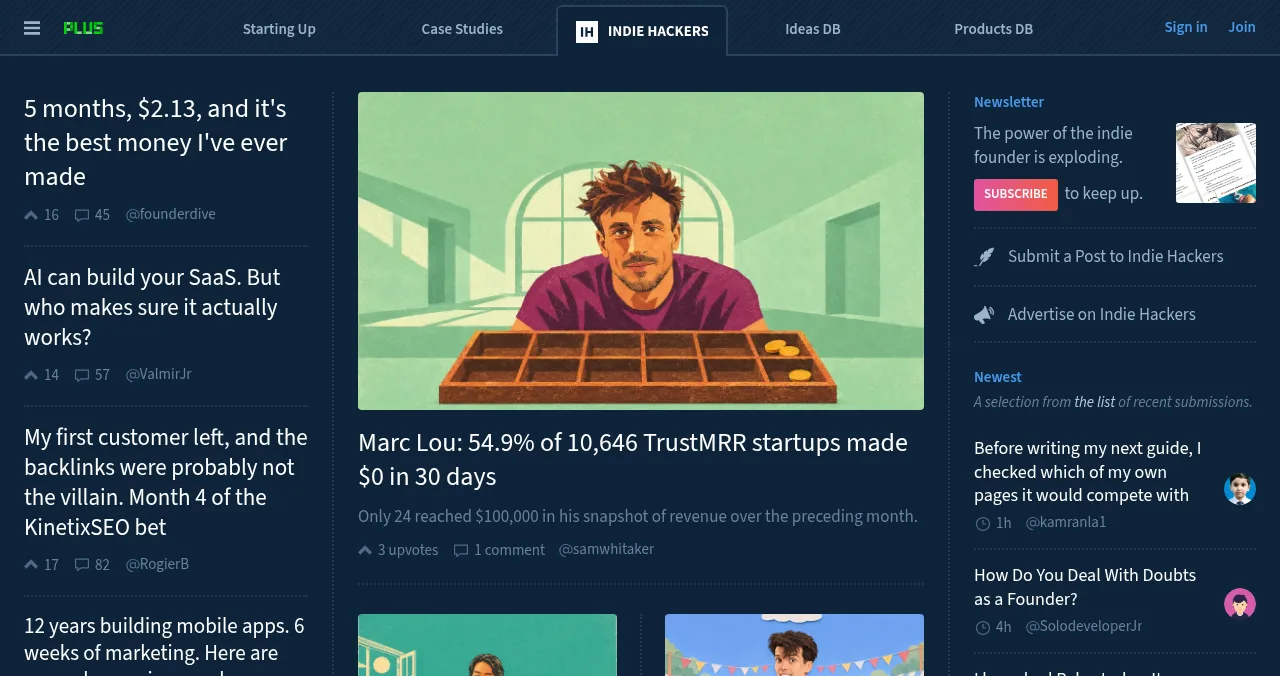
Today the community is where many indie hackers share progress, ask for feedback and post milestones. Our Indie Hackers guide covers what to post there and what gets ignored.
Indie hacker vs startup founder: what's the difference?
Both build products and both take risks. The difference is the deal you make with money.
| Indie hacker | Venture-backed startup | |
|---|---|---|
| Funding | Customers (and savings or a day job) | Investors, in rounds |
| Goal | Profit, independence, ownership | Fast, large growth; an exit |
| Team | Solo or a few people | Grows with each round |
| Pace | As fast as revenue allows | As fast as the money allows |
| Market | Niches, often too small for VCs | Big markets that can return a fund |
| Who decides | You | You, plus a board and investors |
| Failure mode | Slow growth, burnout | Running out of runway |
Table: Indie hacker vs venture-backed startup
Neither is better. Some indie businesses later raise money; some funded founders go indie next time. For a deeper look at the funding choice, see bootstrapping vs VC funding.
What do indie hackers build?
Indie products share a shape: small enough to build and run alone, specific enough that a clear group will pay.

Micro-SaaS
A focused web tool for one job or one niche, sold by subscription. See our micro-SaaS ideas.
Developer tools
APIs, CLIs, libraries and extensions, often open-core, sold to other builders.
Mobile and desktop apps
Utilities and niche apps sold once or by subscription through the app stores.
Templates and digital products
Notion templates, UI kits, starter codebases and courses.
Newsletters and content
A niche audience monetised through subscriptions or sponsors.
Browser extensions
Small tools that live where people already work.
The common thread is a specific person with a specific problem. "Project management for everyone" is a startup pitch; "client approval for wedding photographers" is an indie hack.
How do indie hackers launch their products?
Indie hackers rarely get one big launch. They launch in public, repeatedly, on free channels, and let each moment feed the next. A typical sequence:

- Build in public — share progress, numbers and lessons on Indie Hackers or X while building; see our build in public guide.
- Make one permanent page — a listing and your own site that every later post links to.
- Show it to builders — a Show HN once people can try it without friction.
- Pick a launch day — Product Hunt, Peerlist or a smaller launch site, with the same canonical link.
- Go where the users are — relevant subreddits, niche forums and communities, following each one's rules.
- Keep shipping and re-launching — every major version is a new story to tell.
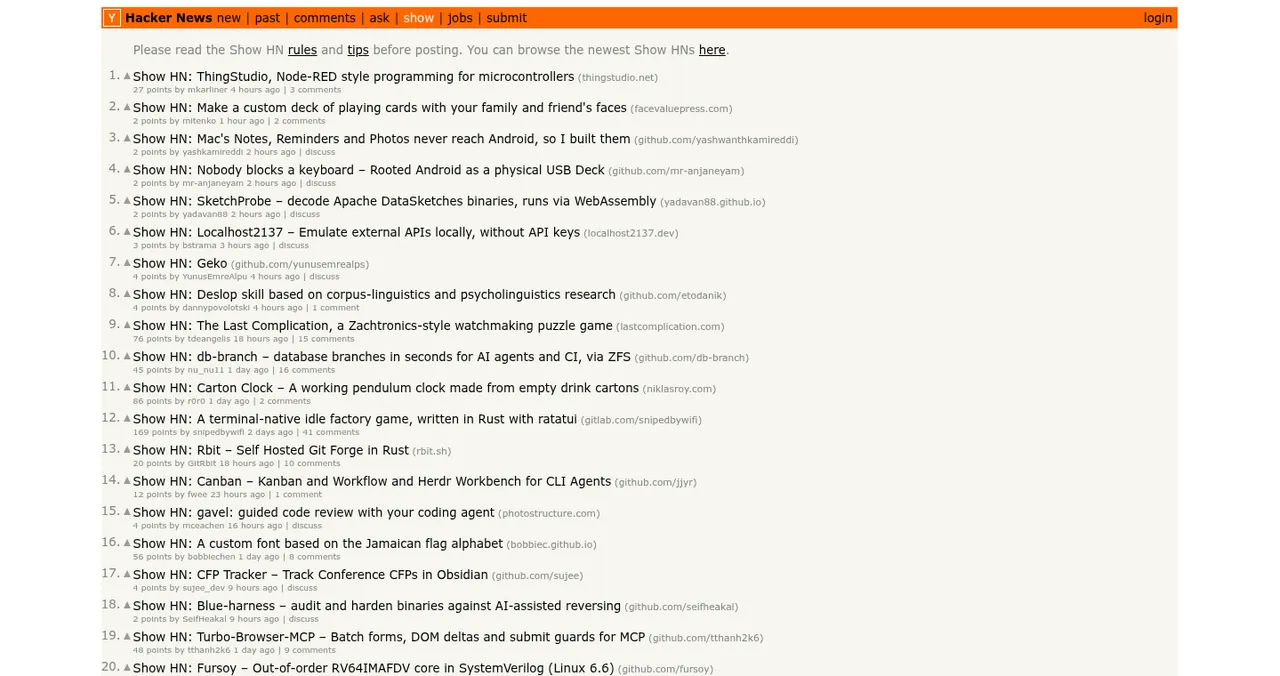
On Hacker News, the Show HN rules want something people can try right now, not a landing page or waitlist, and the site guidelines say not to use HN primarily for promotion or ask anyone to upvote. Our Show HN guide covers the details.
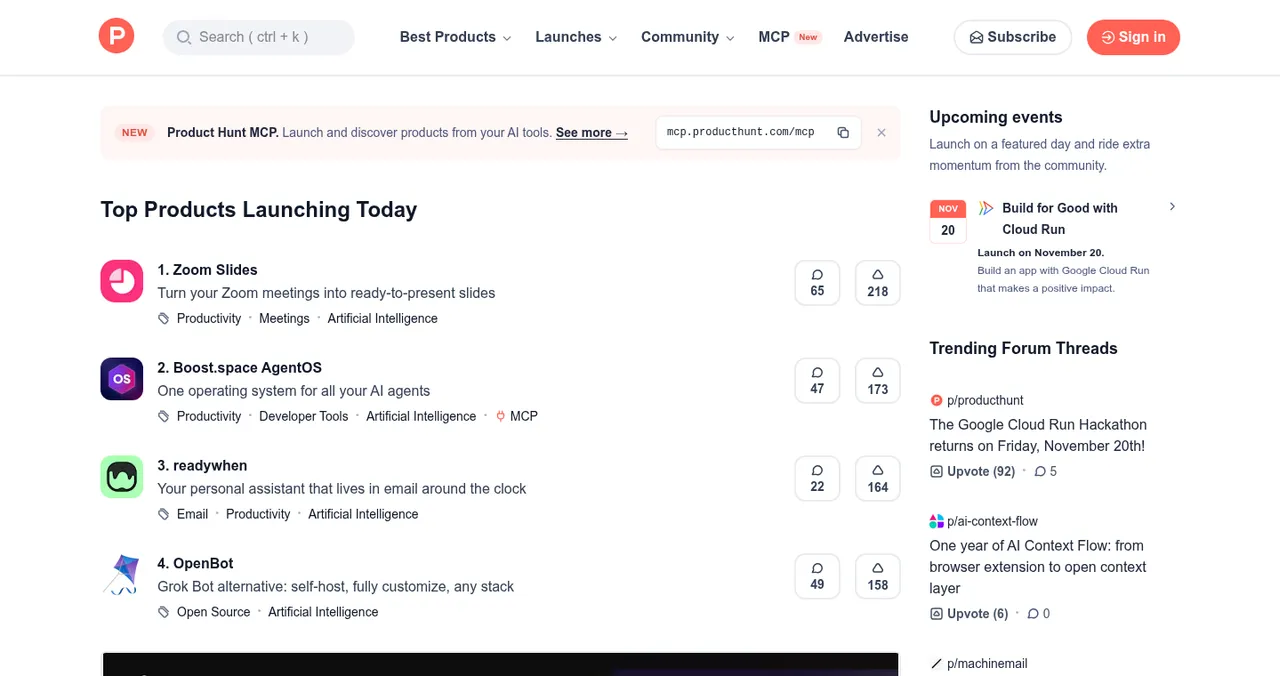
Each of these moments is busy for a day. What lasts is the page they all point to, which is why the second step matters more than it looks. For the full sequence, see how to launch a side project.
The Science of Apps Launchpad: launch free, get outside eyes
Solo founders have one blind spot in common: nobody else has used the product before strangers do. The Launchpad answers both halves of the indie launch problem: a permanent page, and an outside review.

- Free, forever: list in six short steps; automated checks plus a human moderator.
- Permanent: a public profile found by the problem you solve; ranked by relevance, editorial picks and community interest, never payment.
- Built for indie products: it accepts startups, SaaS, mobile apps, AI products, developer tools, browser extensions, games and open-source projects.
- Earned badges: Featured on going live, Verified with a work email on your domain, Community favourite, Editor's pick and more.
- Your product, tested end to end: a free baseline diagnosis of your landing page, discoverability and speed runs as you go live; a full investigation goes through the whole journey.
Arrive
First impression
Discoverability on Google, AI and social; landing page, pricing, trust and speed.
Join
The first minutes
Sign-up, sign-in, recovery and onboarding.
Use
The everyday job
Core flow, dashboards, search, microcopy and error states.
Pay
Value into revenue
Paywall, upgrade, checkout and payments.
Stay
Coming back
Notifications, account, settings and help.
Every screen
Throughout
Accessibility, visual design and consistency.

Evidence for every finding
Each issue is pinned to a screen or backed by a measurement on desktop and mobile.
Five verdicts
Good, Needs improvement, Needs to be fixed, Critical and Recommendation, so you know what to fix first.
Reviewed by an analyst
Every finding is approved by a person before you see it.
Private to you
The report never affects your ranking and isn't public.
See your product as a stranger does
List free, then order the report that fits: what new customers see first, or the full diagnosis and a plan.

 Economy
See what new customers see
- Store listing and homepage, screen by screen
- Scorecard against 60 Laws of UX
- Customers, competitors and the fixes worth most
PremiumThe full diagnosis and the plan
- Every screen, every finding, every flow
- All 60 laws with evidence and fixes
- 8 strategy chapters and a 90-day roadmap
Researched from your live product and fact-checked against the evidence.
Which launch channel should an indie hacker use first?
| Your product | Start with | Then |
|---|---|---|
| Developer tool or open-source project | Launchpad listing, Show HN | Product Hunt, DevHunt |
| Micro-SaaS for a niche | Launchpad listing, the niche's own community | Indie Hackers milestone post, Product Hunt |
| Mobile app | Launchpad listing, store page | Relevant subreddits, Product Hunt |
| Template or digital product | Launchpad listing, X and Indie Hackers | Marketplaces for that format |
| Still an idea | Indie Hackers feedback post | Don't launch yet; validate first |
Table: Where an indie hacker should launch first, by product type
A 30-day indie launch plan
- Week 1
Home base
List free on the Launchpad; read the baseline diagnosis and fix anything Critical.
- Week 2
Builders
Post a Show HN or a milestone on Indie Hackers; answer every comment.
- Week 3
Launch day
Product Hunt or Peerlist, with your listing as the canonical link.
- Week 4
Users
The communities your users already use; collect vouches and testimonials.
Mistakes new indie hackers make

- Building for months before talking to anyone — validate that people will pay first
- Choosing a problem that's too broad — "for everyone" is for funded startups
- One launch, then silence — indie launches are a series; keep shipping and telling
- Every launch pointing somewhere different — one permanent page gathers the signals
- Copying survivor stories — public revenue posts show winners, not the base rate
- Skipping outside review — founders know where every button is; new users don't share your mental model
Ready to launch?
How we know
The history of the term comes from TechCrunch's April 2017 report and the Indie Hackers announcement of April 2023; community and launch rules come from Indie Hackers, Hacker News and the Launchpad's own pages, read on 17–18 November 2026. We don't quote average indie revenues because no reliable figure exists. The search volume for "indie hacking" (about 480 a month) is Google Keyword Planner's global 12-month average. Science of Apps runs the Launchpad.
Key terms, defined
- Indie hacking: building a profitable online business independently, funded by customers rather than investors.
- Indie hacker: a person who builds and runs such a business, usually solo or with a tiny team.
- Bootstrapping: funding a business from savings and revenue instead of outside investment.
- Micro-SaaS: a small, focused software-as-a-service product for one job or niche.
- Building in public: sharing progress, numbers and lessons openly while you build.
- MRR: monthly recurring revenue, the indie hacker's most-shared number.
Frequently asked questions
What does indie hacking mean?
Indie hacking means building a profitable online business independently, usually alone or with a very small team, funded by its customers rather than by venture capital or an employer. TechCrunch's 2017 description of the Indie Hackers community put it simply: 'money is coming from customers, not VCs or employers.'
What is an indie hacker?
An indie hacker is someone who builds and runs an online product on their own terms: a micro-SaaS, an app, a developer tool, a template shop or a newsletter. They usually code or no-code it themselves, launch it publicly, and aim for profit and independence rather than rapid, investor-funded growth.
Where does the term indie hacking come from?
It was popularised by Indie Hackers, a community and website Courtland Allen started in 2016 to share how independent founders build profitable businesses. Stripe acquired it in April 2017; in April 2023 the founders announced it was 'back to being run as a standalone business, owned by the founders.'
How is indie hacking different from a startup?
Both build products, but a venture-backed startup raises investment to chase fast, large growth and usually aims for an acquisition or IPO. An indie hacker funds the business from revenue, grows at the pace customers allow, and optimises for profit and control. Many indie businesses stay small by choice.
How do indie hackers launch their products?
Usually in public and more than once: posting progress on Indie Hackers or X, a Show HN for something people can try, a Product Hunt or Peerlist launch, relevant subreddits, and free directories. The smart ones keep one permanent page, such as a Launchpad listing or their own site, that every launch links to.
Is indie hacking a realistic way to make money?
It can be, but there are no reliable averages to quote: most public stories are survivors. Treat it like any business. Validate that people will pay before building much, keep costs low, and expect slow, compounding growth rather than a breakout launch. Many indie hackers start it as a side project alongside a job.
Do indie hackers need to code?
No. Many write code, but plenty of indie products are built with no-code tools, or are content and template businesses. What they all need is the ability to find a specific problem, ship something that solves it, and reach the people who have it.
Sources
- TechCrunch — Stripe acquires Indie Hackers, a knowledge-sharing community for entrepreneurs, 11 Apr 2017 (checked 18 Nov 2026)
- Indie Hackers — What's New: Indie Hackers is indie again!, 6 Apr 2023 (checked 18 Nov 2026)
- Indie Hackers — Homepage (checked 17 Nov 2026)
- Hacker News — Show HN guidelines (checked 17 Nov 2026)
- Hacker News — Guidelines (checked 18 Nov 2026)
- Science of Apps — Launchpad: launch your product free (checked 18 Nov 2026)
- Science of Apps — Product investigation (checked 18 Nov 2026)
- Science of Apps — Pricing: free listing, Economy and Premium reports (checked 18 Nov 2026)
- Checked November 18, 2026. Figures that change — fees, salaries, prices — are reviewed every six months; if something is out of date, tell us.
Where to go from here
- Indie Hackers guide — how to post and launch there
- How to launch a side project — the step-by-step
- Build in public — the indie hacker's marketing
- Science of Apps - LaunchpadHow to use Indie Hackers to launch and grow: what the community rewards, what to post, and how it fits with Product Hunt and Show HNHow to use Indie Hackers to launch: what the founder community rewards, posts that work, mistakes that get ignored, and where it fits with other launches.
- Science of Apps - LaunchpadHow to launch a side project: where to post it (Show HN, Product Hunt, Indie Hackers, a permanent listing), how to launch on limited hours, and the signals it could be a startupHow to launch a side project on limited hours: where to post it (Show HN, Product Hunt, Indie Hackers, a listing) and signs it could be a startup.
- Science of Apps - LaunchpadBuild in public: what to share, where, how often, which numbers to publish and how to turn followers into users, with a weekly template and the risks to manageBuild in public without just posting into the void: what to share, which metrics, a weekly template, where to post, and how to turn followers into actual users.
- Science of Apps - LaunchpadIndie Hackers vs the Science of Apps Launchpad: a founder community for building in public, or a permanent product listing for users, with your product tested. What each is for and how to use bothIndie Hackers is where founders share the journey; the Launchpad is where users find the product. What each does, what works on each, and how to use both.
- Science of Apps - LaunchpadStartup showcase websites explained: showcase vs launch site vs directory, and the best places to show off what you built, from Peerlist and Indie Hackers to Show HN and permanent listingsStartup showcase websites explained: showcase vs launch site vs directory, and the best places to show what you built, from Peerlist to Show HN.
- Ideas25 micro-SaaS ideas you can build solo — and sell without a sales team25 micro-SaaS ideas a solo founder can build and run: add-ons for platforms people already pay for, niche workflow tools and small automations.






Get the ideas, not the noise.
Sign up with Google and we’ll send you short UX psychology tips by email — why people tap, stall and leave, and what to do about it. Unsubscribe anytime. Prefer something to keep? Get the free Laws of UX guide as a PDF.
Launch day ends. Your listing shouldn't.
The Science of Apps Launchpad gives an indie product a free, permanent listing and tests it end to end with a detailed report, the outside review a solo founder rarely gets.